Abstract
Over a period of 19 yr, the harvestman (Opiliones) community associated with the lowbush blueberry agro-ecosystem in Maine was studied. Eight species representing five genera, four subfamilies, and two families of harvestmen belonging to the suborder Eupnoi were collected. The harvestman community was dominated by two introduced, synanthropic species: Phalangium opilio in all but 1 yr (that year dominated by Rilaena triangularis). Rilaena was recorded for the first time from eastern North America. Relative abundance of harvestman adults increases throughout the season and the temporal pattern of trap capture does not refute speculated life cycles of the harvestmen being univoltine with overwintering eggs. Some blueberry management practices were found to affect trap capture. We did find that on average (with opposite results 1 yr) trap captures are greater in pruned fields than in fruit-bearing fields. Organic fields were found to have higher relative abundance of harvestmen than conventionally managed fields. Conventionally managed fields with reduced-risk insecticides showed no difference in harvestmen relative abundance compared with those conventionally managed fields using the older more persistent organophosphate insecticides. Insecticide trials with common insecticides used in blueberry insect pest management showed that the organophosphate insecticide, phosmet, and the pyrethroid insecticide, esfenvalerate, were detrimental to P. opilio adults when exposed to leaf residues, whereas the reduced-risk insecticide, spinosad, showed no negative effects compared with nonsprayed foliage.
Lowbush blueberry, Vaccinium angustifolium (Aiton), is a perennial shrub native to northeastern North America (Vander Kloet 1978). In Maine, lowbush blueberry is managed for berry production with >60,000 acres in production (Yarborough 1998). The crop is not planted. It occurs naturally as the understory of Acadian and Boreal forests, and when the trees are cleared, the blueberry stands are managed to promote their growth and spread. Lowbush blueberry is a traditional North American crop first managed by indigenous peoples and then by early European colonists (Drummond and Collins 1999). The first reports of wild blueberries shipped from Downeast Maine to be sold as a fresh market fruit date from the late 1800s. The first blueberries of the Maine harvest season were picked by hand for the fresh market and shipped to Boston, New York, Chicago, and cities in Maine (Hoelper et al. 1988). It has only been over the past several decades that various production practices have been developed and implemented to increase berry yields and efficiency of production (Drummond and Collins 1999). These practices include herbicide control of weeds, insecticide and fungicide control of insect pests and disease, irrigation, fertilization, land leveling, and pruning of older plants by either burning or flail-mowing (Yarborough 1998).
Lowbush blueberry is typically managed on a 2-yr cycle (DeGomez 1998). A given field will produce a crop in year 1 and be pruned (mowed or burned) after harvest in year 1 or in the spring of year 2. In year 2, the plants grow vegetatively, producing flower buds by year's end. In year 3, the plants will flower and again produce a crop. This is important to note, because it can have an impact on the density and diversity of arthropods present in blueberry fields. Although insect pest pressure is relatively low in this native crop, pest management typically involves the use of organophosphate insecticides that may have an impact on natural enemies and beneficial arthropods (Stubbs and Drummond 1998, 1999 ; Karem 2005 ; Choate et al. 2008).
Very little information is available about the arthropod fauna associated with lowbush blueberry in Maine; most studies concern only pest insects (Drummond and Collins 1999, Collins and Drummond 2004, MacKenzie et al. 2004, Drummond et al. 2009, Karem et al. 2010). Phipps (1930) conducted the most complete survey of the insect fauna associated with lowbush blueberry. He found that lowbush blueberries are attacked by 292 insect species, almost all native species. The role and occurrence of spiders and hymenopteran parasitoids has been studied to some extent (Maloney 2002, Karem 2005). Collins et al. (1996) identified spiders of 17 families, 54 genera, and 87 species from pitfall traps in blueberry fields of Washington County, ME. However, little is known about the Opiliones fauna associated with lowbush blueberry.
Opiliones have a worldwide distribution (Sankey and Savory 1974, Pinto-Da-Rocha et al. 2007). Some species have been identified as important predators in agriculture, although most species inhabit forested landscapes (Pinto-Da-Rocha et al. 2007). Phalangium opilio L. is a synanthropic polyphagous predator frequently found in agricultural habitats. It was apparently introduced from Europe to North America (Cokendolpher and Lee 1993, Cokendolpher and Holmberg 2009). According to Forster (1962), P. opilio is the Opilione (see above) species most commonly found in arable lands in New Zealand (where it was also introduced from Europe). However, opinions are mixed on the importance of P. opilio as biocontrol agents in agricultural systems.
Although the potential importance of P. opilio's feeding on pests has been recognized, little is known about its activity patterns or its within-plant distribution in various crops. Juen et al. (2003) studied a community of epigeic predators of a small organic field embedded in a diverse agricultural landscape and found that the immature stages of spiders, harvestmen, and beetles may act as important predators of pests and play a key role in the population dynamics of the predator population. P. opilio has been found in a variety of agro-ecosystems in New Zealand including pasture (Martin 1983), Lucerne (Leathwick and Winterbourn 1984), carrots (Berry et al. 1996, Sivasubramaniam et al. 1997), and beans (Hodge and Vink 2000). Vink et al. (2004) recorded 20 spiders and P. opilio from grass and cereal samples. Hilbeck and Kennedy (1996) found P. opilio feeding on Colorado potato beetle, Leptinotarsa decemlineata (Say), in commercial potato fields in eastern North Carolina, and P. opilio was among the arthropods included in a survey of predators of Colorado potato beetles in Delaware potato fields by Heimpel and Hough-Goldstein (1992) . Drummond et al. (1990) showed that P. opilio can significantly reduce survival of Colorado potato beetles in field cages but concluded that it plays a minor role in predation compared with some other common natural enemies of Colorado potato beetles in Michigan potato fields. Dixon and McKinlay (1989) found that P. opilio composed 54% of the harvestman caught in pitfall traps in potato fields in Scotland, and one half of those had consumed aphids. Two studies reported on P. opilio feeding on corn earworm [Helicoverpa zea (Boddie)] eggs in soybean fields (Newton and Yeargan 2001, Pfannenstiel and Yeargan 2002). Allard and Yeargan (2005) studied the diel activity patterns and microspatial distribution of P. opilio in small, fenced arenas in soybean fields. Using serological and exclusion techniques, Ashby (1974) showed P. opilio to be an important ground-dwelling predator of imported cabbageworm, Pieris rapae L. This conclusion is supported by Schmaedick and Shelton (2000), who included P. opilio as an important predator of the imported cabbageworm. P. opilio comprised 15% of the total catch of arthropod predators in pitfall traps and fed readily on Pieris rapae L. eggs and first instars, both in small arenas and on cabbage plants. P. opilio has also been studied as a predator of P. rapae in brussel sprouts (Dempster 1967). Butcher et al. (1988) determined that twospotted spider mites (Tetranychus urticae Koch) were included in the diet of harvestmen but not at sufficiently high rates to be considered as exerting a significant controlling influence on mite populations in New Zealand strawberries. Halaj and Cady (2000) did not find enough evidence to conclude that harvestmen are important predators of insect pests in soybeans.
In this study, we describe the Opiliones fauna associated with lowbush blueberry fields in commercial production in Washington Co., ME. Harvestmen were collected during 9 yr of sampling between 1986 and 2007 (1986–1987, 2000–2001, 2003–2005, 2006, and 2007). Our studies focused on harvestman species richness and species diversity, seasonal trends in occurrence, and the effects of lowbush blueberry crop stage (pruned or fruit-bearing), field edge, and pest management system (conventional, reduced-risk, or organic) on their relative abundances (trap capture).
Materials and Methods
Study Sites.
Study sites were located in commercial lowbush blueberry (Vaccinium angustifolium Ait.) fields in Washington and Hancock Co., ME, the major blueberry-growing regions in Maine, with ≈63,000 acres in blueberry production (Yarborough 2008). All study sites were either mowed by the grower using standard commercial flail-mowers or burned. Burned fields were similarly burned with commercial oil burners or by igniting straw mulch. Herbicides, fungicides, and fertilizers were applied following standard lowbush blueberry practices (Yarborough 2004).
Sampling Methods.
Harvestmen were sampled using pitfall traps consisting of plastic cups 7.0 cm in depth with a top opening diameter of 10.5 cm (height, 13.0 cm; top diameter, 8.6 cm in study 1: 1986 and 1987). The traps were filled one-third to one-half full with ethylene or propylene glycol (before 2000, traps were deployed without preservative). A sheet metal rain shield with four 16 d nails as supports was placed over each trap and remained in place until traps were serviced. The traps were left out for ∼1 wk for each sample. Sampling was performed throughout the growing season (see below). On collection, the contents of each trap were brought back to the laboratory for sorting. Specimens were placed in 70% ethanol and identified to species at a later date.
Opiliones Identifications.
Sexually mature harvestmen were identified to species. Immatures were identified to genera whenever possible and grouped simply as “Immatures” for all analyses. They include Leiobunum (Hadrobunus is removed because they were not present as adults) and Oligolophinae spp. All individuals collected in 1986 and 1987, and representative samples collected in 2005, were sent to J.C.C. (coauthor) for identification. The remaining specimens were identified using reference specimens, keys, and written communication with J.C.C. Species determinations follow the identification keys and descriptions of Bishop (1949), Davis (1934), Sankey and Savory (1974), and Weed (1889) . Specimens of all identified species are deposited in the Invertebrate Zoology collecton, Museum of Texas Tech University, Lubboch, TX.
Studies.
Over the past three decades, between 1986 and 2007, six studies were conducted to investigate the biology of harvestmen associated with lowbush blueberry in Maine. Study 1 (1986 and 1987) was designed to assess the effects of crop phenological stage (vegetative/pruned versus fruit-bearing) and method of pruning on harvestman richness and abundance. Study 2 (2000 and 2001) and study 3 (2003–2005) were designed to assess the effects of pest management system and crop stage on harvestman richness and abundance and allowed for the comparison of field edges to field interiors as habitat for harvestmen. Study 4 (2007) was designed to again assess the occurrence of harvestmen in field edges compared with field interiors. Study 5 (2004) was designed to assess the impact of recommended rates of insecticide applied in the field on the mortality of P. opilio. Study 6 (2006) was designed to assess the influence of one of the more common predators in lowbush blueberry fields, the mound-building ant, Formica exsectoides Forel, on the distribution and abundance of harvestmen.
Study 1: 1986 and 1987 (Treatments: Crop Phenology (Prune Versus Fruit-Bearing) and Prune Method: Mow Versus Burn).
Harvestmen were sampled in either vegetative or in fruit-bearing fields. Pruning is performed by either flail-mowing or burning the above ground stems after harvest resulting in a vegetative stage field. There were three replications of each of the following three treatments: a fruit-bearing field that had been burned the previous year, a flail-mowed field in the vegetative state, and a burn-pruned field in the vegetative state. Fields ranged in size from 2.2 to 105 ha. Burn treatments were applied in November (as typically performed) before each study year, i.e., 1985 or 1986. Mow treatments were applied in April (the typical time of year) of each study year, i.e., 1986 or 1987. Five pitfall traps along a line transect were deployed per field. Starting points and orientations of transects were chosen arbitrarily and were at least 20 m from field edges. In 1986, traps were deployed on 20 June and serviced weekly until 22 August for a total of 9 trap-weeks. In 1987, traps were deployed on 15 May and serviced weekly until 14 August for a total of 12 trap-weeks. A two-way analysis of variance (ANOVA) was used to compare log (base 10)-transformed individuals among the treatments and years (SAS Institute 2002). Treatments and years were the main factors, and pitfall trap captures and sample dates were pooled as an average for within field measures.
Study 2: 2000 and 2001 (Treatments Were Pest Management System: Conventional, Reduced Input, and Organic and Distance Into Blueberry Field From Forest Edge).
Harvestmen were sampled from fruit-bearing blueberry fields maintained under three management practices: conventional, reduced input, and organic. Conventionally managed fields were regularly sprayed with pesticides, including organophosphate insecticides. Reduced input fields were categorized as those fields that were monitored for pests and sprayed with standard insecticides only intermittently, when pest densities exceeded thresholds. Organic fields were those fields that did not have synthetic chemical applications for fertilization or pest management. Fields ranged from 2 to 63 ha. In 2000, four fields were sampled: three conventional fields (flail-mowed the previous year, all three received a July treatment of phosmet) and one reduced input field (burned the previous year, but also receiving a July application of phosmet). In 2001, six fields were sampled: three conventional fields and three organic fields. In each field for both years, there were three transects of four pitfall traps. One trap was set at the edge of each field, and the three remaining traps were set at 3, 15, and 30 m into the field for both years. Trap contents were collected every 1–2 wk in 2000 (trapped continuously), but only the first week of each month in 2001, beginning in May (June in 2001) and continuing until early September. In 2000, because of the lack of replicated reduced input fields (n=1), no statistical comparison of pest management was attempted. A repeated-measures ANOVA was used to compare the square root transformed harvestmen captured in traps placed at varying distances into the field from the forest edge. For this analysis, field was treated as a statistical block, and sample date was the repeated time measure or within-subject measure. In 2001, pest management systems were the main treatment effect. The model for this year was a repeated-measures split-plot ANOVA, where pest management was the main effect and distance from the field edge was a split-plot factor.
Study 3: 2003–2005 (Treatments Were Pest Management System: Conventional, Reduced Input, and Organic and Distance Into Blueberry Field From Forest Edge).
Harvestmen were sampled from fruit-bearing and pruned (vegetative) fields maintained under three different management practices: conventional, reduced risk, and organic. Fields ranged from 0.75 to 7.0 ha. Ten fields each year were managed under a conventional or reduced risk strategy each of the 3 yr. In 2004, four organic fields and, in 2005, three organic fields were selected, but only fruit-bearing fields were sampled. For the conventional and reduced risk fields, five were fruit-bearing and five were in the vegetative (pruned) phase each year. In all years, triplet fields (representing main effects of pest management conventional, reduced-risk, and organic) were separated from other neighboring fields by forested habitat. Reduced-risk fields received only reduced-risk insecticides throughout the season. A spinosad insecticide (SpinTor 2 SC, Dow Agro Sciences, Indianapolis, IN) was used to control blueberry spanworm, Itame argillacearia (Packard), and blueberry maggot fly, Rhagoletis mendax Curran. Bacillus thuringiensis (Javelin or Dipel ES) was also used for control of pest Lepidoptera. The conventional/grower standard (GS) pest management strategy included the application of broad-spectrum organo-phosphate and pyrethrin insecticides, specifically phosmet (Imidan 70 WP) and esfenvaerate (Asana XL), respectively. No insecticides were sprayed in the organic fields. Six pitfall traps were placed in each treatment field. Three traps were placed along the field border within 3 m of the edge, and three were placed at least 30 m out into the field interior. In 2005, an additional three traps were placed outside the field border in the forest/wooded habitat. Traps were deployed five times in 2003 (5 May, 4 June, 8 and 23 July, and 7 August) and 2004 (28 April, 19 May, 7 and 15 July, and 5 August) and four times in 2005 (16 May, 16 June, 14 July, and 8 August). An RCB split-split plot ANOVA was used to compare harvestmen among the various treatments (pest management strategy was the main factor [RR versus GS], prune or fruit-bearing was the split factor, and edge versus field interior was the split-split factor) for each year in 2003 and 2004 (five statistical blocks). In 2005, harvestmen were not sampled in prune fields and therefore a split-plot ANOVA was used to analyze the trap captures of harvestmen. The main factor was pest management strategy (RR versus GS), and the split factor was surrounding forest, field edge, and field interior (five statistical blocks). The organic fields were compared with the reduced-risk and grower standard fields in a separate set of unbalanced one-way ANOVAs to determine whether pest management affected harvestman trap capture in each of the 2 yr by pooling (averaging) all pitfall traps both within each field and over sampling dates. A logarithmic (base 10) transformation was used to stabilize the variance of harvestmen trap captures for all analyses.
Study 4: 2006 (Treatment: Effect of Proximity to Formica exsectoides Colonies on Trap Capture).
As part of a study on the biology of the Alleghany mound ant (Formica exsectoides Forel), pitfall and pan traps were deployed for 24 h at the beginning of June, July, August, and September of 2006. Three active F. exsectoides ant mounds were randomly selected from each of three organic lowbush blueberry fields in Orland, Penobscot, and Amherst, ME. Fields ranged from 2.4 to 16.7 ha. Three line transects were created from the center of each ant mound, separated by 120°. Five traps were placed at set distances from the center of the mound along each transect. During June and July, traps were placed 3, 6, 9, 12, and 15 m from the center of the mound. In August and September, the traps were placed 3, 9, 15, 23, and 30 m from the center of the mound. The extended radius in the late summer was caused by extended foraging distances by the ants in mid-late summer. Therefore, because of the differences in trapping radii, two RCB ANOVAs (block was field and treatment was distance from ant mound) were performed: one for trap captures in June and July and a second for trap captures in August and September. The dependent variable was transformed to square root pooled trap captures (three transects pooled for each mound and across mounds within a field) to stabilize the variance.
Study 5: 2007 (Treatment: Effect of Distance From Field Edge on Opilione Capture).
Pitfall traps were set in 10 conventional fruit-bearing fields in Washington Co., ME. Six pitfall traps were placed in each field. Fields ranged from 6.0 to 15.6 ha. Three traps were placed along the field border within 3 m of the edge (edge), and three were placed at least 30 m out into the field (middle). The traps were left out for 1 wk from 10 to 17 July. An ANOVA (RCB) was used to compare log-transformed harvestmen between field edge and field interior pitfall traps. Trap captures were pooled among traps within each field location treatment (edge versus field interior) in each field (statistical block).
Study 6: Insecticide Exposure Study.
On three dates, 26, 27, and 30 July 2004, vegetative-year blueberry foliage was treated with one of three commonly used insecticides at recommended field application rates (Yarborough and Drummond 2010) to assess their acute toxicity to P. opilio. The insecticides chosen were (1) Imidan 70 WP (21.3 oz/acre), (2) Asana XL (9.6 oz/acre), and (3) SpinTor 2 SC (6 oz/acre). Imidan (phosmet, Gowan Co., Yuma, AZ) is a nonsystemic, organophosphate insecticide that is the most commonly used insecticide in lowbush blueberry insect pest management in Maine (Yarborough and Drummond 2010). Asana (esfenvalerate) is a synthetic pyrethroid insecticide that is used by some lowbush blueberry growers as an alternative to Imidan for blueberry maggot control. SpinTor (spinosad) is one of the most judicious insecticides available for the conservation of predator populations (Williams et al. 2003). It is one of the more versatile “Reduced-Risk” insecticides available for lowbush blueberry growers in Maine (Yarborough and Drummond 2010). Treatments (excluding a nonspray control) were applied in 25 gal of water mixture per acre with a CO2-propelled, 80-in boom sprayer (76-in swath) equipped with four, flat-spray 8002VS TeeJet nozzles operating at 35 psi. Applications were made at slow walking speed regulated by a metronome to 13-m2 plots. On the day of each application (four dates), P. opilio adults were collected from dry pitfall traps that had been placed in nonsprayed blueberry fields 1 or 2 d previously. Individuals were placed in 4-in-diameter, round, plastic cups with petri dish lids. Each insect was provided with water on a cotton wick. One treated lowbush blueberry stem with foliage (collected from the field immediately after the application and before the material dried on the foliage) was cut and placed in each cup. Ten harvestmen were tested on 20, 26, 27, and 30 July against each of the three insecticides and nontreated control (10 per treatment plus 10 untreated checks). Each date was considered a statistical block (n=4). The cups were held at room temperature and assessed daily for 10 d for P. opilio mortality. A two-way nonreplicated ANOVA (RCB) was performed to test for differences in time to death (SAS Institute 2002). A square-root transformation stabilized the variance among treatments.
Spatial Pattern of Harvestmen in Lowbush Blueberry Fields.
Taylor regression (log mean versus log variance, Taylor 1961) was used to estimate spatial pattern (SAS Institute 2002). Trap captures of total harvestmen (all species) using fields that had at least five pitfall traps deployed in field interiors during peak abundance over the 9 yr of sampling were used in this analysis (nine fields in 1986, nine fields in 1987, four fields in 2000, six fields in 2001, and one field in 2006). A linear regression slope significantly smaller than 1.0 was considered evidence of a uniform pattern, a slope not different from 1.0, evidence of a random pattern, and a slope >1.0, evidence of an aggregated or clumped spatial pattern (Southwood 1987).
Distance From Field Edge and Harvestmen Abundance.
A meta-analysis was conducted to assess the overall effect of field location (field edge versus field interior) by calculating effect size (relative mean difference in harvestmen trap capture) for the 6 yr of experiments comprising three studies (2000, 2001, 2003, 2004, 2005, and 2007). The meta-analysis was chosen as a method of analysis because each of the three studies (studies 2, 3, and 5) was characterized by a different experimental design, sample size, and precision. The method of calculating effect sizes for small sample sizes (Hedges and Olkin 1985) was used. A weighted mean average effect size (di+) was calculated along with its variance (S2di+) such that 95% confidence intervals could be estimated to assess whether the weighted mean average effect size was significantly different from zero (Gurevitch and Hedges 2001).
Results and Discussion
Species Diversity and Abundance.
Eight species in five genera, four subfamilies, and two families of harvestmen [suborder Eupnoi.-Sclerosomatidae: Leiobunuinae: Leiobunum bracchiolum McGhee, Leiobunum calcar (Wood), Leiobunum ventricosum (Wood); Phalangiidae: Oligolophinae: Mitopus morio (Fabricius), Odiellus pictus (Wood); Phalangiidae: Phalangiinae: Phalangium opilio Linnaeus; Phalangiidae: Platybuninae: Rilaena triangularis (Herbst)] were captured in pitfall traps in the six studies conducted between 1986 and 2007 (Table 1). Both P. opilio and R. triangularis are presumed to be species that were introduced to this continent from Europe (Cokendolpher and Holmberg, unpublished data). Our study provides the first records of Rilaena from eastern North America (Cokendolpher and Lee 1993). This level of local species richness (eight species) is common throughout temperate climates, although the predominant local richness ranges between four and six species in most temperate habitats (Curtis and Machado 2007). Although P. opilio was numerically dominant in 8 of 9 study yr [R. triangularis (Herbst) was the most abundant species in 2006], an apparent chronological shift occurred in species abundance. In 1986, 96.4% of all sexually mature individuals captured were P. opilio; 99.1% in 1987. In 2000, 80.2% of all individuals captured were P. opilio; 62.8% were P. opilio in 2001. By 2005, only 47.2% were P. opilio. Table 1 also suggests that the dominance of P. opilio in the community changed over time but was not a continuously decreasing trend over the years, because of a return to dominance of P. opilio in 2007.
List of harvestmen species and their relative abundances from pitfall traps in lowbush blueberry in Hancock and Washington Co., ME, for 1986–1987, 2000–2001, 2003–2005, 2006, and 2007
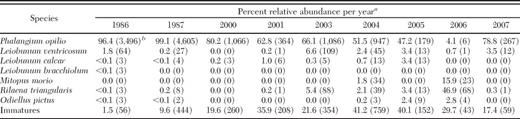
Percent relative abundances based on total no. trapped within a year.
Total individuals trapped per year.
List of harvestmen species and their relative abundances from pitfall traps in lowbush blueberry in Hancock and Washington Co., ME, for 1986–1987, 2000–2001, 2003–2005, 2006, and 2007
Percent relative abundances based on total no. trapped within a year.
Total individuals trapped per year.
When only organic fields are considered, two patterns emerge. First, there appeared to be less dominance by P. opilio compared with conventionally managed fields, and there appeared to be a decrease in the number of P. opilio captured over time as was seen with all fields. In 2004, 25% of all Opiliones captured in organically managed fields were P. opilio. Only 8.3% of the total captured were P. opilio in 2005, and that number decreased to 5.9% in 2006. There was a corresponding increase in the number of R. triangularis captured over the same period (3.1% in 2004, 58.3% in 2005, and 66.7% in 2006). As mentioned above, a strong resurgence occurred in 2007, and this was in an organic field. In a 10-yr study in the United Kingdom (Owen 1991), a similar pattern of a dominance shift occurred in a harvestman community comprised of 10 species. It is not known how common dominance is among harvestmen communities. However, it seems to be more usual in communities that are associated with forested habitats, and it is less common as harvestmen species richness increases (Curtis and Machado 2007).
Seasonal Relative Abundance of Harvestmen.
We observed a general trend of increased average trap capture of all adult harvestmen as the growing season progressed in 7 of the 8 yr in which multiple samples were taken during the growing season (Fig. 1). Adult harvestmen per trap catch did not increase throughout the growing season in 2006. This was the only year in which P. opilio was not the dominant species (Table 1). The temporal pattern of immature trap captures was more variable. In 1987, 2001, and possibly 2005, immatures peaked in late spring to early summer, but in 1986, 2000, 2002, 2003, 2004, and 2006, Phalangiinae immatures (most likely, P. opilio) peaked in mid-late summer. Most Opiliones have been reported to have an annual life cycle (Pinto-Da-Rocha et al. 2007). Species in the families Phalangiidae and Sclerosomatidae appear to have life history patterns characterized by hatch from the eggs in the spring; pass through several instars during the spring and summer; and become sexually mature in the late summer and autumn at which time eggs are usually laid in the leaf litter or soil (Hillyard and Sankey 1989). According to Spoek (1963), both eggs and nymphs of P. opilio may over winter, and two generations may occur in a year in warmer climates. Usually populations include individuals in several stages of development at any one time. Studies by Newton and Yeargan (2002) in Kentucky agro-ecosystems suggested that P. opilio populations have three generations per year, overwintering as eggs. Our data suggest that P. opilio may be partially multivoltine in Maine with one to two generations per year (two adult peaks in years 1986, 1987, 2000, 2001, where P. opilio percent relative abundances were 96, 99, 80, and 63%, respectively). Because adult and nymph trap captures in Maine were always quite low in the early spring, irrespective of year, relative to trap captures in late spring, summer, and fall, we speculate that eggs might be the predominant overwintering stage. A similar phenology of P. opilio is reported from Austria (Freudenthaler 1994 and Komposch 1997), whereas in Spain, P. opilio is common all year round but also peaks at the end of the summer in August (Rambla 1985).
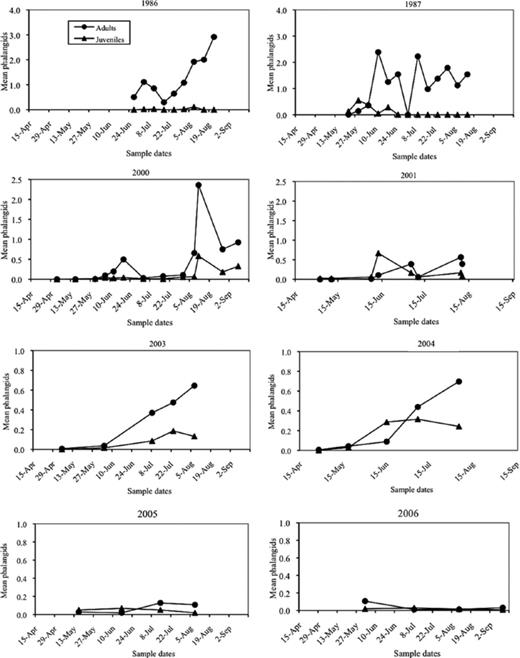
Seasonal abundance (mean Opiliones captured per trap per day) of adult and immatures Opiliones from 1986 to 1987, 2000–2001, and 2003–2006.

Spatial Pattern of Harvestmen in Lowbush Blueberry Fields.
Harvestmen captures (all species) from pitfall traps deployed in the interior sections of fields were used to describe the within-field spatial pattern using Taylor regression (log mean versus log variance). Figure 2 shows that harvestmen are aggregated or clumped within a field (β=1.607 ± 0.073, r2=0.941, P < 0.0001) because a slope significantly >1.0 represents a spatial pattern that is not random, but aggregated. The aggregated spatial pattern may be a result of eggs being laid in large clusters (Pinto-Da-Rocha et al. 2007) and a slow diffusion rate of immatures and adults from oviposition sites. Another reason for the aggregated pattern of harvestmen in blueberry fields might be because of a predatory numerical response to prey as predicted by theory (Price 1997).
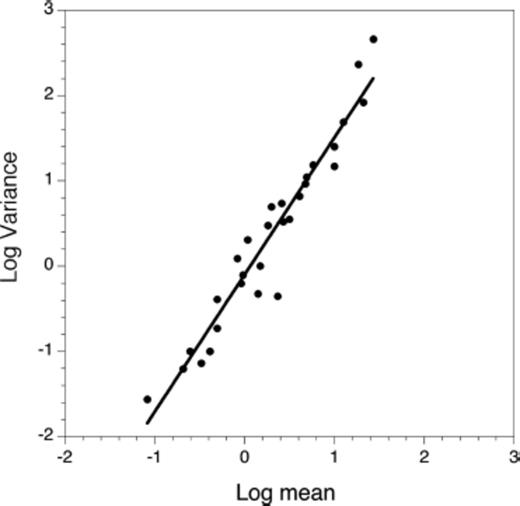
Taylor regression of trap captures of total harvestmen within lowbush blueberry fields (1987–2007).

Blueberry Crop Phenology Stage.
In both 1986 and 1987, there was no significant difference in trap captures of harvestmen because of pruning method (mow versus burn, F=0.670; df=1,8; P=0.437) and no interaction with year and pruning method. We were surprised by this result because it has been found that fire can have detrimental effects on forest harvestman communities (Schaefer 1980, Curry et al. 1985, Loch 1999). However, Schaefer (1980) showed that recovery of harvestmen abundance was rapid. Within 2 yr, there was no difference. However, two points should be made: (1) forest fires burn hotter than grass/shrub fires or fires for blueberry pruning and (2) all the burns for blueberry pruning were not at the same time of the year. Some fields are burned in the late fall and some are burned in the early spring. It seems that burn/mowing in early spring would possibly result in eggs (before hatch) being below ground and possibly surviving the deleterious effects of fire. Burning in fall might result in removing a significant number of adults with few eggs on/underground. Opiliones are primarily nocturnal and could escape death or injury if they are in retreats during the day that offered protection from a fire event of human origin. Therefore, pruning in lowbush blueberry may be detrimental to harvestmen, but it seems that mowing and burning have equivalent effects. If pruning is detrimental to harvestmen, a reduced abundance would be expected immediately after the prune operation resulting in higher trap captures in the fruit-bearing state the following year. This is not what was observed, as described next.
In 3 of the 4 yr that crop phenological stage was studied, fields in the prune cycle tended to have higher densities of Opiliones than fruit-bearing fields (Fig. 3). In 1986 and 2003, significantly more Opiliones were captured in pruned compared with fruit-bearing fields (1986: F=6.709; df=1,8; P=0.0321; 2003: F=79.721, df=1,8; P < 0.0001). There was no significant difference between prune and fruit-bearing fields (F=3.662, df=1,8; P=0.092) in 1987, but the trend in Opilione captures was similar to 1986 and 2003. In 2004, there was a higher mean number of Opiliones captured in fruit-bearing fields (4.77/trap) than in pruned fields (1.36/trap; F=7.173, df=1,8; P=0.028). However, much of the difference was caused by a large mean number of Opiliones captured in one fruit-bearing field (12.33/trap). The range of means for the other fruit-bearing fields was 1.57–3.93/trap. The range of means for the pruned fields was 0.27–2.82/trap.
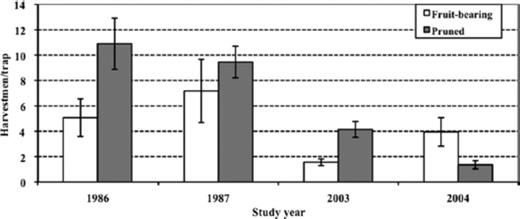
Effect of blueberry crop phenology on trap captures of Opiliones in 1986, 1987, 2003, and 2004 (analysis performed on logarithmic transformed data). Error bars are SEM.

We combined the data from all 4 yr (ignoring the block structure of the experiment in 2003 and 2004 because the block effects were not significant for both years) and conducted an unbalanced two-way ANOVA (factors: year [1986, 1987, 2003, 2004] and crop phenology [prune versus fruit-bearingr]) on log harvestmen trap capture. The results of the combined experiment analysis suggests that, on average, harvestmen trap capture is greater in pruned fields compared with fruit-bearing fields but that the trend is not consistent over all years (crop phenology: F=6.400; df=1,50; P=0.015. year × crop phenology: F=12.754; df=3,50; P < 0.0001). In general, pruned fields are not commonly sprayed with insecticides. However, they are heavily disturbed habitats because pruning operations (burning or mowing) take place at the beginning of each prune cycle. We speculate that insecticide applications may be responsible for the results that we observed of lower densities in fruit-bearing fields in 3 of the 4 yr. However, the opposite trend in 2004 is difficult to explain because in this year as well, insecticides were applied to fruit-bearing fields in a greater amount than pruned fields. Therefore, it is difficult to determine the response of harvestmen to crop phenology. In 2003 and 2004, there was no pest management strategy by crop phenology interaction (F=1.283; df=1,8; P=0.291 and F=0.462; df=1,8; F=0.519; 2003 and 2004, respectively), suggesting that differences in physical habitat disturbance might also affect harvestmen trap capture in prune and fruit-bearing fields.
Effect of Distance From Field Edge on Abundance.
The effect of distance from the field edge was studied over 5 trial yr. Overall, distance from field edge seems to effect trap captures of harvestmen. Harvestmen are more abundant in field interiors. In 2000, there was a significant difference between the square root of trap captures across the distances in the four fields sampled (F=10.272, df=3,9; P=0.003). There was an interaction with sample date and harvestmen capture as a function of distance (F=3.398; df=21,63; P=0.005; Greenhouse-Geiser adjustment). This was because of a single date early in the season where no increasing trend in capture with distance into the field occurred; all other dates showed an increasing trap capture trend with distance. When pooled over sample date, these trends in trap capture can be explained as linear (F=22.861; df=1,9; P=0.001) and quadratic (F=7.895; df=1,9; P=0.020) single degree of freedom contrasts. In general, the square root of harvestmen trap captures increased with increasing distance from the field edge (Fig. 4), possibly leveling off in trap capture at 15 m into the field (quadratic effect). A similar pattern was observed in 2001; however, the differences were not significant (F=2.359, df=3,16; P=0.110). In 2001, there was also no distance × pest management treatment interaction nor a distance × sample date interaction (F=1.592; df=3,16; P=0.230 and F=0.225; df=6,32; P=0.9763; Greenhouse-Geiser adjustment, respectively).
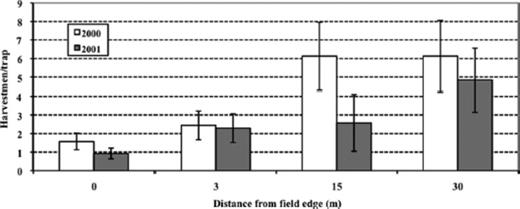
The effect of distance from field edge on Opilione trap captures in 2000 and 2001 (analysis performed on square root transformed data). Error bars are SEM.

Similar trends were observed in 2003, 2004, 2005, and 2007 (Fig. 5). In general, more harvestmen (logarithmic transformed) were captured in traps placed at least 30 m from the field edge compared with the field edge, but only in 2005 did we observe strong effects of distance within a field (2003: F=2.749; df=1,16; P=0.117; 2004: F=0.871; df=1,16; P=0.365; 2005: F=10.909; df=2,16; P=0.001; 2007: F=1.253, df=1,9; P=0.292).
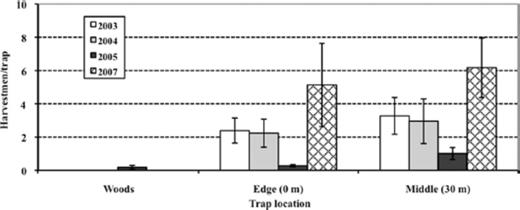
The effect of distance from forest to field edge and field interior on Opilione trap captures in 2003–2005 and 2007. Error bars are SEM.

Because the experimental designs were very different between the three studies, a meta-analysis was performed combining all data from 2000, 2001, 2003, 2004, 2005, and 2007 comparing harvestmen trap captures in field locations that were common to all studies: field edges versus field interiors (at least 30 m into the field). The meta-analysis suggested that when all three experiments conducted over 6 yr are considered together, the harvestmen trap catch is significantly greater in the interior of blueberry fields compared with field edges (weighted mean effect size [di+]=0.600 ± 0.384 [95% confidence interval]). A mean effect size of 0.6 is considered to be an effect with moderate strength (Hedges and Olkin 1985). It is difficult to understand why harvestmen trap captures are significantly higher as one moves from the forest to the field edge and then from the field edge into the field interior. One hypothesis is that insecticides for control of the blueberry maggot fly (Rhagoletis mendax Curran) are often applied to the field perimeter and not the entire field (Collins and Drummond 2004, Drummond et al. 2009), thus increasing exposure of harvestmen to insecticides proximal to field edges. Another possible explanation is that field interiors tend to be free of snow and ice earlier in the spring than field edges and forest habitats, thus providing early spring foraging habitat (F.A.D., unpublished data). There are no studies that we could find that reported on the within-field distribution of harvestmen as related to field edges, and therefore, it is not known how common this phenomenon might be in different cropping systems.
Effect of Pest Management Practices.
The effect of pest management practice was assessed over 4 yr. In 2000, no statistical analysis could be performed on the effect of pest management because treatments were not replicated; however, the single reduced input field did have a higher mean trap catch over the growing season (2.838 ± 0.318 harvestmen/trap ± SE) than did the three conventional fields (0.730 ± 0.134; 1.312 ± 0.193; 0.683 ± 0.144 harvestmen/trap ± SE).
Reduced-risk insect pest management versus conventional pest management was compared between 2003 and 2005. There was no significant difference in the number of harvestmen captured in fields treated with reduced-risk insecticides compared with capture rates in conventionally managed fields in 2003 (F=0.030; df=1,4; P=0.873), 2004 (F=0.453; df=1,4; P=0.538), or 2005 (F=0.011, df=1,4; P=0.920; Fig. 6). When reduced-risk, conventional, and organic management were compared for 2005 as a completely randomized design, there were no differences in trap capture, although the power was compromised because of a low sample size of only three organic fields and because the original design for the reduced-risk and conventional treatments was a randomized block and the efficiency gained in blocking was not attained in this analysis (F=2.082; df=2,10; P=0.176). In 2001, there were fewer (F=8.66; df=1,4; P=0.042) harvestmen trapped in fields treated with conventional insecticides (mean ± SE=4.461 ± 1.252) compared with those fields managed organically (mean ± SE=0.863 ± 0.226). This suggests that organic fields are not consistently higher in harvestmen numbers compared with conventionally managed fields and that the results may vary between locations and years.
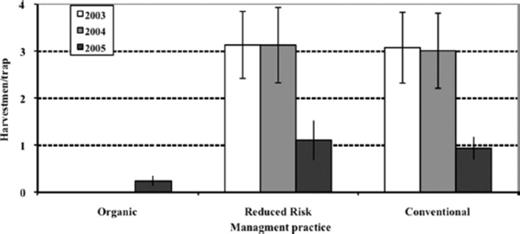
Abundance of Opiliones in blueberry fields managed under three different strategies, 2003–2005. Error bars are SEM.

Insecticide applications are not frequent in lowbush blueberry, ranging from zero to four applications once every 2 yr for a given field (Drummond and Collins 1999, Karem 2005). This may explain the lack of a consistent response in harvestmen captures because of pest management strategy. Specific insecticides that are used may also affect the response in harvestmen (see below). However, there are several other differences between conventionally and organically managed fields besides pesticide chemistry and frequency of application. In general, weed density is much higher in organic fields, and this in turn may support higher numbers of other natural enemy species, as well as other pest insects that may serve as suitable prey for harvestmen (Karem 2005, Drummond et al. 2009).
Direct Effects of Insecticides.
Foliage treated with insecticides resulted in shorter survival rates (square root transformed) of P. opilio than those of individuals exposed to nontreated foliage (F=24.464; df=3,3; P < 0.0001). The control group lived an average of 5.922+0.203 d, whereas P. opilio exposed to foliage treated with Imidan only lived an average of 1.100+0.1333 d. P. opilio exposed to SpinTor and Asana-treated foliage lived an average of 4.918+0.234 and 2.301+0.313 d, respectively. A Tukey honestly significant difference (HSD) post hoc test suggested that exposure to SpinTor resulted in survival rates no different than the control, whereas exposure to Asana and Imidan resulted in survival rates that were not significantly different from one another and both significantly different from the control and SpinTor.
Hilbeck and Kennedy (1996) noted that, although insecticide applications in commercial potato fields greatly suppressed or eliminated predator populations, they began to increase within 1–2 wk after application. Pekár (1999) studied the effect of two different integrated pest management (IPM) practices and conventional spraying on the composition of epigeic spiders and harvestmen in an apple orchard over 4 yr. He concluded that insecticides had limited effect on the composition of epigeic communities and that the density of under story plants and herbicide applications on weeds had a greater influence on abundance.
Direct Effects of Allegheny Mound Ant Colonies.
We did not find any evidence to suggest that F. exsectoides directly affects the relative abundance of harvestmen. We expected that, if these ants were preying in a significant manner on harvestmen, an increase in trap capture would be observed with an increasing distance from a mound; therefore, we conducted single degree of freedom contrasts to assess the linear relationship between trap capture and distance from the mound. In both time periods (June–July and August–September), the mean trap capture did not increase linearly with distance from ant mounds (F=1.114; df=1,15; P=0.308 and F=0.462; df=1,0; P=0.512 for June–July and August–September, respectively). In the field, we observed F. exsectoides workers bringing harvestmen remains back to the nest. This shows that they prey on harvestmen, but apparently they are not a preferred prey species or preyed on heavily enough to result in a gradient of abundance in relation to distance from ant colonies. Cokendolpher and Mitov (2007) compiled an extensive list of harvestmen predators. Their research of the literature suggests that chordates are the predominant predators, but that among the invertebrates, arachnids of the orders Araneae and Opiliones are the most commonly reported predators. Ants of the genus Formica, the genus of the Allegheny mound ant, have also been reported as predators of two of the genera in our study, Phalangium and Mitopus. Whether exocrine gland secretions are highly repellent to ant predators is not known, as is suggested with other predators, especially rodents (Cokendolpher and Mitov 2007).
In summary, harvestmen are abundant in lowbush blueberry. They are second only to ants and spiders as predators of lowbush blueberry pest insects (Maloney 2002, Drummond et al. 2009). Although we have not conducted prey specificity tests, we assume that they prey on a large diversity of both pest and beneficial insects. Acosta and Machado (2007) compiled a list of prey that has been documented for many species of harvestmen. P. opilio, the dominant harvestmen species associated with lowbush blueberry, has a long list of documented prey items comprising seven orders of insects, Chilopoda, three orders of arachnids including Opiliones, one order of Crustacea, and a gastropod species of Mollusca. These prey items are in addition to many scavenged cadavers also of a diversity of taxa, including vertebrates. Based on this dietary composition, it is difficult to hypothesize on the predatory effect and natural control of harvestmen in lowbush blueberry. This should be the research priority in future studies, not only for lowbush blueberry but for many cropping systems.
Our studies encompassing the past 21 yr showed that harvestmen in lowbush blueberry are represented by eight species, but in most years are dominated by P. opilio. The harvestmen life history pattern in Maine lowbush blueberry seems to be one of primarily univoltinism with overwintering eggs. Nymphs are predominant in the spring, with adults increasing in numbers throughout the growing season. Harvestmen are aggregated within lowbush blueberry fields at two levels. First, they are aggregated within the interior of fields with a log mean to log variance regression slope of 1.607, but they also are aggregated in relation to field edges. They are most abundantly trapped within the interior of blueberry fields. We have not determined the mechanism for the edge effect, but we suggest a hypothesis that invokes both higher survival within the interior and a numerical response to higher prey abundance in the field interior, both resulting from a common insect pest management practice that targets insecticide applications along field perimeters. The dominant harvestmen are synanthropic species and survive better in disturbed habitats (Curtis and Machado 2007). This could explain the abundance in the areas away from the trees. Blueberry management practices have some effects but not as we originally expected. We found no evidence that burning fields (to prune) is more detrimental on harvestmen than mowing. We did find that on average (with opposite results one year), trap captures are greater in pruned fields than in fruit-bearing fields. This pruning effect could be caused by the common practice of applying most insecticides for pest management in the fruit-bearing year. Conventionally managed fields with reduced-risk insecticides showed no difference in harvestmen relative abundance compared with those conventionally managed fields using the older more persistent organophosphate insecticides. This was surprising in light of our insecticide trials that showed phosmet to be much higher in toxicity to P. opilio than spinosad. We hypothesize that the low frequency of insecticide application in general might be the reason that we did not see a response between reduced-risk insecticide applications and conventional insecticide applications at the field level. This may also be the reason that organic fields were not consistently better habitats for harvestmen than conventionally managed fields.
We thank S. Hoffmann, the staff of the University of Maine Blueberry Hill Farm, and the many undergraduate students for assistance with field data collection (S. Ratten, D. Thaxter, E. Davis, J. Curtis, R. Look, S. Davis, C. Brunton, and D. Knarr). The following blueberry companies granted permission to conduct these studies on their lands: Jasper Wyman and Son, Milbridge, ME; Cherryfield Foods, Cherryfield, ME; Northeast Blueberry, Jonesboro, ME; and Blueberry Hill Farm Experiment Station, Jonesboro, ME. We also are grateful for the cooperation of independent blueberry growers A. Calhoun and M. Bailey. This research was supported by the Maine Agricultural and Forest Experiment Station through several cooperative CSREES research projects (Awards 99-34221-7408, 2001-34221-10476, 2003-34221-13126, and 2005-34221-15621) and additional grant support from the Maine blueberry industry and grants funded by the USDA/RAMP program (Award 2002-51101-01903) and the USDA/Organic Transitions program. This is the University of Maine Agricultural and Forest Experiment Station Journal Publication 3103.
References