 https://orcid.org/0000-0001-5402-4946
Abstract
Published evidence has shown that troncoconical cuffs improve blood pressure measurement accuracy in subjects with obesity. However, the exact shape of these cuffs according to arm size is unknown. The aim of the present study was to investigate the anthropometric characteristics of the arm in a large population in order to identify the appropriate shape of the cuff for each arm.
The anthropometric characteristics were assessed in 729 adults with middle arm circumference ranging from 16 to 55 cm. Subjects were divided into classes of arm size and the upper-arm slant angle of the truncated cone was calculated.
In the whole sample, the conical shape of the arm progressively increased with increasing arm circumference (r = 0.61, P < 0.0001). Independent predictors of the conical shape were arm circumference (P < 0.0001) and length (negative relationship, P < 0.0001), and female sex (P = 0.048). Women had a slightly more pronounced conical shape of the arm (P = 0.007) than men. However, the decrease in the slant angle across the arm-size classes showed a similar trend in men and women, and in a 2-way analysis of variance there was no interactive effect between arm size and sex on the conical shape of the arm (P = 0.11). On the basis of the slant angle calculated in each arm-size class, we provide dimensions for bladders that would appropriately fit the arm within a given circumference range.
To properly fit the upper arm in patients with obesity cuffs should have a troncoconical shape. This study provides reference data according to arm size.
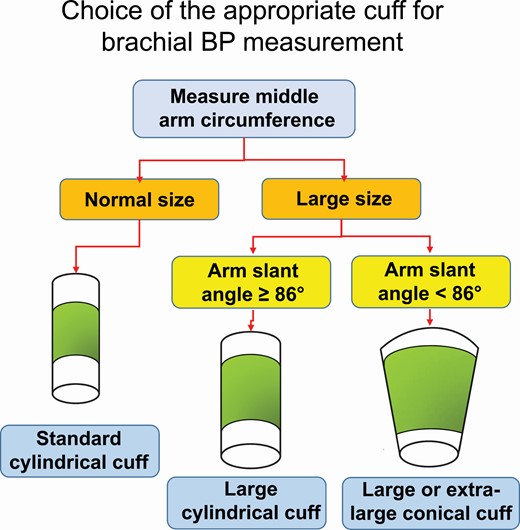

Uniform compression of the brachial artery under the cuff is a key factor for accurate blood pressure (BP) measurement.1,2 Previous studies have documented that in the large majority of the subjects the upper arm has a troncoconical shape and that the frustum of the cone slant angle progressively decreases with increasing arm size.3,4 When the proximal circumference of the arm is much larger than the circumference near the elbow, a condition frequently present in obese individuals, the use of rectangular (cylindrical) cuffs and bladders may lead to inaccurate measurements.5,6 In these arms a cylindrical cuff will expand irregularly on the lower part of the arm applying an uneven compression to the brachial artery.5,7 This may lead to an important overestimation of BP as shown by previous studies in patients with obesity.5–7 Due to the published evidence, recent guidelines of scientific societies including the American Heart Association (AHA) recommended that in these subjects conically shaped cuffs and bladders should be used.8,9 However, even these guidelines could not provide detailed recommendations on the precise shape (slant angle) of cuffs for accurate BP measurement because the relationship between arm circumference and optimal conical shape of the cuff remains largely unknown. Thus, the aim of this study was to provide information on the shape of the upper arm in a large sample of patients referred to outpatient clinics to identify appropriate cuff shapes in relation to arm size.
METHODS
Participants
Participants for this study were subjects 18–98 years old with upper-arm middle circumference between 16 and 55 cm. Patients attending general medical outpatient clinics at the Padova University Hospital and the Villa Maria Hospital, Padova, Italy, participating in several investigations on device validations or the effect of different cuff models on brachial BP measurement were recruited. Collecting anthropometric data to document the upper-arm shape was a secondary aim of all those studies. The present analysis was performed in 729 white subjects aged 55.7 ± 17.0 years (359 women). Their clinical characteristics by sex are shown in Table 1. The procedures followed were in accordance with institutional guidelines and all participants gave their written informed consent. As all subjects participated in previous studies approved by the local Ethics Committees, no approval of Ethics Committee was required for the present analysis.
Characteristics of the 729 participants stratified by sex
| Variable | Men (N = 370) | Women (N = 359) | P |
|---|---|---|---|
| Age (years) | 56.3 ± 16.3 | 55.0 ± 17.7 | 0.30 |
| Weight (kg) | 88.2 ± 24.0 | 77.1 ± 24.5 | <0.001 |
| Height (cm) | 175.3 ± 7.4 | 162.7 ± 6.7 | <0.001 |
| Body mass index (kg/m2) | 28.7 ± 7.8 | 29.2 ± 9.4 | 0.41 |
| Arm length (cm) | 21.8 ± 1.6 | 20.1 ± 1.6 | <0.001 |
| Arm middle circumference (cm) | 31.9 ± 5.7 | 30.6 ± 6.6 | 0.006 |
| Proximal–distal circumference difference (cm) | 8.0 ± 2.7 | 7.9 ± 2.8 | 0.58 |
| Arm skinfold thickness (cm) | 1.7 ± 0.9 | 1.8 ± 0.9 | 0.014 |
| Upper-arm slant angle (°)a | 86.7 ± 1.1 | 86.5 ± 1.2 | 0.007 |
| Systolic blood pressure (mm Hg) | 141.0 ± 21.2 | 137.0 ± 24.3 | 0.019 |
| Diastolic blood pressure (mm Hg) | 85.7 ± 14.4 | 82.0 ± 15.2 | 0.001 |
| Variable | Men (N = 370) | Women (N = 359) | P |
|---|---|---|---|
| Age (years) | 56.3 ± 16.3 | 55.0 ± 17.7 | 0.30 |
| Weight (kg) | 88.2 ± 24.0 | 77.1 ± 24.5 | <0.001 |
| Height (cm) | 175.3 ± 7.4 | 162.7 ± 6.7 | <0.001 |
| Body mass index (kg/m2) | 28.7 ± 7.8 | 29.2 ± 9.4 | 0.41 |
| Arm length (cm) | 21.8 ± 1.6 | 20.1 ± 1.6 | <0.001 |
| Arm middle circumference (cm) | 31.9 ± 5.7 | 30.6 ± 6.6 | 0.006 |
| Proximal–distal circumference difference (cm) | 8.0 ± 2.7 | 7.9 ± 2.8 | 0.58 |
| Arm skinfold thickness (cm) | 1.7 ± 0.9 | 1.8 ± 0.9 | 0.014 |
| Upper-arm slant angle (°)a | 86.7 ± 1.1 | 86.5 ± 1.2 | 0.007 |
| Systolic blood pressure (mm Hg) | 141.0 ± 21.2 | 137.0 ± 24.3 | 0.019 |
| Diastolic blood pressure (mm Hg) | 85.7 ± 14.4 | 82.0 ± 15.2 | 0.001 |
Data are mean ± SD.
aAngle between the slant surface of a truncated cone and the base (the upper-arm circumference at the axilla).
Characteristics of the 729 participants stratified by sex
| Variable | Men (N = 370) | Women (N = 359) | P |
|---|---|---|---|
| Age (years) | 56.3 ± 16.3 | 55.0 ± 17.7 | 0.30 |
| Weight (kg) | 88.2 ± 24.0 | 77.1 ± 24.5 | <0.001 |
| Height (cm) | 175.3 ± 7.4 | 162.7 ± 6.7 | <0.001 |
| Body mass index (kg/m2) | 28.7 ± 7.8 | 29.2 ± 9.4 | 0.41 |
| Arm length (cm) | 21.8 ± 1.6 | 20.1 ± 1.6 | <0.001 |
| Arm middle circumference (cm) | 31.9 ± 5.7 | 30.6 ± 6.6 | 0.006 |
| Proximal–distal circumference difference (cm) | 8.0 ± 2.7 | 7.9 ± 2.8 | 0.58 |
| Arm skinfold thickness (cm) | 1.7 ± 0.9 | 1.8 ± 0.9 | 0.014 |
| Upper-arm slant angle (°)a | 86.7 ± 1.1 | 86.5 ± 1.2 | 0.007 |
| Systolic blood pressure (mm Hg) | 141.0 ± 21.2 | 137.0 ± 24.3 | 0.019 |
| Diastolic blood pressure (mm Hg) | 85.7 ± 14.4 | 82.0 ± 15.2 | 0.001 |
| Variable | Men (N = 370) | Women (N = 359) | P |
|---|---|---|---|
| Age (years) | 56.3 ± 16.3 | 55.0 ± 17.7 | 0.30 |
| Weight (kg) | 88.2 ± 24.0 | 77.1 ± 24.5 | <0.001 |
| Height (cm) | 175.3 ± 7.4 | 162.7 ± 6.7 | <0.001 |
| Body mass index (kg/m2) | 28.7 ± 7.8 | 29.2 ± 9.4 | 0.41 |
| Arm length (cm) | 21.8 ± 1.6 | 20.1 ± 1.6 | <0.001 |
| Arm middle circumference (cm) | 31.9 ± 5.7 | 30.6 ± 6.6 | 0.006 |
| Proximal–distal circumference difference (cm) | 8.0 ± 2.7 | 7.9 ± 2.8 | 0.58 |
| Arm skinfold thickness (cm) | 1.7 ± 0.9 | 1.8 ± 0.9 | 0.014 |
| Upper-arm slant angle (°)a | 86.7 ± 1.1 | 86.5 ± 1.2 | 0.007 |
| Systolic blood pressure (mm Hg) | 141.0 ± 21.2 | 137.0 ± 24.3 | 0.019 |
| Diastolic blood pressure (mm Hg) | 85.7 ± 14.4 | 82.0 ± 15.2 | 0.001 |
Data are mean ± SD.
aAngle between the slant surface of a truncated cone and the base (the upper-arm circumference at the axilla).
Measurements
Measurements of arm dimensions were made with the subjects in the supine position with arms resting comfortably at the sides.5 Upper-arm proximal, middle, and distal circumferences were measured to the nearest 0.5 cm with a measuring tape. Proximal circumference was measured just below the axilla and distal circumference just above the antecubital fossa. Middle circumference was measured at the midpoint from the acromion to the olecranon. Upper-arm length was measured from the axilla to the antecubital fossa. The proximal and distal circumferences were used to calculate the slant angle of the upper-arm truncated cone according to the formula:
where SA is the slant angle in degrees, “C1” is the arm proximal circumference in cm, “C2” is the arm distal circumference in cm, and “L” is the distance between the 2 in cm. The slant angle is the angle between the slant surface of a truncated cone and the base (the upper-arm circumference at the axilla), and can be taken as an index of conicity: the smaller the slant angle the greater the conical shape of the arm. When the slant angle approximates 90°, the arm can be assumed to have a cylindrical shape.
Skinfold thickness was measured in triplicate with a manual caliper at the triceps and biceps, and the average of the 6 measurements was defined as upper-arm skinfold thickness. Body mass index was calculated as body weight divided by height squared. BP was measured with a mercury sphygmomanometer in the sitting position using the standard auscultatory method. Three BP measurements were performed by 2 persons experienced in device validation using cuffs whose bladders had to cover at least 80% of the circumference of the arm and the average of the 6 BP readings was taken. The deflated cuffs were snugly applied to the upper arm with the center of the bladder over the brachial artery.
Statistics
For statistical analysis, the subjects were divided into 6 classes of upper-arm circumference with 5 cm intervals (≤22.5, 23–27.5, 28–32.5, 33–37.5, 38–42.5, and ≥43 cm). For a practical approach to the problem, in 708 participants we also used the arm circumference classes recommended by the AHA.8 The between-group differences were compared using a 1-way analysis of variance and P values for trend were estimated. Sex-specific analyses were also carried out. In addition, the conical shape of the arm was evaluated in a 2-way analysis of variance using the arm-size class and sex as fixed factors and the upper-arm slant angle as the dependent variable. P values for factors and their interaction were provided. For between-sex comparisons, the significance of differences was tested using unpaired t-test for continuous variables and χ2 test for categorical variables. Relations between continuous variables were assessed using Pearson’s correlation with Bonferroni adjustment. Age, sex, arm length, arm middle circumference, and skinfold thickness were included in a multivariable linear regression analysis to identify independent predictors of the upper-arm slant angle. Arm circumference was also expressed as percent of height (circumference/height × 100). Data are presented as mean ± SD unless specified. A P < 0.05 or less was considered as statistically significant.
RESULTS
In our study participants the slant angle of the upper arm ranged from 80.4° to 89.2°. The distributions of the slant angle and of the proximal–distal circumference difference are shown in Supplementary Figure S1 online. The distribution of the arm slant angle was skewed to the left with a negative coefficient of skewness (−0.96, P < 0.001). Conversely, the distribution of the circumference difference was skewed to the right with a positive coefficient of skewness (1.04, P < 0.001). As expected, the 2 variables were negatively correlated (Supplementary Figure S2 online).
The characteristics of the participants by sex are shown in Table 1. Age and body mass index did not differ between the 2 sexes. Women were shorter and had smaller arm length and circumference than men. Women had a slightly more pronounced conical shape of the upper arm, as documented by the smaller arm slant angle and had a greater skinfold thickness (Table 1). The between-sex difference in the slant angle was attenuated after adjustment for arm size and length (P = 0.044). The difference between the proximal and distal arm circumferences was similar in the 2 sexes. In the present sample, BP was slightly higher in men than in women.
In the group as a whole, the upper-arm slant angle was negatively correlated with arm circumference and skinfold thickness (Figure 1) and was positively correlated with arm length (R = 0.11, P = 0.005). The correlation with the slant angle slightly increased when arm circumference was expressed as percent of height (R = −0.64, P < 0.001). However, in a linear multivariable analysis only arm circumference and length, and female sex remained independent predictors of the arm slant angle (Table 2). However, sex was rejected by the model if height was included indicating that the association with sex was due to women being shorter than men. In Supplementary Table S1 online, the characteristics of the participants grouped according to arm size are shown. The decrease in the slant angle across the 6 arm-size classes showed a similar trend in men and women (P < 0.0001 in both, Figure 2). In a 2-way analysis of variance in which arm-size group and sex were fixed factors, a significant effect of both arm size (P < 0.001) and sex (P = 0.001) was found on the conical shape of the arm (slant angle) without a significant interaction (P = 0.11) between arm size and sex.
Predictors of the upper-arm slant anglea (conical shape) in a multivariable linear regression analysis
| Predictors | Coefficient | Standard error | t | P |
|---|---|---|---|---|
| Age (years) | 0.000 | 0.002 | 0.084 | 0.93 |
| Sex, female | 0.153 | 0.077 | 1.978 | 0.048 |
| Skinfold thickness (cm) | 0.013 | 0.060 | 0.210 | 0.83 |
| Arm size (cm) | −0.130 | 0.009 | −14.837 | <0.001 |
| Arm length (cm) | 0.146 | 0.021 | 6.947 | <0.001 |
| Predictors | Coefficient | Standard error | t | P |
|---|---|---|---|---|
| Age (years) | 0.000 | 0.002 | 0.084 | 0.93 |
| Sex, female | 0.153 | 0.077 | 1.978 | 0.048 |
| Skinfold thickness (cm) | 0.013 | 0.060 | 0.210 | 0.83 |
| Arm size (cm) | −0.130 | 0.009 | −14.837 | <0.001 |
| Arm length (cm) | 0.146 | 0.021 | 6.947 | <0.001 |
Data from 729 subjects. The variance inflation factor was <3 for all variables.
aAngle between the slant surface of a truncated cone and the base (the upper-arm circumference at the axilla).
Predictors of the upper-arm slant anglea (conical shape) in a multivariable linear regression analysis
| Predictors | Coefficient | Standard error | t | P |
|---|---|---|---|---|
| Age (years) | 0.000 | 0.002 | 0.084 | 0.93 |
| Sex, female | 0.153 | 0.077 | 1.978 | 0.048 |
| Skinfold thickness (cm) | 0.013 | 0.060 | 0.210 | 0.83 |
| Arm size (cm) | −0.130 | 0.009 | −14.837 | <0.001 |
| Arm length (cm) | 0.146 | 0.021 | 6.947 | <0.001 |
| Predictors | Coefficient | Standard error | t | P |
|---|---|---|---|---|
| Age (years) | 0.000 | 0.002 | 0.084 | 0.93 |
| Sex, female | 0.153 | 0.077 | 1.978 | 0.048 |
| Skinfold thickness (cm) | 0.013 | 0.060 | 0.210 | 0.83 |
| Arm size (cm) | −0.130 | 0.009 | −14.837 | <0.001 |
| Arm length (cm) | 0.146 | 0.021 | 6.947 | <0.001 |
Data from 729 subjects. The variance inflation factor was <3 for all variables.
aAngle between the slant surface of a truncated cone and the base (the upper-arm circumference at the axilla).
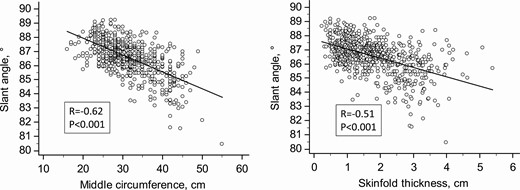
Correlation of the upper-arm slant angle with arm circumference and skinfold thickness in 729 adults.

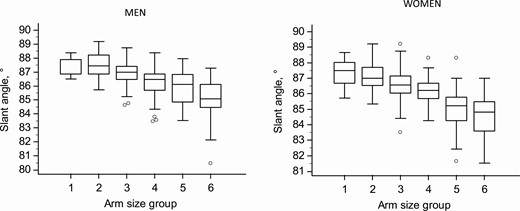
Upper-arm slant angle in the 729 participants stratified by sex and grouped into classes of upper-arm circumference. Group 1 = ≤22.5 cm, group 2 = 23–27.5 cm, group 3 = 28–32.5 cm, group 4 = 33–37.5 cm, group 5 = 38–42.5 cm, and group 6 = ≥43 cm. The Box-and-Whisker plots show the median and the 25th and 75th percentiles; the whiskers indicate the 5th and 95th percentiles; estimates >1.5 times the interquartile distance (i.e., outliers) are represented as single circles.

AHA cuffs
In Figure 3, the upper-arm slant angle (a) and the proximal–distal circumference difference (b) in 708 participants grouped according to the 4 cuff sizes (small adult, adult, large adult, and extra-large adult) recommended by the AHA8 are shown. As expected, the slant angle progressively declined and the circumference difference progressively increased across the 4 cuff-size groups (Supplementary Table S1 online). Within each cuff-size category, arm length (negative relationship) and middle circumference were independent predictors of the conical shape of the arm. In the 3 categories with larger arm, also skinfold thickness showed an independent association with the conicity index (P value from 0.030 to 0.004). Sex was not a significant predictor of the slant angle within any of the 4 categories. On the basis of the slant angle calculated in each group, we worked out the appropriate conical shape for a bladder and cuff that would fit the arm of the subjects belonging to the 4 groups. For a practical application of this approach, in Table 3 we provide the exact dimensions of the 4 bladders. However, it should be pointed out that occasionally a pronounced conical shape could be found also in people with a middle upper-arm circumference <35 cm. Taking the 85° slant angle as the cut-point between normal and conical arms, in the present study the frequency of conical arms was 0%, 2.3%, 30.1%, and 47.4%, respectively, on going from the small adult to the extra-large cuff-size group. Using the 86° cutoff, the frequencies were 6.6%, 14.9%, 57.8%, and 73.7%, respectively. The frequency of participants with a difference between the proximal and distal upper-arm circumference ≥10 cm was 0%, 9.6%, 52.0%, and 73.7%, respectively, across the 4 AHA classes.
Suggested proximal and distal bladder lengths to allow for uniform compression of the brachial artery in each of the 4 cuff sizes recommended by the American Heart Association based on mid-upper-arm circumference8
| Cuff | Small adult | Adult | Large adult | Extra-large adult |
|---|---|---|---|---|
| Circumference range | 22–26 cm | 27–34 cm | 35–44 cm | 45–52 cm |
| Bladder dimensions at midpoint | 12 × 22 cm | 16 × 30 cm | 16 × 36 cm | 16 × 42 cm |
| Bladder proximal length (cm) | 25.7 | 32.8 | 39.8 | 46.7 |
| Bladder distal length (cm) | 22.3 | 27.2 | 32.2 | 37.3 |
| Difference between proximal and distal length (cm) | 3.4 | 5.6 | 7.6 | 9.4 |
| Bladder slant angle (°)a | 87.4 | 86.8 | 85.6 | 84.6 |
| Cuff | Small adult | Adult | Large adult | Extra-large adult |
|---|---|---|---|---|
| Circumference range | 22–26 cm | 27–34 cm | 35–44 cm | 45–52 cm |
| Bladder dimensions at midpoint | 12 × 22 cm | 16 × 30 cm | 16 × 36 cm | 16 × 42 cm |
| Bladder proximal length (cm) | 25.7 | 32.8 | 39.8 | 46.7 |
| Bladder distal length (cm) | 22.3 | 27.2 | 32.2 | 37.3 |
| Difference between proximal and distal length (cm) | 3.4 | 5.6 | 7.6 | 9.4 |
| Bladder slant angle (°)a | 87.4 | 86.8 | 85.6 | 84.6 |
The bladder lengths have been estimated from the upper-arm slant angles measured in 708 subjects.
aAngle between the slant surface of a truncated cone and the base (the upper-arm circumference at the axilla).
Suggested proximal and distal bladder lengths to allow for uniform compression of the brachial artery in each of the 4 cuff sizes recommended by the American Heart Association based on mid-upper-arm circumference8
| Cuff | Small adult | Adult | Large adult | Extra-large adult |
|---|---|---|---|---|
| Circumference range | 22–26 cm | 27–34 cm | 35–44 cm | 45–52 cm |
| Bladder dimensions at midpoint | 12 × 22 cm | 16 × 30 cm | 16 × 36 cm | 16 × 42 cm |
| Bladder proximal length (cm) | 25.7 | 32.8 | 39.8 | 46.7 |
| Bladder distal length (cm) | 22.3 | 27.2 | 32.2 | 37.3 |
| Difference between proximal and distal length (cm) | 3.4 | 5.6 | 7.6 | 9.4 |
| Bladder slant angle (°)a | 87.4 | 86.8 | 85.6 | 84.6 |
| Cuff | Small adult | Adult | Large adult | Extra-large adult |
|---|---|---|---|---|
| Circumference range | 22–26 cm | 27–34 cm | 35–44 cm | 45–52 cm |
| Bladder dimensions at midpoint | 12 × 22 cm | 16 × 30 cm | 16 × 36 cm | 16 × 42 cm |
| Bladder proximal length (cm) | 25.7 | 32.8 | 39.8 | 46.7 |
| Bladder distal length (cm) | 22.3 | 27.2 | 32.2 | 37.3 |
| Difference between proximal and distal length (cm) | 3.4 | 5.6 | 7.6 | 9.4 |
| Bladder slant angle (°)a | 87.4 | 86.8 | 85.6 | 84.6 |
The bladder lengths have been estimated from the upper-arm slant angles measured in 708 subjects.
aAngle between the slant surface of a truncated cone and the base (the upper-arm circumference at the axilla).
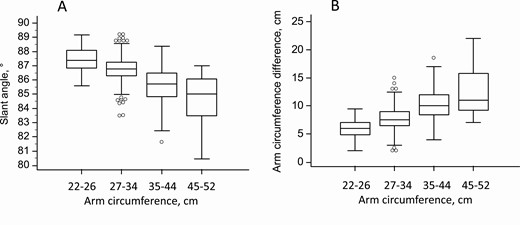
Upper-arm slant angle (a) and proximal–distal circumference difference (b) in 708 participants grouped according to the cuff size recommended by the American Heart Association. Small adult (22–26 cm), adult (27–34 cm), large adult (35–44 cm), and extra-large adult (45–52 cm). The Box-and-Whisker plots show the median and the 25th and 75th percentiles; the whiskers indicate the 5th and 95th percentiles; estimates >1.5 times the interquartile distance (i.e., outliers) are represented as single circles.

Discussion
This study confirms our previous findings that in adults the upper-arm frustum of the cone slant angle is <90°. In the present report the slant angle ranged from 80.4° to 89.2°. The conical shape of the arm was proportional to the arm circumference and was more pronounced in women and in subjects with short arm. The association with arm circumference was greater when the circumference was expressed as percent of body height. Skinfold thickness was also correlated with the conicity index. However, in a multiple regression including arm middle circumference arm fatness was not an independent predictor of the arm slant angle in the group as a whole but only within the categories with larger arm. The present study fills a gap in the current literature by presenting normative data on the shape of cuffs and bladders for BP measurement in relation to the arm shape that can be used by manufacturers and healthcare professionals.
To obtain accurate BP measurements, the cuff should perfectly adhere to the arm and apply a uniform pressure on the arm surface.1,2,5 This requirement applies to cuffs used for both the auscultatory and the oscillometric measurements.3,5–7 A rectangular (cylindrical when in place) cuff does not exert a uniform pressure on a conically shaped arm because the lower half of the cuff can not evenly adhere to the arm surface when the cuff is inflated and thus the distal part will transmit a lower pressure to the subcutaneous tissue overlying the brachial artery. Using an arm model, Lan et al. showed that maximum pressure transmission ratio from the cuff to the arterial wall across the soft tissue of the arm is highly related to the shape of the upper arm highlighting the importance of using a cuff shaped according to arm geometry.10 This recommendation appears even more important for the oscillometric method in which measured cuff pressure oscillations are a reflection of the entire artery volume change under the cuff rather than that of the central section.10
Using a pressor sensor applied on the center of the cuff, we actually demonstrated that there was a clear drop in pressure when a cylindrical cuff was used on large troncoconical arms.5,11 In 33 subjects with arm circumference ≥42 cm, a higher pressure discrepancy between the pressure in and the pressure under the cuff was found for the cylindrical cuff compared with the conical cuff with a mean between-cuff difference of 10.2 mm Hg (P < 0.001).11 In 133 subjects divided into 5 groups with slant angle of ≥88°, 86–87.9°, 84–85.9°, 82–83.9°, and <82°, the between-cuff differences detected with the sensor were 0.5, 0.6, 4.7, 12.0, and 14.3 mm Hg, respectively (P. Palatini et al., unpublished data). From these data, it appears that the loss of pressure using a cylindrical cuff is negligible for arms with a slant angle ≥86°, is modest for arms with slant angles between 84° and 86°, and is pronounced for arms with slant angle below 84°. Thus, at least in this latter group a conically shaped cuff should be preferred.
The use of a cylindrical cuff on a large troncoconical arm may thus have important consequences for the accuracy of BP measurement when either the auscultatory or the oscillometric method is used. Indeed, in previous studies we showed that common rectangular cuffs do not work effectively on patients having upper arms with a pronounced conical shape.5,11,12 In 220 individuals with arm circumference ranging up to 42.5 cm we found that in large arms a cylindrical cuff overestimated BP measured with a troncoconical cuff and that arm conicity and size were independently related to the between-cuff BP discrepancies.5 In the group with arm circumference of 37.5–42.5 cm, the mean difference between the 2 cuffs was 2.0/1.8 mm Hg (P = 0.001/<0.001). The mean slant angle in this group was 85.5°. Differences as great as 9.7/7.8 mm Hg were found in individuals with slant angle equal to or less than 83°. In a further study11 in 33 subjects with upper-arm circumference ≥42 cm and a mean slant angle of 84.1°, the mean between-cuff difference was 5.3/3.0 mm Hg (P < 0.001/=0.01, vs. a group of controls). In the participants with systolic BP ≥ 150 mm Hg the between-cuff systolic BP difference was 9.1 mm Hg, indicating that the BP overestimation caused by the use of a cylindrical cuff may be greater in people with higher BP. Also in that study, the arm slant angle was an independent predictor of the between-cuff systolic BP discrepancy.
In the abovementioned studies5,11 both conically shaped cuffs and bladders were used. Some researchers have proposed the use of rectangular bladders, with3 or without13 an arcuate upper edge, inside the conical cuffs which provided reliable BP measurements.3 Thus, also non troncoconical bladders inside troncoconical cuffs might be successfully used but to our knowledge no comparative studies on the performance of troncoconical cuffs containing bladders of different shape have been made. Unfortunately, some companies do not provide information on dimensions and shape of the bladders inside troncoconical cuffs. To promote a better knowledge and a more widespread use of these cuffs it is essential that these characteristics be disclosed by manufacturers.
The above findings have led some scientific societies to provide recommendations on the shape of cuffs for BP measurement in subjects with obesity.8,9 The AHA states that a cone-shaped cuff should be selected to provide a more accurate estimation of BP in patients with obesity.8 However, no indications are provided regarding either the size of arms for which conical cuffs are needed or the appropriate slant angle that would suit these cuffs. Recent guidelines of some scientific societies even completely disregarded this issue.14,15 A consensus document recently provided recommendations on BP measurement in large arms for clinical use and research purposes.7 Experts recommended that troncoconically shaped cuffs should be used in people with large arms, especially with arm circumferences greater than 42 cm using bladders with frustum of the cone slant angle of 85°. The present results expand on previous findings by providing detailed information on the appropriate dimensions of troncoconical cuffs in relation to arm size.
A conically shaped cuff could be used in all arm-size categories in adults. However, for practical reasons, for arm circumferences ≤32 cm and slant angles ≥86° cylindrical cuffs can be used because previous data have shown that below this cut-points the measurement error using a cylindrical cuff is small.5,12 Beyond this limit the error becomes larger and troncoconical cuffs are recommended with dimensions suitable for a given range of arm circumferences. For example, suitable measures for the large adult cuff proposed by the AHA guidelines8 should be 39.8 cm for the proximal length and 32.2 cm for the distal length. For the extra-large adult cuff the corresponding values should be 46.7 and 37.3 cm, respectively.
Limitations
A limitation of the present study is that we did not compare the performance of the 2 cuffs and we assumed that a troncoconical cuff provides more accurate readings than a cylindrical cuff on the basis of previously published data. However, a body of evidence supports the notion that in people with obesity a conically shaped cuff performs better than a rectangular cuff.5–7,12,16 Second, there was a relatively small number of patients in the group with severe obesity and the data provided for this group may be regarded as provisional rather than conclusive and should be further evaluated in larger samples. Third, we enrolled only Caucasians and could not evaluate whether there was an influence of the racial background on the relationships between upper-arm characteristics. Therefore, the present results may not be applicable to other ethnic groups.
Today there is general agreement that cylindrical cuffs and bladders may cause falsely elevated BP readings in people with large arms. BP overestimation may be pronounced especially in short obese women with so-called “funnel arm.” This may lead clinicians to incorrectly identify hypertension and to overtreat patients with inappropriately aggressive interventions. This issue has been given minimal attention by healthcare professionals despite potentially harmful effects. Given the increasing number of subjects with obesity,17,18 appropriately shaped cuffs should be developed by manufacturers for people with large arms using the criteria proposed in the present study.
FUNDING
The study was funded by the Associazione “18 maggio 1370,” San Daniele del Friuli, Italy.
DISCLOSURE
The authors declared no conflict of interest.