 https://orcid.org/0000-0001-8323-2234
Abstract
Development, commercialization and use of Li-ion batteries (LIBs) will reach their peak soon. At present, this is posing the future risk of supply of raw materials for LIBs due to their restricted distribution and lack of effective Li-recycling technology. Sodium-based batteries (SBBs) are considered the best alternative to LIBs due to their similarity in chemistries and fabrication techniques. However, SBB technology does not have high energy density and is not mature enough yet to meet the energy requirement of wide application sectors. Scientists are optimizing different anode, cathode and electrolyte materials, and fabrication techniques to boost the electrochemical performance of SBB. Several companies have been founded to commercialize the SBB technology. This review summarizes the development of different SBB chemistries and their commercialization by companies. It also discusses chemistries that seem promising in the future development and commercialization of SBBs.
Introduction
Energy demand is increasing rapidly so are the environmental issues, the requirement for carbon neutral society and resource scarcity. Pumped hydroelectricity is used for large-scale energy storage. Energy storage devices such as Li-ion batteries (LIBs) and sodium-based batteries (SBBs) are promising due to high energy density, cyclic life, rapid development and commercialization in the last few years, and widespread applicability in residential, industrial, e-mobility and electronic sectors. The global battery market size is predicted to reach 424 billion USD, and the global sodium ion battery (SIB) market size is predicted to reach 4368 million USD by 2030 [1]. Although LIB and SIB development began around the same time, progress and commercialization of LIB took place at a fast pace, credited to the discovery of appealing cathode chemistry by Goodenough in the 1980s [2–4]. Also, the lack of a suitable anode for SIBs led to the underdevelopment of SIB. The re-emergence of research interest in SIB commenced after increasing concerns about the restricted distribution of raw materials, broken supply chains and production units for LIBs. SIBs have excellent features like sustainability, cost–effectiveness, ubiquitousness, high-rate capability, safety, co-free cathode chemistry and long cycle life [5–7]. Due to abundance, the cost of raw materials for SIB is 30-fold lower than LIB. Also, it is the best suitable appendage or replacement for LIBs because of similarities in charge storage, material and process requirements for battery fabrication. Moreover, the manufacturing process and infrastructure installed for LIBs can be used for SIBs. Promising reports on SIBs toward the development of hard carbon (HC) anodes [8, 9], Na-compensation methods in solid electrolyte interphase (SEI) formation [10–13], O3-type oxide cathode [14, 15], cathode and electrolyte additive [16–18], parameters affecting full cell performance [19, 20] have hastened the development and commercialization of SIBs. Several companies which developed full-cell chemistry and prototype for the commercialization of SBBs are Novasis energies, Faradion, Natron Energy, Rechargion Energy, HiNa, Altris, TIAMAT, AGM, Contemporary Amperex Technology Co., Ltd. (CATL), etc. SBBs have applications in residential, commercial and industrial sectors. It is considered that due to comparatively lower energy density, its applicability in the electrical vehicle section is limited; however, with innovations in electrode materials and electrolytes, this gap is closing quite faster. SBBs can be an alternative to Li-ion batteries (LIBs) in the EV sector as well, considering their higher thermal safety and faster-charging ability. Due to their high energy density, alternate chemistries like Na–S, Na–O2 and Na–CO2 are attracting researchers’ attention. The theoretical energy density of 1274, 1100–1600 and 1125 Whkg−1 are associated with Na–S, Na–O2 and Na–CO2 chemistries, respectively [21–23]. Extensive research works are going on Na–S and Na–O2 batteries. More focus can be engaged on Na–CO2 batteries due to the effective utilization of CO2. Also, the reaction of Na and CO2 gives smaller charge potential, suppressing electrolyte decomposition. This helps in improved round-trip efficiency with prolonged life [24]. Despite several exciting features, SBBs face many challenges, such as high first-cycle capacity loss, unsuitable electrolytes and air and moisture instability of the cathode. Emerging chemistries such as alloying anodes, mixed metal-based cathodes, Na compensation additives and solid-state electrolytes hold promise in future robust SBB technology. This review summarizes the material development, commercialization journey and emerging chemistries of SBBs.
Material development journey of SBB chemistry
The development journey of SBBs is shown in Fig. 1. In 1976, the first intercalation-based compound transition metal dichalcogenide, that is TiS2 was developed as a cathode and reported with Na and Li metal as an anode by Winn [25].
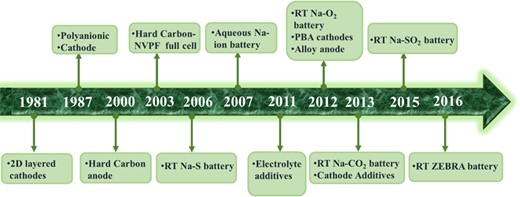
Materials development for SBBs.
In 1980, NaMeO2 (Me=Ni, Co, Fe, etc.)-based compounds were developed by Delmas’s group [26, 27]. Soon after, transition metal-based layered compounds were developed by Goodenough’s group with groundbreaking properties [28]. Also, spinel LiMn2O4 with Li insertion and extraction properties is reported. In 1987, phosphate-based polyanionic cathode (NaTi2(PO4)3) was first developed by Delmas’s group with sodium intercalation properties [29]. Intercalation of two Na atoms can be observed, but polarization was also high due to the low electronic conductivity of NaTi2(PO4)3.
Generally, SIB cathodes are classified into oxide-based, polyanion-based (e.g. sulfates, oxalates, phosphates, etc.) and Prussian blue compounds. Based on the atomic arrangements and coordination of Na+, layered transition metal oxides (TMOs) cathodes are categorized as O and P types. Oxide-based cathodes display higher capacity than polyanion-based cathodes; however, they show poor stability. On the other hand, polyanion-based cathodes display long stability with higher working voltages due to the inductive effect and presence of strong covalent bonds giving rise to stable frameworks. Mostly, materials based on sulfates, phosphates, borates, silicates belongs to polyanion types with a strong X–O covalent bond (X = S, P, B, Si), significantly avoiding oxygen evolution. This is the reason polyanions show better stability than oxide-based cathodes [30]. Recently, the mixed polyanionic combination of oxalate- and phosphates-based Na2Fe(C2O4)(HPO4) cathode demonstrated a higher potential of 3.1 V for SIB with 104 mAhg−1 capacity. During cycling, the cathode displays Fe2+/Fe3+ redox reactions with no crystallographic changes, which benefits more extended stability [31]. Atin Pramanik et al. [32] have developed Li-rich perovskite oxalate KLi3Fe(C2O4)3 (KLFC) cathode, which delivers a specific capacity of 99 mAhg−1 at 5 mAg−1 in 1.7–4.3 V versus Na+/Na. In recent years, F-based polyoxyanionic cathodes are coming into the picture, showing a more substantial iconicity for the transition metal–F bond than the transition metal–O bond [33].
In the case of oxide-based cathodes for SIB, the P2-type cathode shows lesser initial capacity than the O3-type due to the limited storage of Na content. The detachment of Na+ during the charging–discharging process of P2 phase material gives rise to O2 phase material. The process is irreversible, which leads to capacity fading with performance deterioration. In general, O3- and P2-type cathodes are the most widely studied. The cathode’s multi-phase concept is gradually attracting researchers’ attention to club the advantages of each phase to improve the cathode’s electrochemical performance.
On the anode side, to counter the safety issues of the metallic anode, the development of carbonaceous anode materials gained interest. These anodes could be commercialized for LIBs but not SIBs due to the small d-spacing of carbon and the large size of Na+ than Li+. For the intercalation of Na+, an expanded graphitic structure is required. In 2000, HC (nongraphitic carbon) [8], which is an intercalation-based anode for SIBs, was first developed by Stevens and Dahn [34] from glucose precursor with a reversible capacity of 300 mAhg−1. The famous house of card model for carbon structure is also proposed in this study (Fig. 2a). In 2003, Barker et al. reported the first viable Na-ion full cell using HC anode and NaVPO4F as a cathode in 1 M NaClO4 in EC/DEMC electrolyte [35]. The reversible Na insertion/extraction behavior is observed due to the V3+/V4+ redox couple with a theoretical capacity of 143 mAhg−1. In 2006, a room-temperature solid-state Na–S battery was first reported by Park et al. [36] using PVDF gel electrolyte with TEGDME solvent and NaCF3SO3 salt. PVDF was used due to its higher sodium-ion conductivity than PEO at room temperature. These battery systems have a high theoretical energy density of 954 Whkg−1. The first discharge capacity was 489 mAhg−1 with two voltage plateaus at 2.28 and 1.28 V. In 2007, an aqueous rechargeable alkali ion battery was first reported by Wu’s group using LiCoO2 as cathode and LiV3O8 as an anode in working voltage between 0.5 and 1.5V [37] as shown in Fig. 2b. It uses nonpoisonous material, nonflammable electrolytes and stable electrode systems in a saturated aqueous LiNO3 solution. In 2011, for the first time, fluoroethylene carbonate (FEC) electrolyte additive was reported by Komaba et al. [38] in NaNi1/2Mn1/2O2 and HC full cell. FEC electrolyte showed an additional decomposition peak at 0.7 V in the first reduction cycle (Fig. 3). Adding 2 vol % of FEC to propylene carbonate electrolyte is shown to improve capacity retention. However, difluoroethylene carbonate (DFEC) and ethylene sulfite (ES) addition cause a detrimental effect on cell performance. In 2012, high-capacity alloying anodes such as SnSb-C, Sn and Sb were reported for SIB. SnSb-C nanocomposite showed a first discharge capacity of 754 mAhg−1 with coulombic efficiency (CE) of 75%. Sb anode showed a capacity of 600 mAhg−1, close to the theoretical capacity with a CE of 98% [39–41].


The effect of FEC additive on the electrolyte. Adapted with permission from Ohsawa et al. Copyright 2011 American Chemical Society [38].
Key components of SIB
At present, considering the available battery chemistries, SIB has the potential to work as an alternative energy storage device to LIB. The essential components of any battery are the anode, cathode, electrolyte and separator to separate the anode and cathode. Unlike LIB, the commercialized graphite cannot be used as an anode in SIB due to the larger size of Na+. Though HC has a lesser capacity, it is an appealing anode for SIB owing to simple and cost-effective synthesis, long-term stability and smooth electrochemistry compared to the sluggish kinetics of other oxides, sulfide-based anodes [42]. The storage mechanism of HC is categorized into different models such as insertion–adsorption, adsorption–insertion, adsorption–pore filling and adsorption–insertion–pore filling; however, it still needs deeper investigation [43]. The capacity of HC can be further improved by heteroatom doping, microstructural modification and graphitization methods. HC currently shows potential for application as a mainstay anode in full-cell SIB but still needs more optimization. On the other hand, the most common cathodes for SIB are oxides, phosphates and Prussian blue analogs (PBAs) [44–46]. The electrolytes play a crucial role in determining the electrochemical performance of the battery. Generally, SIB electrolytes are divided into two classes, aqueous electrolytes, which show higher ionic conductivity and are safer in terms of risk of explosion. However, the lower potential window is an obstacle to its development. Another class of electrolytes is organic based, which is presently in use where sodium salt is dissolved in one or a combination of organic solvents [47, 48]. Furthermore, separators electronically separate the anode and cathode, and ionically Na conducting. Generally, glass microfibers or polypropylene/polyethylene are commercialized separators under Whatman and Celgard.
Commercialization journey of SBB
SBB has revived interest due to increasing interest in clean energy transition and the scarcity of Li sources. Different anode and cathode chemistries used by companies are presented in Fig. 4. In 2009, the first aqueous Na-ion battery was launched by Aquion Energy, a US spin-off company. MnO2 cathode, NaTi2(PO4)3 anode, NaClO4 electrolyte and synthetic cotton separator were used. In 2011, UK-based Company, Faradion Limited was founded to develop SIB using HC anode, and oxide-based cathodes with the possibility of transportation in a 0 V discharged state. They claimed 150 Whkg−1 energy density for pouch cells and applicability in two-wheeler applications. Though the energy density is lesser than that of LIB, charge storage and transportation of battery at zero volt is possible with SIB. This is because a copper current collector is used in the case of anode for LIB, which oxidizes and dissolves at zero volt. On the other hand, an aluminum current collector is used in the case of SIB, which is oxidation resistive at zero volt. This provides an opportunity to store the charges at zero volt and can easily be transported at zero volt without any safety hazards [49]. Faradion claimed in their patent that the other SBB energy storage devices could transport at zero volt when it contains at least one or more SIB cells with a potential in the range of −0.1 to 1 V.
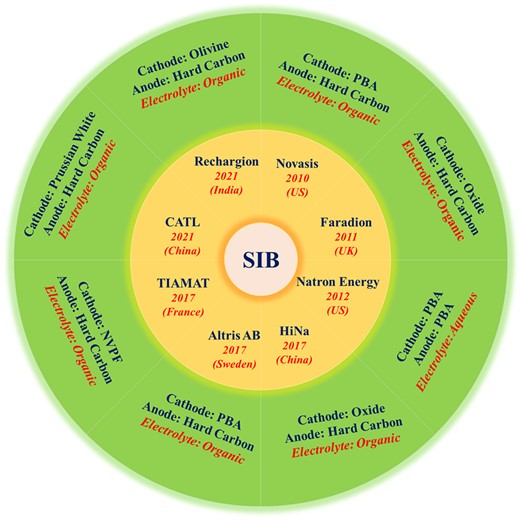
Commercialization of different SIB battery chemistries by various companies.
In 2012, Natron Energy (Stanford’s spin-off) was founded to develop SIB using PBA-based electrodes with nontoxic and earth-abundant materials. It uses a PBA electrode with an aqueous electrolyte for SIB fabrication. After several years of research, in 2015, Faradion’s prototype electric bicycle based on SIB was launched with a 418 Wh battery pack. In 2017, SIB research skyrocketed, with battery companies like HiNa, Altris and TIAMAT coming into the market. HiNa uses an oxide cathode and an HC anode. Altris uses a PBA cathode and an HC anode. In 2021, CATL launched its first-generation SIB. It uses a PBA cathode and porous HC anode. In the same year, Rechargion Energy Pvt. Ltd, an Indian start-up, began commercial SIB development.
Commercialized full-cell technologies
HC‖Oxide
Oxide-based cathode materials provide the highest capacity and working voltage [15]. Co-based cathode used in LIB poses cost and toxicity problems [50]. In SIB, O3-type materials show high capacity, and P2-type materials show high cell voltage [51, 52].
Initially, Faradion used O3-type Na0.950Ni0.317Mn0.317Mg0.158Ti0.208O2-based cathode with a theoretical capacity of 164 mAhg−1 [53, 54] (Fig. 5). Later mixed-phase O3- and P2-type materials were used with a capacity of 156 mAhg−1 at a 0.2 C rate. High tap density is also desirable for high energy density batteries. Mixed-phase cathode material showed 33% higher tap density than only O3-type cathode by adjusting the morphology. To synthesize the HC anode, a precursor with low hydrogen and carbon content is preferred, resulting in higher tap density. Tailored carbon with the reduced surface functional group provided the capacity of 330 mAhg−1 at a 0.2 C rate, and in full cell, 134 mAhg−1 capacity is obtained with 90% of the CE [54].

(a) Charge–discharge and (b) stability of O3-type cathode and HC full cell of Faradion. Adapted with permission from Barker et al. Copyright 2013 Royal Society of Chemistry [54].
Faradion has successfully produced 50 kWh of SIB prototype [55]. HiNa is using NaxCu1-y-zFeyMnzO2 oxide cathode and reported an energy density of 135 Wh kg−1 over 3000 cycles at a 3 C rate. The format of the battery is a pouch and 18 650 cylindrical cells. HiNa has successfully produced over 10 000 of 100 kWh SIB prototypes [55].
HC‖polyanionic cathode
Open-framework structures are interesting cathode materials due to the availability of open channels for Na diffusion [56, 57]. Sodium vanadium fluorophosphate (NVPF) is one such example of a polyanionic cathode that exhibits a theoretical capacity of 128 mAhg−1 and an energy density of 507 Wh kg−1. TIAMAT has commercialized NVPF cathode material with HC anode giving an energy density of 122 Wh kg−1 at a 1 C rate (Fig. 6) [56, 58]. Rechargion Energy has also developed prototype pouch cells with NVPF cathode and proprietary HC anode with ongoing innovations on electrodes and electrolytes.


HC‖PBA
Considering the low-cost factor of SIB, Fe-based Prussian blue (Fe[Fe(CN)6]·nH2O) analogs are an interesting candidate as cathode material. Prussian white NaxFe[Fe(CN)6]y·nH2O](M = Mn, Fe) is commercially attractive due to its high theoretical capacity of 170 mAhg−1 and flat operating potential of 3.6 V [59–61]. However, complicated synthesis, reproducibility and high crystal water content are shortcomings of PBAs. HC‖‖PBA full cell of Novasis exhibited 98.6% capacity retention after 500 cycles at ambient temperature (Fig. 7) [62, 63]. PBAs can provide an energy density of 136 Wh kg−1 in the full cells. Altris and Novasis energies use HC‖‖PBA full-cell chemistry.

Novasis pouch cell (a) cycling performance and (b) rate performance at room temperature Adapted with permission from Lu et al. Copyright 2018 WILEY‐VCH [62].

During the development of cathode materials at Novasis, initially, NaxMnFe(CN)6 (NMFC) showed 68 mAh g−1 capacity. After accommodating the second Na+ ion through structural rearrangement, the capacity could be increased to 134 mAh g−1. Finally, after optimization, 160 mAh g−1 capacity could be achieved. In the final optimized structure, maximum Na+ ions can be accommodated, so Na-free untreated anode can be utilized in full cell, saving the extra cost and processing step to compensate for Na loss in initial cycles [62, 64].
PBA‖PBA
PBA analogs have faster Na+ ion conduction due to open-channel structure. By tuning the transition metal in the PBA system, its electrochemical redox potential can be tuned and it can be used either as a positive electrode or negative electrode in the SIB system [65–68]. PBAs use sustainable and nontoxic transition metals, but the presence of crystal water is problematic for large-scale applicability (Fig. 8). Heat treatment can remove water, but structural distortion after heating reduces the battery cycle life [69]. Its practical application is shown by Natron energy by using hexacyanoferrate as a cathode and hexacyanomanganate as an anode in the full cell.

(a) Charge–discharge of R-Na2-δMnHCF/Na half-cell, HC/R-Na2-δMnHCF full cell and HC/Na half-cell and (b) charge and discharge and stability (inset) curves of a HC/NaxMnHCF full cell. Adapted with permission from Goodenough et al. Copyright 2015 American Chemical Society [69].

Recently, Natron Energy introduced its product called Blue Rack for stationary storage powered by Blue pack, which is PBA chemistry-based SIB technology. It has features like 500 kW of power, fast charging in 15 min, a wide operating temperature range (−30°C to +50°C), >97% round-trip efficiency and over 50 000 cycle life which is 25 times greater than lithium-ion-based competitors. Compared to Li-ion and lead-acid technology, the Natron Blue Rack technology can produce 40 W/Wh power per energy (10 W for Li-ion and 7 W for lead acid). The Blue Rack cabinet is the world’s first SIB designed for critical applications like UPS data centers and industrial power environments. The Natrons’s Blue Rack batteries claimed to have the longest life, industrial highest power and safest battery. A comparison of the energy density of different commercialized anode and cathode for LIB and SIB chemistries is shown in Fig. 9.
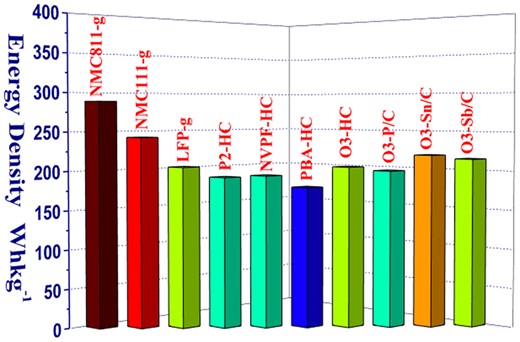
Comparison of the energy density of different anode and cathode LIB and SIB chemistries.

Emerging technologies
Organic materials-based anodes
The state-of-the-art graphite anode from the LIB is unsuitable for SIB due to the larger size of Na+ ions. The organic materials, for example molecules with azo, carboxylates and amines group, show improved capacity with lower insertion voltage for Na+ ions [70, 71]. In this regard, metal-organic framework (MOF) and covalent-organic framework (COF) are emerging in various fields like gas adsorption, catalysis, drug delivery, energy storage devices, etc. [72–75]. MOF and COF materials possess flexible tunable structures, porosity and large surface area. The freedom of modifiable structure ability of these materials provides an opportunity to design the electrode material depending on the battery chemistry. Recently, a sodium naphthalene-2,6-dicarboxylate (Na-NDC) anode was developed using microwave-assisted synthesis by Desai et al. The Na-NDC has shown 250 mAhg−1 capacity at 25 mA g−1 with 400 cycles stability. The synthesis route can be expandable to other sodium carboxylates [76]. Additionally, N-doped porous, integrated carbon structure prepared from the carbonization of 1,3,5-tris(4-aminophenyl)benzene and terephthalaldehyde COF have shown stable performance as SIB anode with 303 mAhg−1 reversible capacity at 100 mAg−1 current density [77]. These MOF- and COF-based materials arise as a new class of electrode materials in SIB due to the well-defined porosity and structure-modifiable property with redox active sites.
Na-compensation additives
First-cycle capacity is depleted in SEI and cathode–electrolyte interphase (CEI) formation, which consumes Na+ ions irreversibly. Several additives have been effectively researched as Na-compensation agents in electrodes and electrolytes. Additive works in a battery working voltage window and provides Na+ ions by oxidative decomposition with irreversible electrochemical performance. In this line, Sodium biphenyl (Na-Bp) has been reported as a Na additive in dimethoxyethane, as shown in Fig. 10a. The full cell of the NVP cathode and NaxHC anode provided an energy density of 218 Wh kg−1 at a 2 C rate [11, 78]. Another study reported Naph-Na in tetrahydrofuran and spraying on the anode. The full cell is fabricated using an HC anode with Na0.9[Cu0.22Fe0.30Mn0.48]O2 cathode, and it delivered a reversible capacity of 127 mAh g−1 [13].

(a) Scalable roll-to-roll process for manufacturing. Adapted with permission from Li et al. Copyright 2019 The Royal Society of Chemistry [78]. (b) CEI layers on the NFMO electrode surfaces without additive and with Na2CO3 and NaF additive. Adapted with permission from Chung et al. Copyright 2021 the Authors [80]. (c) Cyclic stability of NFMO without additive and with NFMO-NC and NFMO-NF. Adapted with permission from Chung et al. Copyright 2021 the Authors [80].

Na2CO3 additive to the P2-NaxMO2 phase is reported by Mariyappan Sathiya et al., which provided Na+ ions and stabilized the P2-phase [79]. Two major inorganic components of SEI and CEI are Na2CO3 and NaF. Dissolving these additives in the electrolyte could improve the stability of the electrode–electrolyte interface and electrode materials. P2-Na0.67Fe0.5Mn0.5O2 (NFMO) shows a discharge capacity of 186, 197 and 196 mAh g−1 in additive-free, NFMO–Na2CO3 and NFMO–NaF electrolytes, respectively [80] (Fig. 10b and c). Moreover, SbF3 has also been studied in the electrolyte, which leads to the formation of biphasic SEI consisting of Na–Sb alloy and NaF layers. The bilayer SEI suppressed dendritic formation and provided fast ion transport [81]. Na-compensation additives without side reactions and gas evolution hold promise in the future development of SIB technology.
Recently, many self-sacrificial Na additives are explored (e.g. Na2CO3, NaN3, Na3P, Na2C4O4, etc.) [82–84]. Na3P shows higher capacity, but the challenge is moisture sensitivity, making it difficult for synthesis and storage [83]. In the case of Na2CO3, which shows 505 mAhg−1 high theoretical capacity, it provides 90 mAhg−1 capacity as actual decomposition [83]. Na2C4O4 shows a lower capacity of 205 mAhg−1 but is superior in cost and environmental safety [84]. Hence, selecting the perfect self-sacrificial Na additives that can provide high capacity utilization, is nontoxic, low cost and shows chemical and thermal stability is still challenging. This needs extensive studies to be performed in order to come up with the perfect self-sacrificial Na salts.
Solid-state SBBs
To address the safety issues of flammable liquid batteries, solid-state batteries are advantageous due to their high thermal stability and wider electrochemical window. NASICON Na3Zr2Si2PO12 (NZSP) solid electrolyte (SE) has been used with an NVP cathode. NVP‖‖ Na3Zr2Si2PO12‖‖Na cell delivers a capacity of 106.9 mA h g−1 and 50 mA h g−1 at 0.1 C and 1 C, respectively [85].
The interfacial resistance is the main hurdle toward achieving the full potential of SSB due to poor contact between Na metal and SE. In another study by Yang et al., SSB battery is reported using NaTi2(PO4)3(NTP), NVP materials and NZSP SE. By introducing SnOx/Sn thin film using magnetron sputtering between Na metal and SE, interfacial resistance is drastically decreased to 3 from 581 Ω cm2. The NTP/SnOx/Sn-NZSP/Na SSB delivered a capacity of 87.4 mAh g−1 after 100 cycles. The first discharge capacities are 93.1 and 103.1 mAh g−1 for NVP/NZSP/Na and NVP/SnOx/Sn-NZSP/Na full cells, respectively, as shown in Fig. 11a. The discharge capacity after 100 cycles is 100 mAh g−1 at 1 C. The alloying reaction between Na metal and Sn leads to the formation of a stable interface and increases cell performance [86]. Manthiram’s group reported laminated PEO–SN–NaClO4/PAN–Na3Zr2Si2PO12–NaClO4 SE, which provided 1.36 × 10⁻⁴ S cm−1 Na+-ion conductivity and stable voltage window of 0–4.8V. The full cell is fabricated with Na2MnFe(CN)6 cathode and Na metal anode. The reported capacity is 110 mAhg−1 at 0.2 C, as shown in Fig. 11b [87]. The ceramic/polymer composite SE shows characteristics of both polymer and inorganic electrolytes, such as flexibility, good interface compatibility and high modulus and conductivity, addressing the shortcomings of individual SE systems. Inorganic–polymer composite electrolytes will be the promising future of SSB research and commercialization.

(a) Cyclic stability comparison of NVP/NZSP/Na and NVP/SnOx/Sn-NZSP/Na full cells at 1 C. Adapted with permission from Janek et al. Copyright 2020 American Chemical Society [86] and (b) stability of Na‖‖PEO–SN–NaClO4/PAN–Na3Zr2Si2PO12–NaClO4 ‖‖ PB cell. Manthiram et al. Copyright 2020 WILEY‐VCH [87].

Cationic and anionic redox chemistry for cathodes
Na-TMOs as cathodes provide higher specific capacity. However, the cation redox reactions of TMOs lower the energy density of Na-TMOs-based SIB because of capacity fading. In this regard, a new emerging solution of the utilization of anion and cation redox couples to the cathode materials can enhance the capacity of cathode materials. Along with cation redox in TMOs, an O2−/n− anion redox can add extra capacity value to the cathode [88]. However, in the case of Na-rich TMOs cathodes, this O2−/n− can degrade the performance due to the formation of the Na–O–Na bond with Na+ occupancy in transition metal layers. The oxygen anions are released during the desodiation of Na+ from the transition metal layers, which further contribute to the O2 evolution giving rise to the capacity fading with poor reversibility and structural collapse. On the other hand, cation redox-active couples maintain the reversibility of the oxide structure during cycling. In this contribution, Ti-substituted Na4/7[□1/7Ti1/7Mn5/7]O2 (□ is transition metal vacancy) cathode has shown the improved capacity of 167 mAh g−1 at 10 mA g−1 current density with enhanced stability due to the stabilization of oxygen 2p orbitals by Ti4+ substitution [88]. Doping of Mg2+ to the Na0.67Fe0.5Mn0.5O2-layered cathode provides the reversibility of Fe3+/Fe4+ redox couple. This inhibits the irreversible migration of Fe and thereby avoids capacity fading of the cathode [89]. The anion redox reactions can be deeply studied by advanced characterization tools where one can thoroughly understand the stability of O2 2p orbitals to help improve the capacity and cathode stability.
Conclusion and future outlook
SBBs are a very appropriate pick as an alternative to LIBs mainly due to their cost–effectiveness and high-rate capability. Progress and development of HC anodes, Na-compensation methods in SEI formation, O3-type mixed-metal oxide cathode, cathode and electrolyte additives, and parameters affecting full-cell performance have hastened the development and commercialization of SIBs. Several companies have been founded to develop full-cell chemistry and prototype for the commercialization of SBBs, such as Novasis energies, Faradion, Natron Energy, Rechargion Energy, HiNa, Altris, TIAMAT, AGM, CATL, etc.
In Na-based batteries, currently, Na–S and Na–NiCl2 batteries are commercially manufactured and supplied for grid-scale energy storage due to deep discharge time and long cycle life. High energy density SBBs chemistries such as Na–S, Na–O2 and Na–CO2 show better performance at the research level. However, its practical utilization at commercial levels is forbidden due to metallic sodium’s presence. There are many works focused on sodium metal anode. Still, it needs a long way to go to a practical level concerning the safety issues that arise from metallic sodium. Nevertheless, fast-paced research and development toward reduction of cost, increment of energy density and materials sustainability of SIBs will lead to the commercialization of SIBs for grid-scale storage as well as electric mobility in the near future. Due to their inherent safer chemistry, SIB can be transported in a zero charge state, decreasing the critical safety mitigation measures and transportation costs.
Acknowledgements
The authors acknowledge the funding support from Technovuus, the Automotive Research Association of India (ARAI) and Department of Heavy Industries, Government of India.
Authors’ contributions
Poonam Yadav (Conceptualization [equal], Methodology [equal], Writing—original draft [lead], Writing—review and editing [equal]), Vilas Shelke (Conceptualization [supporting], Supervision [equal], Writing—review and editing [supporting]), Apurva Patrike (Writing—review and editing [supporting]) and Manjusha Shelke (Conceptualization [equal], Supervision [equal], Writing—review and editing [equal]). The manuscript was conceptualized and written through the contributions of all authors. All authors have approved the final version of the manuscript.
Funding
This research was funded by Technovuus, Automotive Research Association of India.
Conflict of interest statement. None declared
Data availability
The data underlying this article were provided by [third party] under licence / by permission. Data will be shared on request to the corresponding author with permission of [third party]. The data underlying this article will be shared on reasonable request to the corresponding author.
References
Research and Markets world's lagest market research store. https://www.researchandmarkets.com/reports/5659602 (12 November 2022, date last accessed).