 https://orcid.org/0000-0001-8914-2897
Abstract
NHS-IL12 is a first-in-class, recombinant fusion protein composed of the human monoclonal antibody NHS76 (binds exposed DNA/histones at sites of intratumoral necrosis) fused to 2 IL-12 heterodimers. The maximum tolerated dose (MTD) and recommended phase II dose (RP2D) of NHS-IL12 monotherapy given subcutaneously (SC) every 4 weeks was previously reported. The study was expanded to include a high-exposure cohort with NHS-IL12 SC every 2 weeks (q2w).
This single-arm, phase I trial evaluated NHS-IL12 12 µg/kg SC q2w or 16.8µg/kg SC q2w in patients with metastatic solid tumors. The primary endpoint was safety.
Using a 3+3 design, 13 patients with advanced cancer were enrolled and 12 were dose-limiting toxicity (DLT) evaluable. There was 1 DLT (Grade 3 aspartate transaminase/alanine transaminase [AST/ALT] elevation). Other grade 3 toxicities included: flu-like symptoms 1/13 (8%), decreased absolute lymphocyte count (ALC) 1/13 (8%), decreased white blood cell count (WBC) 1/13 (8%), but most adverse events reported were low grade and self-limiting grade. Fifty percent of evaluable patients (6/12) experienced stable disease (SD) with 42% (5/12) developing progressive disease (PD) at the first restaging.
Biweekly NHS-IL12 was well tolerated in this small phase I study. Additional studies incorporating NHS-IL12 with other immunomodulating agents are underway. (ClinicalTrials.gov Identifier: NCT01417546).
NHS-IL12 can be safely administered every 2 weeks in patients with solid tumors.
Low grade lymphopenia, fever, flu-like symptoms, and transaminitis are common with the use of NHS-IL12 on a biweekly schedule.
NHS-IL12 monotherapy had modest activity in advanced solid tumors with stable disease in 50%.
Discussion
Interleukin 12 (IL-12) is produced by activated phagocytes and dendritic cells (DCs) and is critical to regulating the transition from innate to adaptive immunity. IL-12 directly acts on DCs to enhance antigen presentation and produce more IL-12,1 and stimulates cytotoxic activity through activating natural killer (NK) cells, NKT, and CD8+ T cells.2-4 Furthermore, IL-12 drives differentiation of helper T cells toward a Th1 phenotype, in turn promoting cytokine production, including interferon-γ (IFN-γ).5-8 Prior clinical evaluation of systemic recombinant IL-12 (rIL-12) in patients with advanced renal cell cancer or melanoma yielded significant safety concerns with the majority of trial patients (n = 12 of 17) requiring hospitalization.6 These prominent safety concerns led to the evaluation of different routes of administration and dosing intervals; however, toxicity concerns have persisted.9-11
NHS-IL12 is a novel immunocytokine with 2 IL-12 molecules fused to NHS76, a human IgG1 monoclonal antibody which recognizes DNA/histone complexes exposed within necrotic tumor. We previously reported the phase I trial of monthly NHS-IL12 (NCT01417546), which demonstrated that NHS-IL12 had an acceptable safety profile with low grade, self-limited treatment-related adverse events (TRAEs) including lymphopenia, flu-like symptoms and low-grade liver transaminases elevation.12 Pharmacokinetic and pharmacodynamic monitoring of NHS-IL12 and subsequent cytokine analysis revealed a time-dependent rise in IFN-γ followed by a subsequent rise in IP-10, TNF-α, and counterregulatory cytokines, such as IL-10. The cytokine response peaked 36 hours after initial dosing and normalized close to the patients’ baselines between day 8 and day 15 post-treatment.12 Based on these kinetics, the NHS-IL12 phase I trial was expanded to include a biweekly high exposure cohort where patients with advanced cancers received NHS-IL12 every 2 weeks at the recommended phase II dose (Table 1).
Trial details
| Type of study | Phase I, 3+3 |
| Agent of study | NHS-IL12 |
| Dose levels | 12 µg/kg (DL7) or 16.8 µg/kg (DL8) |
| Dosing route and interval | Subcutaneously every 2 weeks |
| Primary endpoint | Dose-limited toxicities |
| Exploratory endpoints | Tumoral response, biochemical changes, immune changes |
| Stage | Advanced or metastatic |
| Age | Median (range): 59 (35-79) years |
| Number of patients | 7 (male), 6 (female) |
| Number of prior systemic therapies | Median (range): 2 (1-6) |
| Cancer types | Prostate cancer (n = 5), colorectal cancer (n = 3), cervical cancer (n = 3), vaginal cancer (n = 1), and pancreatic cancer (n = 1) |
Among the first 3 evaluable patients in DL7, there was one dose-limiting toxicity (DLT; grade 3 alanine aminotransferase [ALT] and aspartate aminotransferase [AST] elevation) after the first dose of NHS-IL12. Therefore, DL7 was expanded to 7 patients, of whom 6 were evaluable for DLTs (1 withdraw due to grade 2 flu-like symptoms prior to the end of the DLT period) and 6 patients enrolled to DL8. No additional DLTs were observed in DL7 or DL8. Treatment-related adverse events (TRAEs) were consistent with the known effects of NHS-IL12, including predominantly grade 1-2 elevations in ALT (n = 6; 46%) and flu-like symptoms (n = 6; 46%), as well as decreased lymphocyte count, fever, and elevated AST. There were no grade 4 or 5 TRAEs. Tumor response was assessed at 8 weeks. Six patients had stable disease (SD), while 5 others had progressive disease (PD).
NHS-IL12 monotherapy dosed every 2 weeks was well tolerated but had limited activity in metastatic or advanced malignancies. NHS-IL12 combination studies are needed.
| Trial Information | |
|---|---|
| Disease | Malignant epithelial and mesenchymal tumors/neoplasms |
| Stage of disease/treatment | Metastatic/unresectable locally advanced |
| Prior therapy | At least 1 prior therapy (adjuvant or metastatic setting) or not a candidate for therapy of proven efficacy for their disease due to an underlying physical condition. No limit |
| Type of study | Phase I, 3+3 |
| Primary endpoint | Dose-limiting toxicities (DLTs) |
| Secondary endpoints | N/A |
| Exploratory endpoints | Tumoral response, biochemical changes, immune changes |
| Investigator’s analysis | Study completed. Drug is tolerable, evidence of immunologic activity, but indeterminant clinical activity |
| Drug Information | |
|---|---|
| Generic/working name | NHS-IL12 |
| Company name | EMD Serono |
| Drug type | Biological |
| Drug class | Immunocytokine |
| Dose | 12 and 16.8 |
| Unit | µg/kg |
| Route | Subcutaneous |
| Schedule of administration | Every 14 days |
| Drug Information | |
|---|---|
| Generic/working name | NHS-IL12 |
| Company name | EMD Serono |
| Drug type | Biological |
| Drug class | Immunocytokine |
| Dose | 12 and 16.8 |
| Unit | µg/kg |
| Route | Subcutaneous |
| Schedule of administration | Every 14 days |
| Drug Information | |
|---|---|
| Generic/working name | NHS-IL12 |
| Company name | EMD Serono |
| Drug type | Biological |
| Drug class | Immunocytokine |
| Dose | 12 and 16.8 |
| Unit | µg/kg |
| Route | Subcutaneous |
| Schedule of administration | Every 14 days |
| Drug Information | |
|---|---|
| Generic/working name | NHS-IL12 |
| Company name | EMD Serono |
| Drug type | Biological |
| Drug class | Immunocytokine |
| Dose | 12 and 16.8 |
| Unit | µg/kg |
| Route | Subcutaneous |
| Schedule of administration | Every 14 days |
| Patient Characteristics | |
|---|---|
| Number of patients, male | 7 |
| Number of patients, female | 6 |
| Stage | Advanced or metastatic |
| Age: median (range) | Median (range): 59 (35-79) years |
| Number of prior systemic therapies: median (range) | Median (range): 2 (1-6) |
| Performance status: ECOG | 0: 7 1: 6 2: 0 3: 0 4: 0 |
| Cancer types or histologic subtypes | prostate cancer: n = 5; colorectal cancer, n = 3; cervical cancer, n = 3; vaginal cancer, n = 1; pancreatic cancer, n = 1 |
| Primary Assessment Method | |
|---|---|
| Number of patients screened | 13 |
| Number of patients enrolled | 13 |
| Number of patients evaluable for toxicity | 13 |
| Number of patients evaluated for efficacy | 11 |
| Evaluation method | NCI Common Terminology Criteria for Adverse Events v4.0 |
| Response assessment, complete response | 0 (0%) |
| Response assessment, partial response | 0 (0%) |
| Response assessment, stable disease | 6 (50%), DL7 = 4; DL8 = 2 |
| Response assessment, progressive disease | 5 (42%), DL7 = 1; DL8 = 4 |
| Response assessment, not evaluable | 1 (8%), DL7-1 |
Assessment, Analysis, and Discussion
| Completion | Study completed |
|---|---|
| Investigator’s assessment | Drug is tolerable, evidence of immunologic activity, but indeterminant clinical activity. |
| Completion | Study completed |
|---|---|
| Investigator’s assessment | Drug is tolerable, evidence of immunologic activity, but indeterminant clinical activity. |
| Completion | Study completed |
|---|---|
| Investigator’s assessment | Drug is tolerable, evidence of immunologic activity, but indeterminant clinical activity. |
| Completion | Study completed |
|---|---|
| Investigator’s assessment | Drug is tolerable, evidence of immunologic activity, but indeterminant clinical activity. |
Preclinical studies comparing NHS-IL12 and rIL-12 demonstrated enhanced tumor-targeting affinity and extended plasma half-life of NHS-IL12 as well as improved proliferation and activation of splenic lymphocytes, antigen-presenting cells, and tumor-infiltrating lymphocytes.13,14 Unlike rIL-12, the initial clinical experience with NHS-IL12 has demonstrated a reassuring safety profile.12 Early studies with rIL-12 resulted in significant high grade toxicity with several patient hospitalizations for excessive grade ≥3 toxicity: leukopenia, 65%; hyperbilirubinemia, 47%; elevated AST, 47%; elevated ALT, 35%; fatigue, 35%.6 The phase I clinical trial with NHS-IL12 reported a much lower rate of grade 3 TRAEs (20.3%), with one grade 4 TRAE (lymphopenia). In this trial, the maximum tolerated dose of NHS-IL12 was 16.8 µg/kg SC every 4 weeks. NHS-IL12 resulted in a time-dependent rise in IFN-γ and IL-10,12 which led to expanding this high-exposure cohort where dosing frequency was increased to every 2 weeks (q2w). The primary endpoint was safety, with additional exploratory endpoints: tumor response, biochemical and immune subset changes.
Eligible subjects had histologically or cytologically verified metastatic or locally advanced solid epithelial or mesenchymal tumors which were measurable per RECISTv1.1 or evaluable. All completed, or progressed on, at least one prior therapy, or were not candidates for therapy of proven efficacy. Subjects were ≥18 years old, with ECOG performance status of ≤2, and adequate bone marrow, hepatic, and renal function. Patients with known autoimmune disease or defect, brain metastases, prior rIL-12 therapy, or clinically significant cardiovascular disease were excluded. All subjects gave written informed consent. Study protocol (NCT01417546) was approved by the NIH’s IRB, and conducted in accordance with institutional and federal guidelines.
Using a 3+3 design, 13 patients with advanced cancers received NHS-IL12 SC q2w, at 2 dose levels (DL): 12 µg/kg (DL7, n = 7) or 16.8 µg/kg (DL8, n = 6) between February 13, 2018, to October 6, 2020. Data cutoff date for analysis was June 30, 2021. All patients were monitored for DLTs 28 days after the first dose of NHS-IL12. TRAEs were graded according to NCI CTCAE v4.0. Computed tomography (CT) of the abdomen and the pelvis and bone scans were performed at baseline, and every 8 weeks. For patients with non-measurable, but evaluable disease, tumor markers (eg, PSA) were monitored for response. Immune cell subtype and cytokine analysis were measured prior to dosing on day 1 as well as prior to dosing on days 15, 29, 43 and at restaging.
Median age was 59 years (range 35 to 79), with a median of 2 prior therapies (range 1 to 6). The majority of patients had prostate cancer (n = 5; 41.6%), colorectal cancer (n = 3; 25%), or cervical cancer (n = 3; 25%).
Among the first 3 evaluable patients in DL7, there was one DLT (grade 3 AST/ALT elevation after the first dose of NHS-IL12). Subsequently, DL7 was expanded to 7 patients, of which 6 were evaluable for DLTs (1 withdrew due to grade 2 flu-like symptoms prior to the end of the DLT period) and 6 patients enrolled to DL8. No additional DLTs were observed in DL7 or DL8.
Patients received a median of 4 doses (range: 1 to 16) of NHS-IL12. TRAEs were consistent with known effects of NHS-IL12, with predominantly grades 1-2 elevations in ALT (n = 6; 46%) and flu-like symptoms (n = 6; 46%) as well as lymphopenia, fever, and elevated AST. Dosing NHS-IL12 q2w did not increase high grade TRAEs. Furthermore, there was no increased toxicity in 2 patients who received multiple doses at 12 µg/kg q2w NHS-IL12 for 11 and 12 doses, respectively, highlighting the safety of multiple sequential doses. Of note, the patient who withdrew due to flu-like symptoms subsequently developed a grade 2 wound dehiscence of an existing slow healing wound outside of the DLT window.
Tumor response was assessed at 8 weeks with CT if measurable or tumor markers if evaluable. Six patients had stable disease (SD), while 5 had progressive disease (PD). There were no partial or complete responses to NHS-IL12 monotherapy q2w. However, several patients with PD at the start of the initial trial with q4w dosing exhibited SD for prolonged periods of time, including one patient on-study for 603 days with SD who only came off study secondary to study closure.
Serum cytokines and peripheral immune subsets were evaluated before and 14 days after the 1st dose (day 14) and 14 days after the 2nd dose (day 28) of NHS-IL12. Cytokines (IFN-γ, IL-10, TNF-α) were evaluated with a custom Meso Scale Discovery V-PLEX Panel (Meso Scale Diagnostics LLC, Rockville, Maryland, USA), and cryopreserved peripheral blood mononuclear cells (PBMCs) were examined by multicolor flow cytometry using 30 markers in 4 panels15 to identify 158 peripheral immune cell subsets16 as previously described.17,18 This assay identified 10 parental cell types and 148 refined subsets indicative of maturation status/function.
We assessed for notable immunologic differences that correlated with best overall response (BOR). Due to the small number of patients enrolled at each DL, this analysis was performed with DLs combined. Patients who developed SD had higher serum levels of IL-12 p70 and lower nonclassical monocytes at baseline than patients who developed PD. After 2 weeks of therapy, a greater increase in immature (CD56br CD16-) NK cells and double-positive NK cells (CD56br CD16+) were noted in patients who developed SD compared to PD. After 4 weeks of therapy, those who developed SD were found to have greater increases in: total CD8+ T cells, central memory (CCR7+ CD45RA-) and effector memory (CCR7- CD45RA-) CD8+ T cells, and immature NK cells (Fig. 1). Details of adverse events and dose-limiting toxicities are shown in Tables 2-5.
Treatment-related adverse events (dose levels combined).
| AEs | NC | G1 | G2 | G3 | G4 | G5 | All |
|---|---|---|---|---|---|---|---|
| Hematologic | |||||||
| Decreased WBC | 10 | 0 | 2 | 1 | 0 | 0 | 3 |
| Neutropenia | 12 | 0 | 0 | 1 | 0 | 0 | 1 |
| Lymphopenia | 8 | 1 | 3 | 1 | 0 | 0 | 5 |
| Systemic symptoms | |||||||
| Fever, non-neutropenic | 8 | 1 | 4 | 0 | 0 | 0 | 5 |
| Fatigue | 10 | 1 | 2 | 0 | 0 | 0 | 3 |
| Malaise | 12 | 1 | 0 | 0 | 0 | 0 | 1 |
| Chills | 10 | 3 | 0 | 0 | 0 | 0 | 3 |
| Flu-like symptoms | 7 | 2 | 3 | 1 | 0 | 0 | 6 |
| Headache | 10 | 2 | 1 | 0 | 0 | 0 | 3 |
| Myalgia | 10 | 3 | 0 | 0 | 0 | 0 | 3 |
| Arthralgia | 11 | 1 | 1 | 0 | 0 | 0 | 2 |
| Hypotension | 12 | 0 | 1 | 0 | 0 | 0 | 1 |
| Allergic reaction | 12 | 0 | 1 | 0 | 0 | 0 | 1 |
| Dizziness | 12 | 1 | 0 | 0 | 0 | 0 | 1 |
| Gastrointestinal | |||||||
| Nausea | 12 | 1 | 0 | 0 | 0 | 0 | 1 |
| Vomiting | 12 | 1 | 0 | 0 | 0 | 0 | 1 |
| Anorexia | 12 | 1 | 0 | 0 | 0 | 0 | 1 |
| Alanine aminotransferase increased | 7 | 4 | 1 | 1 | 0 | 0 | 6 |
| Aspartate aminotransferase increased | 8 | 3 | 1 | 1 | 0 | 0 | 5 |
| Alkaline phosphatase increased | 12 | 1 | 0 | 0 | 0 | 0 | 1 |
| Gastroesophageal reflux disease | 12 | 0 | 1 | 0 | 0 | 0 | 1 |
| Mucositis oral | 11 | 1 | 1 | 0 | 0 | 0 | 2 |
| Cutaneous | |||||||
| Dry skin | 12 | 1 | 0 | 0 | 0 | 0 | 1 |
| Hyperhidrosis | 12 | 0 | 1 | 0 | 0 | 0 | 1 |
| Skin and subcutaneous tissue disorders—Intermittent maculo-papular rash | 12 | 0 | 1 | 0 | 0 | 0 | 1 |
| Wound dehiscence—Perineum, at previous surgical wound site | 12 | 0 | 1 | 0 | 0 | 0 | 1 |
| Lab abnormalities | |||||||
| Hyperkalemia | 12 | 1 | 0 | 0 | 0 | 0 | 1 |
| Localized symptoms | |||||||
| Back pain | 12 | 0 | 1 | 0 | 0 | 0 | 1 |
| Bone pain | 12 | 1 | 0 | 0 | 0 | 0 | 1 |
| Oral pain | 12 | 1 | 0 | 0 | 0 | 0 | 1 |
| Injection site reaction | 9 | 4 | 0 | 0 | 0 | 0 | 4 |
| Localized edema | 12 | 1 | 0 | 0 | 0 | 0 | 1 |
CTCAE version 4 was used.
Abbreviation: NC, no change from baseline.
Treatment-related adverse events (dose level 7), n = 7.
| AEs | NC | G1 | G2 | G3 | G4 | G5 | All |
|---|---|---|---|---|---|---|---|
| Hematologic | |||||||
| Lymphopenia | 4 | 0 | 3 | 0 | 0 | 0 | 3 |
| Systemic symptoms | |||||||
| Fever, non-neutropenic | 6 | 0 | 1 | 0 | 0 | 0 | 1 |
| Fatigue | 6 | 1 | 0 | 0 | 0 | 0 | 1 |
| Malaise | 6 | 1 | 0 | 0 | 0 | 0 | 1 |
| Chills | 6 | 1 | 0 | 0 | 0 | 0 | 1 |
| Flu-like symptoms | 5 | 1 | 2 | 1 | 0 | 0 | 2 |
| Headache | 6 | 1 | 0 | 0 | 0 | 0 | 1 |
| Myalgia | 6 | 1 | 0 | 0 | 0 | 0 | 1 |
| Arthralgia | 5 | 1 | 1 | 0 | 0 | 0 | 2 |
| Hypotension | 6 | 0 | 1 | 0 | 0 | 0 | 1 |
| Gastrointestinal | |||||||
| Alanine aminotransferase increased | 5 | 1 | 0 | 1 | 0 | 0 | 2 |
| Aspartate aminotransferase increased | 6 | 0 | 0 | 1 | 0 | 0 | 1 |
| Alkaline phosphatase increased | 6 | 1 | 0 | 0 | 0 | 0 | 1 |
| Gastroesophageal reflux disease | 6 | 0 | 1 | 0 | 0 | 0 | 1 |
| Cutaneous | |||||||
| Dry skin | 6 | 1 | 0 | 0 | 0 | 0 | 1 |
| Wound dehiscence—perineum, at previous surgical wound site | 6 | 0 | 1 | 0 | 0 | 0 | 1 |
| Localized symptoms | |||||||
| Bone pain | 6 | 1 | 0 | 0 | 0 | 0 | 1 |
| Injection site reaction | 5 | 2 | 0 | 0 | 0 | 0 | 2 |
| Localized edema | 6 | 1 | 0 | 0 | 0 | 0 | 1 |
CTCAE version 4 was used.
Abbreviation: NC, no change from baseline.
Treatment-related adverse events (dose level 8), n = 6.
| AEs | NC | G1 | G2 | G3 | G4 | G5 | All |
|---|---|---|---|---|---|---|---|
| Hematologic | |||||||
| Decreased WBC | 3 | 0 | 2 | 1 | 0 | 0 | 3 |
| Neutropenia | 5 | 0 | 0 | 1 | 0 | 0 | 1 |
| Lymphopenia | 4 | 1 | 0 | 1 | 0 | 0 | 2 |
| Systemic symptoms | |||||||
| Fever, non-neutropenic | 2 | 1 | 3 | 0 | 0 | 0 | 4 |
| Fatigue | 4 | 0 | 2 | 0 | 0 | 0 | 2 |
| Chills | 4 | 2 | 0 | 0 | 0 | 0 | 2 |
| Flu-like symptoms | 4 | 1 | 1 | 0 | 0 | 0 | 2 |
| Headache | 4 | 1 | 1 | 0 | 0 | 0 | 2 |
| Myalgia | 4 | 2 | 0 | 0 | 0 | 0 | 2 |
| Allergic reaction | 5 | 0 | 1 | 0 | 0 | 0 | 1 |
| Dizziness | 5 | 1 | 0 | 0 | 0 | 0 | 1 |
| Gastrointestinal | |||||||
| Nausea | 5 | 1 | 0 | 0 | 0 | 0 | 1 |
| Vomiting | 5 | 1 | 0 | 0 | 0 | 0 | 1 |
| Anorexia | 5 | 1 | 0 | 0 | 0 | 0 | 1 |
| Alanine aminotransferase increased | 2 | 3 | 1 | 0 | 0 | 0 | 4 |
| Aspartate aminotransferase increased | 2 | 3 | 1 | 0 | 0 | 0 | 4 |
| Mucositis oral | 4 | 1 | 1 | 0 | 0 | 0 | 2 |
| Cutaneous | |||||||
| Hyperhidrosis | 5 | 0 | 1 | 0 | 0 | 0 | 1 |
| Skin and subcutaneous tissue disorders—Intermittent maculo-papular rash | 5 | 0 | 1 | 0 | 0 | 0 | 1 |
| Lab abnormalities | |||||||
| Hyperkalemia | 5 | 1 | 0 | 0 | 0 | 0 | 1 |
| Localized symptoms | |||||||
| Back pain | 5 | 0 | 1 | 0 | 0 | 0 | 1 |
| Oral pain | 5 | 1 | 0 | 0 | 0 | 0 | 1 |
| Injection site reaction | 4 | 2 | 0 | 0 | 0 | 0 | 2 |
CTCAE version 4 was used.
Abbreviation: NC, no change from baseline.
Dose-limiting toxicities.
| Dose Level | Dose of Drug | Number Enrolled | Number evaluable for Toxicity | Number with a Dose-Limiting Toxicity |
|---|---|---|---|---|
| 7 | 12 µg/kg | 7 | 6 | 1 |
| 8 | 16.8 µg/kg | 6 | 6 | 0 |
| Dose Level | Dose of Drug | Number Enrolled | Number evaluable for Toxicity | Number with a Dose-Limiting Toxicity |
|---|---|---|---|---|
| 7 | 12 µg/kg | 7 | 6 | 1 |
| 8 | 16.8 µg/kg | 6 | 6 | 0 |
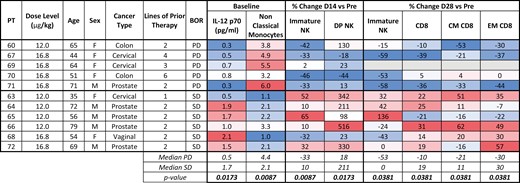
Immune status at baseline and early changes in the immune profile after NHS-IL12 associate with best overall response (BOR). Immune parameters were compared at baseline and as percent change from baseline to 2- or 4-weeks post-treatment in patients treated with 12 µg/kg or 16.8 µg/kg q2w NHS-IL12 with a BOR of stable disease (SD) vs progressive disease (PD). PBMC subsets were calculated as a percent of total PBMC. Significant differences at baseline and in the percent change from baseline to 2 weeks and from baseline to 4 weeks between patients with a BOR of SD and PD are shown. Analytes with differences between groups are those with P <.05 (calculated by the Mann-Whitney test). Analyte values are individually scaled from low (blue) to high (red). Gray—timepoint not available for patient. Abbreviations: PT, patient; F, female; M, male; BOR, best overall response; PD, progressive disease; SD, stable disease; NK, natural killer; DP, double positive; CM central memory; EF, effector memory.

These clinical trajectories as well as the immune correlatives suggest the ability of NHS-IL12 to promote an immune response in traditionally “cold” or immune-excluded tumors, and make it an attractive agent to include in future combination immunotherapies. Baseline IL-12 p70 and circulating nonclassical monocytes may serve as predictive biomarkers and warrant further prospective evaluation. NHS-IL12 at doses up to 16.8µg/kg q2w are safe and are associated with biologic activity. Subsequent studies of this agent alone or in combination are required to determine its level of clinical activity, some of which are in progress (NCT04708470, NCT04287868, NCT04633252).
Acknowledgments
We thank the nursing staff of the National Cancer Institute and the fellows of the Genitourinary Malignancies Branch at the National Cancer Institute for their care of our patients. Most importantly, we appreciate the patients with cancer who enroll in investigational trials to advance knowledge in this disease. This work was supported by the Intramural Research Program of the Center for Cancer Research, National Cancer Institute, National Institutes of Health. The content of this publication does not necessarily reflect the views or policies of the Department of Health and Human Services, nor does mention of trade names, commercial products, or organizations imply endorsement by the US government. This trial was run in accordance with the Declaration of Helsinki after approval by the Scientific Review Committee of the Center for Cancer Research (CCR), National Cancer Institute (NCI), and National Institutes of Health Institutional Review Board (IRB). Ongoing safety oversight was conducted by the IRB and an appointed Safety Monitoring Team. Any serious AEs were reported to the U.S. Food and Drug Administration for review, per guidelines. Informed consent was obtained from each participant, including consent for treatment, primary and secondary endpoints, and correlative studies.
Funding
This work was supported by the Intramural Research Program of the Center for Cancer Research, National Cancer Institute, National Institutes of Health.
Conflict of Interest
The authors indicated no financial relationships.
Data Availability
The data underlying this article will be shared on reasonable request to the corresponding author.
References
Author notes
Principal Investigator: Dr. James L. Gulley