 https://orcid.org/0000-0003-3494-0992
Abstract
Toward the end of the 1960s, the car industry in Japan was reaching its maturity, and it seemed increasingly certain that Japan’s future was firmly linked to cars. At the 16th and 17th Tokyo Motor Shows, in 1969 and 1970, an unprecedented number of show cars made by Japanese car manufacturers were introduced. At these shows, Toyota introduced a series of show cars, the EX-I, EX-II, EX-III, and EX-7, as well as the Commuter.
The end of the 1960s was not just a turning point for the Japanese car industry but also for Japanese society as a whole. Through rapid (re)modernization, the country had attained economic wealth and power, but the consequences of modernization were becoming increasingly devastating. The anticipated and endorsed future was under revision when the news about pollution and political turmoil reached the nation’s media.
Focusing on Toyota Motors, this article examines early Japanese “show cars” by approaching them from the viewpoint of the anticipated but complex and uncertain future at the turn of the 1960s to the 1970s. The purpose of this article is to analyze and summarize the future vision(s) of Toyota by applying a close analysis of the design objects.
Introduction
As historian of technology Gijs Mom argues, throughout the history of car design, largely for practical reasons, the imaginable future has held great significance. This future has offered a vivid space, and one which has been speculative about the cars of tomorrow. It has been envisioned by car manufacturers and their audience—by “producers” and “users,” as identified by Mom—who employ the umbrella term “fictional cars” for these at least partly imagined vehicle facsimiles.1 Perhaps the most impactful type of these fictional cars have been the exhibition vehicles presented by car manufacturing companies. This article will concentrate on such vehicles that are today commonly known as “concept cars.” Due to the ambiguousness of this term, I utilize the term “show car,” following the definition of Japanese car design historian Kōichi Hayashi.2
At the Toyota section of the 16th Tokyo Motor Show, which opened in October 1969, three strikingly futuristic cars were presented.3 These were the first three of the Toyota EX-series: EX-I, EX-II, and EX-III.4 The cars included two wedge-shaped sports cars and three versions of one tiny commuter car. In the following year’s show, Toyota continued the EX-series with the EX-7, and also introduced the Toyota Commuter.5 This article investigates car design6 and its relationship to this imagined future by examining the visual appearance of Japanese show cars at the turn of the 1960s to the 1970s.7 The examined time period covers the years 1969 and 1970, and I have focused my analysis on cars designed by the Toyota Design Department of Toyota Motors.8 By applying a close analysis of the design objects, I analyze and summarize why these show cars appeared as they did and what kind of future vision Toyota was intentionally or unintentionally trying to display through their design.9
To decode Toyota’s vision for the future at the turn of the 1970s is hardly an easy task. Clearly there are numerous visions within one car manufacturer—in its different sections and levels of administration. And, just one show car alone, might embody several different intentions and strategies. As Mom illustrates, the relationship between the expected user and designer is a complicated one, even before the design process begins.10 Here, to confront these ambiguities, I follow three theoretical tracks: an art historical approach, which argues that by analyzing images’ contents in relation to their contexts it is possible to detect (with certain limitations) the meanings and intentions in these images;11 Mom’s theories concerning the design process and the “role of expectations” within it;12 and finally Reinhart Koselleck’s categories “experience” and “expectation,” which embody past and future, and from which he formulates the methodology of “space of experience” and “horizon of expectation.”13
The research data in this article is drawn from four sources: contemporary Japanese car magazines (Car Graphic, Motor Fan, and Motor Magazine);14 materials regarding the design process of the show cars discussed in this article;15 discussions with Toyota’s former design director Hideichi Misono and his concurrent consultation with car designer Noritsuna Watanabe in 2018;16 and previous research relevant to this topic.
Based on these sources and methodological approaches, this study is unable to encompass the complex of interconnections between car design in the context of the car industry and its wider societal context.17 It is beyond the scope of this article to examine, for example, how Toyota’s intentions regarding designing the cars of the future followed the intentions of governmental administration or Toyota’s investment and development strategies regarding production models. To specify in detail the relationship between these and the show cars is an important as well as a complex subject that calls for further research. Structurally, the article starts with an introduction to the social circumstances in which the show cars were first presented, and is then followed by a close analysis of each show car.
Rapid (re)modernization and its devastating side effects
Industrial car design was not the only sector in Japanese society that was moving through an exceptional transition at the turn of the 1960s to the 1970s. As it has been argued elsewhere, the rapid (re)modernization that followed the Second World War was reaching its economic and ideological saturation point.18 Therefore, past, present, and future were felt particularly strongly and everpresent in social discourse.19
Uniquely strong economic growth between 1950 to 1973, when Japan’s GNP grew approximately twenty-nine times bigger, was later referred to as “Japan’s economic miracle.”20 The most intense period of (re)modernization, urbanization, and industrialization took place during the 1960s. According to Conrad Totman, the results of this period were an increase in population, production volume, production efficiency, consumption of fossil fuels, and the country’s involvement in international affairs.21
Within these societal transitions, society was moving toward its later “automobility.”22 This meant, for instance, that the government, operating via the Ministry of International Trade and Industry (MITI), put a huge effort into supporting the growth of the domestic car industry. This was accomplished by large investments, favorable taxation and customs policies, and a large redevelopment of transportation infrastructures and city planning policies.23 Despite these efforts, passenger cars were, as Susan Townsend accurately points out, still scarcely available for the masses. It was not before the 1970s that the volume of transportation by passenger car approached the volume that of rail transportation.24 In that sense, the car can be considered essentially as a matter of the future; it was not yet available for the masses, but contemporary people were already experiencing it and those in power were already imagining, as well as implementing, the development which would lead to it’s later dominance in Japan.
For a majority of people, the results of this transition appeared as growing prosperity when compared to the earlier decades of scarcity: the new “bright life” (akarui seikatsu).25 Periodizing events such as the Tokyo Olympics (1964) and Osaka World Exposition, EXPO’70 (1970) were interpreted as evidence of this new way of life.26 During the 1950s, national economic policies turned their focus to increasing domestic consumption, which meant rising wages and a greater availability of consumer goods. By the 1960s, an average household was now able to buy commodities such as a refrigerator, a television, and a washing machine and, later on, a car, an air conditioner, and a color television.27 Growing prosperity, together with favorable domestic economic policies, and Japan’s international economic position, meant a new beginning for Japanese industrial design, including car design.28
Despite the increasing prosperity, it was toward the end of the 1960s that this modernization began to face resistance as the Japanese became aware of modernization’s devastating side effects. Pollution problems in Minamata, Niigata, Toyama, and Yokkaichi—which had been ongoing for decades—were made public as a result of legal proceedings.29 At the same time, the photochemical smog problem in the rapidly motorized Tokyo and Kantō area, as well as the increasing number of fatal road accidents stimulated public debate.30 At the governmental level, the outcomes of these devastating issues resulted in the Kōgai Taisaku Kihonhō (The Fundamental Act for Environmental Pollution Prevention)—which was legislated in 1967 and amended in 1970—and the gradual improvement of automobile and road safety which was achieved through legislation, education and improvements in vehicle safety standards such as requirements for seat belts, headrests, and speedometers, etc.31 At the same time, in the late 1960s, the somewhat conservative, somewhat anti-American, but also Marxist political turmoil—which had emerged in the 1950s and continued actively over a decade since the demonstrations against The Treaty of Mutual Cooperation and Security Between the United States and Japan (1960)—spilled over again into violent riots around Japan.32
Discussion: Sports cars for intercity highways and commuters for congested cities
In this section, I analyze Toyota’s show cars in two categories. First, I consider three show cars in the sports car category: the Toyota EX-I (1969), EX-III (1969), and EX-7 (1970). Second, I concentrate on two show cars in the category of small-sized commuter cars—the Toyota EX-II (1969) and the Commuter (1970).
In the sports car category, there were three two-seater, two-door cars whose exterior styling was similar: all were rather low and appeared as aerodynamically optimized. Technically, the major difference was the engine placement: in EX-I, the engine was mounted in front, while EX-III and EX-7 were mid-engine cars. The cars were all designed by the “Advanced Design Team,” and supervised by in-house designers Noritsuna Watanabe33 and Masao Fujita.34 All the cars were designed and built between 1968 and 1970.35
When examining these cars in an international context, they seem very similar to contemporary European and American show cars. The general appearance of the EX-I was closer to production models—such as the Nissan Silvia (introduced at the Tokyo Motor Show in 1964)—than the other two EX-series designs. To name a few earlier show cars that likely had influence on the EX-series sports cars, there were the General Motors GM-X Stiletto (presented at the New York World’s Fair in 1964),36 the Chevrolet Astro I (presented at the New York Motor Show in 1967), and the Ferrari Pininfarina 250 P5 (presented at the Geneva Auto Show in 1968).37 Furthermore, in the international context—largely due to the increasing popularity of motorsports—showing, producing, and selling sports cars had become a global phenomenon in the 1960s. This meant that most contemporary show cars were sports cars, not luxury sedans that were typical in the 1950s and early 1960s.38
To start with the EX-I (Figure 1), its exterior design’s distinctive features included square headlights with an unusual transparent cover (which apparently functioned as the front wing), a distinctive long bonnet implying a relatively big front engine, a large rear window and glass roof, and a spoiler on top of the cabin. Details included chrome moldings surrounding the windows and tail lamps, dashboard lighting provided by optical fiber, and the absence of wing mirrors. The car had an automatic transmission, but Toyota did not reveal any other technical details about it.39
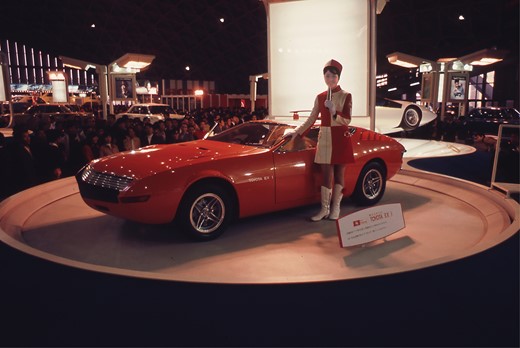
Toyota EX-I at the show. The lightning design highlighted the shape of the car and created an alluring scenery around the Toyota stand. Source: Japan Automobile Manufacturers Association, Inc.

Based on its design features, we can make the following inferences. Toyota EX-I’s design, which focused on aerodynamics, and technical features, such as a relatively big engine (implied by the bonnet’s size) and automatic transmission, proposed a future in which constant driving at high speed would have been an endorsed way of transport. This proposal was accepted by contemporary audiences: for example, according to Car Graphic, the EX-I was a sports car for the “future’s inter-city high-speed motorways.”40 Also, its luxurious details implied a future with increasing economic prosperity. What is more, simply by presenting this kind of sports car at the show, Toyota declared that a sports car, which was very rarely owned by contemporary Japanese, would be a more normal commodity in the future.41 The absence of the wing mirrors had at least two different possible origins: in constant speed driving, the function of wing mirrors would have decreased, or possibly aesthetic reasons.42
The EX-III (Figure 2), rotating askew on two pillars, was placed on the other side of the same stand as the EX-I. When observing the exterior design of this minimalistic yet sculptural car, the first recognized things are its pearl white monocoque body made of fiber-reinforced plastic (FRP), its slightly darkened and large windows that made the whole car appear to be black and white, and the number of different air intake and exhaust holes around the car’s body.43 Inside the car one could recognize a thrust lever in the center console. Again, the wing mirrors were absent, and Toyota did not reveal any technical details about the car.44
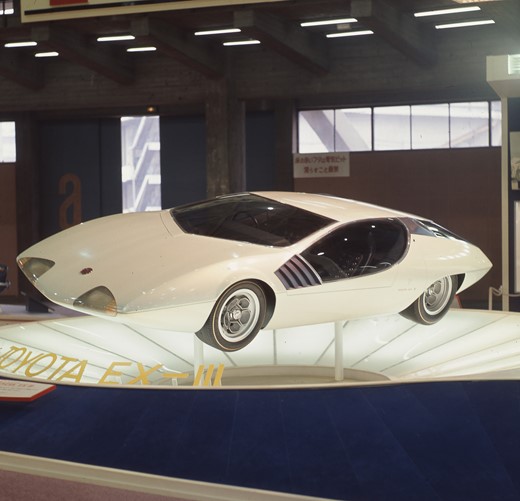
At the show, the EX-III’s presentation aimed to display the car’s monocoque structure, and to associate the car with aviation design. Source: Japan Automobile Manufacturers Association, Inc.

When compared to the EX-I, the EX-III’s design differed considerably from contemporary Japanese production models. In its design, it is possible to detect several features that were reminiscent of aviation: a monocoque body, use of FRP, a thrust lever, the overall shape, as well as the pearl white and black coloring—which was presumably borrowed from the Chevrolet Astro III.45 What is more, contemporary audiences speculated that, judging from its shape and large air exhaust holes on the top of the car, the EX-III’s power unit was a gas turbine engine: one more reference to aviation technology.46 In that sense, the EX-III continued a long and rather utopian tradition of using aviation as a source of inspiration in car design.47
The future Toyota EX-III represented was largely similar to the EX-I. The distinction between these two was that the EX-III’s design was more utopian: a future in which the maximum speed would be even higher and where the car itself would have resembled a jet plane in its technology and aesthetic appearance. If the EX-I was a sports car (merely) for “inter-city high-speed motorways,” the EX-III was aiming for “superhighways of the future,” as Car Graphic formulated the car’s future function.48
In the following year’s show, Toyota introduced the EX-7 (Figure 3) as a possible production model of the famous racing car Toyota 7, whose exterior was also designed by Watanabe.49 EX-7’s massive eight-cylinder engine was the same as in the Toyota 7, except two turbochargers were left out, the importance of which was highlighted by the constant opening of the engine room for the show’s audience.50 This direct link to car racing was underlined by presenting a picture of the Fuji Speedway next to the EX-7 at the show, as well as by the EX-7’s coloring.51 In addition to the details about the engine, Toyota also claimed that the EX-7 had power steering and an automatic transmission, as well as air bags. Once again, wing mirrors, and this time even the rear-view mirror were absent.52
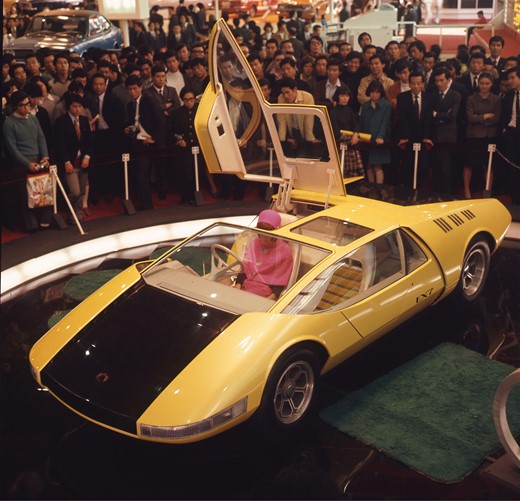
EX-7’s strikingly flat body resembled contemporary Italian show car design—for example the Ferrari 512 S Modulo (1970). As in Italian counterparts, the EX-7’s design’s distinctive feature was its door opening system. Source: Japan Automobile Manufacturers Association, Inc.

The interior of the EX-7 was described by Car Graphic as: “A cockpit equipped with digital apparatus, resembling the interior of a spaceship.”53 This bizarre futuristic interior was composed of yellow fabrics and white plastics, and the dashboard was full of “futuristic dreams,”54 including digital monitors assembled in a horizontal cylinder right next to the steering wheel. Between the driver’s and passenger’s seat, there was a center console containing a cassette player and radio. The driving position was extremely shallow. Therefore Toyota had developed a hydraulic system that raised the seats, equipped with seat belts, automatically when upward doors were opened: exactly as in the Chevrolet Astro I (1966).
The EX-7 continued similar narratives of the future that had already been stated by the EX-III at the previous show. However, there were some differences in this future vision: first, in the EX-7, Toyota also introduced safety features within the car; second, it put much more emphasis on the design and entertainment devices of the interior; and third, the engine and its details played a major role at the show. It seems that the EX-7 was presenting a rather contradictory future vision. The car’s performance would have enabled a top speed of around 300 kilometers per hour. This evidently meant the increased potential for fatal accidents, thus negating the advantages gained by safety belts and air bags. Similarly, in a car in which a massive engine was placed right behind the passengers’ necks, the enjoyment of the entertainment system would have been virtually impossible.
When comparing the EX-series sports cars to the small commuter cars, obviously the contrast is great. Commuter cars were both extremely small, designed for two people, and followed the global trend of commuter show cars that were presented in the United States and Europe at the same time. Examples include the General Motors Hybrid 512E (1969) and the AMC Amitron (1967).55 The EX-II was equipped with a gas engine, while the Commuter had an electric engine, which was the biggest difference between these two cars. These tiny commuters were designed and developed by a different team than the sports cars, but the information regarding this process is largely missing. Toyota engineer chief Jiro Kono, who had been supervising the Toyota 2000GT in collaboration with Yamaha Motors, seems to have administered the EX-II project.
The EX-II (Figure 4) was presented in three different types. The hemispherical-shaped EX-II type A had a closed cabin made of transparent plastic and was designed for commuter traffic. Type B, a convertible with a luggage space in the front of the car, was for logistics at airports. Type C, a convertible with a cloth canopy, was for vacation use at holiday resorts. All the types were run by Yamaha’s motorbike engine, placed behind the seats; and had automatic transmission, and the maximum speed was reportedly 90 kilometers per hour.56
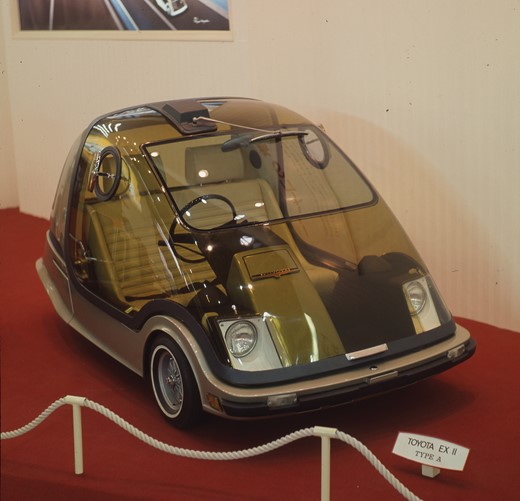
EX-II’s design appears rather futuristic when compared to the concurrent American and European commuter-type show cars. Yet the car’s objectives and the illustrations alongside the cars meet the internationally common ambitions of transport design in the twentieth century. Source: Japan Automobile Manufacturers Association, Inc.

Despite the fact that the EX-II appeared technically more utilitarian than the EX-I and the EX-III, it was still presenting ideas of a utopian future. Air transportation to holiday resorts in distant locations, and dense-populated cities are both influential parts of the iconology of the twentieth century’s utopian future.57 To underline the expectations of their future vision, Toyota presented three illustrations on the wall behind each type of EX-II at the show. Type B had an illustration of a jet plane and the EX-II at an airport, and type C’s illustration presented a view of a hotel’s private beach with the EX-II on it; and the illustration behind type A presented a city of the future and its transportation system.
In this illustration (Figure 5), there is a highway leading to the city of tomorrow in which there is an endless flow of two kinds of cars running above the ground in two separate lanes. Small commuter cars, exactly like the EX-II type A, are traveling in one lane, and wedge-shaped sports cars, similar to the Toyota EX-III, in the other. Based on an interview with Jiro Kono at the show, Car Graphic’s reporter explained this vision in the following way: future transportation would be divided into intercity transportation and transportation within urban areas. Hence, when entering or leaving this future city, one would have changed his or her vehicle at the parking areas outside the city.58
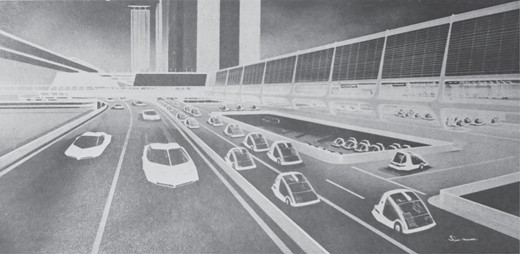
The illustration behind the EX-II’s stand was later used in the cover page of the “Future Report”article in Motor Fan 1/1970. Source: Motor Fan 1/1970, 119.

We can draw a number of interesting conclusions based on this illustrated vision. It fit together well with the future expectations featured in contemporary car magazines that were expecting an increase in automation, use of electricity, average speed, and the number of small commuter cars.59 It was adopted by Motor Fan, which used the same illustration in the magazine’s “Future Report” published in its first issue of 1970.60 The vision followed the ideas of Kenzō Tange’s A Plan for Tokyo 1960 (1961) and Tokaido Megalopolis (1964), which were the most comprehensive examples of city planning executed on the utopian principles of postwar modernism in Japan.61 Also, Metabolists’ theories of architecture; with the idea of increasing mobility and the “capsule” as a fundamental unit of future architecture.62
The EX-II was followed by the Toyota Commuter (Figure 6). A tiny, three-wheeled electric vehicle was introduced in the following year’s show. The electric motor of the front-driven car was placed on top of the front wheel. According to Toyota, the operating range of the vehicle was seventy kilometers with one charge, affording a maximum speed of twenty-five kilometers per hour. With its three-wheel design and remarkable doors (the whole side panel opened as a door), the Commuter would have afforded driving, parking, and turning around on exceptionally narrow roads and in even more crowded future cities.
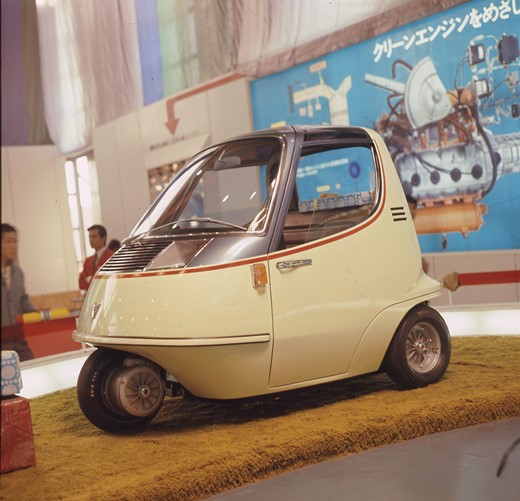
There were two Toyota Commuters in the show. The one missing from the image was for the driving demonstrations on a tiny driving-track in Toyota’s section. Source: Japan Automobile Manufacturers Association, Inc.

Following the EX-II, the design of the Toyota Commuter also presented the future of a denser population, with less space for cars and lower vehicle emissions. It seems reasonable to interpret the Commuter as a direct response to contemporary social demands for the future: by introducing the Commuter, Toyota was really pushing hard to meet the requirements of the new pollution act, or at least to create a public image that it was working toward meeting these requirements.
Toyota’s vision
Before considering the overall appearance of Toyota’s vision, it is important to underline that there appeared a notable consensus within the design of show cars in Japan in 1969 and 1970. Almost every car manufacturer was presenting show cars that met one or both of the two categories of either a sports car or commuter car. For example, in the 1970 Tokyo Motor Show, Nissan introduced a fully electric commuter—the 315-X—as well as two wedge-shaped sports cars—the 270X and the 126X. Toyo Kogyo (Mazda) introduced a hybrid commuter, the EX005, alongside a mid-engine sports car, the Mazda RX-500. Therefore, it seems that Toyota’s vision was part of a larger, possibly even a global trend in car design at that time.
Toyota’s show cars envisioned a future in which a car would have been practical for both high-speed intercity and congested urban transportation. Toyota’s vision was based on an expectation of increasing prosperity, technological development, and the growing significance of automobility in Japanese society.
When considering this vision in its social context of the turn of 1960s and 1970s, we can find the following ideas. Regarding concerns of pollution and road safety, there is a conflict between Toyota’s vision and these issues. Even though the Commuter’s electric engine was presumably a response to the pollution problem, the increased driving speed and engine performance in the sports cars would have negated this impact. The vision was consistent with some of the Metabolists’ ideas, as well as Kenzō Tange’s urban visions—particularly the Tokaido Megalopolis.63 But interestingly, when comparing Toyota’s vision to EXPO’70—which was, according to William Gardner, “the city of the future” in contemporary Japan64—these two future visions do not seem to have much in common. It is not surprising when we note that the cars had only a minor role in EXPO’70. At the Automobile Pavilion, only a few passenger cars were exhibited, and the highlight of the pavilion was a computer-controlled traffic system designed by GK-Design65—not privately owned cars for the “superhighways.”66 When we examine the transportation in Japan at the turn of the 1970s, we see that both transportation types that Toyota’s show cars covered were concurrently largely covered by rail transportation.67 In that sense, it seems appropriate to suppose that Toyota was envisioning a privately owned passenger car system that would have replaced rail transportation, including the recently opened bullet train, and wide networks of commuter trains and subways—or, at least would have been a serious rival for it.68
Toyota’s vision suggested that every household using a car as a main transportation option would have needed two different types of cars—or a reconsideration of the privately owned car system—for example, car rental or joint ownership. All the features of this vision were international, yet not so recent. For example, a similar design for future transportation was introduced by The Walt Disney Company in the film Magic Highway U.S.A. in 1958, and by General Motors at “Futurama II” at the 1964 New York World’s Fair. Two different car types, for two car use functions, meant that Toyota was moving forward from the idea of a universal car—a dominant idea of the global car industry since the 1920s—but the exact intention of this remains unanswered. As explained above, this strategy contained a certain contradiction within it: the problems that show cars of the sports car category would have aggravated were the same problems that show cars in the commuter car category were trying to alleviate. This notion gives even more significance in Jiro Kono’s visionary view regarding future of transportation. Only by separating the vehicle types to different transportation systems it would have been possible to reconcile the two distinct types of show cars, and unite the contemporary concerns regarding safety, pollution, and traffic congestion, and the utopian ambitions of high-speed transportation. What is more, during those turbulent times within Japanese society, this vision enabled Toyota to develop, show, and prepare for two different futures—and to please different political outcomes of this uncertain situation.
If we consider all these show cars through Gijs Mom’s theory, it might seem that the producer’s (Toyota) vision did not meet users’ (audience) needs, and that is the reason why the show cars never appeared as production models. Yet, when confronting the current transportation networks of Japan—the intercity highways and tiny cars in the congested urban areas—Toyota’s vision from fifty years ago seems newly accurate and successful.
Acknowledgments
This work was financially supported by Scandinavia-Japan Sasakawa Foundation (Grant number GA18-FIN-0075), and Helsinki University Fund for Arts and Social Sciences, 2018. The paper is a result of collaborative research with Professor Takayuki Higuchi (Chiba University, Graduate School of Engineering, Design Research Institute) during the summer of 2018. Here, I want to thank all the people who kindly helped me in this research both in Finland and in Japan, especially: Professor emeritus Pekka Korvenmaa, Aalto University; Professor Takayuki Higuchi, Chiba University; previous Deputy Director and Curator of Toyota Automobile Museum, Mr. Shinji Hamada; former Senior General Manager of Toyota Design, and Vice President of Japan Industrial Designers Association, Mr. Hideichi Misono; and art historian (PhD) Juhana Lahti, Finnish Heritage Agency. I am convinced that without the help I received from these people, this research would not have been possible, and the article never been completed. However, all possible errors remain mine.
If you have any comments to make in relation to this article, please go to the journal website on http://jdh.oxfordjournals.org and access the article. There is a faculty on the site for sending e-mail responses to the editorial board and other readers.
The author has made all attempts to secure copyright and reproduction rights for the images presented. Any additional information or missing or unmentioned copyrights would be greatly appreciated.
Frans Autio is a doctoral researcher in the Doctoral Program in History and Cultural Heritage at the University of Helsinki, Finland. He is working on his doctoral dissertation in which he is examining industrial car design, focusing on the transition of its future expectations during the 1960s and 1970s. His aim is to understand the relationship between the expected but human-made futures, the ecological yet historical conditions in the present global warming, systems of capitalism and automobility, and visually stimulating car design.
Footnotes
Gijs Mom, “‘The Future is a Shifting Panorama’: The Role of Expectations in the History of Mobility,” in Zukünfte des Automobils: Aussichten und Grenzen der Autotechnischen Globalisierung, eds. W. Canzler and G. Schmidt (Berlin: Edition Sigma, 2008), 31–58.
Both of these terms have a vivid history. They are the terms that have been used when describing various kinds of exhibition vehicles in Japan and elsewhere, at least from the 1970s onwards. I would interpret “concept car” as more recent than “show car.” Hayashi’s definition is his own, and the car industry, or car media, do not utilize the term exactly as he uses it. However, within the limitations of this article, I find it very useful. Hayashi defines “show car” in the following way: 1. It is built for the motor show, and it is not meant to go on sale as it is presented at the show, 2. It will not end up on the market and therefore appears only as a representation of the future car, or when presented at the motor show; it is at a very early level of development and it will not be on sale for at least one year after the presentation at the show. K. Hayashi, “日本の自動車デザインの変遷における企業内デザイン部門とデザイン戦略の関係” [Relations between Corporate Design Departments and Design Strategies in the Transitions of Japanese Automotive-Designs], (PhD Thesis, Chiba University, 2014), 30. Translation by author.
The first Tokyo Motor Show was held in 1954 and it was an annual event until 1973. At the 1969 show (24 October to 6 November), there were 1,523,500 visitors; at the 1970 show (30 October to 12 November) 1,452,900 visitors. “History & Record,” Tokyo Motor Show, accessed 12 December 2022, <https://www.tokyo-motorshow.com/en/history/>.
The prefix EX is an abbreviation of “experimental.” Show cars that are analyzed in this article are all, except one, from the “EX-series.” However, only the sports cars (EX-I, EX-III and EX-7) were designed by the “Toyota Advanced Design Team,” supervised by Noritsuna Watanabe and administered by Mamoru Yaegashi. There is very limited information about the design process of the two small commuter cars. These were designed separately from Watanabe’s design team. Hideichi Misono, interview with the author in Chiba, June 26, 2018, and in Nagoya 8 July 2018; Hideichi Misono, emails to author June 8, 2018; December 13, 2018; December 15, 2018.
All these Toyota show cars were demolished shortly after their presentation at the shows. In total, sixteen Japanese show cars were presented at these two shows, which was, as Hayashi illustrates, a remarkable increase from previous shows. Hayashi, “Relations between Corporate Design Departments and Design Strategies,” Appendix 2 and 3, 30–46.
In this article, “car design” refers to a process of creating a mass-produced and drivable vehicle, and to the different outcomes of this process—for example, sketches, scale models, and the mass-produced vehicles.
We are lacking academic research on the history of car design in general, and Japanese car design has very rarely been considered in English. There is not a single study available in English that considers this topic. Kōichi Hayashi’s doctoral thesis, which contributes to the history of Japanese car design, also contributes briefly to the history of Japanese show cars by methods of quantitative analysis, but does not analyze the design of each show car. Hayashi, “Relations between Corporate Design Departments and Design Strategies,” 30–46.
The section of the company that produced automobiles was known as Toyota Motors in the 1960s and 1970s. Hereafter I shall refer to the section known as Toyota Motors as “Toyota.” In 1967, Toyota reorganized the Design section into the Design department, and the first General Manager of the Design department was Masao Morimoto, followed by Mamoru Yaegashi in 1969. In 1968 Mamoru Yaegashi established a new design team, known as the “Toyota Advanced Design Team,” which started working in 1968. Hideichi Misono, email to author 13 December 2018; 15 December 2018; Hayashi, “Relations between Corporate Design Departments and Design Strategies,” 17–19.
I want to note that examining Toyota’s cars by trying to find a comprehensive and consistent expected future is only one way to examine these cars. Alternatively, we could also have followed David Gartman’s interpretation of show cars as exhibition vehicles that were intended to create an illusion of technological and scientific progress by showing futuristic and exciting styling and design—and to “entertain and excite the audience with grand spectacles that put them in the buying mood.” Obviously, this approach would have produced a different result. David Gartman, Auto Opium: A Social History of American Automobile Design (London: Routledge, 1994), 158.
For example, there are the intentions of a designer pursuing their artistic style and visions of the car of tomorrow; there are the intentions of a designer in charge to make a successful concept model that would be suitable to be presented to the public; and there are the intentions of a management or public affairs section to present a show car that would receive positive reactions from the audience. Gijs Mom explains this as a process in which the producer and the user are both “fantasizing” about the artifact’s future use, and the producer’s intention is therefore to design an artifact with as many different future functions as possible—or different artifacts for different futures. Mom, “‘The Future is a Shifting Panorama,’” 39.
In this article, the show cars are understood as images that have haptic properties: multi-materiality and three-dimensionality. Regarding meanings and intentions, these theories suggest that it is possible to detect even unintended ones, and ones that are not limited to a single actor. See, for example, M. Bal and N. Bryson, “Semiotics and Art History,” The Art Bulletin 73, no. 2 (199): 174–208; S. Vihma, Products as Representations: A Semiotic and Aesthetic Study of Design Products (Helsinki: University of Art and Design Helsinki, 1995), 2–25; S. Bann, “Meaning/Interpretation” in Art of Art History: A Critical Anthology, ed. Donald Preziosi (Oxford: Oxford University Press, 2009), 256–70.
Mom, “‘The Future is a Shifting Panorama’,” 31–58.
R. Koselleck, Futures Past: On the Semantics of Historical Time, trans. Keith Tribe (New York: Columbia University Press, 2004), 259–63.
Car Graphic (CG), in Japanese as “カーグラフィック”; Motor Fan (MF), in Japanese as “モーターファン”; Motor Magazine (MM), in Japanese as “モーターマガジン.” In this article, I use the English version of the names of the magazines because the Japanese names are basically English written in Japanese characters.
These materials were shared with me by the Toyota Automobile Museum in Nagoya. The materials include original sketches and renderings by Noritsuna Watanabe and Masao Fujita as well as photographs of the design process and photographs of the completed show cars.
Hideichi Misono started his career in Toyota in 1969 as a car designer and later held the position of Senior General Manager of the Toyota Design Center in the early 2000s. For this article, I had two discussions with him in 2018, on 26 June (Chiba) and 8 July (Nagoya). Based on our discussions regarding the topics, Misono concurrently consulted Noritsuna Watanabe and also communicated Watanabe’s personal thoughts to me by email. Hideichi Misono, interview with the author in Chiba, 26 June 2018, and in Nagoya 8 July 2018; Hideichi Misono, email to author 8 June 2018; 13 December 2018; 15 December 2018.
There are many studies about the Japanese car industry in the postwar period. For example, M. A. Cusumano, The Japanese Automobile Industry: Technology and Management at Nissan and Toyota (Cambridge: Harvard University Press, 1985); P. A. Genther, A History of Japan’s Government-Business Relationship: The Passenger Car Industry (Ann Arbor: University of Michigan, Center for Japanese Studies, 1990); S. Townsend, “The ‘Miracle’ of Car Ownership in Japan’s ‘Era of High Growth’, 1955–73,” Business History 55, no. 3 (2013): 498–523; Hayashi, “Relations between Corporate Design Departments and Design Strategies.”
Here I follow Laura Hein’s argument that Japan was largely modernized before the war, and this was an essential factor in its postwar economic success. See, L. Hein, Fueling Growth: The Energy Revolution and Economic Policy in Postwar Japan (Cambridge: Harvard University Press, 1990), 22.
We are lacking research that focuses particularly on this phenomenon of past futures in Japan. However, the contradiction between expectations of a better or a worse future, present prosperity, and anxiety in Japanese society has been considered here and there in many studies recently, particularly in research about postwar modern architecture, and the architecture movement “Metabolism.” Here, we follow this paradigm. For example, see Rem Koolhaas and Hans Ulrich Obrist, Project Japan: Metabolism Talks…, eds. Kayoko Ota and James Westcott (London: Taschen, 2011); Hyunjung Cho, “Competing Futures: War Narratives in Postwar Japanese Architecture 1945–1970,” (PhD Thesis, University of Southern California, 2011); Hyunjung Cho and Chunghoon Shin, “Metabolism and Cold War Architecture,” The Journal of Architecture 19, no. 5 (2014): 623–44; William O. Gardner, The Metabolist Imagination: Visions of the City in Postwar Japanese Architecture and Science Fiction (Minneapolis: University of Minnesota Press, 2020).
Andrew Gordon explains this in detail: in 1950, Japan’s GNP was 11 billion dollars and in 1973, it was 320 billion dollars. See Andrew Gordon, A Modern History of Japan: From Tokugawa Times to the Present (New York: Oxford University Press, 2003), 245–46 (in more detail 245–51).
Conrad D. Totman, A History of Japan (Oxford: Blackwell Publishing: 2005), 465–66.
“Automobility” is a term introduced by Mimi Sheller and John Urry, meaning a situation in which society is dependent on cars, and the mobility that they enable, on a constitutional level. Mimi Sheller and John Urry, “The City and the Car,” International Journal of Urban and Regional Research 24, no. 4 (2000): 737–57.
Townsend, “The ‘Miracle’ of Car Ownership,” 505–16. Passenger car production (excluding three-wheeled motor vehicles) was 20,268 units per year in 1955 and by 1970 it had increased to 3,178,708 units per year. The number of cars owned increased also: 42,588 cars were owned in 1950; this increased to 8,778,972 cars by 1970. 日本の自動車産業の歩み [“Development of the Japanese Automobile industry”] (Tokyo: Japan Automobile Manufacturers Association, 1997), 387. Construction of the first Japanese highway, the Meishin Highway, was completed in 1963; construction of the Shuto expressway started in 1962; and the Tōmei motorway, connecting Tokyo and Osaka, was completed in 1969. See also André Sorensen, The Making of Urban Japan Cities and Planning from Edo to the (London: Routledge, 2002), 191–93; Raffaele Pernice, “The Transformation of Tokyo During the 1950s and Early 1960s: Projects Between City Planning and Urban Utopia,” Journal of Asian Architecture and Building Engineering 5, no. 2 (2006): 253–60.
Townsend, “The ‘Miracle’ of Car Ownership,” 504.
As it was formulated in a booklet distributed for Japanese by the US occupation forces. In 1947, when the new Constitution of Japan was adopted, 20 million copies of the booklet entitled “Atarashii Kenpō, Akarui Seikatsu” (New Constitution, Bright Life) was distributed in Japan. John W. Dower, Embracing Defeat: Japan in the Wake of World War II (New York: W.W. Norton & Co./New Press, 1999), 172–73, 402.
EXPO’70 has been considered the culmination point of the economic “euphoria” of the 1960s, as well as the end of postwar optimism in architecture and design. See Yoshikuni Igarashi, Bodies of Memory: Narratives of War in Postwar Japanese Culture, 1945-1970 (Princeton: Princeton University Press, 2000), 165; Cho, “Competing Futures,” 241–42, Gardner, The Metabolist Imagination, 2, 87–88.
These three consumer items were referred to as the “three sacred treasures,” referring to the Imperial Regalia of Japan. By the mid-1960s, 90 percent of households had been able to purchase these items. Gordon, A Modern History of Japan, 267.
Regarding industrial design in general, see, e.g., Sarah Teasley, Designing Modern Japan (London: Reaktion Books Ltd, 2022), 199–260; Yasuko Suga, “Modern Design in Japan (1957–1973)” in Encyclopedia of East Asian Design, eds. Haruhiko Fujita and Christine Guth (London: Bloomsbury, 2020), 283–86; on industrial car design, see Hayashi, “Relations between Corporate Design Departments and Design Strategies,” 37–38.
Mercury pollution in Minamata was continuous from 1932, but the serious symptoms of this pollution in local people became known as the “Minamata disease” in 1956; similar mercury pollution was discovered at Niigata in 1965. In Toyama, the fact that local people had suffered from cadmium poisoning from 1912 onwards, known as the “Itai-itai disease,” was admitted by the Ministry of Health and Welfare in 1968; and in Yokkaichi, the fact that pollution by local petrochemical refineries caused several different symptoms of serious respiratory diseases, known as “Yokkaichi Asthma,” was revealed in 1970. The public discourse regarding these “four big pollution diseases” was intensive during the 1960s and 1970s; civil law proceedings began in 1967. Simon Avenell, Transnational Japan in the Global Environmental Movement (Hawaii: University of Hawai‘i Press, 2017), 26–36.
The number of fatal road accidents grew from 4,429 (1951) to its peak of 16,528 in 1970. Takashi Oguchi, “Achieving safe road traffic—the experience in Japan,” in IATSS Research vol. 39 (Tokyo: International Association of Traffic and Safety Sciences, 2016), 111–14.
Shiro Kawashima, “A Survey of Environmental Law and Policy in Japan,” North Carolina Journal of International Law and Commercial Regulation 20, no. 2 (1995): 242–46. The legislation on road safety was improved especially in the 1970s: the “Traffic Safety Policies Basic Act” went into effect in 1970, and policymakers formulated the “First Fundamental Traffic Safety Program” at the end of 1970. Oguchi, “Achieving safe road traffic,“ 113. As Hayashi shows, both had a direct influence on Japanese car design, and especially on show cars. Hayashi, “Relations between Corporate Design Departments and Design Strategies,” 37, 99.
Gordon, A Modern History of Japan, 283–87 (270–87).
Noritsuna Watanabe, after graduation from the Tokyo University of Arts, started his career at Toyota in 1965. In the late 1960s, he studied at the ArtCenter College of Design (ACCD) in Pasadena, California; he came back to Japan in 1968 and joined the “Advanced Design Team” in which he supervised the design of Toyota EX-I, EX-III, EX-IV (an uncompleted show car in 1970) and EX-7. In 1970 Watanabe was transferred to the exterior design section, and in 1973 he started as General Manager of Calty Design Research, which is a design company in California founded by Toyota Motors that year.
Masao Fujita joined Toyota Motors before 1965, and, under the supervision of Mamoru Yaegashi, he designed Toyota’s futuristic 1:2 scale model presented at the Tokyo Motor Show in 1965. In the late 1960s, at the same time as he was in the Advanced Design Team, he was supervising the exterior design of the Toyota Celica, which came into production in 1970.
This “Advanced Design Team” was not recognized in the Toyota Design Department’s organizational chart. According to Noritsuna Watanabe, it was a small team with Toyota’s most skilled designers administered directly by Mamoru Yaegashi. When Watanabe came back from the ACCD in 1968, the team was already established. Hideichi Misono, email to the author, 15 December 2018 (including comments by Watanabe).
In a photograph of Masao Fujita from 1965 where he is explaining the design of the futuristic 1:2 scale model at the Toyota design section, there is a photograph of the GM-X Stiletto on the wall.
The influence of American car design was strong at Toyota, and Toyota was aware of the latest American car designs at the end of the 1960s. First, Toyota Design manager Masao Morimoto himself studied at the ACCD, and Mamoru Yaegashi (who directly administered Watanabe and Fujita) had connections in the United States at that time: his connections made it possible to establish Calty Design Research in 1973 in California. Also, Watanabe studied at ACCD right before he started designing the EX-series. According to Hideichi Misono, the MITI’s seminars held around Japan by ACCD in 1956 were the “real beginning” of Japanese car design. After that, the Japanese External Trade Recovery Organization (JETRO) started a program for Japanese design students to study at the ArtCenter, and many of Toyota’s designers participated in that program. This connection between the ACCD and early Japanese car design calls for further examination. Hideichi Misono, interview with the author at Chiba University on 26 June 2018; ArtCenter History, ArtCenter, accessed 4 December 2022, <https://www.artcenter.edu/about/get-to-know-artcenter/history.html>.
There is an absence of academic research that concentrates on the influence of motorsports on car design and mobility in general. Tim Benton examines the phenomenon in the early stages of car history. See Tim Benton, “Dreams of Machines: Futurism and l’Esprit Nouveau,” Journal of Design History 3, no. 1 (1990): 19–34.
According to Hideichi Misono, the EX-I did not include any technical properties, but was a “mock-up” model. Hideichi Misono, interview with the author at Chiba University on 26 June 2018.
“第16回東京モーターショー” [The 16th Tokyo Motor Show] in CG 12/1969, 76.
The production volumes of contemporary sports cars were very limited. For example, only 351 Toyota 2000GTs were produced. Furthermore, the price of these cars made them unobtainable by ordinary Japanese people: the contemporary price of a Toyota 2000GT was more than twice (¥2.38 million) the average gross household income (around ¥856,000 in 1966). Townsend, “The ‘Miracle’ of Car Ownership,” 511.
That was quite typical in contemporary show cars; for example, the Opel CD (1969) and the Alfa Romeo Carabo (1968) were lacking wing mirrors.
Fiber-reinforced plastic (FRP) was adapted to show car design in the 1960s from motorsports. This material is much lighter than steel and it increases the car’s performance level.
Based on the later information and photographs of the design process, the Toyota EX-III was not a drivable car. Motor Magazine noted that and called the car “a mock-up model,” presuming that it was developed only in terms of styling without any actual development of technology. “69-東京モーターショー特集” in MM 12/1969, 80.
The Astro III was featured in CG 6/1969, 76–78.
CG speculated this possibility. CG 12/69, 75. In the 1960s, some car manufacturers were trying to adapt this jet-plane technology for passenger cars. The Chrysler Turbine Car was probably the most advanced of these (55 were produced between 1963 and 1964). CG had had a test drive of this car in 1964 (CG 1/1964, 91–94), so the technology was familiar to Japanese designers and their audience as well.
Gartman, Auto Opium, 130–35, 151–52, 159–63; Benton, “Dreams of Machines,” 19–34.
“The 16th Tokyo Motor Show,” CG 12/1969, 75, translation by author.
Toyota 7 578A (1970) was the last updated model of the Toyota 7 (1968–1970).
Thus, the EX-7’s performance (claimed to be 450 PS) exceeded the top contemporary sports cars, such as the Lamborghini Miura (350 PS in 1966).
Many of the famous contemporary racing cars were painted in two colors: for example, the Porsche 917K (1970).
Despite all this considerably detailed technical information, there is no information if the car was drivable or not.
カーグラフィック1970年12月号臨時増刊: 第17回東京モーターショー/ 71 ‘国産・輸入乗用車 [Car Graphic, December 1970 Special Issue: 17th Tokyo Motor Show/ 71’ Domestic/ Imported Passenger Cars], ed. Shotaro Kobayashi (Tokyo: Nigensha Publishing Co., Ltd., 1970), 6. Translated by author.
“Car Graphic, December 1970 Special Issue,” 5.
General Motors commuter cars were introduced in CG 8/1969, 75–86. In CG 3/1970 there was also an article “世界のコミューター: 大メーカーの試作コミューター” [Commuters Around the World: Commuter Prototypes from Major Manufacturers], in which many commuter cars were introduced to the Japanese audience.
The majority of Japanese car engines were not bigger than 360 cc. This “keijidōsha” category of cars had lower taxation, which made them usually the only possible car for Japanese people.
For example: Ruth Eaton, Ideal Cities: Utopianism and the (Un)Built Environment (New York: Thames & Hudson, 2002), 239–41; Even Smith Wergeland, “From Utopia to Reality: The Motorway as a Work of Art,” (PhD Thesis, Arkitektur-og designhøskolen i Oslo, 2013), 47–125.
“The 16th Tokyo Motor Show,” CG 12/1969, 79.
For example, see MF 5/1969; MF 1/1969; MF 7/1969; MF 9/1969; MF 1/1970; MF 1/1971; MM 1/1970; CG 9/1969; CG 8/1970.
“未来特集” [Future report] in MF 1/1970, 87–128. The report of over forty pages included several sub-articles, such as Tōru Origuchi’s article “都市とコミューター” [City and Commuter], 119–28.
See Hyunjung Cho, “Kenzō Tange’s A Plan for Tokyo, 1960: a plan for urban mobility,” Arq: Architectural Research Quarterly 22, no. 2 (2018): 139–50. One of these principles was the idea of separation of different forms of transportation. See, e.g., Wergeland, “From Utopia to Reality,” 90–102.
The idea of the capsule was formulated by Kishō Kurokawa in his essay “Capsule Declaration” in 1969. Kisho Kurokawa, “Capsule Declaration,” in Metabolism in Architecture (essay originally published in Space Design 3/1969) (London: Studio Vista, 1977), 75–85.
Cho, “Kenzō Tange’s A Plan for Tokyo.”
Gardner, The Metabolist Imagination, 87–88.
GK-Design, which can be considered one of the most successful independent design offices in Japan, was established in 1952 by Kenji Ekuan, who was also a member of the Metabolists. It is notable that computer-controlled vehicles were designed by a design office, and not a car manufacturing company such as Toyota.
In the EXPO area there were moving walkways, a monorail, electric buses, and even a gondola lift. The area itself, however, was accessible by car.
Sorensen, The Making of Urban Japan Cities, 251–52.
This seems to be originally an American invention; from its very beginning, rail transportation was a serious competitor for privately owned cars—in the United States, it seems that the car industry was successful in overtaking rail transportation in the postwar period, but specific research focusing on how this happened is missing.