Abstract
The ongoing war in Ukraine has thrust China–Russia relations into the global spotlight, with both nations asserting their stance against forming a military alliance. This article introduces a novel ‘balance-of-beliefs’ framework, positing that the foundation of peacetime alliances lies in leaders' shared beliefs. Using operational code analysis, this study quantifies the philosophical and instrumental beliefs of leaders from the United States (Barack Obama), Australia (Tony Abbott), China (Xi Jinping) and Russia (Vladimir Putin) between 2013 and 2015, and includes additional comparison between Putin and Xi between 2016 and 2022. This research examines the essential role of aligned world-views on ‘the nature of the political universe’ (which we label a P-1 belief) and ‘the strategic approach to achieving political objectives’ (an I-1 belief). The findings reveal that such congruence is crucial for fostering like-minded alliances in peacetime, as evidenced by the US–Australia alliance. In contrast, the divergent P-1 beliefs of Xi and Putin hinder a Sino-Russian military alliance; yet, their aligned I-1 beliefs facilitate pragmatic cooperation on specific issues. This analysis underscores the need for US and European policy-makers to devise nuanced strategies in response to the evolving dynamics of a rising China and a resurgent Russia.
The ongoing conflict in Ukraine has cast a spotlight on the relationship between China and Russia, raising questions about why the two nations have refrained from establishing a formal military alliance despite increasing threats and challenges from the United States. In a joint statement in May 2015, both countries declared that their relations had reached a ‘historic peak’ and pledged to deepen their ‘comprehensive strategic partnership of coordination’.1
Shortly before launching the invasion of Ukraine in February 2022, Putin visited Beijing to show support for China's hosting of the Winter Olympics and signed a joint statement with Xi reaffirming that there were ‘no limits’ to their ‘friendship’ and no ‘forbidden areas of cooperation’.2 During this visit, Russia's energy giants Gazprom and Rosneft finalized substantial energy deals with China National Petroleum Corporation (CNPC). These agreements involved the supply by Gazprom of ten billion cubic metres of natural gas annually for 25 years, through a new pipeline, and the delivery by Rosneft of 100 million tonnes of crude oil to CNPC within a decade, via Kazakhstan.3 These energy deals have proven crucial for Russia in countering western sanctions amid escalating tensions over Ukraine.
According to official Chinese records, between 2013 and 2023 Presidents Xi Jinping and Vladimir Putin met 42 times, marking a significant enhancement in their bilateral ties.4 In October 2023, Putin attended the third Belt and Road Forum for International Cooperation in Beijing. This was Putin's first foreign trip beyond friendly former Soviet states since Russia started its war with Ukraine. During the meeting, Xi stressed that ‘the deepening China–Russia relations’ were ‘not a stopgap measure, but a long-term solution’.5 In May 2024, Putin made his first foreign trip to China after his reelection to the Kremlin. Xi and Putin signed a joint statement pledging a ‘new era’ of their strategic partnership, with both sides expressing serious concerns about the United States' attempts to ‘disrupt strategic stability in order to maintain its absolute military advantage.’ 6 In their latest meeting at the SCO (Shanghai Cooperation Organization) summit in July 2024, Putin mentioned that ‘bilateral ties between Moscow and Beijing were at their best in history.’ 7
However, despite the deepening of their partnership, China and Russia have publicly disavowed any intentions of forming a military alliance against the United States. Former Chinese vice minister of foreign affairs Fu Ying, in a 2016 article for Foreign Affairs, emphasized that China had no interest in a formal alliance with Russia nor in creating an anti-US or anti-western bloc.8 In a similar vein, in November 2023, despite mounting pressures from the West since the start of the Ukrainian crisis, Russian defence minister Sergey Shoigu clearly stated that defence ties between Russia and China were not aimed at third countries. He added, ‘Unlike certain aggressive western countries, we are not creating a military bloc.’9 This raises an intriguing empirical question: why have China and Russia categorically ruled out the possibility of a military alliance? Additionally, a theoretical question arises: under what conditions would these two nations be more inclined to forge a formal military alliance during peacetime?
The balance-of-threat theory, a prevalent framework in International Relations (IR), suggests that states are more likely to form military alliances when they face a common threat.10 Since the end of the Cold War, the United States has emerged as the only country with both the capability and intention to threaten Russia and China. It is an open secret that the US-led NATO expansion has penetrated Russia's traditional sphere of interest in eastern Europe, although NATO denies its anti-Russian intention.11 According to Putin, one of the reasons for Russia to invade Ukraine in early 2022 was rooted in Russia's longstanding resentment regarding the NATO expansion. In the Asia-Pacific, China has also faced mounting strategic pressure from the US, particularly since Donald Trump's ‘showdown’ with China—in terms of the trade and tech wars, and the whole-of-government approach adopted against China during his term in office (2017–2021).12 The administration of Joe Biden has continued Trump's China policy by promoting a ‘grand alliance’ against China with other democracies, thus posing a significant security challenge to both Russia and China.13 However, the reluctance of Russia and China to form a military alliance, as mentioned above, becomes an empirical anomaly, contradicting the expectations of the balance-of-threat theory.
This article introduces a novel ‘balance-of-beliefs’ argument to shed light on the China–Russia relationship. It suggests that we need to ‘bring leaders back in’ when discussing alliance formation in peacetime. Unlike wartime alliances that are formed in response to immediate threats, peacetime alliances are more complex and costly to establish. Therefore, the presence of ‘shared beliefs’ among leaders becomes crucial for such alliances to materialize.
Applying this balance-of-beliefs argument to Sino-Russian relations, we contend that the primary hindrance to forming a formal alliance lies in the diverse belief systems of the top leaders in both countries. We employ operational code (OpCode) analysis to compare the two leaders' key operational code beliefs: the philosophical belief in the political universe (referred to below as P-1) and the instrumental belief in strategy for achieving political goals (I-1). While Xi and Putin share instrumental beliefs in strategy (I-1), their divergent philosophical beliefs in the political universe (P-1) prevent them from forming a military alliance in peacetime, though they may cooperate based on shared interests.
The remainder of this article unfolds as follows. First, we examine three existing arguments explaining the absence of a China–Russia alliance: the ‘axis of convenience’, the ‘soft alliance’ and the ‘unipolar syndrome’. While these arguments contain elements of truth, they downplay the role of leaders, particularly their ‘beliefs’ in peacetime alliance formation. It is imperative to reintegrate the role of leaders into the discussion.
In the second and third sections, we introduce a balance-of-beliefs analysis and argue that shared beliefs, especially a shared world-view, are a necessary condition for peacetime alliances. We utilize OpCode analysis as a methodological tool to measure and compare leaders' beliefs, enabling the development of testable hypotheses in accordance with our balance-of-beliefs argument. We test these hypotheses by examining public speeches from four top leaders: Barack Obama (United States), Tony Abbott (Australia), Putin (Russia) and Xi (China) between 2013 and 2015, with an additional comparison between Putin and Xi from 2016 to 2022.
In the fourth section, we conduct a brief case-study to explore how the shared threat posed by the United States has prompted Russia and China to engage in interest-based cooperation in both the security and economic domains. In conclusion, we propose that although the divergent world-views (P-1 belief) of Putin and Xi discourage a military alliance in peacetime, changes in the international landscape, such as the onset of war between Russia and Ukraine in 2022, may alter their P-1 beliefs. Therefore, the possibility of a future alliance between Russia and China is not out of reach, contingent upon the strategic actions of the US towards both nations. To navigate the events of the early twenty-first century effectively, the US must recognize the divergent world-views of Xi and Putin and formulate distinct strategies for dealing with a rising China and a resurgent Russia.
Why not form an alliance?
The question of why China and Russia have not formed a military alliance has sparked heated debate over the years. Since the declaration of a bilateral strategic partnership in 1996, experts and observers have proposed three prevalent perspectives on the reluctance to forge such an alliance.14
First, there is the ‘axis of convenience’ argument articulated by scholars like Bobo Lo, which posits that deep-seated ideological, historical and geopolitical differences between Russia and China make a genuine alliance unlikely.15 In his 2015 commentary, Joseph Nye, Jr, further highlighted significant issues in economic, military and demographic domains that hinder the prospects of a Sino-Russian alliance.16 Some observers, like Zack Beauchamp, even dismiss the notion of a military alliance between the two nations as mere illusion.17
In contrast to this pessimistic outlook, some scholars advocate the ‘soft alliance’ argument. This perspective acknowledges the reluctance of both China and Russia to pursue a traditional military alliance, but suggests that their current ‘comprehensive strategic partnership of coordination’ might constitute a preparation for a fully-fledged alliance in the future, becoming the next military threat to the United States.18 Gilbert Rozman, for instance, lists six reasons underpinning the resilience of the Chinese-Russian partnership.19 Huiyun Feng adds that the shared threat posed by the United States is driving China and Russia closer and could, potentially, lead to an alliance if the United States continues to exert simultaneous pressure on both nations.20
The third view, known as the ‘unipolar syndrome’ argument, contends that China and Russia are hesitant to publicly label the United States as their adversary due to the substantial power imbalance inherent in the unipolar world order.21 Under this rationalist perspective, the vast power gap between the US and other states discourages the formation of traditional military alliances, as any attempt at hard balancing would likely prove futile. In essence, the United States is deemed too formidable to counteract, rendering military challenges by China and Russia, either individually or collectively, unproductive. Moreover, both China and Russia have relied on the United States for economic development, albeit to varying degrees. Wang Jisi, a prominent IR scholar in China, argues that ‘a stable, cooperative relationship with the United States is in the best interest of China on its road to modernization’.22
While these three arguments capture elements of truth regarding China–Russia relations, they share certain analytical shortcomings. First, they underscore the significance of external factors while downplaying the role of leaders in decision-making. The ‘axis of convenience’ argument emphasizes how historical memories and geopolitical competition constitute major obstacles for China and Russia. Conversely, the ‘soft alliance’ argument highlights external threats from the United States as the driving force behind closer ties. The ‘unipolar syndrome’ thesis underscores structural impediments to alliance formation under unipolarity.
While external conditions certainly matter, leaders play a critical role in the decision-making process, especially when it comes to alliance formation. For example, the bitter historical experiences and memories of the Sino-Soviet split and border dispute in the 1950s and 1960s have left a deep scar on Chinese policy elites, who vowed not to rely on the Soviet Union (USSR) and later Russia for close ties. Therefore, according to Lo, the best relationship between China and Russia is an ‘axis of convenience’, suggesting that the fragile and superficial relationship will not deepen in the future. However, we have witnessed rapid development in the bilateral relationship between China and Russia from the era of Jiang Zemin (1989–2002) to that of Xi. The issue is not that historical memories do not matter; rather, it is about the conditions and leadership types that allow the two countries to overcome the hindrance of history and geography in bilateral relations. This is not to downplay the importance of history and geography in influencing Russia–China relations; instead, it emphasizes the role of leadership, particularly leaders' beliefs, in shaping and reshaping the bilateral relations between China and Russia.
In other words, without considering the influence of leaders, we cannot fully comprehend the dynamics of China–Russia relations after the Cold War. Questions arise, such as why Russian President Boris Yeltsin sought a close relationship with China in the early 1990s, why Jiang strongly supported border demarcation talks with Russia in the 1990s and why the China–Russia relationship became ‘aloof’ under Putin in the early 2000s. Mere external conditions fall short of explaining these nuances in the post-Cold War bilateral relationship.
Second, all three arguments tend to overlook the distinction between wartime and peacetime conditions in alliance dynamics.23 Alliance formation occurs more frequently during wartime due to the immediacy and clarity of external threats. For instance, during the Second World War, Britain and France formed a military alliance because both faced direct military aggression from Germany. Similarly, the United States, initially reluctant, joined the Allied forces after being attacked by Japan at Pearl Harbor. Even ideological adversaries like the USSR and the US formed alliances during wartime.24 However, peacetime threats differ; Russia, despite its security concerns regarding NATO expansion, does not confront an immediate military threat to its survival. China claims that the US' ‘pivot to Asia’ and ‘Free and Open Indo-Pacific’ strategies aim to contain its rise, but making an assessment of the actual threat level from the US remains challenging.
The ambiguity of threat levels during peacetime may explain why Russia and China are hesitant to establish a formal alliance, as the costs of such an alliance are substantial.25 Nonetheless, this does not imply that alliance formation in peacetime is impossible. The continuous expansion of NATO serves as a noteworthy example of alliance evolution during peacetime. While concerns about Russia contribute to NATO's expansion, some scholars argue that democratic ideals and ideologies among western countries also play a role.26 Consequently, during peacetime, political leaders and shared values wield significant influence in shaping alliance dynamics.
Balancing beliefs and operational code analysis
In this study, we introduce a ‘balance-of-beliefs’ argument to shed light on peacetime alliances, particularly within the context of China–Russia relations, by emphasizing the pivotal role of leaders in decision-making. The essence of this argument is that when leaders share similar belief systems, the likelihood of two states forming an alliance during peacetime increases, whereas divergent beliefs make alliance formation more challenging. This ‘balance-of-beliefs’ argument draws insights from and complements Stephen Walt's balance-of-threat theory.
Walt contends that a state's alliance decisions are shaped by its perception of threats, with these threats stemming from factors like aggregate power, geographic proximity, aggressive intentions and offensive capabilities.27 However, as previously mentioned, measuring and operationalizing threat levels during peacetime pose difficulties. Additionally, Walt does not specify which threat factor carries more weight than others. Is aggregate power more significant than proximity and offensive capabilities, or do aggressive intentions hold the decisive role in threat perceptions? Moreover, Walt does not delve into the ideological foundation behind threat perceptions. While threat perception reacts to external factors, leaders' internal ideology and belief systems also significantly shape these perceptions.28
Alexander Wendt provides an illustrative example: ‘500 British nuclear weapons are less threatening to the United States than 5 North Korean nuclear weapons’.29 According to Wendt, the difference in threat perception between the United Kingdom and North Korea arises from the shared ideology between the United States and the UK, along with leaders' beliefs concerning ‘friend vs enemy’.30 It is worth noting that while Walt acknowledges the role of ideology, he suggests that alliance formation is more influenced by threat perceptions than ideologies.31 Mark Haas challenges Walt's assertion on ideology and argues that the degree of ideological difference actually shapes threat perception and, consequently, affects alliance formation and global politics.32
In this study, inspired by Haas's argument on ideology, we propose that leaders' belief systems, as a crucial psychological variable, play a substantial role in shaping states' threat perceptions. Ideology represents one form of belief, although the distinctions and similarities between ideologies and beliefs are beyond the scope of this article. As mentioned earlier, the ‘balance-of-beliefs’ argument posits that states are more inclined to form alliances when their leaders' belief systems align. John Duffield identifies five dimensions of leaders' belief systems: 1) world-views; 2) identities, loyalties and emotional attachments; 3) principal goals and values of political life; 4) causal beliefs for desired outcomes; and 5) shared norms concerning appropriate political behaviour. All these dimensions of leaders' beliefs collectively shape their policy choices.33
To capture the multidimensional nature of belief systems, we introduce OpCode analysis, a psychological approach commonly used in leadership studies and recently employed as a neo-behavioural approach in foreign policy analysis. This approach posits that the study of foreign policy decision-making should focus on bridging the external world of events and the internal world of beliefs by employing the leader's operational code belief system. It underscores two categories of beliefs: philosophical beliefs about ‘the nature of the political universe’, representing the external world of events, and instrumental beliefs that guide ‘decisions regarding the exercise of power versus other actions in the political universe’, outlining possible strategies, tactics and moves.34
Building on Nathan Leites' foundational studies of the Bolshevik operational code in the 1950s, Alexander George formalized the methodology of OpCode analysis by proposing ten questions as a tool for assessing and analysing an individual's philosophical and instrumental belief system.35 These questions are as follows:
Philosophical beliefs
P-1 What is the ‘essential’ nature of political life? Is the political universe essentially one of harmony or conflict? What is the fundamental character of one's political opponents?
P-2 What are the prospects for the eventual realization of one's fundamental values and aspirations? Can one be optimistic, or must one be pessimistic on this score; and in what respects the one and/or the other?
P-3 Is the political future predictable? In what sense and to what extent?
P-4 How much ‘control’ or ‘mastery’ can one have over historical development? What is one's role in ‘moving’ and ‘shaping’ history in the desired direction?
P-5 What is the role of ‘chance’ in human affairs and in historical development?
Instrumental beliefs
I-1 What is the best approach for selecting goals or objectives for political action?
I-2 How are the goals of action pursued most effectively?
I-3 How are the risks of political action calculated, controlled and accepted?
I-4 What is the best ‘timing’ of action to advance one's interests?
I-5 What is the utility and role of different means for advancing one's interests?
Ole Holsti initially formulated six types of operational codes for leaders—a concept further refined by Stephen Walker into four belief systems encompassing three key beliefs: (P-1) nature of the political universe; (I-1) strategic approach to goals; and (P-4) ability to control historical development. In this article, we spotlight two ‘master’ OpCode beliefs—P-1 (nature of the political universe) and I-1 (strategic approach to goals)—as essential tools for operationalizing the balance-of-beliefs argument, because other OpCode beliefs are derived from them.36
These two OpCode beliefs function as two independent variables that elucidate the variations in state-to-state relationships, the dependent variable. P-1 delves into the ‘nature of the political universe’, serving as a gauge for leaders' political ideologies and world-views. I-1, on the other hand, focuses on the ‘strategic approach to goals’, intimately tied to the material interests of political leaders. When two leaders share common values or ideologies, we observe convergent P-1 beliefs in the OpCode analysis. Similarly, if two leaders share a strategy for pursuing (material) interests, we discern convergent I-1 beliefs in the OpCode analysis.
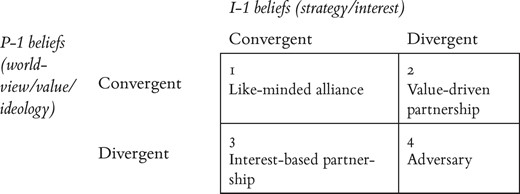
Our argument posits that the interplay between P-1 and I-1 beliefs shapes the spectrum of state-to-state relationships, which can be typologized into four categories: ‘like-minded alliance’, ‘interest-based partnership’, ‘value-based partnership’ and ‘adversary’. A ‘like-minded alliance’ is characterized by a bilateral relationship founded on a written military commitment. It is important to note that alliance literature distinguishes between defensive, offensive and neutral alliances,37 but in this context, ‘like-minded alliance’ centres on the formal treaty signed by both governments, irrespective of the alliance's nature. A ‘partnership’ represents a standard bilateral relationship between two states without a written military commitment. This partnership can either be ‘interest-based’, focusing on cooperation driven by material benefits, or ‘value-oriented’, emphasizing principled or norm-based collaboration between countries. The final category, ‘adversary’, denotes states more inclined towards a hostile relationship.
The P-1 and I-1 beliefs of two leaders are coded as either convergent or divergent, as illustrated in figure 1, showcasing how the interplay between these beliefs shapes state-to-state relations. Cell 1 represents a scenario where both leaders exhibit convergent P-1 and I-1 beliefs, indicating shared world-views, values, ideologies and strategic preferences. Our model suggests that such countries are more likely to form a ‘like-minded alliance’ during peacetime.
Balance of beliefs and state-to-state relationships

Cell 2 signifies that two leaders share world-views and fundamental values but have differing strategic approaches to achieving political goals. In this case, our model indicates that their convergent world-views and ideologies are more likely to foster a form of value-oriented cooperation between the two countries, potentially focusing on issues like human rights, democratic values or social justice.
Cell 3 depicts a situation where two leaders possess different world-views and value beliefs but share similar strategic preferences for pursuing their interests. Our model suggests that these countries are more inclined towards interest-based cooperation.
Cell 4 suggests that the two leaders share neither world-views nor strategic preferences. In this scenario, the two countries are more likely to perceive each other as adversaries during peacetime.
In summary, four testable hypotheses emerge:
H1. If two leaders share both P-1 and I-1 beliefs, signifying similar world-views, values, ideologies and strategic approaches, they are more likely to form a ‘like-minded alliance’ during peacetime.
H2. If two leaders hold convergent P-1 beliefs but divergent I-1 beliefs, indicating shared world-views and values but differing strategic approaches, they are more likely to develop a ‘value-driven partnership’ during peacetime.
H3. If two leaders hold convergent I-1 beliefs but divergent P-1 beliefs, indicating a shared strategy for achieving political goals but differing world-views and values, they are more likely to form an ‘interest-based partnership’ during peacetime.
H4. If two leaders share neither P-1 nor I-1 beliefs, signifying divergent world-views, values and strategic approaches, they are less likely to form alliances and more likely to perceive each other as adversaries during peacetime.
Traditionally, OpCode analysis relied on qualitative methods such as interview interpretation and text analysis to measure leaders' beliefs. However, since the 1990s, scholars including Stephen Walker, Mark Schafer and Michael Young have developed computer-based content analysis programmes like the Verbs in Context System (VICS) and Profiler Plus to scientifically retrieve and analyse a leader's OpCode beliefs.38 VICS, a software programme for content analysis based on verbs in leaders' speeches, codes verbs using a dictionary to construct indices of a leader's view of the political universe and preferences for strategies based on George's ten questions about philosophical and instrumental beliefs. Many scholars have employed OpCode analysis and the VICS indices to analyse foreign policy decision-making by examining decision-makers' belief systems.39
It is important to note that OpCode analysis adopts an ‘at-a-distance’ approach to examining leaders' belief systems, meaning that psychological characteristics are assessed remotely without direct access to the individuals.40 While issues like authorship of speeches and leaders' potential deceptions or manipulations of speeches for impression management may arise, they are beyond the scope of this article.41 Nonetheless, as these speeches are public statements made and publicized in front of an audience, leaders incur a cost if they fail to uphold their words by being caught ‘cheating’ the public. Even authoritarian leaders reliant on strong charisma cannot escape this cost.
OpCode analysis and the VICS scheme focus on cognitive information—information that has been consciously processed. Therefore, while speeches and statements may be prepared by speechwriters rather than leaders themselves, they still reflect leaders' views on specific policy matters. Leaders would not deliver speeches and statements to which they had not consented. As for deception and manipulation of the speeches, it may happen occasionally in the real world. VICS focuses on large numbers of verbs and uses the general pattern of the verbs to infer a leader's belief system. Leaders may attempt to deceive the public with a few brief phrases or verbs. For example, to show their peace-loving ideology, leaders may choose cooperative words to justify their warlike actions. But war remains war. No matter how carefully leaders choose their words and frame their narrative, they cannot change the fundamental nature of war. Therefore, VICS, which examines a broad array of verbs and general verb patterns, can ‘swamp few intentional deceptions’.42
As a preliminary to this study, we collected public speeches and statements on foreign affairs from leaders in the United States, Australia, China and Russia between 2013 and 2015. To ensure a matching time-frame, we collected speeches by Putin, Obama and Abbott to align with Xi's ascent to the presidency of China in March 2013.43 In addition, we collected speeches by Xi and Putin from 2016 to 2022 to compare the OpCode beliefs of these two leaders.
Alliance formation is a different matter to alliance maintenance. The potential Russia–China alliance is yet to be formed, while the alliance between the United States and Australia (for example) is an existing one which needs to be maintained. However, our balance-of-beliefs argument posits that leaders' beliefs serve as the foundation for both alliance formation and maintenance. Ideally, we would be able to compare the China–Russia case with another newly formed military alliance during peacetime. Since such an ideal case does not exist in the twenty-first century, we conducted a preliminary study comparing leaders' belief systems in the China–Russia and Australia–US cases. We encourage other scholars to test our balance-of-beliefs hypotheses with other newly formed alliances during peacetime in the future.
We sourced these speeches and statements primarily from the LexisNexis news database and official government websites, including the Ministry of Foreign Affairs of the People's Republic of China, the Russian president's website, the White House archives for the Obama administration and transcripts from Australian prime ministers.44 All these speeches and public statements are published in English and originate from official government sources. The speeches were coded as part of a purposive (rather than random) sample, so we focused on speeches on foreign policy topics, which typically exceeded 1,000 words. For example, we included Putin's speech from the eleventh annual meeting of the Valdai Discussion Club on 24 October 2014.45 Similarly, we included Xi's keynote address from the opening ceremony of the Boao Forum for Asia on 7 April 2013, the full-text transcript of which can be found on the websites of both the Chinese Foreign Ministry and the People's Daily (English version).46
In total, we collected 264 speeches for Obama, 25 for Abbott, 173 for Putin and 112 for Xi. We utilized Profiler Plus to code the VICS indices in all speeches for these four leaders. Concentrating on the two key OpCode beliefs, P-1 and I-1, the VICS indices measure P-1 belief continuously from cooperation (+1.0) to conflict (−1.0), while I-1 belief is also assessed on a continuous scale from cooperation (+1.0) to conflict (−1.0). Table 1 presents a summary of mean comparisons of the OpCode beliefs in the VICS indices among these four leaders. It is worth noting that VICS indices include five philosophical and five instrumental beliefs (from P-1 to P-5 and from I-1 to I-5). For two instrumental beliefs, I-4 and I-5, there are specific breakdowns to measure the timing of one's actions (I-4 belief) and the utility of means (I-5 belief). Since our balance-of-beliefs model relies on the two ‘master beliefs’ to measure leaders' worldviews (P-1 belief) and their strategic direction (I-1 belief), our OpCode analysis will focus primarily on interpreting and comparing the P-1 and I-1 beliefs of leaders. Other OpCode indices are included in the table for reference by scholars who wish to explore additional aspects of the leaders' belief systems using the OpCode analysis approach.47
Mean scores of the operational code beliefs of four named leaders (2013–2015)
| Mean scores | |||||
|---|---|---|---|---|---|
| Obama (N=264) | Abbott (N=25) | Putin (N=173) | Xi (N=112) | ||
| Philosophical beliefs | |||||
| P-1 | Nature of political universe (conflict/cooperation) | .49 | .43 | .61 | .67 |
| P-2 | Realization of political values (optimism/pessimism) | .24 | .23 | .33 | .46 |
| P-3 | Political future (unpredictable/predictable) | .19 | .16 | .19 | .18 |
| P-4 | Historical development (low control/high control) | .25 | .22 | .18 | .29 |
| P-5 | Role of chance (small/large role) | .95 | .96 | .97 | .94 |
| Instrumental beliefs | |||||
| I-1 | Strategic approach to goals (conflict/cooperation) | .57 | .63 | .73 | .68 |
| I-2 | Intensity of tactics (conflict/cooperation) | .24 | .30 | .34 | .32 |
| I-3 | Risk orientation (averse/acceptant) | .34 | .34 | .44 | .37 |
| I-4 | Timing of action | ||||
| a) Conflict/cooperation | .41 | .34 | .26 | .31 | |
| b) Words/deeds | .51 | .54 | .37 | .42 | |
| I-5 | Utility of means | ||||
| Punish | .11 | .08 | .04 | .07 | |
| Threat | .02 | .04 | .02 | .02 | |
| Oppose | .09 | .07 | .07 | .07 | |
| Appeal | .57 | .55 | .63 | .58 | |
| Promise | .05 | .07 | .08 | .10 | |
| Reward | .16 | .20 | .16 | .17 | |
| Mean scores | |||||
|---|---|---|---|---|---|
| Obama (N=264) | Abbott (N=25) | Putin (N=173) | Xi (N=112) | ||
| Philosophical beliefs | |||||
| P-1 | Nature of political universe (conflict/cooperation) | .49 | .43 | .61 | .67 |
| P-2 | Realization of political values (optimism/pessimism) | .24 | .23 | .33 | .46 |
| P-3 | Political future (unpredictable/predictable) | .19 | .16 | .19 | .18 |
| P-4 | Historical development (low control/high control) | .25 | .22 | .18 | .29 |
| P-5 | Role of chance (small/large role) | .95 | .96 | .97 | .94 |
| Instrumental beliefs | |||||
| I-1 | Strategic approach to goals (conflict/cooperation) | .57 | .63 | .73 | .68 |
| I-2 | Intensity of tactics (conflict/cooperation) | .24 | .30 | .34 | .32 |
| I-3 | Risk orientation (averse/acceptant) | .34 | .34 | .44 | .37 |
| I-4 | Timing of action | ||||
| a) Conflict/cooperation | .41 | .34 | .26 | .31 | |
| b) Words/deeds | .51 | .54 | .37 | .42 | |
| I-5 | Utility of means | ||||
| Punish | .11 | .08 | .04 | .07 | |
| Threat | .02 | .04 | .02 | .02 | |
| Oppose | .09 | .07 | .07 | .07 | |
| Appeal | .57 | .55 | .63 | .58 | |
| Promise | .05 | .07 | .08 | .10 | |
| Reward | .16 | .20 | .16 | .17 | |
Source: Authors' elaboration.
Mean scores of the operational code beliefs of four named leaders (2013–2015)
| Mean scores | |||||
|---|---|---|---|---|---|
| Obama (N=264) | Abbott (N=25) | Putin (N=173) | Xi (N=112) | ||
| Philosophical beliefs | |||||
| P-1 | Nature of political universe (conflict/cooperation) | .49 | .43 | .61 | .67 |
| P-2 | Realization of political values (optimism/pessimism) | .24 | .23 | .33 | .46 |
| P-3 | Political future (unpredictable/predictable) | .19 | .16 | .19 | .18 |
| P-4 | Historical development (low control/high control) | .25 | .22 | .18 | .29 |
| P-5 | Role of chance (small/large role) | .95 | .96 | .97 | .94 |
| Instrumental beliefs | |||||
| I-1 | Strategic approach to goals (conflict/cooperation) | .57 | .63 | .73 | .68 |
| I-2 | Intensity of tactics (conflict/cooperation) | .24 | .30 | .34 | .32 |
| I-3 | Risk orientation (averse/acceptant) | .34 | .34 | .44 | .37 |
| I-4 | Timing of action | ||||
| a) Conflict/cooperation | .41 | .34 | .26 | .31 | |
| b) Words/deeds | .51 | .54 | .37 | .42 | |
| I-5 | Utility of means | ||||
| Punish | .11 | .08 | .04 | .07 | |
| Threat | .02 | .04 | .02 | .02 | |
| Oppose | .09 | .07 | .07 | .07 | |
| Appeal | .57 | .55 | .63 | .58 | |
| Promise | .05 | .07 | .08 | .10 | |
| Reward | .16 | .20 | .16 | .17 | |
| Mean scores | |||||
|---|---|---|---|---|---|
| Obama (N=264) | Abbott (N=25) | Putin (N=173) | Xi (N=112) | ||
| Philosophical beliefs | |||||
| P-1 | Nature of political universe (conflict/cooperation) | .49 | .43 | .61 | .67 |
| P-2 | Realization of political values (optimism/pessimism) | .24 | .23 | .33 | .46 |
| P-3 | Political future (unpredictable/predictable) | .19 | .16 | .19 | .18 |
| P-4 | Historical development (low control/high control) | .25 | .22 | .18 | .29 |
| P-5 | Role of chance (small/large role) | .95 | .96 | .97 | .94 |
| Instrumental beliefs | |||||
| I-1 | Strategic approach to goals (conflict/cooperation) | .57 | .63 | .73 | .68 |
| I-2 | Intensity of tactics (conflict/cooperation) | .24 | .30 | .34 | .32 |
| I-3 | Risk orientation (averse/acceptant) | .34 | .34 | .44 | .37 |
| I-4 | Timing of action | ||||
| a) Conflict/cooperation | .41 | .34 | .26 | .31 | |
| b) Words/deeds | .51 | .54 | .37 | .42 | |
| I-5 | Utility of means | ||||
| Punish | .11 | .08 | .04 | .07 | |
| Threat | .02 | .04 | .02 | .02 | |
| Oppose | .09 | .07 | .07 | .07 | |
| Appeal | .57 | .55 | .63 | .58 | |
| Promise | .05 | .07 | .08 | .10 | |
| Reward | .16 | .20 | .16 | .17 | |
Source: Authors' elaboration.
Methodology and findings
We employed the ANOVA test48 to compare the means of the VICS indices for P-1 and I-1 beliefs between two leaders. Subsequently, we utilized the results of pairwise comparisons to test the hypotheses derived from the balance-of-beliefs argument.
Table 2 below summarizes the pairwise comparisons of P-1 and I-1 beliefs among these leaders using the ANOVA test. Note that in tables 2 and 3, a convergent result indicates that the difference in OpCode beliefs between two leaders is not statistically significant (p>.05), while a divergent result suggests a statistically significant difference (p<.05).
Pairwise comparisons of P-1/I-1 beliefs between two named leaders (2013–2015) (ANOVA test)
| Abbott | Putin | Xi | |
|---|---|---|---|
| Obama | P-1 convergent I-1 convergent | P-1 divergent I-1 divergent | P-1 divergent I-1 divergent |
| Abbott | P-1 divergent I-1 convergent | P-1 divergent I-1 convergent | |
| Putin | P-1 divergent I-1 convergent |
| Abbott | Putin | Xi | |
|---|---|---|---|
| Obama | P-1 convergent I-1 convergent | P-1 divergent I-1 divergent | P-1 divergent I-1 divergent |
| Abbott | P-1 divergent I-1 convergent | P-1 divergent I-1 convergent | |
| Putin | P-1 divergent I-1 convergent |
Source: Authors' elaboration.
Pairwise comparisons of P-1/I-1 beliefs between two named leaders (2013–2015) (ANOVA test)
| Abbott | Putin | Xi | |
|---|---|---|---|
| Obama | P-1 convergent I-1 convergent | P-1 divergent I-1 divergent | P-1 divergent I-1 divergent |
| Abbott | P-1 divergent I-1 convergent | P-1 divergent I-1 convergent | |
| Putin | P-1 divergent I-1 convergent |
| Abbott | Putin | Xi | |
|---|---|---|---|
| Obama | P-1 convergent I-1 convergent | P-1 divergent I-1 divergent | P-1 divergent I-1 divergent |
| Abbott | P-1 divergent I-1 convergent | P-1 divergent I-1 convergent | |
| Putin | P-1 divergent I-1 convergent |
Source: Authors' elaboration.
Mean score comparisons of operational code beliefs between Xi and Putin (2016–2022) (ANOVA test)
| Mean scores | |||
|---|---|---|---|
| Putin (N=611) | Xi (N=217) | ||
| Philosophical beliefs | |||
| P-1 | Nature of political universe (conflict/cooperation) | .5995** | .6470** |
| P-2 | Realization of political values (pessimism/optimism) | .3323** | .4113** |
| P-3 | Political future (unpredictable/predictable) | .2267** | .1829** |
| P-4 | Historical development (low control/high control) | .2514** | .1921** |
| P-5 | Role of chance (Small role/large role) | .9405** | .9650** |
| Instrumental beliefs | |||
| I-1 | Strategic approach to goals (conflict/cooperation) | .7406* | .6891* |
| I-2 | Intensity of tactics (conflict/cooperation) | .3262 | .3082 |
| I-3 | Risk orientation (averse/acceptant) | .4692 | .3963 |
| I-4 | Timing of action | ||
| a) Conflict/cooperation | .2391** | .3110** | |
| b) Words/deeds | .3711** | .4346** | |
| I-5 | Utility of means | ||
| Punish | .0515 | .0671 | |
| Threat | .0176 | .0172 | |
| Oppose | .0609 | .0717 | |
| Appeal | .6584** | .6141** | |
| Promise | .0656 | .0746 | |
| Reward | .1469 | .1559 | |
| Mean scores | |||
|---|---|---|---|
| Putin (N=611) | Xi (N=217) | ||
| Philosophical beliefs | |||
| P-1 | Nature of political universe (conflict/cooperation) | .5995** | .6470** |
| P-2 | Realization of political values (pessimism/optimism) | .3323** | .4113** |
| P-3 | Political future (unpredictable/predictable) | .2267** | .1829** |
| P-4 | Historical development (low control/high control) | .2514** | .1921** |
| P-5 | Role of chance (Small role/large role) | .9405** | .9650** |
| Instrumental beliefs | |||
| I-1 | Strategic approach to goals (conflict/cooperation) | .7406* | .6891* |
| I-2 | Intensity of tactics (conflict/cooperation) | .3262 | .3082 |
| I-3 | Risk orientation (averse/acceptant) | .4692 | .3963 |
| I-4 | Timing of action | ||
| a) Conflict/cooperation | .2391** | .3110** | |
| b) Words/deeds | .3711** | .4346** | |
| I-5 | Utility of means | ||
| Punish | .0515 | .0671 | |
| Threat | .0176 | .0172 | |
| Oppose | .0609 | .0717 | |
| Appeal | .6584** | .6141** | |
| Promise | .0656 | .0746 | |
| Reward | .1469 | .1559 | |
Source: Authors' elaboration.
Note:*P < .05 (two-tailed test) means there is less than 5% chance that the results occurred randomly, indicating that the findings are statistically significant.
**P < .01 (two-tailed test) means there is less than 1% chance that the results occurred randomly, indicating an even higher level of statistical significance.
Mean score comparisons of operational code beliefs between Xi and Putin (2016–2022) (ANOVA test)
| Mean scores | |||
|---|---|---|---|
| Putin (N=611) | Xi (N=217) | ||
| Philosophical beliefs | |||
| P-1 | Nature of political universe (conflict/cooperation) | .5995** | .6470** |
| P-2 | Realization of political values (pessimism/optimism) | .3323** | .4113** |
| P-3 | Political future (unpredictable/predictable) | .2267** | .1829** |
| P-4 | Historical development (low control/high control) | .2514** | .1921** |
| P-5 | Role of chance (Small role/large role) | .9405** | .9650** |
| Instrumental beliefs | |||
| I-1 | Strategic approach to goals (conflict/cooperation) | .7406* | .6891* |
| I-2 | Intensity of tactics (conflict/cooperation) | .3262 | .3082 |
| I-3 | Risk orientation (averse/acceptant) | .4692 | .3963 |
| I-4 | Timing of action | ||
| a) Conflict/cooperation | .2391** | .3110** | |
| b) Words/deeds | .3711** | .4346** | |
| I-5 | Utility of means | ||
| Punish | .0515 | .0671 | |
| Threat | .0176 | .0172 | |
| Oppose | .0609 | .0717 | |
| Appeal | .6584** | .6141** | |
| Promise | .0656 | .0746 | |
| Reward | .1469 | .1559 | |
| Mean scores | |||
|---|---|---|---|
| Putin (N=611) | Xi (N=217) | ||
| Philosophical beliefs | |||
| P-1 | Nature of political universe (conflict/cooperation) | .5995** | .6470** |
| P-2 | Realization of political values (pessimism/optimism) | .3323** | .4113** |
| P-3 | Political future (unpredictable/predictable) | .2267** | .1829** |
| P-4 | Historical development (low control/high control) | .2514** | .1921** |
| P-5 | Role of chance (Small role/large role) | .9405** | .9650** |
| Instrumental beliefs | |||
| I-1 | Strategic approach to goals (conflict/cooperation) | .7406* | .6891* |
| I-2 | Intensity of tactics (conflict/cooperation) | .3262 | .3082 |
| I-3 | Risk orientation (averse/acceptant) | .4692 | .3963 |
| I-4 | Timing of action | ||
| a) Conflict/cooperation | .2391** | .3110** | |
| b) Words/deeds | .3711** | .4346** | |
| I-5 | Utility of means | ||
| Punish | .0515 | .0671 | |
| Threat | .0176 | .0172 | |
| Oppose | .0609 | .0717 | |
| Appeal | .6584** | .6141** | |
| Promise | .0656 | .0746 | |
| Reward | .1469 | .1559 | |
Source: Authors' elaboration.
Note:*P < .05 (two-tailed test) means there is less than 5% chance that the results occurred randomly, indicating that the findings are statistically significant.
**P < .01 (two-tailed test) means there is less than 1% chance that the results occurred randomly, indicating an even higher level of statistical significance.
We observe that Obama and Abbott exhibit convergent P-1 and I-1 beliefs, indicating shared world-views, values, ideologies and strategic preferences. This aligns with our H1 hypothesis, supporting the notion that shared world-views (P-1 belief) and similar strategic approaches to political goals (I-1 belief) are essential conditions for a military alliance during peacetime. The centennial celebration of ‘Mateship’ between the United States and Australia in 2018, along with the signature of the new AUKUS security partnership—involving the US, Australia and the UK—in 2021, underscores the strength of their like-minded alliance.
In contrast, our analysis reveals that during the period of our preliminary study, Putin and Xi held divergent world-views and values (P-1 belief) but shared a similar strategic approach to achieving their goals (I-1 belief). This suggests that Russia and China may not form a peacetime alliance, due to differing values and world-views regarding the nature of the political universe. However, their shared belief in strategic approach (I-1 belief) opens avenues for interest-based cooperation, a topic we will delve into in our later case-study. It is worth noting that Abbott held a convergent I-1 belief (strategy) with both Russia and China, despite having a divergent P-1 belief (world-view/value) from both Putin and Xi. This implies that Australia might have been inclined to engage in interest-based cooperation with Russia and China under Abbott's leadership.
In reality, the world witnessed the conclusion of a ‘history-making’ free trade agreement in June 2015 by Australia and China—a notable achievement for Abbott.49 In the case of Russia, Abbott vowed to ‘shirtfront’ Putin (a term used in Australian Rules football) over the shooting down over Ukraine of Malaysia Airlines flight MH17 in July 2014, in which 298 people, including 38 Australians, were killed.50 However, Abbott did not openly confront Putin in this manner when they met at the Asia–Pacific Economic Cooperation ministerial meeting in November in Beijing. Instead, both leaders were reported as having called for ‘progress in the investigation into the downing of flight MH17’.51 It is clear that despite strained relations over the Ukraine crisis after 2014, Australia and Russia engaged in interest-based cooperation.
Another noteworthy observation from table 2 is that Obama held divergent P-1 beliefs (world-view/value) as well as I-1 beliefs (strategy) with both Putin and Xi. This suggests that the United States is more likely to consider both Russia and China as adversaries, aligning with our H4. While Obama attempted to reset the US–Russia relationship during his first term, that relationship faltered due to events like the Libyan civil war and the ‘Orange Revolution’ in Ukraine, which culminated in Russia's annexation of Crimea in 2014.52
Similarly, while Obama publicly stated that the US pivot to Asia did not target China, Chinese leaders believed it aimed to contain China's rise.53 Our OpCode analysis indicates that both countries have treated each other as adversaries even during the Obama administration, potentially foreshadowing the further deterioration in US–China relations under the Trump and Biden administrations.
In the 2022 Indo-Pacific Strategy of the United States China was labelled a particular ‘challenge’ for the United States because it is ‘undermining human rights and international law, including freedom of navigation, as well as other principles that have brought stability and prosperity to the Indo-Pacific’.54 It is evident that the US has treated China as its adversary since the Obama era, although some politicians might not want to acknowledge it in public.
In summary, our OpCode analyses support H1, H3 and H4. Convergent world-views and values (P-1 belief) along with shared strategic approaches (I-1 belief) between Obama and Abbott indicate a robust, like-minded alliance between the United States and Australia that is expected to endure and potentially strengthen during peacetime. Conversely, divergent world-views and values (P-1 belief) between Putin and Xi suggest a lack of an ideational/value-based foundation for a military alliance during peacetime. However, their shared belief in strategy (I-1 belief) suggests a readiness for interest-based cooperation. Divergent world-views (P-1 belief) and strategic beliefs (I-1 belief) between Obama on one side and Putin and Xi on the other point to the United States treating both Russia and China as adversaries—and vice versa.
In order to further test our hypotheses, we conducted an additional comparison of the OpCode beliefs between Xi and Putin from 2016 to 2022. In this period, we collected 611 speeches for Putin and 217 for Xi. Table 3 displays the mean score comparison of their philosophical beliefs during this period. Interestingly, we observed significant differences in all philosophical beliefs between Xi and Putin at the .01 level. It indicates a high level of statistical significance, meaning there is only a 1 in 100 chance that the observed differences occurred randomly. Specifically, Xi exhibits a more cooperative world-view than Putin on the P-1 belief, while he holds a more optimistic view on the realization of political values (P-2). However, Putin demonstrates higher confidence levels in predicting political futures (P-3) and controlling historical development (P-4). Additionally, Xi shows a slightly higher belief in chance in historical development (P-5) compared to Putin. Putin's philosophical beliefs portray him as a confident leader with a pessimistic and conflictual world-view, which may shed light on his aggressive actions against Ukraine in 2022. In contrast, Xi appears to be a less assertive leader with a more cooperative world-view.
The differences in instrumental beliefs between the two leaders are also intriguing. While the difference in I-1 beliefs is statistically significant at the .05 level, it becomes insignificant at the .01 level. This means that the difference in I-1 beliefs between Xi and Putin is notable, with less than 5 per cent chance that it occurred randomly, but it is not considered significant at a stricter less than 1 per cent chance threshold. Comparing against our previous analyses from the 2013–2015 period, we observe slight increases in the I-1 scores of both Xi and Putin in 2016–2022. Initially, their beliefs appeared to diverge, but upon adjusting the significance level, they appear to converge again. This indicates that the difference in I-1 beliefs between Xi and Putin is marginal. According to our model, the relationship between China and Russia falls between an interest-based partnership and an adversary.
This finding contradicts the conventional view and political rhetoric from both Chinese and Russian governments, which often tout a ‘no-limits’ partnership.55 However, considering the historical conflicts between the two nations, particularly Russia's invasions of China, it is understandable that Chinese leaders, including Xi, may harbour suspicions and distrust towards Russia. Our research suggests that the current cooperative relationship between China and Russia is primarily based on shared interests; it could potentially shift towards a competitive or conflictual direction in the future.
Interest-based cooperation between Russia and China
Our OpCode analysis indicates that the relationship between China and Russia relies more on common interests (the I-1 belief) than shared world-views and values (the P-1 belief) among their leaders. This explains why a formal military alliance between the two nations has not materialized. In this section, we delve into a brief case-study focusing on how the ‘common interest’ in dealing with the US threats has shaped the bilateral relationship between China and Russia since the 2000s.
Russia's 2008 war with Georgia strained the former's relations with the West, especially the United States. This conflict, essentially a proxy war, originated in the ‘colour revolutions’ in former Soviet republics like Georgia, Ukraine and Kyrgyzstan between 2003 and 2005.56 These revolutions resulted in the toppling of pro-Russian incumbents by pro-western opposition leaders. During this period, the United States established military bases in Central Asia and provided military advisers to Georgia. Georgia has subsequently pursued NATO membership.
Just two weeks before the outbreak of war in 2008, the United States and Russia conducted separate parallel military exercises in the region. During the conflict, Russia invaded Georgia's Abkhazia and South Ossetia regions. Although the US strongly condemned Russia's actions, it refrained from direct involvement, instead sending humanitarian aid. Russia, in the aftermath, publicly asserted privileged interests in certain regions, implicitly referring to the Commonwealth of Independent States.57 This declaration resembled Russia's version of the ‘Monroe doctrine’, aimed at limiting US and European influence.
Subsequently, Russia's relations with the West deteriorated—particularly after the 2013–14 Ukraine crisis and Russia's annexation of Crimea in 2014. Western economic sanctions triggered a severe economic crisis in Russia. Ukraine played a pivotal role in shaping US perceptions of Russia, leading to heightened tensions. As Michael McFaul notes, ‘After Putin annexed Crimea … Russia and the US, as well as Russia and the West, have clashed.’58
Even during Trump's tenure, which was characterized by the warmth of his personal relationship with Putin, Russian meddling in the 2016 US presidential election and investigations into Trump's ties with Russia hindered diplomatic progress. The US Congress imposed new sanctions on Russia, and Trump cancelled his planned meeting with Putin during the 2018 Argentina G20 meeting. Russia withdrew from the Open Skies Treaty on 15 January 2021, following the US pullout in November 2020.59 After Biden's inauguration to the US presidency a few days later, the bilateral relationship between the US and Russia worsened. New sanctions announced by the US in April 2021 included the expulsion of ten Russian diplomats and intelligence officers from Washington. Russia retaliated by calling back its ambassador to Washington and sanctioning American diplomats. As the long-time Russia-watcher James Goldgeier points out, even good diplomacy cannot smooth a clash of interests between the two nations.60 The ongoing war between Russia and Ukraine which ensued from Russia's invasion in February 2022 has dragged US-Russian relations to a new nadir.
Concerning US–China relations, the American threat towards China intensified into the 2010s. Starting in 2009, Obama initiated a series of foreign policies with a strategic focus on the Asia–Pacific. It was later labelled the ‘US pivot towards Asia’, aiming to strengthen US multidimensional engagement in the region. The ‘pivot to Asia’ policy aimed to strengthen ties with traditional allies, enhance political engagement and promote the Trans-Pacific Partnership (later superseded by the Comprehensive and Progressive Agreement for Trans-Pacific Partnership), which notably excluded China. China, in response, has conducted rapid and massive island reclamation projects in the South China Sea since 2013, which has provoked regional concern among both south-east Asian countries and the United States. Tensions escalated in 2015 when the US conducted freedom of navigation operations (FONOPs) in disputed areas of the South China Sea.
Following Trump's rise to the US presidency in 2017, a fully-fledged confrontation with China unfolded, encompassing a trade war, tech war and military containment strategy. The COVID–19 pandemic further strained relations, with Trump's rhetoric blaming China for the pandemic. The US intensified FONOPs, sent the 7th fleet to the Taiwan Strait and conducted further joint military exercises in the Indo-Pacific region. Biden has largely continued Trump's policies towards China, emphasizing competition and strategic confrontation. He has framed the US–China relationship as an ‘extreme competition’ and a ‘long-term strategic competition’.61 The United States has strengthened ties with Taiwan, supported south-east Asian claimants in the South China Sea and reinforced alliances. The 2021 AUKUS security pact was principally aimed at countering China's influence in the Indo-Pacific.
Strategically, under Biden, the United States has appeared to confront both Russia and China simultaneously. As David Sanger observed following a presidential address to Congress early in 2021: ‘Competition with China and containment of Russia were the subtext of the president's call for action.’62 This approach is seen as driven by a competition between democratic and authoritarian regimes, potentially heralding a new Cold War.63
It is essential to note that strained relations between Russia and the United States, and between the US and China, are not solely attributed to any one party. Our previous OpCode analysis has demonstrated that US leaders hold divergent worldviews (P-1 belief) and strategic approaches (I-1 belief) compared to Russian and Chinese leaders. For Putin and Xi, although their divergent worldviews preclude a formal alliance between Russia and China, their convergent strategic approaches (I-1 belief) have formed the basis for ‘common interests’ in international cooperation. For example, China and Russia held a common stand on the Iran and Syria issues in the United Nations. Both China and Russia were integral in negotiating the Joint Comprehensive Plan of Action (JCPOA), also known as the Iran nuclear deal, which was signed in 2015. The agreement aimed to limit Iran's nuclear capabilities in exchange for lifting economic sanctions. After the US withdrawal from the JCPOA in 2018, the Trump administration sought to reimpose UN sanctions on Iran through the ‘snapback’ mechanism in Resolution 2231. China and Russia strongly opposed these efforts, arguing that the US, having withdrawn from the agreement, had no standing to trigger the snapback provision. Their opposition effectively blocked the US attempt, demonstrating their coordinated stance and influence in the Security Council.64 On the Syria issue, according to the UN Security Council veto dataset, China and Russia have jointly vetoed Syria-related Middle Eastern resolutions ten times since 2011. Although Russia vetoed six other resolutions without China, the four Syria-only resolutions from 2011 to 2014 were vetoed by both China and Russia.65
Diplomatic coordination between Russia and China aimed at the United States is evident. For instance, Russian foreign minister Sergei Lavrov visited China shortly after a US–China high-level meeting in Anchorage, Alaska in March 2021. In May 2021, Putin and Xi had a virtual meeting to celebrate the completion of four Russian-built nuclear power plants in China, one day before US Secretary of State Antony Blinken and Lavrov met at the Arctic Council meeting in Iceland.66 Joint projects like the International Lunar Research Station highlight their common interests, as does economic cooperation—cited by Putin in June 2021 as a ‘key area’ of coinciding interests between the two states.67 As mentioned above, China has signed several massive energy deals with Russia since the West imposed economic sanctions on Russia over the Ukraine crisis in 2014. In addition, the two countries have also coordinated their efforts in the Belt and Road Initiative (BRI) and the Eurasian Economic Union.68
Despite growing cooperation, underlying issues between China and Russia remain unaddressed. Divergent philosophical beliefs in world-views and values between Xi and Putin could be a cause. For instance, significant breakthroughs in energy cooperation between the two occurred only after the Ukraine crisis gave rise to western sanctions against Russia—which became the major driving force in concluding the bilateral energy deals. There are two possible implications of this. First, economic cooperation between the two countries will face more challenges than promising opportunities in the future. As reported, Russia has made huge compromises in negotiating the energy deals with China.69 Russia initially wanted China to pay the same price for gas as Europe does, at US$380.50 per thousand cubic metres. However, China refused. Although the exact price details haven't been disclosed, it's likely China got a better deal because it has more leverage over Russia, especially after Russia's actions in Ukraine hurt its international reputation and led to western sanctions on Russia's energy sector.70 This temporary compromise might entail future friction between the two nations. Second, the common security threat plays an important role in enhancing economic cooperation. However, a diminution of the security threat may also have a negative impact on economic cooperation in the future.
Additionally, both nations understand that overdependence can lead to vulnerability. China has diversified its oil supply in Central Asia—traditionally Russia's sphere of influence. Russia, in turn, seeks energy markets in other Asian countries, such as Japan, India, Mongolia, South Korea and Vietnam, and even North Korea.71 Intentionally or not, Russia's energy cooperation with some Asian countries has brought China some strategic discomfort. For example, Russia's 2012 energy deal with Vietnam in the South China Sea, where China has claimed its undisputed sovereignty, was seen as a ‘stab in the back’ on the part of Russia by some Chinese analysts.72 In June 2024, Putin paid a state visit to Vietnam and signed 11 memorandums for cooperation in civil nuclear projects, energy and petroleum, education, and disease prevention. The close energy cooperation between Russia and Vietnam in the South China Sea will inevitably be at odds with China's claims and interests in that region.73 In the same vein, Russia has deep concerns that China's Silk Road Economic Belt (part of the BRI) across Central Asia will undermine Russia's geopolitical influence in Eurasia.74 As Ankur Shah points out, ‘despite the public rhetoric harmonizing Xi and Putin's premier foreign-policy projects, there is little tangible evidence to show that Russia is even an official partner country of the Belt and Road Initiative’.75
Russia's arms trade with China is another complex aspect. While Russia is a crucial weapons supplier to China, it has been cautious about transferring advanced military technology given China's potential as a global competitor. Even though Russia sold its S-400 missile system to China in 2014, it was viewed as a financial decision rather than a strategic one. Russia's arms deals with China's neighbours, like Vietnam, serve as deterrence against China in the South China Sea. For example, Russia has sold six Kilo-class submarines to the Vietnamese Navy since 2009, which were more advanced than those which China obtained from Russia.76
Conclusion
In this research, we have made two theoretical and methodological contributions to the studies of China–Russia relations. First, we have challenged the traditional balance-of-threat theory and introduced a novel alliance formation theory in peacetime—the balance-of-beliefs argument. This theory posits that a convergence of belief systems serves as a crucial prerequisite for alliance formation during times of peace, given the difficulties in assessing and quantifying threats among states. Second, employing the OpCode analysis, a psychological approach, we have proposed a new method to measure leaders' beliefs and empirically tested our hypotheses within the balance-of-beliefs argument by scrutinizing the convergences and divergences of two critical OpCode beliefs (the P-1 and I-1 beliefs) held by four leaders from the United States, Australia, China and Russia during the period between 2013 and 2015. Our OpCode analyses offer substantial support for our balance-of-beliefs argument, demonstrating that shared world-views and values (the P-1 belief) and a shared belief in strategy (the I-1 belief) are essential prerequisites for establishing and sustaining like-minded alliances during peacetime, as exemplified by the cases of Australia and the United States.
Xi and Putin notably differ significantly in their world-views and values (the P-1 belief), which explains why China and Russia have not formed a military alliance despite mounting pressure and threats from the United States. However, they share a common instrumental belief in strategies for achieving political goals (the I-1 belief). This shared belief implies that Xi and Putin are more inclined to cooperate strategically, engaging in interest-based cooperation in specific issue areas. In addition, we examined the OpCode beliefs of Xi and Putin from speeches delivered between 2016 and 2022. The results reveal stark differences in their philosophical beliefs, significantly reducing the likelihood of forming a military alliance between them. Additionally, the key instrumental belief (I-1) regarding strategy between Xi and Putin is on the brink of divergence. This suggests that their bilateral relationship is primarily rooted in common interests and may transition towards a competitive or conflictual direction in the future. A brief case-study reinforces these empirical findings by highlighting how the Sino-Russian relationship primarily hinges on common interests, primarily driven by a shared perception of the United States as a common threat during the 2010s. Nevertheless, fundamental differences persist between the two nations, such as economic competition and military distrust, which may stem from the divergent philosophical belief systems in world-views and values held by Xi and Putin.
Our findings hold two significant policy implications. First, while our research indicates that Xi and Putin do not currently share a similar P-1 belief (world-view/value) conducive to alliance formation, it does not rule out the possibility of a future China–Russia military alliance. A leader's belief system can evolve due to changing external circumstances. The balance-of-beliefs argument is more applicable during peacetime. If US threats directed at Russia and China escalate to a level approaching wartime conditions, a Sino-Russian military alliance may transition from being a mere illusion to a harsh reality, affecting not only the United States but also the broader western world. The ongoing Russia–Ukraine conflict has brought Russia to the brink of a confrontation with NATO, raising the spectre of a potentially catastrophic nuclear event. It is imperative for global powers, especially US leaders, to contemplate strategies for de-escalation. In this context, China could play a pivotal role in facilitating de-escalation between Russia and the West. However, it requires some strategic wisdom and courage to reset the US–China relations.
The United States, as the current hegemon in a unipolar world, holds the initial advantage in shaping the strategic landscape of the twenty-first century. Naturally, the hegemon seeks to safeguard its dominance or extend its unipolar moment. Nevertheless, if the United States pursues a strategy aimed at simultaneously countering both Russia and China, it risks a self-fulfilling prophecy: successful Sino-Russian cooperation could hasten US decline instead of preserving its hegemony. Our research underscores that Putin and Xi hold distinct world-views and values. Treating Russia and China as identical autocratic regimes or forcing them into the same grouping would be a strategic misjudgement. Both Russia and China aspire to garner respect, recognition and a prominent status in global politics.77 The United States must contemplate how to coexist with a rising China and a resurgent Russia. Balancing the protection of US vital interests while accommodating the legitimate interests of Russia and China will be a pivotal task for US policy-makers in the coming decades.78
Footnotes
Xinhua, ‘China, Russia pledge to remember history, strengthen practical cooperation’, Global Times, 9 May 2015, https://www.globaltimes.cn/content/920682.shtml. (Unless otherwise noted at point of citation, all URLs cited in this article were accessible on 31 July 2024.)
President of Russia, ‘Joint statement of the Russian Federation and the People's Republic of China on the international relations entering a new era and the global sustainable development’, 4 Feb. 2022, http://en.kremlin.ru/supplement/5770.
Olga Tanas and Dina Khrennikova, ‘Russia signs oil and gas deals with China as relations with the West sour’, Bloomberg, 4 Feb. 2022, https://www.bloomberg.com/news/articles/2022-02-04/russia-s-gazprom-signs-new-gas-supply-contract-with-china.
CCTV News, ‘Xi Jinping tong erluosi Zongtong Pujing Huitan’ [Xi Jinping holds talks with Russian President Putin], People's Daily, 18 Oct. 2023, http://politics.people.com.cn/n1/2023/1018/c1024-40098142.html.
Karson Yiu, ‘Xi, Putin detail “deepening” relations between Beijing and Moscow during conference in China’, ABC News, 18 Oct. 2023, https://abcnews.go.com/International/xi-putin-detail-deepening-relations-beijing-moscow-conference/story?id=104032366.
Cao Desheng, ‘China, Russia intensify partnership’, China Daily, 17 May 2024, https://epaper.chinadaily.com.cn/a/202405/17/WS6646a779a310df4030f51973.html.
Pavel Mikheyev, ‘Putin and Xi to meet at SCO summit to bolster security and counter the US’, Reuters, 3 July 2024, https://www.reuters.com/world/putin-arrives-kazakhstan-russia-china-dominated-sco-summit-2024-07-03/.
Fu Ying, ‘How China sees Russia: Beijing and Moscow are close, but not allies’, Foreign Affairs 95: 1, 2016, pp. 96–105 at p. 96, https://www.foreignaffairs.com/articles/china/2015-12-14/how-china-sees-russia.
‘Putin calls for closer Russia–China cooperation on military satellites and prospective weapons’, Associated Press, 8 Nov. 2023, https://apnews.com/article/russia-china-military-cooperation-d4fedabf86d88e2cc0074159294026f9.
Stephen M. Walt, The origins of alliances (Ithaca, NY: Cornell University Press, 1987).
For NATO expansion and US strategy towards Russia after the Cold War, see James M. Goldgeier and Michael McFaul, Power and purpose: US policy toward Russia after the Cold War (Washington DC: Brookings Institution Press, 2003); M. E. Sarotte, Not one inch: America, Russia, and the making of post-Cold War stalemate (New Haven, CT: Yale University Press, 2021).
Bob Davis and Lingling Wei, Superpower showdown: how the battle between Trump and Xi threatens a new Cold War (New York: HarperCollins, 2020).
Yen Nee Lee, ‘Biden may face an uphill task trying to form an “anti-China alliance” in Asia’, CNBC News, 21 Feb. 2021, https://www.cnbc.com/2021/02/22/biden-could-have-a-hard-time-gathering-asian-countries-against-china.html.
Jennifer Anderson, The limits of Sino-Russian strategic partnership, Adelphi Paper 315 (London: Oxford University Press and International Institute of Strategic Studies, 1997); Martha Brill Olcott, Michael McFaul and Sherman Garnett, eds, Rapprochement or rivalry? Russia–China relations in a changing Asia (Washington DC: Carnegie Endowment for International Peace, 2000); Bobo Lo, Axis of convenience: Moscow, Beijing, and the new geopolitics (Washington DC: Brookings Institution Press, 2008); James Bellacqua, ed., The future of China–Russia relations (Lexington, KY: The University Press of Kentucky, 2010). For excellent reviews on Chinese scholars' debates over a possible alliance between China and Russia, see Ruonan Liu and Feng Liu, ‘Contending ideas on China's non-alliance strategy’, The Chinese Journal of International Politics 10: 2, 2017, pp. 151–71, https://doi.org/10.1093/cjip/pox003; Adam P. Liff, ‘China and the US alliance system’, The China Quarterly, vol. 233, 2018, pp. 137–65, https://doi.org/10.1017/S0305741017000601.
Lo, Axis of convenience.
Joseph S. Nye, Jr, ‘A new Sino-Russian alliance?’ Project Syndicate, 12 Jan. 2015, http://www.project-syndicate.org/commentary/russia-china-alliance-by-joseph-s--nye-2015-01.
Zack Beauchamp, ‘The big problems in the Russia–China relationship can't be solved by a gas deal’, Vox, 23 May 2014, http://www.vox.com/2014/5/23/5741362/russia-china-pipedream-alliance.
Michael O'Hanlon and Adam Twardowski, ‘An alliance between Russia and China is the next military threat’, 12 Dec. 2019, The Hill, https://thehill.com/opinion/national-security/474424-an-alliance-between-russiaand-china-is-the-next-military-threat/.
Gilbert Rozman, ‘Asia for the Asians: why Chinese–Russian friendship is here to stay’, Foreign Affairs, 29 Oct. 2014, https://www.foreignaffairs.com/articles/east-asia/2014-10-29/asia-asians; also Gilbert Rozman, The Sino-Russian challenge to the world order (Redwood City, CA: Stanford University Press, 2014).
Huiyun Feng, The new geostrategic game: will China and Russia form an alliance against the United States? (Copenhagen: Danish Institute of International Studies, 2015).
Robert A. Pape, ‘Soft balancing against the United States’, International Security 30: 1, 2005, pp. 7–45, https://doi.org/10.1162/0162288054894607; T.V. Paul, ‘Soft balancing in the age of U.S. primacy’, International Security 30: 1, 2005, pp. 46–71, https://doi.org/10.1162/0162288054894652; Kai He and Huiyun Feng, ‘If not soft balancing, then what? Reconsidering soft balancing and US policy toward China’, Security Studies 17: 2, 2008, pp. 363–95, https://doi.org/10.1080/09636410802098776.
See Kenneth Lieberthal and Wang Jisi, Addressing U.S.–China strategic distrust (Washington DC: John L. Thornton China Center at the Brookings Institution, 2012), p. 7.
For the different natures of alliances in peacetime and wartime, see Patricia A. Weitsman, ‘Intimate enemies: the politics of peacetime alliances’, Security Studies 7: 1, 1997, pp. 156–93, https://doi.org/10.1080/09636419708429337; and Patricia A. Weitsman, Dangerous alliances: proponents of peace, weapons of war (Redwood City, CA: Stanford University Press, 2004).
Mark L. Haas, ‘When do ideological enemies ally?’ International Security 46: 1, 2021, pp. 104–46, https://doi.org/10.1162/isec_a_00413.
For more difficulties of peacetime alliances, see James D. Morrow, ‘Alliances, credibility, and peacetime costs’, Journal of Conflict Resolution 38: 2, 1994, pp. 270–97, https://doi.org/10.1177/0022002794038002005.
Alexandra Gheciu, ‘Security institutions as agents of socialization? NATO and the “new Europe”’, International Organization 59: 4, 2005, pp. 973–1012, https://doi.org/10.1017/S0020818305050332; Rachel A. Epstein, ‘NATO enlargement and the spread of democracy: evidence and expectations’, Security Studies 14: 1, 2005, pp. 63–105, https://doi.org/10.1080/09636410591002509.
Walt, The origins of alliances, p. 22.
Henry R. Nau, ‘Ideas have consequences: the Cold War and today’, International Politics 48: 4/5, 2011, pp. 460–81, http://doi.org/10.1057/ip.2011.19; John M. Owen, IV, The clash of ideas in world politics: transnational networks, states, and regime change, 1510–2010 (Princeton: Princeton University Press, 2010); Daryl Grayson, Calculating credibility: how leaders assess military threats (Ithaca, NY and London: Cornell University Press, 2005).
Alexander Wendt, ‘Constructing international politics’, International Security 20: 1, 1995, pp. 71–81 at p. 73, https://doi.org/10.2307/2539217.
Wendt, ‘Constructing international politics’.
Walt, The origins of alliances.
Mark L. Haas, The ideological origins of great power politics, 1789–1989 (Ithaca, NY: Cornell University Press, 2005).
John S. Duffield, World power forsaken: political culture, international institutions, and German security policy after unification (Redwood City, CA: Stanford University Press, 1998), pp. 24–5.
Stephen G. Walker, ‘Foreign policy analysis and behavioral International Relations’, in Stephen Walker, Akan Malici and Mark Schafer, eds, Rethinking foreign policy analysis: states, leaders and the microfoundations of behavioral International Relations (London and New York: Routledge, 2011), p. 6.
Nathan Leites, The operational code of the Politburo (New York: McGraw Hill, 1951); Alexander L. George, ‘The “operational code”: a neglected approach to the study of political leaders and decision-making’, International Studies Quarterly 13: 2, 1969, pp. 190–222, https://doi.org/10.2307/3013944. For an excellent example of operational code analysis applications in foreign policy analysis, see Mark Schafer and Stephen G. Walker, eds, Beliefs and leadership in world politics: methods and applications of operational code analysis (New York: Palgrave Macmillan, 2006).
Ole R. Holsti, The ‘operational code’ as an approach to the analysis of belief systems: final report to the National Science Foundation, grant SOC75-15368 (Durham, NC: Duke University, 1977); Stephen G. Walker, ‘The interface between beliefs and behavior: Henry Kissinger's operational code and the Vietnam War’, Journal of Conflict Resolution 21: 1, 1977, pp. 129–68, https://doi.org/10.1177/002200277702100107; Stephen G. Walker, ‘The motivational foundations of political belief systems: a re-analysis of the operational code’, International Studies Quarterly 27: 2, 1983, pp. 179–202, https://doi.org/10.2307/2600545; Schafer and Walker, Beliefs and leadership in world politics.
Brett Ashley Leeds, ‘Do alliances deter aggression? The influence of military alliances on the initiation of militarized interstate disputes’, American Journal of Political Science 47: 3, 2003, pp. 427–39, https://doi.org/10.2307/3186107.
Stephen G. Walker, Mark Schafer and Michael D. Young, ‘Profiling the operational codes of political leaders’, in Jerrold M. Post, ed., The psychological assessment of political leaders: with profiles of Saddam Hussein and Bill Clinton (Ann Arbor, MI: University of Michigan Press, 2003), pp. 215–45 at pp. 215–16; Stephen G. Walker, Mark Schafer and Michael D. Young, ‘Systematic procedures for operational code analysis: measuring and modeling Jimmy Carter's operational code’, International Studies Quarterly 42: 1, 1998, pp. 175–89, https://doi.org/10.1111/0020-8833.00074.
For some examples, see Walker, Schafer and Young, ‘Systematic procedures for operational code analysis’; Huiyun Feng, ‘The operational code of Mao Zedong: defensive or offensive realist?’, Security Studies 14: 4, 2005, pp. 637–62, https://doi.org/10.1080/09636410500468818; Akan Malici and Johanna Malici, ‘The operational codes of Fidel Castro and Kim Il Sung: the last Cold Warriors?’, Political Psychology 26: 3, 2005, pp. 387–412, http://doi.org/10.1111/j.1467-9221.2005.00423.x; B. Gregory Marfleet, ‘The operational code of John F. Kennedy during the Cuban Missile Crisis: a comparison of public and private rhetoric’, Political Psychology 21: 3, 2000, pp. 545–58, https://doi.org/10.1111/0162-895X.00203; Mark Schafer and Stephen G. Walker, ‘Democratic leaders and the democratic peace: the operational codes of Tony Blair and Bill Clinton’, International Studies Quarterly 50: 3, 2006, pp. 561–83, https://doi.org/10.1111/j.1468-2478.2006.00414.x.
March Schafer and Stephen Walker, ‘Operational code analysis at a distance: the verbs in context system of content analysis’, in Schafer and Walker, Beliefs and leadership in world politics, p. 26.
For an extensive discussion, see Mark Schafer, ‘Issues in assessing psychological characteristics at a distance’, Political Psychology 21: 3, 2000, pp. 511–28, https://doi.org/10.1111/0162-895X.00201.
Schafer and Walker, ‘Operational code analysis at a distance’, p. 47.
Tony Abbott left office in September 2015, hence our collection period for Abbott ended in 2015.
See relevant national government websites at www.fmprc.gov.cn, http://en.kremlin.ru, https://obamawhitehouse.archives.gov and https://pmtranscripts.pmc.gov.au.
For the English transcript of President Putin's speech at Valdai in 2014, see President of Russia, ‘Meeting of the Valdai international discussion club’, 24 Oct. 2014, http://en.kremlin.ru/events/president/news/46860.
For the Ministry of Foreign Affairs of the People's Republic of China, see www.fmprc.gov.cn. For Xi's speech at the Boao Forum in 2013, see People's Daily Online, ‘Full text of Xi Jinping's speech at opening ceremony of Boao Forum’, 8 April 2013, http://en.people.cn/102774/8198390.html.
For more details on the OpCode analysis and VICS indices, see Schafer and Walker, ‘Operational code analysis at a distance’, pp. 25–51.
ANOVA, or Analysis of Variance, is a statistical test used to identify differences among research results from independent samples or groups.
Dan Conifer, ‘Australia and China sign “history making” free trade agreement after a decade of negotiations’, ABC News, 17 June 2015, https://www.abc.net.au/news/2015-06-17/australia-and-china-sign-free-trade-agreement/6552940.
Gabrielle Chan and Gay Alcorn, ‘Tony Abbott says he will “shirtfront” Vladimir Putin over downing of MH17’, Guardian, 13 Oct. 2014, https://www.theguardian.com/world/2014/oct/13/tony-abbott-says-he-will-shirtfront-vladimir-putin-over-downing-of-mh17.
‘MH17 Disaster: Tony Abbott holds talks with Putin’, BBC News, 12 Nov. 2014, https://www.bbc.com/news/world-australia-30015042.
Mikhail Zygar, ‘The Russian reset that never was’, Foreign Policy, 9 Dec. 2016, https://foreignpolicy.com/2016/12/09/the-russian-reset-that-never-was-putin-obama-medvedev-libya-mikhail-zygar-all-the-kremlin-men.
Kenneth Lieberthal and Wang Jisi, Addressing U.S.–China strategic distrust (Washington DC: John L. Thornton China Center at Brookings, 2012).
The White House, Indo-Pacific strategy of the United States, 2022, https://www.whitehouse.gov/wp-content/uploads/2022/02/U.S.-Indo-Pacific-Strategy.pdf, p. 5.
See Guy Faulconbridge and Laurie Chen, ‘Putin to visit China to deepen “no limits” partnership with Xi’, Reuters, 15 Oct. 2023, https://www.reuters.com/world/putin-visit-china-deepen-no-limits-partnership-with-xi-2023-10-15.
Ronald D. Asmus, A little war that shook the world: Georgia, Russia, and the future of the West (New York: Palgrave Macmillan, 2010).
Jeffrey Mankoff, Russian foreign policy: the return of great power politics (Lanham, MD: Rowman & Littlefield, 2009), p. 31.
Michael McFaul, ‘Putin, Putinism, and the domestic determinants of Russian foreign policy’, International Security 45: 2, 2020, pp. 95–139 at p. 95, https://doi.org/10.1162/isec_a_00390.
The treaty, signed in 1992 and entered into force in 2002, aimed to increase confidence in and transparency of military activities by permitting each state-party to conduct short-notice, unarmed observation flights over the others' entire territories to collect data. See Hollis Rammer, ‘Russia officially leaves Open Skies Treaty’, Arms Control Today, July/Aug. 2021, https://www.armscontrol.org/act/2021-07/news/russia-officially-leaves-open-skies-treaty.
James Goldgeier, ‘U.S.-Russian relations will only get worse: even good diplomacy can't smooth a clash of interests’, Foreign Affairs, 6 April 2021, https://www.foreignaffairs.com/articles/russia-fsu/2021-04-06/us-russian-relations-will-only-get-worse.
‘Biden: China should expect “extreme competition” from US’, AP News, 7 Feb. 2021; Emma Ashford, ‘Great-power competition is a recipe for disaster’, Foreign Policy, 1 April 2021, https://foreignpolicy.com/2021/04/01/china-usa-great-power-competition-recipe-for-disaster.
David E. Sanger, ‘Biden calls for U.S. to enter a new superpower struggle’, New York Times, 29 April 2021, https://www.nytimes.com/2021/04/29/us/politics/biden-china-russia-cold-war.html.
Gideon Rachman, ‘The decoupling of the US and China has only just begun’, Financial Times, 17 Aug. 2020, https://www.ft.com/content/9000d2b0-460f-4380-b5de-cd7fdb9416c8.
Michelle Nichols, ‘Russia, China build case at U.N. to protect Iran from U.S. sanctions threat’, Reuters, 10 June 2020, https://www.reuters.com/article/us-usa-iran-russia-china/russia-china-build-case-at-un-to-protect-iran-from-us-sanctions-threat-idUSKBN23G2YR/.
United Nations, ‘UN Security Council meetings & outcomes tables, veto list’, Dag Hammarskjöld Library, n.d., https://research.un.org/en/docs/sc/quick.
Elizabeth Wishnick, ‘Will Russia put China's Arctic ambitions on ice?’ The Diplomat, 5 June 2021, https://thediplomat.com/2021/06/will-russia-put-chinas-arctic-ambitions-on-ice/.
TASS, ‘Trade between Russia and China may reach $200 bln by 2024—Putin’, 5 June 2021, https://tass.com/economy/1299185.
Jeanne L. Wilson, ‘Russia's relationship with China: the role of domestic and ideational factors’, International Politics 56: 6, 2019, pp. 778–94, https://doi.org/10.1057/s41311-018-0167-8.
Erica Downs, ‘In China–Russia gas deal, why China wins more’, Fortune, 20 June 2014, http://fortune.com/2014/06/20/in-china-russia-gas-deal-why-china-wins-more.
Sarah Lain, ‘The significance of the China–Russia gas deal’, The Diplomat, 24 May 2014, https://thediplomat.com/2014/05/the-significance-of-the-china-russia-gas-deal/.
Elizabeth Buchanan, ed., Russian energy strategy in the Asia–Pacific: implications for Australia (Canberra: ANU Press, 2021).
‘Beihou tongdao: Ergongsi kuoda nanhai youqi kaicai, pengci Zhongguo jiuduanxian’ [Stab in the back? Russian company expands oil and gas exploration in the South China Sea, ‘touching’ China's nine-dash line], Sohu, 10 Sept. 2018, https://www.sohu.com/a/253014265_100200965.
Khanh Vu and Minh Nguyen, ‘Visiting Vietnam, Putin seeks new “security architecture” for Asia’, Reuters, 19 June 2024, https://www.reuters.com/world/russian-president-putin-arrives-vietnam-state-visit-2024-06-19/; Nguyen Dieu Tu Uyen and John Boudreau, ‘Vietnam welcomes Putin for state visit criticized by U.S.’, Time, 19 June 2024, https://time.com/6990106/vietnam-russia-putin-state-visit-us-criticism/.
Huiyun Feng, ‘China and Russia vs. the United States?’ The Diplomat, 2 March 2015, http://thediplomat.com/2015/03/china-and-russia-vs-the-united-states.
Ankur Shah, ‘Russia loosens its Belt’, Foreign Policy, 16 July 2020, https://foreignpolicy.com/2020/07/16/russia-china-belt-and-road-initiative/.
‘Vietnam receives sixth and final submarine from Russia’, Naval Today, 20 Jan. 2017, https://www.navaltoday.com/2017/01/20/vietnam-receives-sixth-and-final-submarine-from-russia/.
Deborah Welch Larson and Alexei Shevchenko, ‘Status seekers: Chinese and Russian responses to U.S. primacy’, International Security 34: 4, 2010, pp. 63–95, https://doi.org/10.1162/isec.2010.34.4.63.
Hugh White, The China choice: why America should share power (Collingwood, Vic.: Black Inc., 2012); Amitai Etzioni, ‘Accommodating China’, Survival 55: 2, 2013, pp. 45–60, https://doi.org/10.1080/00396338.2013.784466; and T.V. Paul, Accommodating rising powers: past, present, and future (Cambridge, UK: Cambridge University Press, 2016).
Author notes
An earlier version of this article was presented at the 2022 annual convention of the International Studies Association (ISA). The authors would like to thank Stephen Walker, Valerie Hudson, Andrea Ghiselli and the participants of the ISA panel for their constructive comments and suggestions. All errors are the authors' own. This project is funded by the Australian Research Council [DP230102158 and DP210102843].