 https://orcid.org/0000-0002-3831-0755
ABSTRACT
The Paddlefish Polyodon spathula rostrum aids in finding zooplankton prey, increases feeding efficiency, and provides lift and stability during swimming. This structure can sometimes be damaged or even completely missing, with little known about the effects of rostrum injury or loss on growth, survival, and swimming capability. Our objectives were to (1) determine the proportion of Paddlefish with a damaged rostrum in the Alabama River and assess how this proportion varied based on location along the river, fish length, and sex; (2) quantify the relationship between Paddlefish rostrum damage and body condition or gonad development; and (3) investigate the correlation between Paddlefish rostrum injury and dam passage rate at Claiborne Lock and Dam.
We collected Paddlefish (n = 409) from throughout the Alabama River and quantified rostrum injuries for each. Gonad weights (from 309 fish) and rostrum weights (from 93 fish) were quantified, and a subset of 100 fish was implanted with combined acoustic and radio transmitters and tracked via both stationary acoustic and radio receivers.
The highest percentage of Paddlefish with rostrum damage occurred in the lower two sections of the Alabama River (lower Alabama River and Claiborne Lake), whereas lower percentages were observed in the upper two sections (William “Bill” Dannelly Reservoir and Jones Bluff Reservoir). Female Paddlefish had significantly better rostrum condition scores than males, and rostrum condition did not vary as a function of fish length. Males with rostrum damage had significantly lower body condition than males without damage, whereas there was no significant effect in females. Upstream passage rates past Claiborne Lock and Dam did not differ between individuals with rostrum damage and those without rostrum damage, and a calculated rostrum damage score did not differ significantly between fish that passed the dam and those that did not pass.
Although the occurrence of damaged rostra varied among dam sites and the body condition of males varied slightly (albeit significantly), the body condition of females and passage by fish with damaged versus undamaged rostra did not differ. As such, the overall effects of rostrum damage did not appear to be detrimental given the parameters that we measured for damaged individuals.
The Paddlefish rostrum or “paddle” helps them swim using less energy, improves feeding by funneling water into the mouth, and aids in finding food. Tracking migrating Paddlefish with damaged rostrum in the Alabama River below and just above the lowermost dam, Claiborne Lock and Dam, showed that damage to the rostrum did not reduce the chance that Paddlefish could make it across the spillway to continue their spawning migration. Whether or not this kind of damage causes reduced long-term survival or reduced reproduction is yet to be determined.
INTRODUCTION
Dams alter the hydrology of rivers, causing both positive and negative economic and ecological effects on river systems. Positive effects can include hydropower energy production, flood control, water supply, navigation, irrigation, and recreation (Altinbilek, 2002; Jackson et al., 2001; Johnson & Martinez, 2015; Lambert, 2010; Poff & Hart, 2002; Singh & Singal, 2017). However, negative effects include the conversion of lotic habitat to lentic habitat, altered river hydrology, altered thermal regimes, and the prevention of native species movement, resulting in reduced access to spawning grounds, potential genetic bottlenecks, and the reduction of migratory cues, such as water pulses and temperature changes (Bednarek, 2001; Ligon et al., 1995; Petts & Gurnell, 2005; Williams et al., 2012). Dams can also lead to direct physical injury or even death to fish (Algera et al., 2020; Keefer et al., 2013), with fatalities attributed to pressure changes, shear forces, and contact injuries related to dam operations (Keefer et al., 2013). Lock-and-dam structures can be a source of fish injuries or death via disorientation in turbulent water, collisions with the physical structures, and hydropower turbine collisions (when turbines are present; Pracheil et al., 2016). Dams can also represent physical barriers that block or delay the unwanted range expansion of invasive organisms (Cooper et al., 2021) and that create habitat for lentic species.
Anadromous, catadromous, and potamodromous species may be particularly affected by the presence of dams given that they rely on migrations. The Paddlefish Polyodon spathula is a potamodromous fish found throughout the Mississippi River drainage, within the Mobile River drainage, and across several Gulf of Mexico tributaries (DeVries et al., 2009; Jennings & Zigler, 2009). The Paddlefish is a large, cartilaginous fish identified by smooth, mostly scaleless skin; a heterocercal caudal fin; and, most recognizably, a large rostrum extending from the head, accounting for up to one-half the body length of juvenile Paddlefish and one-quarter to one-third the body length of adults (Hoover et al., 2000, 2009; Thompson, 1934). The rostrum is covered with many electroreceptors that allow the fish to detect electrical fields like those generated from zooplankton (Wilkens & Hofmann, 2007; Wilkens et al., 1997). This structure also generates high-velocity vortices that increase feeding efficiency by directing food particles into the mouth and across the gill rakers (Patel & Riveros, 2013); however, once in the mouth, the flow of water and movement of food particles via a crossflow mechanism are complex (Brooks et al., 2018; Haines & Sanderson, 2017). In addition, the Paddlefish rostrum helps with stabilization while swimming (Allen & Riveros, 2013), and it generates lift and vortices to counteract the downward force and drag produced by the agape mouth when Paddlefish are filter feeding (Allen & Riveros, 2013; Patel & Riveros, 2013; Riveros et al., 2020).
Given the importance of the Paddlefish rostrum, any morphological changes, such as altered rostrum shape and position due to injury, may have differential effects on the hydrodynamics, swimming performance (Allen & Riveros, 2013; Ohlberger et al., 2006; Patel & Riveros, 2013), and ultimate survival of these fish. Although the rostrum of a Paddlefish assists via both prey location and swimming efficiency, individuals can survive with a damaged rostrum or even with a completely amputated rostrum (see recent summary by Hoover et al., 2019). Injuries such as these have been attributed to turbine collisions and collisions with rock piles at the base of dams (Brown, 1951; Coker, 1929), powerboat strikes, snag fishing, or interactions during dam passage, either through shear forces or direct collision with dam structures (Hoover et al., 2019; Rosen & Hales, 1980; Southall, 1982), although to date no precise causes of rostrum damage have been determined. Published records indicate that Paddlefish with damaged rostra were collected as early as 1904 (Stockard, 1907), and 36 (66%) of 53 fish collected in 1916 were noted to have damaged rostra in the Mississippi River near Lock and Dam 19 (Keokuk, Iowa) at 3 years postconstruction (Coker, 1929). Meanwhile, no fish (out of 500) sampled on Pepin Lake, a reservoir of the Mississippi River located further upstream from Lock and Dam 19, had broken rostra during that same year. Despite the published occurrence of damaged rostra and the importance of the rostrum to individual Paddlefish, little is known about the occurrence, extent, or distribution of damage in other systems. Quantifying the general prevalence and effects of rostrum damage (as well as the life stage at which the injuries are occurring, although only adults are considered here) will help managers to better understand and perhaps mitigate this injury.
Our overall goal for this research was to quantify the occurrence and severity of rostrum injuries throughout the lower 383 km of the Alabama River and evaluate the potential impacts of this damage on fish. Our specific objectives were to (1) determine the proportion of Paddlefish with a damaged rostrum in the Alabama River and assess how this proportion varied based on location along the river, fish length, and sex; (2) quantify the relationship between Paddlefish rostrum damage and body condition as well as gonad development; and (3) investigate the correlation between Paddlefish rostrum injury and the passage rate at Claiborne Lock and Dam (CLD).
METHODS
Study area
The Alabama River is formed by the confluence of the Tallapoosa and Coosa rivers near Montgomery, Alabama, beyond which it flows downstream 512.6 km until merging with the Tombigbee River to form the Mobile River, which then ultimately flows into the Gulf of Mexico (Figure 1). The Alabama River is divided by three lock-and-dam structures: Robert F. Henry Lock and Dam (RFHLD) at river kilometer (RKM) 380.3 (measuring upstream from its confluence with the Tombigbee River), Millers Ferry Lock and Dam (MFLD) at RKM 214, and CLD at RKM 116.6. Both RFHLD and MFLD, which were completed in 1972 and 1969, respectively, were constructed for navigation, flood control, and hydropower. Claiborne Lock and Dam was completed in 1969 and constructed for navigation and flood control. These structures divide the river into four sections, impounding three reservoirs: Jones Bluff Reservoir, located upstream of RFHLD; William “Bill” Dannelly Reservoir, located between MFLD and RFHLD; Claiborne Lake, located between CLD and MFLD; and the lower Alabama River section downstream of CLD.

Map of the Alabama River study area, including the locations of acoustic receivers (red circles), radio receivers (white circles with black outline), and lock-and-dam structures (green bars; Robert F. Henry Lock and Dam [RFHLD]; Millers Ferry Lock and Dam [MFLD]; Claiborne Lock and Dam [CLD]).

Our study area included the section of the Alabama River from the tailrace below RFHLD downstream to the confluence with the Tombigbee River, including both MFLD and CLD. The study was primarily focused around CLD, which has a crested spillway, six floodgates, and a navigational lock chamber. When the downstream gauge height reaches 10.06 m, the crested spillway at CLD becomes inundated, which allows for upstream and downstream passage of migratory fishes (Hershey et al., 2022; Laubach, 2020; Mettee et al., 2004; Simcox et al., 2015). Both MFLD and RFHLD differ from CLD in that they are substantially taller, have hydropower facilities, and do not have crested spillways.
Paddlefish collection and biological measures
Paddlefish were collected throughout the Alabama River by the Alabama Department of Conservation and Natural Resources (ADCNR) as part of the population assessment for this stock using large-mesh (150–200-mm square measure), multifilament gill nets from sites below CLD to above RFHLD. Gill nets were set for no longer than 1 h and were tended constantly to minimize stress and injury to the fish. Collections occurred in 2017, 2018, and 2022, with most sampling occurring during winter and spring. There were 76 individuals collected from February 28 to May 16, 2017; 136 collected from October 23, 2017, to June 26, 2018; and 97 collected from March 28 to May 19, 2022, for a total of 309 Paddlefish (all but seven were collected prior to spawning). Sex, flat eye-to-fork length (FEFL, nearest mm; Ruelle & Hudson, 1977), weight (nearest 0.01 kg), total gonad weight (nearest 0.1 g; excluding gonadal fat bodies, which anecdotally contributed very little to Alabama River Paddlefish gonads), rostrum condition (scale = 0–20; see index definition below and examples in Supplemental Materials Figure 1A–E [see online Supplementary Material]), and capture location were recorded at the time of capture given that fish were euthanized on site according to ADCNR procedures. Rostra from 93 fish with fully intact rostra were removed and weighed (nearest 0.1 g) to generate a rostrum weight–fish length relationship for use with quantifying relative weight (Wr) and body condition. Paddlefish were also sampled by Auburn University (AU) during winter and spring of both 2022 and 2023 using the same techniques as the ADCNR collections, but AU sampling focused on the area below CLD, with the same variables recorded. The AU collections included 42 fish collected from January 24 to March 15, 2022, and 58 fish collected from December 5, 2022, to March 15, 2023, for a total of 100 Paddlefish. These fish were released (they were also used in our telemetry study; see next section), with sex determined at the time of tag implantation when possible (female = eggs visible in incision; male = no eggs visible and tubercles present on head or caudal fin; undetermined = no eggs or tubercles present).
Paddlefish surgery and tagging methods
For AU-collected fish, only individuals greater than 650 mm FEFL were tagged to ensure reproductive maturity and therefore a higher likelihood of migration (Hoxmeier & DeVries, 1997) and to ensure that the tag weight did not exceed 2% of fish body weight (Cooke et al., 2012; Winter, 1983). To quantify movement patterns and dam passage rate, Paddlefish were internally tagged with combined acoustic–radio transmitter (CART) tags (Model CART MM-MC-16-50; LOTEK Wireless). In addition, a uniquely numbered anchor tag (Model FM-95W; Floy Tag) was inserted into the right ventral side of each fish for external identification in the event of recapture. Surgical implantation methods followed standard protocols as well as Protocols 2019-3618 and 2022-5017 approved by the Institutional Animal Care and Use Committee at AU (Cooke et al., 2012; Harms & Lewbart, 2000; Hershey et al., 2022; Thomas et al., 2024). All tags and surgery tools were soaked in 2% chlorhexidine gluconate solution for sterilization prior to each surgery and then were rinsed with distilled water immediately prior to making the incision. During surgery, each fish was sedated with tricaine methanesulfonate (MS-222) and placed on a V-shaped surgery board with water continuously pumped through the mouth and over the gills. A small incision (∼3 cm) was made to insert the CART tag into the body cavity on the ventral side of the fish. A 14-gauge needle was inserted 2 cm posterior to the incision to guide the tag antenna outside of the fish’s body. The incision was closed using simple interrupted, dissolvable sutures, and cyanoacrylate glue was applied to assist with incision closure and healing. Tag identification numbers, the date and location of capture, and a photograph were recorded before fish were released at their capture location within 11 RKM downstream of CLD. All fish quickly regained equilibrium upon release and swam away within a few seconds.
Quantifying rostrum condition
We developed a rostrum condition index to determine how the extent of rostrum damage might be affecting Paddlefish in the Alabama River. This index uses a scoring system based on a combination of the proportion of rostrum remaining and the severity of injury. To determine an estimated eye-to-rostrum-tip length (ERTL) for a fish with a damaged rostrum, we generated a linear regression of the loge(ERTL) of fish with undamaged rostra versus the loge(FEFL) based on all collected fish with fully intact rostra to calculate the proportion of rostrum remaining for each fish (similar to the relative rostrum length described by Hoover et al., 2000). The proportion of rostrum remaining was defined as the measured ERTL that was present divided by the expected ERTL of an undamaged fish with that same FEFL. The proportion of rostrum remaining multiplied by 10 generated the ERTL score of 0–10. For eight individuals collected by AU and the 309 individuals collected by ADCNR without a measured ERTL, the proportion of rostrum remaining was visually estimated in the field and from photos.
The severity of rostrum injury (SRI) was quantified based on observation and rating of three components: bleeding (score of 0.0–3.3, where 0.0 = actively bleeding and 3.3 = no active bleeding), cartilage protrusion (score of 0.0–3.3, where 0.0 = cartilage protruding from the wound and 3.3 = no cartilage protruding), and discoloration, which can indicate infection in the wound or stress from injury (score of 0.0–3.3, where 0.0 = discolored tissue or skin and 3.3 = no discoloration); see Supplemental Materials for examples. These components were summed for the SRI score, which ranged from 0 to 10. The SRI and ERTL scores were summed for a final score of 0–20, which was the overall rostrum condition score (RCS). For example, an individual with a score of 0 was completely missing its rostrum; the base of the rostrum was in poor condition, had evidence of a recent injury, was open and actively bleeding, and had cartilage protruding, and there was discoloration of the affected wound region. At the other extreme, a score of 20 indicated that the individual had a rostrum that was full in length and undamaged.
Stationary acoustic tracking
Stationary acoustic receivers (Model WHS 3250L; LOTEK Wireless), which were anchored to the riverbank, were deployed throughout the study area (Figure 1). One stationary receiver was located at the furthest upstream location of the study area in the tailrace of RFHLD (RKM 380.3). Additional stationary receivers were located in the Alabama River approximately every 5–15 RKM from the RFHLD tailrace downstream to RKM 0, for a total of 42 stationary acoustic receivers. At MFLD, one acoustic receiver was located directly below the gates on the lock wall (RKM 214), and another receiver was located in the lock chamber. For CLD at RKM 116.6 of the Alabama River, there were three acoustic receivers anchored in the tailrace (two on the river side of the lock wall below the gated spillways and one directly below the crested spillway in the tailrace) plus one in the lock chamber. For all detections, stationary acoustic receivers recorded the date and time and the fish’s unique identification number.
Stationary radio-tracking
Two radio receiver stations were established at CLD—one downstream and one upstream of the dam—to record fish detections near CLD while minimizing variation associated with detection range and acoustic interference with the stationary acoustic receivers located close to CLD. Receiver stations were installed on the roofs of public picnic shelters, with each receiver station having a Yagi antenna connected to a radio receiver (Model SRX 800; LOTEK Wireless). Each antenna was pointed perpendicular to the river channel and directed downward into the water column so that the receiver detected any fish with a tag emitting the targeted frequency that passed through the detection zone and recorded the fish’s unique identification number. Two rechargeable, deep-cycle batteries (12 V; 125 amp-hours) provided power and were changed monthly to allow the radio receiver to continuously scan for fish. The stationary radio receiver below CLD recorded the presence of tagged fish in the tailrace, while the radio receiver above CLD recorded the tagged fish in the dam forebay; their detections did not overlap.
Data analysis
First objective
To quantify variation in the occurrence of rostrum damage throughout the Alabama River, the proportion of Paddlefish with a damaged rostrum out of the total number of Paddlefish sampled was quantified in the four distinct sections of the Alabama River (lower Alabama River, Claiborne Lake, William “Bill” Dannelly Reservoir, and Jones Bluff Reservoir) separated by the three lock-and-dam structures and was compared across sections using a chi-square test. To determine how rostrum condition varied spatially across each of the four river sections, an ANOVA was used to compare RCS as a function of river section. In addition, to determine how the severity of rostrum damage varied spatially among Paddlefish with rostrum damage across river sections, an ANOVA was used to compare the RCSs of those individuals with rostrum damage (RCS < 20) as a function of river section.
Second objective
We used linear regression to quantify how the RCS related to FEFL, body condition, and the gonadosomatic index (GSI). If the relationship violated the necessary assumptions about the variance of the residuals for a regression to be valid, we either applied a loge transformation to the data or used a nonparametric test (two-dimensional Kolmogorov–Smirnov test [2DKS]; Garvey et al., 1998) to determine whether the relationship between variables could be distinguished from a random pattern. A Welch’s t-test was used to determine whether there was a difference in the RCS as a function of sex. Statistical analyses were performed in RStudio version 1.4.1717, with an α level of 0.05 (RStudio Team, 2021).
Body condition was quantified using two different indices. Relative condition factor (Kn) was calculated as
where w is the observed weight of a fish at a given length and W is the expected weight of a fish at the same length derived from the length–weight regression based on all measurements of fish in the study (Le Cren, 1951). We chose to include Kn given that the parameters for the standard weight equation for Paddlefish (from Brown & Murphy, 1993) were derived primarily from fish from the genetically distinct Mississippi River drainage population versus our Alabama River drainage fish, and it was unclear how accurately that equation would represent Alabama River drainage fish. The Wr was calculated as described by Neumann et al. (2012). To accurately compare the Kn and Wr of fish across variation in rostrum damage, we first needed to account for the missing rostrum weight for damaged fish. To do so, we generated a loge transformed FEFL–rostrum weight regression using only fish with fully intact rostra (n = 93; i.e., the collection described previously) to find the expected intact rostrum weight of a fish as a function of length. This full expected rostrum weight was then multiplied by the proportion of rostrum missing for each individual to estimate the missing rostrum weight specific to that individual. The calculated missing rostrum weight for that Paddlefish was added to the total measured body weight of the fish at the time of its collection. Next, a loge transformed length–weight regression was calculated separately by sex (for fish sampled by both AU and ADCNR) to find the weight of a fish of a given length. In this regression, the length was measured as FEFL, and the weight was measured as total body weight measured at the time of collection plus the missing rostrum weight. After Kn and Wr were calculated for each fish separately, each variable was compared as a function of the RCS by sex using a linear regression for fish whose sex was identified. Given that fish gonadal weight can be influenced by food consumption and swimming energetics, impairment of rostrum function could impact gonad weight. The GSI was calculated for each individual (again while accounting for the missing rostrum weight for those with damaged rostra). Linear regressions were analyzed separately by sex to determine the relationship between the RCS and GSI.
Third objective
The stationary acoustic and radio receivers at CLD allowed the determination of successful passage events. The location and time detections of individuals from the distributed stationary acoustic and radio receivers were combined based on the CART tag identification numbers to create large-scale location/movement profiles of all tagged individuals throughout the study area. Passage rate was determined as the number of tagged fish identified as successfully having passed upstream of CLD out of the total number of fish that were tagged, at large, and had previously been detected in the tailrace of the dam (downstream within ∼500 m of the structure) 24 h or later after tagging. To evaluate whether upstream passage at CLD was influenced by rostrum condition, Fisher’s exact test was used to determine whether the RCS of tagged fish detected below CLD differed between fish that passed upstream of CLD versus those not passing for the years 2022 and 2023 separately.
RESULTS
A greater proportion of Paddlefish from the lower Alabama River (n = 137/191; 71.7%) and Claiborne Lake (n = 37/52; 71.2%) had at least some level of damage to the rostrum (RCS < 20) versus those from William “Bill” Dannelly (n = 20/135; 14.8%) and Jones Bluff (n = 4/31; 12.9%) reservoirs (chi-square test: χ2 = 129.01, df = 3, P < 0.001; Figure 2). Paddlefish from the lower Alabama River (n = 191) and Claiborne Lake (n = 52) had significantly lower RCSs than individuals from William “Bill” Dannelly (n = 135) and Jones Bluff (n = 31) reservoirs when all fish were considered (ANOVA: F3, 405 = 31.62, P < 0.001; Figure 3, top panel). However, when considering only Paddlefish that had any rostrum damage, the average RCS did not differ across the four river sections (ANOVA: F3, 185 = 0.91, P = 0.44; Figure 3 bottom panel). Relative to length, fewer Paddlefish without damaged rostra were longer than 877 mm FEFL than would have been expected at random (2DKS: n = 409, D = 0.04, P = 0.05; inflection point = [877, 19.49]; Figure 4). Across all river sections, female Paddlefish (n = 167) had significantly higher average RCSs than males (n = 198; Welch’s t-test: t = 2.42, df = 362.08, P = 0.02). In 2022, one fish was never detected (likely a transmitter issue) and 13 fish did not return to the tailrace; 11 (85%) of those 13 fish had an RCS less than 20. In 2023, one fish was never detected and 32 fish did not return to the tailrace; 22 (69%) of those 32 fish had an RCS less than 20.

Proportion of Paddlefish collected in each of the four Alabama River sections (lower Alabama River, Claiborne Lake, William “Bill” Dannelly Reservoir, and Jones Bluff Reservoir) that had any kind of rostrum damage (i.e., rostrum condition score < 20). Dams separating the sections are indicated (Claiborne Lock and Dam [CLD], Millers Ferry Lock and Dam [MFLD], and Robert F. Henry Lock and Dam [RFHLD]).

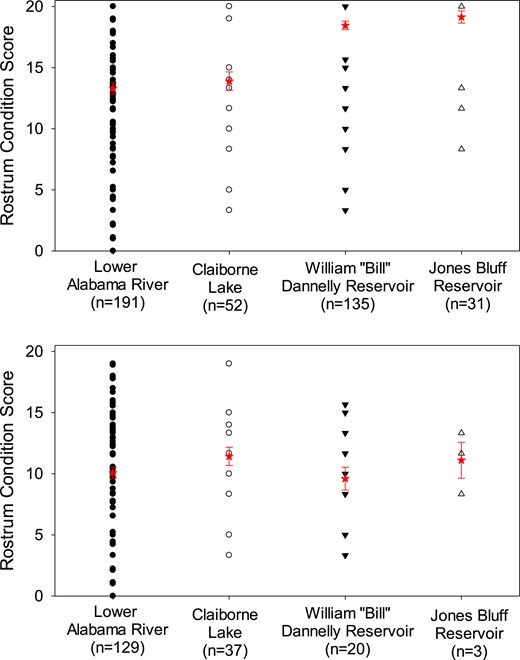
Paddlefish rostrum condition scores as a function of river section divided by three lock-and-dam structures in the Alabama River. The top panel includes all fish, while the bottom panel only includes fish with any rostrum damage (i.e., rostrum condition score < 20). Black dots indicate individual fish data points, while red stars represent the mean ± SE. Note that many dots are overlapping, particularly for rostrum condition scores equal to 20 in the top panel.

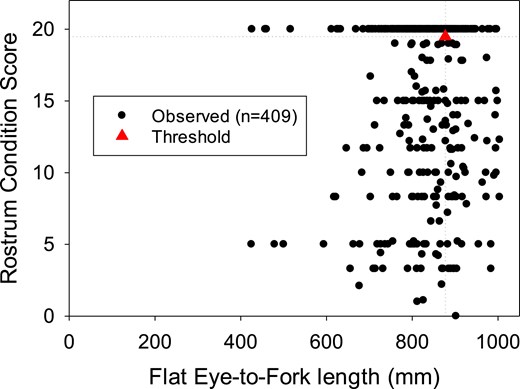
Rostrum condition score as a function of flat eye-to-fork length for male and female Paddlefish in the Alabama River. Data points represent each individual fish, and the red triangle and horizontal and vertical dotted lines represent the inflection point—the size above which there are fewer Paddlefish with undamaged rostra than would have been expected at random.

The Kn of male Paddlefish (n = 198; adjusted for the proportion of missing rostrum) increased significantly with RCS (linear regression: F1, 196 = 4.37, P = 0.04, R2 = 0.02; Figure 5). In contrast, Kn and RCS were not related for females (n = 167; linear regression: F1, 165 = 0.17, P = 0.68, R2 = −0.01; Figure 5). Similarly, the Wr of male Paddlefish (n = 198; adjusted for the proportion of missing rostrum) increased significantly with RCS (linear regression: F1, 196 = 4.61, P = 0.033, R2 = 0.018; Figure 5), whereas Wr and RCS were not related for females (n = 167; linear regression: F1, 165 = 0.27, P = 0.60, R2 = −0.004; Figure 5). The GSI did not differ with RCS for males (n = 158; linear regression: F1, 156 = 1.04, P = 0.31, R2 = 0.00) or females (for GSI values > 10, n = 39; linear regression: F1, 37 = 1.44, P = 0.24, R2 = 0.01; Figure 6).
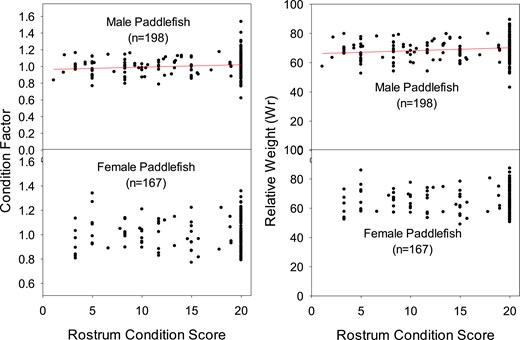
Condition factor (left panels) and relative weight (Wr; right panels) as a function of rostrum condition score for male (top) and female (bottom) Paddlefish in the Alabama River. The significant relationships for male Paddlefish are indicated by the regression lines.

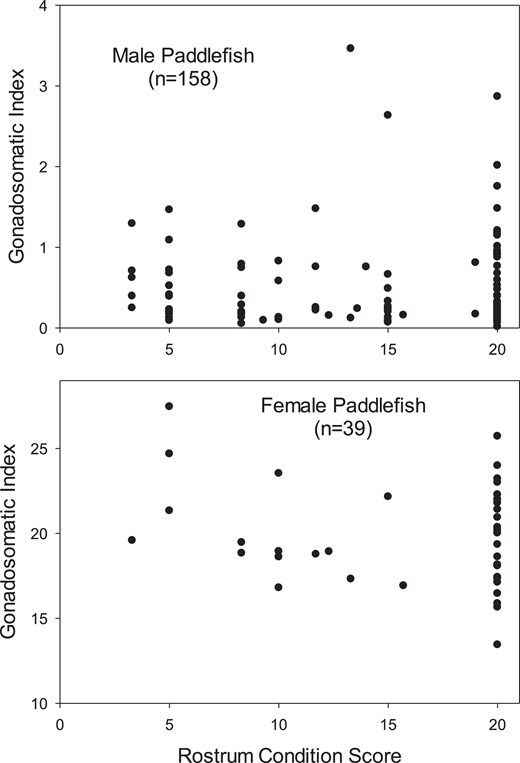
Gonadosomatic index as a function of the rostrum condition score for male Paddlefish and for females with gonadosomatic index values greater than 10 in the Alabama River.

For tagged Paddlefish that were detected in the tailrace of CLD, the mean RCS did not differ between fish that passed upstream and those that did not pass upstream in 2022 (Welch’s t-test: t = 0.92, df = 22.98, P = 0.37) or 2023 (Welch’s t-test: t = 1.89, df = 65.94, P = 0.06; Figure 7). In both 2022 and 2023, Paddlefish that were tagged and at large and were detected in the CLD tailrace 24 h or later after tagging had an upstream passage rate of 41.4–43.3% (Table 1), and there was no significant effect of the presence of rostrum damage (RCS < 20) versus the absence of damage (RCS = 20) on whether fish passed upstream of CLD in 2022 (Fisher’s exact test: P = 1.00) or 2023 (Fisher’s exact test: P = 0.34; Table 2).
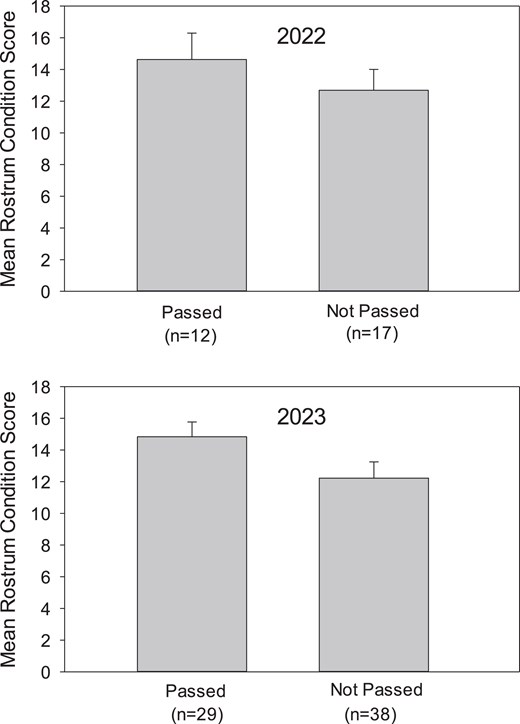
Mean (±SE) rostrum condition score for Paddlefish that were detected in the Claiborne Lock and Dam tailrace and that passed or did not pass upstream of the dam in 2022 and 2023.

Number of individual Paddlefish that were tagged and at large, the number detected in the Claiborne Lock and Dam (CLD) tailrace 24 h or later after tagging, and the number that passed upstream of CLD in 2022 and 2023.
| Variable | 2022 | 2023 |
|---|---|---|
| Tagged and at large | 42 | 100 |
| Detected in CLD tailrace | 29 | 67 |
| Passed upstream | 12 | 29 |
| Passage rate (%) | 41.40 | 43.30 |
Number of tagged individual Paddlefish that passed or did not pass Claiborne Lock and Dam in 2022 and 2023 and whether they had a damaged or undamaged rostrum.
| 2022 | 2023 | |||
|---|---|---|---|---|
| Passage status | Damaged | Undamaged | Damaged | Undamaged |
| Passed | 9 | 3 | 22 | 7 |
| Did not pass | 13 | 4 | 33 | 5 |
DISCUSSION
The Paddlefish rostrum has been well documented to affect swimming and feeding efficiency (Allen & Riveros, 2013; Haines & Sanderson, 2017; Wilkens & Hofmann, 2007), and damage to the rostrum can be common in some populations of Paddlefish (Hoxmeier & DeVries, 1997; Mestl & Sorensen, 2009; Rosen & Hales, 1980). We found that Paddlefish rostrum damage occurred throughout the Alabama River, with spatial variation in its occurrence. However, rostrum damage did not appear to affect the ability of fish to pass the crested spillway at the lowermost lock-and-dam structure (CLD), with mixed effects on the response variables that we measured.
Relative to our first objective, the spatial variation of rostrum damage across river sections in the Alabama River suggested that proximity to CLD may be related to damage, perhaps due to variation in factors contributing to damage across river sections or lock-and-dam structures. Given that there were proportionally fewer occurrences of fish with rostrum damage in the two upstream sections, it is possible that the infrastructure upstream of MFLD and at RFHLD may be less injurious to Paddlefish. Neither MFLD nor RFHLD has a crested spillway such that fish are not able to pass these structures (as they can at CLD; Hershey et al., 2022), and the absence of a crested spillway might reduce Paddlefish collisions with barriers at these structures compared to CLD. It is possible that when fish attempt to pass CLD during periods of spillway inundation, they may collide with the now-submerged structure; alternatively, shear forces during times of non-inundation may result in injury from the waterfall-like crested spillway. During summer, the crested spillway may have a hydraulic head of 10 m, potentially resulting in injury for any fish passing downstream over the structure (for discussion of shear forces and the Paddlefish rostrum, see Patel et al., 2019; Pflugrath et al., 2021; Riveros et al., 2020; Thurmer et al., 2020). In addition, MFLD and RFHLD both have hydropower facilities, whereas CLD does not. This could indicate that lower damage potential exists at the structures containing hydropower facilities, particularly due to mitigation efforts (such as filter screens or other intake structures); however, it is also possible that injuries resulting from hydropower operations may be more severe than the breaking of a rostrum, resulting in fish mortality, although this may not necessarily be the case for Paddlefish (see Pflugrath et al., 2021; Pracheil et al., 2015; Saylor, 2021). In fact, Saylor (2021) noted that juvenile Paddlefish were relatively resistant to turbine blade strikes and that the resulting rostrum damage was generally nearly full amputation. Given that we found injury rates to be lower at the two hydropower lock-and-dam facilities, turbine strikes may not be a controlling factor. In addition, no dead Paddlefish were observed during our sampling efforts, although dead Paddlefish do not always float and therefore are not always necessarily visible (however, such undetected mortalities would need to have some form of bias across locations to affect our conclusions). Further investigation into direct sources of Paddlefish rostrum damage and mortality would be helpful for understanding this complex issue and informing future management strategies. Other hazards could involve colliding with boats near lock-and-dam structures (Gutreuter et al., 2003; Killgore et al., 2011; though one would expect that to result in repeated lacerations to the fish body), damage from passing through turbulent waters at the gates, hydropower entrainment (discussed above), or other interactions, although to date the effects of these hazards remain speculative (see recent review by Hoover et al., 2019; but also see Coker, 1929, for early efforts to “test” such effects).
The prevalence of rostrum damage has been shown to vary dramatically with changing habitats. In the Missouri River, 10% of Paddlefish collected within an 84-km stretch downstream of Gavins Point Dam had lost most or all of the rostrum (Rosen & Hales, 1980), similar to values found in our two upstream Alabama River sections. When Paddlefish were sampled just prior to and after the snagging season in the Missouri River below Gavins Point Dam (to determine whether snagging contributed to rostrum damage), 12.74–12.76% of fish had rostrum damage, with no effect of the snagging season (Mestl & Sorensen, 2009). Furthermore, the proportion of individuals with rostrum damage can vary spatially by habitat type within a river system. For example, in a previous study, 1% of Paddlefish collected in oxbow habitats, 9.3% of those collected in channel habitats, and 13.4% of those collected in backwater habitats had rostrum damage (Hoxmeier & DeVries, 1997), while over 70% of Paddlefish collected in the CLD tailrace had rostrum damage (present study). Although rostrum injuries have been observed in Paddlefish throughout much of the species’ range, it is rarely the study focus, sometimes making it difficult to identify patterns.
This study focused on the effects of nonlethal rostrum injuries, although mortality associated with damage to a Paddlefish’s rostrum could certainly be occurring as well. While it is difficult to directly quantify mortality due to injury, additional investigation could help to better understand potential sources of rostrum damage and the resulting effects. Mortality due to infection and stress from rostrum injuries would be difficult to determine for wild, free-range adult fish but nonetheless could still be important to recognize for future management, particularly in the Alabama River, where fish appear to experience particularly high rostrum injury rates. Lesions and open wounds on the rostrum can make fish susceptible to infectious pathogens (Durborow et al., 2015). Estimating Paddlefish mortality in the Alabama River due to rostrum damage would likely require a large-scale, long-term tagging and biomonitoring study, likely also including a recapture study, which would be nearly impossible given the spatial scale of the study area, the long-distance movements of Paddlefish, their low recapture rates, and ultimately the difficulty in attributing specific causes of mortality to wild fish. Despite severe rostrum damage, Paddlefish do appear to be resilient and adaptable, as demonstrated by the continued survival of individuals with damaged or missing rostra. Paddlefish clearly can recover from such injuries, as evidenced by fish with injuries that have had sufficient time to fully heal (see also an example from our work in Supplemental Materials Figure 2). Tests with juvenile Paddlefish passing through turbines demonstrated that blade strikes can cause mortality and rostrum damage (Pflugrath et al., 2021). When juvenile Paddlefish were struck on the lateral surface of the head with a 52-mm turbine blade moving at 7.3 m/s, the rostrum was nearly amputated (Pflugrath et al., 2021; but see Saylor, 2021). In adult Paddlefish throughout the Alabama River and other waterbodies, rostrum injuries consistent with near amputation and breakage of the rostrum have been observed, some of which are healed, suggesting previous injury. Further study is needed to determine whether some of the damage observed in this study could be due to turbine blade strikes on adult Paddlefish (although, again, those would be concentrated upstream, where injury rates were lowest).
Rostrum condition did not vary linearly as a function of FEFL. However, the 2DKS analysis demonstrated that the relationship between the RCS and length was not random. The analysis showed that the number of Paddlefish longer than 877 mm FEFL with undamaged rostra was lower than would have been expected at random. There are multiple potential explanations for this pattern, including a reduced growth rate or survival rate of Paddlefish with damage. Given the chance that a fish will sustain damage at any time in life and given that the cumulative probability of receiving damage likely increases with time, there is a greater likelihood that a Paddlefish will experience damage to the rostrum before reaching a large size and, presumably, older age. Alternatively, very large fish with undamaged rostra may have lower catchability in large-mesh gill nets. Further studies to address this are needed to determine the best explanation for this pattern. In a previous study, the frequency of rostrum damage did not significantly change with fish length for Paddlefish from 460 to 1,020 mm FEFL (Rosen & Hales, 1980). Male Paddlefish make upstream spawning movements earlier in the season and remain in spawning areas longer than females, which may contribute to a higher risk of rostrum injury (accruing lower RCSs; Schwinghamer et al., 2019; Stancill et al., 2002).
Relative to our second objective, male Paddlefish with lower RCSs had lower body condition (Kn and Wr), which could be due to a decreased ability of fish with a damaged rostrum to find and consume prey as well as a decreased ability to maintain position in the water column. In addition, the reduced condition in males could also be due to less hydrodynamically efficient swimming of fish with a damaged rostrum, causing them to spend more energy than their uninjured counterparts. Similarly, Rosen and Hales (1980) found that Paddlefish with scars or rostrum damage had a lower coefficient of condition (K) than those without scars or rostrum damage. Reduced K-values of scarred fish suggested that growth was influenced by trauma from these injuries (Rosen & Hales, 1980). However, in our study, females with lower RCSs did not exhibit reduced condition, which may be due to the large variation in body weight across times of year and spawning condition at the time of capture (given that mature females rapidly gain weight with increased egg production near spawning times and lose weight quickly when eggs are released, although nearly all of our collected fish were prespawn). In addition, for Paddlefish with more recent injuries, much of the weight gain and increased body condition likely occurred prior to the rostrum injury, potentially masking any effects due to injury. Alternatively, a lack of relationship between rostrum damage and condition in females could indicate that females were simply not affected by rostrum damage in the same way as males (although the effect in males was relatively small, with an R2 of 0.02).
Finally, the GSI was not affected by rostrum condition, which suggests that gamete production and development were not hindered due to rostrum damage. Relative to harvest, the lack of reduction in GSI due to rostrum damage indicates that the output of roe by harvested females would not be diminished by rostrum damage.
Relative to our third question, upstream passage of Paddlefish at CLD was not significantly influenced by rostrum condition, suggesting that rostrum damage was not important in determining whether an individual would pass the lowermost lock-and-dam structure (with the crested spillway). In addition, the lack of an observed difference in passage success suggests that any effect of rostrum damage on swimming performance was not sufficient to influence upstream passage ability, although future work should evaluate this more precisely via modeling and laboratory swimming performance trials. As such, rostrum damage should not be a hindrance in population connectivity between Paddlefish in the lower Alabama River and Claiborne Lake sections. Factors other than rostrum condition, such as gauge height, temperature, and year, may be better predictors of whether a Paddlefish successfully passes upstream of CLD (Hershey et al., 2022). Similarly, mean dam head and 10th-percentile water temperature were the most important variables determining the successful upstream passage of Paddlefish in the Mississippi River (Zigler et al., 2004). However, the spring season and 25th-percentile water temperature were most important for downstream passage of Paddlefish in the Mississippi River (Zigler et al., 2004). Overall, we found nothing to suggest that rostrum damage affects Paddlefish spawning movements, thus indicating likely negligible impacts on stock recruitment, although we could not explicitly measure relative spawning success between Paddlefish with damaged versus undamaged rostra.
In summary, we found spatial variation in Paddlefish rostrum damage, with the lower two sections of the Alabama River displaying significantly higher proportions of fish with rostrum damage relative to the upper two sections, which may be influenced by differences in the design of the lock-and-dam structures that divide these sections of the river. While female Paddlefish had significantly better rostrum condition than males, suggesting that males may be more susceptible to rostrum damage than females, body condition differed with rostrum condition for males but not for females, and GSI did not differ with rostrum condition for either males or females. Overall, there was no difference in the upstream passage rate of Paddlefish at CLD relative to their rostrum condition. Although some differences were observed between Paddlefish with versus without rostrum damage, there appear to have been generally minimal effects of rostrum damage on Alabama River Paddlefish.
SUPPLEMENTARY MATERIAL
Supplementary material is available at Transactions of the American Fisheries Society online.
DATA AVAILABILITY
The data underlying this article were generated by both Auburn University personnel and ADCNR. Data will be shared on request to the corresponding author with permission of ADCNR.
ETHICS STATEMENT
All work was conducted in accordance with Auburn University Institutional Animal Care and Use Protocols 2019-3618 and 2022-5117.
FUNDING
Funding and support for this work were provided by the Engineer Research and Development Center, an in-memoriam award from the North American Sturgeon and Paddlefish Society to N.M.S., and the Alabama Agricultural Experiment Station and the U.S. Department of Agricultures's Hatch Program of the National Institute of Food and Agriculture.
ACKNOWLEDGMENTS
We thank Henry Hershey, Tom Hess, Justin Kowalski, Eli Lamb, Colby Lee, Kalli Parauka, Chris Rotar, Chris Smith, and Ehlana Stell for their help with fieldwork and assistance on this project. We also thank Jason Schooley, Ehlana Stell, Justin Kowalski, and two anonymous reviewers for their review of an earlier version of the manuscript.
REFERENCES
Author notes
CONFLICTS OF INTEREST: None declared.