 https://orcid.org/0000-0002-1333-7580
Abstract
Women make up 51% of the world's population, and the global population of postmenopausal women is growing. About 25% of these women experience debilitating menopausal symptoms. Since it is important that all health care professionals have a fundamental knowledge of managing women presenting with symptoms related to the menopause, this European Society of Endocrinology Clinical Practice Guideline was developed. It provides guidance on evaluation and optimal clinical management of women who go through the menopause in middle age, those with Premature Ovarian Insufficiency (POI), Early Menopause and those for whom hormones are not appropriate, including women with, or at high risk of, breast cancer. This guideline discusses the benefits and risks of hormone therapy administration as well as summarizing other treatments for menopausal symptoms. Further, the contentious issue of the impact of menopausal hormone therapy in the prevention of chronic disease is considered.
Summary of recommendations
Evaluation
R 1.1 We recommend that menopause is considered as a spectrum and includes the perimenopause and postmenopause. (Good Clinical Practice)
R 1.2 We recommend that perimenopause is considered when menstrual irregularity and/or vasomotor symptoms (VMS) are present, even in younger women (40-45 years). (Good Clinical Practice)
R 1.3 We recommend that premature ovarian insufficiency (POI) is considered in women under 40 years of age in the presence of menstrual irregularity and/or subfertility and/or vasomotor symptoms. (Good Clinical Practice)
R 1.4 We recommend biochemical testing for diagnosis or management of (peri)menopause in women older than 45 years is not necessary. (Good Clinical Practice)
R 1.5 We recommend biochemical testing for the presence of POI in women under 40 years of age in the presence of menstrual irregularity and/or subfertility and/or vasomotor symptoms; biochemical testing for the presence of perimenopause or menopause can also be considered in women aged 40-45 years. (Good Clinical Practice)
R 1.6 If biochemical testing for perimenopause is considered, we suggest measuring FSH at day 2 to 5 of the menstrual cycle or after an interval greater than 40 days without menstruation. (Good Clinical Practice)
R 1.7 We recommend that, when the medical history and clinical presentation of a woman of reproductive age include interference with the menstrual cycle and/or lead to menopause-like symptoms, other diagnoses should be considered. These may require additional testing. (Good Clinical Practice)
R 1.8 We recommend that all women with POI are referred to a menopause expert and where possible, a multidisciplinary team. (Good Clinical Practice)
R 1.9 We suggest that where possible, women in perimenopause, who are under the age of 40 and have apparent contraindications for hormone replacement therapy, are referred to a unit with particular expertise in managing such women. These include, for example, women with a history or high risk of a hormone dependent cancer, thrombotic or cardiovascular high risk, women who have an inadequate response to hormone therapy or those who have significant adverse effects.
Management
R 2.1 We recommend that a holistic approach is taken for women during perimenopause and menopause, not having a sole focus on hormone replacement therapy (HRT)/ menopausal hormone therapy (MHT). (Good Clinical Practice)
R 2.2 We recommend that women in peri- and post-menopause who are appropriate candidates for MHT can be managed in primary care according to recognized guidelines.
R 2.3 We recommend that before starting HRT/MHT women are well-informed about the benefits and risks of treatment and other options in order to facilitate shared decision making. (Good Clinical Practice)
R 2.4 We recommend, if indicated, in women with a uterus, to start MHT with a preparation combining oestrogen and progestogen. (⊕⊕⊕⊕)
R 2.5 We recommend, if indicated, in women without a uterus, to start MHT with a preparation with oestrogen alone. (⊕⊕⊕○)
R 2.6 We recommend that in women treated with MHT for symptoms, treatment effects should be re-evaluated after 3 months. In case of an inadequate response, adverse effects or intolerability, dose and formulation should be re-evaluated. (Good Clinical Practice)
R 2.7 We recommend taking into account individual characteristics and comorbidities when prescribing MHT and also, preference, availability and costs when choosing between transdermal and oral preparations. (Good Clinical Practice)
R 2.8 We recommend HRT in POI irrespective of the presence of vasomotor—or other climacteric symptoms as the multimodal benefits clearly exceed the risk. HRT should be continued until the anticipated age of natural menopause and then the ongoing prescription reevaluated periodically. (Good Clinical Practice)
R 2.9 We recommend initiating MHT in women within 10 years of natural menopause onset or under 60 years for bothersome menopausal symptoms such as vasomotor or other climacteric symptoms. (⊕⊕⊕⊕○) Women should also be informed that MHT prevents bone loss and reduces fracture risk and may have positive effects on the cardiovascular system. (Good Clinical Practice)
R 2.10 We suggest that for women with symptoms of vulvovaginal atrophy local or systemic MHT can be considered depending on the presence of other symptoms. Local oestrogen is usually started alone but can be administered with systemic MHT if needed. (⊕⊕○○)
R 2.11 We suggest that in women without symptoms of perimenopause/menopause who are under 60 years of age, MHT initiation might be considered for bone protection. (⊕⊕○○)
Specific conditions
Age
R 3.1 We suggest a targeted approach to MHT continuation in women over 60 yrs. We suggest taking into account the effect on VMS and/or other climacteric symptoms, the changing benefit-risk profile with age and effect on bone and personal preferences. (Good Clinical Practice)
Venous thromboembolism (VTE)
R 3.2 We recommend that, if in a woman with a previous VTE, HRT/MHT is indicated after individual risk—benefit assessment, transdermal low dose oestrogen should be used. (⊕⊕⊕○)
Cardiovascular disease
R 3.3 MHT should not be used primarily for primary or secondary prevention of cardiovascular disease (CVD). (⊕⊕⊕○)
Diabetes
R 3.4 We recommend that well-controlled diabetes is not considered a contraindication for MHT use; transdermal oestrogen is the preferred choice. (⊕⊕⊕○)
Hypertension
R 3.5 In women with well-controlled hypertension there is no contra-indication for MHT; transdermal oestrogen is the preferred choice. (⊕⊕○○) We recommend MHT not be initiated in the presence of uncontrolled hypertension. (Good Clinical Practice)
Stroke
R 3.6 We recommend that MHT is not used to prevent stroke. (⊕○○○)
Migraine
R 3.7 We suggest that in women with an indication for MHT and a history of migraine with aura, transdermal oestrogen is recommended. (⊕○○○)
Breast cancer
R 3.8 We recommend that all women initiating MHT are informed about the increased risk for breast cancer. (Good Clinical Practice)
R 3.9 We recommend that systemic MHT is not used in women with a history of breast cancer. Considerations include factors such as age and individual characteristics of the tumour. (⊕⊕○○)
R 3.10 We suggest that low dose vaginal oestrogen, dosed to treat vaginal issues, can be considered in women with a history of breast cancer and genitourinary symptoms if other non-hormonal therapies are ineffective. (⊕○○○)
Endometrial cancer
R 3.11 We suggest that initiation of MHT can be considered in women with a history of early stage endometrial cancer who are considered disease free. (⊕○○○)
Ovarian cancer
R 3.12 We suggest that the risk for ovarian cancer is not a major determinant for the decision to initiate MHT or not. (⊕○○○)
R 3.13 We suggest that initiation of MHT can be considered in women with (a history of) certain subtypes of ovarian cancer. (⊕○○○)
Mood and cognition
R 3.14 We recommend not to routinely use MHT to treat clinical depression in perimenopause/menopause. (⊕○○○)
Dementia
R 3.15 We recommend that MHT is not used to prevent or treat dementia (⊕○○○)
Introduction
Women who have functioning ovaries at some point during their reproductive years will go through menopause if they live long enough, and therefore menopause can be considered a normal component of aging. A proportion of those women will experience symptoms that impair quality of life and will seek treatment. It is important that all health care professionals have a fundamental knowledge of managing women presenting with symptoms related to the menopause. Menopause Hormone Therapy (MHT—often termed Hormone Replacement Therapy), is considered an appropriate option to treat these symptoms in most women.
The European Society of Endocrinology initiated this clinical practice guideline on evaluation and management of Menopause and the Perimenopause. It not only covers women who go through the menopause in middle age, but also those with Premature Ovarian Insufficiency (POI), Early Menopause and those for whom hormones are not appropriate, including women with, or at high risk of, breast cancer. It covers the diagnosis and optimal clinical management of menopause-related symptoms, including hormonal and non-hormonal therapies. This guideline discusses the benefits and risks of hormone therapy administration as well as summarizing other treatments for menopausal symptoms. The contentious issue of the impact of MHT in the prevention of chronic disease is considered.
The epidemiology of menopause
Women make up 51% of the world's population. In 2021, 26% of women globally were postmenopausal according to the WHO, and the global population of postmenopausal women is growing (Menopause). The British Menopause Society suggests that 25% of these women experience debilitating menopausal symptoms (17-BMS-TfC-What-is-the-menopause-AUGUST2023-A.pdf) and consequently the numbers being seen within many clinical specialties will increase.
Pathophysiology of menopause
Menopause is a biological stage in a woman's life marked by the cessation of menstruation and loss of fertility. A woman is defined as postmenopausal from 1 year after her last period. The changes associated with the perimenopause (the years leading up to the menopause and 1 year after it; see Figure 1) and the menopause occur when ovarian function diminishes. This includes the cessation of both egg (oocyte) maturation and sex hormone (principally oestrogen, progesterone and anti-Müllerian hormone (AMH) secretion. Women have a finite number of oocytes at birth and the quantity declines with advancing age. The menopause is characterised by the eventual depletion of the oocyte store and cessation of menstruation. Menstrual cycle irregularity often occurs before periods stop completely.
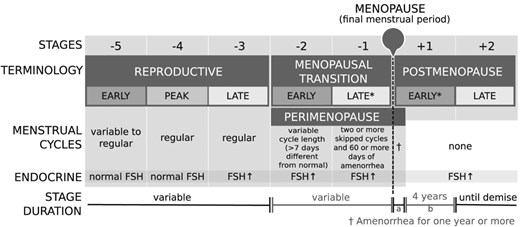
Stages of the menopause. Adapted in Ambikairajah A et al.1 and Soules et al.2 Within the STRAW criteria, menopause is central to the staging system and is labelled as point zero (0). There are five stages preceding the Final Menstrual Period (FMP) (−5 to −1) and two following it (+1 to +2). Stages −5 to −3 encompassed the Reproductive Interval; −2 to −1 reflect the Menopausal Transition; and +1 to +2, defined Post-menopause.2 The menopausal transition (−2 to −1) begins with a variation in menstrual cycle length and rise in follicle stimulating hormone (FSH). It ends with the FMP. Early post-menopause (+1) is defined as within 5 years since the FMP and is further subdivided into segments “a”; the first 12 months after the FMP and “b”; the following 4 years. Whereas late post-menopause (+2), is defined as having a variable duration since it ended with a woman's death. Finally, the STRAW criteria defined perimenopause (−2 to +1a) as ending 12 months after the FMP.

Most tissues contain oestrogen receptors through which the hormone exerts its effects. The most immediate changes resulting from reduced oestrogen levels are evident in the regulation of the menstrual cycle. However, oestrogen depletion associated with the menopause has many other effects on the body—for example causing vasomotor, musculoskeletal, urogenital, and psychological symptoms. Oestrogen has also been shown to have an impact on the function of other systems in later life, including bones and the cardiovascular system. Oestrogen depletion explains some of the differences in the incidence of osteoporosis between men and women.
Definitions
Natural menopause is defined as the absence of menses for longer than 1 year. In Europe, it occurs at about the age of 51 years. The detailed stages of the perimenopause are described best using the STRAW criteria (see Figure 1). Menopause may occur suddenly with abrupt cessation of menses or may be a more gradual phenomenon. It is associated with elevated follicle stimulating hormone (FSH).
Early menopause is defined as menopause occurring between the age of 40 and less than 45 years.
Perimenopause is a transition phase when ovarian function declines and concentrations of oestrogen fall. It is often associated with the onset of symptoms and may last for 2-4 years. It ends 1 year after the menopause. The term is often used inter-changeably with Menopause Transition (see Figure 1) although the precise definition of this can vary as it does not include one year post menopause in the STRAW criteria.
Premature Ovarian Insufficiency (POI) is the onset of menopause under the age of 40 years with amenorrhoea or irregular menstrual cycle for 4-6 months, in combination with low oestradiol and elevated gonadotrophins.
Menopausal Hormone Therapy (MHT) is hormone therapy given to women around the age of the natural menopause to treat symptoms of menopause. Both unopposed and opposed oestrogen are used depending on absence or presence of a uterus. It may be started prior to the menopause and be continued for many years after it.
Hormone Replacement Therapy (HRT) (also known as Hormone Therapy) is hormone replacement given to young women with POI or those with early menopause who have become menopausal. In this circumstance, the term “replacement” is accurate in that the aim is not only symptom management but also restoring oestrogen levels to those experienced by a premenopausal woman in order to counteract any medical complications related to oestrogen deficiency.
Symptoms of the menopause
Many women experience a range of symptoms during the menopause and perimenopause and these symptoms often lessen or disappear over time. The most common include vasomotor symptoms (VMS; for example, hot flushes and sweats), effects on mood (for example, low mood) and urogenital symptoms (for example, vaginal dryness). VMS are common, occur in most ethnic groups and are influenced by ethnicity and other demographic factors.3 On average, African-American women had more hot flushes than white women, and Asian women had the fewest hot flushes. VMS may continue for 7 years or more.4 The same study reported that early menopause (between 40 and less than 45 years) affected 3.7% of African-American women, 2.9% of white women, 2.2% of Chinese women and 0.8% of Japanese women.
Other symptoms are sleep problems, depressed mood, anxiety and palpitations, muscle and joint discomfort and headaches and migraines.5 Sleep problems may be secondary to VMS occurring at night, but disturbed sleep can occur independently of hot flashes.6 Disturbed sleep can in turn cause fatigue, irritability and difficulties with memory and concentration. Although some of these symptoms may not be linked directly to oestrogen deficiency, they may still be alleviated by MHT. Variations in consultation patterns for menopausal symptoms depend on many factors, including cultural, ethnic, educational and psychosocial factors, as well as the impact of the symptoms on the women. However, many women want more support for managing menopausal symptoms from their health care professionals.
Clinical consequences
Postmenopausal women are at increased risk of a number of conditions, such as osteoporosis, cardiovascular disease (CVD) and changes in the vagina and bladder which occur as a result of aging, although oestrogen depletion may play a negative role.
During the latter part of the last century, menopausal hormone therapy (MHT, also known as hormone therapy (HT) and hormone replacement therapy (HRT), see Definitions) was advocated for both symptom relief and chronic disease prevention. This followed publications of several observational studies suggesting a decrease in the incidence of CVD, osteoporosis and dementia, among other conditions of age. However, two influential studies—the Women's Health Initiative (WHI)7 and the Million Women Study (MWS)8—reported on the risks and benefits associated with the use of MHT. The publication of these studies was associated with a significant reduction in women's use of MHT/HRT) throughout Europe. WHI was the biggest and only RCT of MHT/HRT and placebo and MWS was a large observational study including a wide range of participants. The earlier studies were likely affected by a healthy user bias and therefore, their results suggesting a significant decrease in CVD are less valid.
Socioeconomic status is linked to the use of MHT, with women of lower socioeconomic status being less likely to use MHT. Inequalities in referral rates have also been associated with geography and age. There is also evidence that physician speciality is associated with probability of MHT prescriptions. In the USA and in Sweden, women receiving care from gynaecologists are significantly more likely to use MHT than women receiving care from family physicians.9,10 Therefore, there is a need for education of all healthcare professionals.
Importantly, lifestyle is a major factor influencing the occurrence of menopausal symptoms, their severity and their treatment, for example, obesity impacts both menopausal symptoms and general health.
Methods
Guideline working group
This clinical guideline was initiated and developed on behalf of The European Society of Endocrinology (ESE). The clinical chair of the working group, Prof Mary Ann Lumsden, was appointed by the ESE Clinical Committee. Prof Olaf Dekkers and Dr Leonie van Hulsteijn served as the methodological team and Dr Antoan Stefan Sojat as ESE Young Endocrinologists and Scientists representative. The other members were suggested by the chairs and approved by the ESE Clinical Committee, including Prof Stephanie Faubion, Prof Angelica Lindén Hirschberg, Dr Channa Jayasena, Prof Irene Lambrinoudaki, Dr Yvonne Louwers, and Prof JoAnn Pinkerton. Prior to the process, all participants completed conflict of interest forms (see Appendix 1). The process was approved by the ESE Executive Committee. There were several virtual working group meetings and one in-person meeting (Leiden, The Netherlands December 13 & 14, 2023). In between meetings the working group communicated by email.
Target groups
This guideline was developed for health care professionals who see women in (peri)menopause and beyond and who seek guidance for evaluation and management of these women. The guideline served as a source document for the preparation of patient education material published on the ESE website, to empower women and their treating clinicians.
Aims
The overall purpose of this guideline is to provide clinicians with practical guidance on the evaluation and management of women in menopause and beyond, including hormonal, non-hormonal, lifestyle, and psychosocial interventions, with an emphasis on patient-centred care. Gender-affirming hormonal therapy is not included within this guideline because the therapeutic goals and risks of therapy in transwomen are distinct to those of MHT for menopause.
In clinical practice, both the recommendations and the clinical judgment of treating clinicians should be considered. Recommendations may need adaptation to local or national circumstances.
Summary of methods used for guideline development
The methods used for establishing the guideline have been described in detail previously.11,12 Grading of Recommendations, Assessment, Development, and Evaluation (GRADE) was used as a methodological basis. Clinical questions were defined (see below), followed by systematic literature searches. An average effect for specific outcomes was estimated where possible.
The recommendations took into account the quality of the evidence, the balance of desirable and undesirable outcomes, and individual values and preferences (patient preferences, goals for health, costs, management inconvenience, feasibility of implementation).11,13 The recommendations are worded as “recommend” (strong recommendation) or “suggest” (weak recommendation). The meaning of a strong recommendation is that all reasonably informed persons (clinicians, policy makers and patients) would want the management in accordance with the recommendation, while for a weak recommendation, most persons would still act in accordance with the guideline, but some would not.14 Formal evidence synthesis was performed and graded for recommendations addressing our initial clinical questions (see “Clinical questions, eligibility criteria, and definition of endpoints” section).
The quality of the evidence behind the recommendations was rated as very low (⊕○○○), low (⊕⊕○○), moderate (⊕⊕⊕○), or high (⊕⊕⊕⊕). Recommendations that were based on good clinical practice and experience of the working group members were not formally graded,15 but acknowledged in the guideline as “good clinical practice”. Recommendations that were neither based on evidence or good clinical practice, were not graded at all. Consensus was reached upon discussion; minority positions were considered in the rationale behind the recommendations.
Review process
A draft of the guideline was reviewed by patient representative Rachel Weiss (Founder of the Menopause Café charity) and four experts in the field (see Acknowledgments section) and was distributed to all ESE members for commenting. All comments and suggestions were then discussed and implemented as thought appropriate by the guideline working group (see Appendix 2).
Endorsement by other societies
To achieve wide acceptance of the guidelines within the clinical community of the different disciplines involved in the management of women in (peri)menopause, the draft of the guideline document was submitted to several other professional/learned societies. Finally, the following societies endorsed the present guideline: the Endocrine Society (ES), the European Menopause and Andropause Society (EMAS) and the British Menopause Society (BMS).
Four years after publication, ESE's Clinical Committee will assess the need for, and extent of, a revision of this guideline.
Results of the systematic reviews
Clinical questions, eligibility criteria, and definition of endpoints
At the start of the guideline process, the working group formulated clinical questions regarding treatment of women in menopause (peri- and postmenopause). Many of these had been subject to extensive review in recent years with development of guidelines for practice within Europe (European Menopause and Andropause Society (EMAS)), the UK (National Institute of Health and Care Excellence (NICE), British Menopause Society), the USA (The Endocrine Society, The Menopause Society) and Asia (Indian Menopause Society). Reviews and metanalyses were considered for our guideline and most areas not subject to further extensive review. However, there were three areas where it was considered that further information was needed. These clinical questions formed the basis for the new systematic reviews and are summarized in Table 1.
Clinical questions.
| Clinical question | Search criteria | Papers included (n) | Respective recommendation | |||
|---|---|---|---|---|---|---|
| Population | Intervention | Comparison | Outcome | |||
| Question I: What is the efficacy of locally absorbed low dose oestrogen on sexual function, compared to systemically absorbed oestrogen or placebo? | (Peri/post)menopausal women | Locally absorbed low dose oestrogen | Systemically absorbed oestrogen/placebo (ie, oral or transdermal) | Sexual function | 416-19 | R 2.10 |
| Question II: What is the impact of different oestrogen dosages on fracture risk in peri/postmenopausal women? | (Peri/post)menopausal women | Oestrogen dosage A, oestrogen dosage B etc | Comparative, placebo or no treatment | Fractures: hip, vertebral | 1420-33 | R 2.11 |
| Question III: What is the impact of progestogen monotherapy on menopausal symptoms? | Symptomatic (peri/post)menopausal women | Progesterone, synthetic progestogen | Placebo or no treatment | Symptoms of menopause (ie, VMS, QoL, cognition (memory), sleep) | 1034-43 | R 2.9 |
| Clinical question | Search criteria | Papers included (n) | Respective recommendation | |||
|---|---|---|---|---|---|---|
| Population | Intervention | Comparison | Outcome | |||
| Question I: What is the efficacy of locally absorbed low dose oestrogen on sexual function, compared to systemically absorbed oestrogen or placebo? | (Peri/post)menopausal women | Locally absorbed low dose oestrogen | Systemically absorbed oestrogen/placebo (ie, oral or transdermal) | Sexual function | 416-19 | R 2.10 |
| Question II: What is the impact of different oestrogen dosages on fracture risk in peri/postmenopausal women? | (Peri/post)menopausal women | Oestrogen dosage A, oestrogen dosage B etc | Comparative, placebo or no treatment | Fractures: hip, vertebral | 1420-33 | R 2.11 |
| Question III: What is the impact of progestogen monotherapy on menopausal symptoms? | Symptomatic (peri/post)menopausal women | Progesterone, synthetic progestogen | Placebo or no treatment | Symptoms of menopause (ie, VMS, QoL, cognition (memory), sleep) | 1034-43 | R 2.9 |
VMS, vasomotor symptoms; QoL, quality of life.
Clinical questions.
| Clinical question | Search criteria | Papers included (n) | Respective recommendation | |||
|---|---|---|---|---|---|---|
| Population | Intervention | Comparison | Outcome | |||
| Question I: What is the efficacy of locally absorbed low dose oestrogen on sexual function, compared to systemically absorbed oestrogen or placebo? | (Peri/post)menopausal women | Locally absorbed low dose oestrogen | Systemically absorbed oestrogen/placebo (ie, oral or transdermal) | Sexual function | 416-19 | R 2.10 |
| Question II: What is the impact of different oestrogen dosages on fracture risk in peri/postmenopausal women? | (Peri/post)menopausal women | Oestrogen dosage A, oestrogen dosage B etc | Comparative, placebo or no treatment | Fractures: hip, vertebral | 1420-33 | R 2.11 |
| Question III: What is the impact of progestogen monotherapy on menopausal symptoms? | Symptomatic (peri/post)menopausal women | Progesterone, synthetic progestogen | Placebo or no treatment | Symptoms of menopause (ie, VMS, QoL, cognition (memory), sleep) | 1034-43 | R 2.9 |
| Clinical question | Search criteria | Papers included (n) | Respective recommendation | |||
|---|---|---|---|---|---|---|
| Population | Intervention | Comparison | Outcome | |||
| Question I: What is the efficacy of locally absorbed low dose oestrogen on sexual function, compared to systemically absorbed oestrogen or placebo? | (Peri/post)menopausal women | Locally absorbed low dose oestrogen | Systemically absorbed oestrogen/placebo (ie, oral or transdermal) | Sexual function | 416-19 | R 2.10 |
| Question II: What is the impact of different oestrogen dosages on fracture risk in peri/postmenopausal women? | (Peri/post)menopausal women | Oestrogen dosage A, oestrogen dosage B etc | Comparative, placebo or no treatment | Fractures: hip, vertebral | 1420-33 | R 2.11 |
| Question III: What is the impact of progestogen monotherapy on menopausal symptoms? | Symptomatic (peri/post)menopausal women | Progesterone, synthetic progestogen | Placebo or no treatment | Symptoms of menopause (ie, VMS, QoL, cognition (memory), sleep) | 1034-43 | R 2.9 |
VMS, vasomotor symptoms; QoL, quality of life.
Randomized controlled trials (RCTs) presenting data on (post)menopausal women were eligible. RCTs presenting data on women with Turner syndrome (not the scope of this guideline) or women with (a history of (breast)) cancer were excluded. Mixed populations of women with natural and surgical menopause were considered, but where possible, data were stratified. Only studies investigating preparations which are currently on the market were included. Patient relevant outcomes were selected, ie, symptoms or events rather than surrogate markers (eg, “fractures” and not “bone mineral density”). Studies reporting on outcomes “sexual function”, “symptoms” and “quality of life (QoL)” had to be scored using validated questionnaires.
The follow-up for studies reporting on fracture risk had to be at least 1 year. In case of multiple studies describing the same cohort, the study comprising the highest number of subjects was included. Eligible studies were restricted to languages familiar to the authors (English, French, German, Dutch and Spanish). Authors were contacted for clarification when reported data were not sufficient for accurate data extraction.
Description of search and selection of literature
PubMed, MEDLINE, Embase, Web of Science, and Cochrane Library were searched with the help of a specialized librarian to identify potentially relevant studies. The literature searches for questions I, II and III were performed in September 2023, October 2023 and November 2023, respectively. Searches can be found in Appendix 3 (see section on Supplementary material). All studies obtained from the searches were entered into reference manager software (EndNote X21, Clarivate Analytics, Philadelphia, PA) and title and abstract were screened. Potentially relevant studies were retrieved for detailed assessment. References of included studies were assessed for additional relevant articles.
Summary and interpretation of evidence from the systematic reviews
Clinical question I: what is the efficacy of locally absorbed low dose oestrogen on sexual function, compared to systemically absorbed oestrogen or placebo?
There were no RCTs identified comparing locally absorbed low dose oestrogen versus systemically absorbed low dose oestrogen.
Four RCTs were included comparing locally absorbed low dose oestrogen versus placebo in a total of 917 women.16-19 Various preparations were investigated; oestradiol softgel vaginal insert 4 μg and 10 μg,16 vaginal oestrogen ring 2 mg,18 oestradiol 10 μg and oestriol 10 μg in a base cream intravaginally19 and oestradiol vaginal tablet 10 μg.17 All studies assessed sexual function after 3 months through the Female Sexual Function Index (FSFI). The FSFI is a validated 19-item, self-reported measure of female sexual function that provides scores on overall levels of sexual function as well as on six primary components of sexual function: desire, arousal, lubrication, orgasm, satisfaction and pain.44 Maximum score of the sum of domains is 36, where a higher score indicates better sexual function. For details of included studies and GRADE assessment see Appendix 4. Overall, quality of evidence was low due to a serious risk of bias.
Only one study reported a significant improvement in total FSFI score after three months use of oestradiol softgel vaginal insert 10 µg vs placebo (mean difference 9.43 vs 7.46, P < .05), the other three studies found no clear difference (see Figure 2).
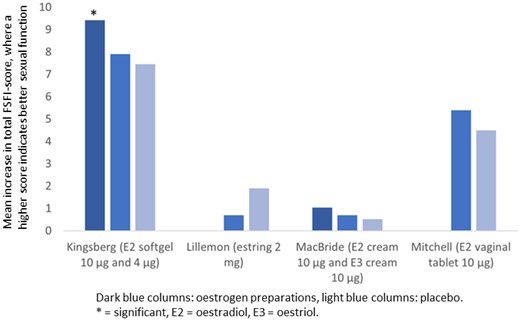
Effects of locally absorbed low dose oestrogen and placebo on sexual function, as measured by total FSFI-score.

Concerning FSFI domains: an improvement in “lubrication” and “pain” was seen with oestradiol softgel vaginal insert 10 μg and oestriol 10 μg in a base cream intravaginally.16,19 Oestriol 10 μg in a base cream intravaginally also improved “desire”.19
Based on this limited data on small numbers of women, no firm conclusions can be drawn regarding the effect of locally absorbed low dose oestrogen versus placebo on sexual function.
Clinical question II: what is the impact of different systemic oestrogen dosages on fracture risk in postmenopausal women?
Fifteen RCTs were initially included;20-33,45 one study was later excluded after publication of an Expression of Concern,46 leaving a total of 14 studies comprising 30 910 women included in this review. For details of included studies and GRADE assessment Appendix 5. Overall, quality of evidence was low, due to study limitations (concerns on adhering to intervention and missing outcome data) and imprecision in smaller studies. In addition, most studies included women with a relatively young age, resulting in study populations with a low fracture risk at baseline.
Only two studies assessed the impact of different oestrogen dosages on fracture risk and found no difference in combined MHT containing conjugated equine oestrogen (CEE) 0.625 mg vs 0.3 mg and combined MHT containing 17-β oestradiol 1 mg vs 2 mg, respectively.25,33 However, there were no events in both studies, probably due to the relatively young age of included women and moderate length of follow-up.
Vickers et al. assessed fracture risk comparing combined MHT to oestrogen alone (CEE 0.625 mg/MPA 2.5/5.0 mg daily vs CEE 0.625 mg daily) and found no clear difference (hazard ratio (HR) of osteoporotic fractures 1.5 (95%CI 0.62-13.72), P = .35).32
The other studies compared various MHT regimens versus placebo, calcium or no treatment; the largest one being the WHI reporting a hazard ratio (HR) of 0.67 (95%CI 0.47-0.96) for hip fractures and HR 0.65 (95%CI 0.46-0.92) for vertebral fractures after daily use of CEE 0.625 mg/MPA 2.5 mg.20 Figure 3 clearly illustrates that fewer women in MHT groups experience total fractures (3A) and hip or vertebral fractures (3B) than in control groups.
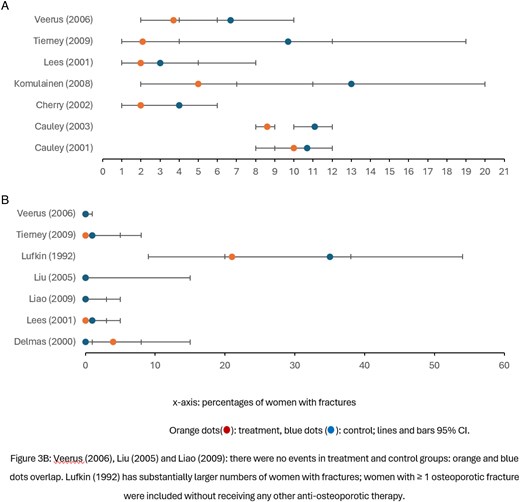
Percentages of women with fractures (total fractures: (A), hip or vertebral fractures: (B)).

Clinical question III: what is the impact of progestogen monotherapy on menopausal symptoms?
Ten RCTs assessing the impact of progestogen monotherapy (ie, MHT including progestogen, but without oestrogen) on menopausal symptoms were included.34-43 Study numbers were small, ranging from 10 to 223 women. Details of included studies and GRADE assessment can be found in Appendix 6. Overall, quality of evidence was very low (concerns on randomization process, adhering to intervention and missing outcome data) and imprecision in smaller studies, and results might have been influenced by the placebo effect.
VMS
Nine studies reported on the effects on VMS of progestogen monotherapy (514 women) vs placebo (325 women).34,36-43 VMS were measured according to the vasomotor component of the Green Climacteric Scale and/or changes in their frequency and/or severity.
Oral progesterone preparations were used in five studies.37-41 Hitchcock et al. reported an improvement in VMS frequency and severity after 3 months oral use of 300 mg micronized progesterone at bedtime,37 but these results could not be confirmed by Prior et al., using the same treatment regimen39 or by Schüssler et al., using the same dosage short-term (3 weeks).41 In a small cross-over trial (n = 32) women reported a decrease of VMS frequency after 3 months use of 20 mg MPA.40
Short-term daily use of 5 mg norethisterone did not result in a reduction of hot flush frequency.38
VMS also did not respond to low-dose (5-60 mg daily) transdermal progesterone treatment;34,42,43 it is acknowledged that progesterone cream is not well absorbed compared to oral micronized progesterone.
In one study a monthly intramuscular depot of 150 mg MPA was administrated during 6 months.36 89.5% of women in the treatment group reported elimination or significant decrease of hot flushes, vs 25% in the placebo group (P < .001).
Sleep
Schüssler et al. found no difference in subjective sleep quality in a cross-over trial after daily use of 300 mg oral progesterone or placebo during 3 weeks, however women did not report sleep disturbances at entering the study.41
Psychological functioning
Three studies, all using transdermal progesterone preparations, assessed psychological functioning through the psychological components of the Green Climacteric Score (GCS) and the Menopause-Specific Quality of Life (MenQoL) questionnaire.34,41,42 Stephenson et al. reported “significant beneficial changes over placebo P < .05 in women using 20 mg transdermal progesterone daily for 4 weeks.42 However, no significant effects on psychological functioning were reported by Benster et al. after 6 months use of natural progesterone cream in daily dosages ranging from 5 to 60 mg,34 and by Wren et al after 3 months daily use of 32 mg progesterone cream.43
Physical functioning
Above mentioned three studies also assessed physical functioning through the somatic components of the GCS and the MenQoL questionnaires.34,41,42 No significant effect of progesterone treatment vs placebo on physical functioning was found.
Cognition
Schüssler et al. and Berent-Spillson et al. performed a range of tests assessing verbal and visual cognitive function in postmenopausal women after daily oral use of 300 mg progesterone during 3 weeks and 200 mg progesterone during 12 weeks, respectively.35,41 Apart from a small improvement in verbal memory, no significant improvements were seen in other components of cognition such as visual memory, speed of information processing and attention.
Sexual function
Only one study assessed sexual function and found no major differences on the sexual components of the GCS and MenQoL questionnaire after 12 weeks of treatment with 32 mg progesterone cream vs placebo.43
Adverse effects
Vaginal spotting or bleeding during progestogen treatment was reported by 9.5% of women, compared to 2.1% in the placebo group. Other reported adverse effects were headache (4% progestogen vs 1.5% placebo) and nausea (2.3% progestogen vs 0.3% placebo). A list of all studies including these reported adverse effects can be found in Table S6.
In conclusion, hampered by a relatively small number of included women and heterogeneity in progesterone treatment formulations and regimens, we did not find a consistent beneficial effect of progestogen monotherapy on menopausal symptoms (Table 2).
Impact of progestogen monotherapy on menopausal symptoms.
| Symptom | Effect |
|---|---|
| VMS | No consistent beneficial effect of oral progesterone No effect of progesterone cream Beneficial effect of i.m. depot MPA |
| Sleep | No effect of oral progesterone |
| Psychological functioning | No consistent beneficial effect of progesterone cream |
| Physical functioning | No effect of progesterone cream |
| Cognition | Small improvement in verbal memory after oral progesterone; other components of cognition no effect |
| Sexual health | No effect of progesterone cream |
| Symptom | Effect |
|---|---|
| VMS | No consistent beneficial effect of oral progesterone No effect of progesterone cream Beneficial effect of i.m. depot MPA |
| Sleep | No effect of oral progesterone |
| Psychological functioning | No consistent beneficial effect of progesterone cream |
| Physical functioning | No effect of progesterone cream |
| Cognition | Small improvement in verbal memory after oral progesterone; other components of cognition no effect |
| Sexual health | No effect of progesterone cream |
i.m., intramuscular; MPA, medroxyprogesterone acetate.
Impact of progestogen monotherapy on menopausal symptoms.
| Symptom | Effect |
|---|---|
| VMS | No consistent beneficial effect of oral progesterone No effect of progesterone cream Beneficial effect of i.m. depot MPA |
| Sleep | No effect of oral progesterone |
| Psychological functioning | No consistent beneficial effect of progesterone cream |
| Physical functioning | No effect of progesterone cream |
| Cognition | Small improvement in verbal memory after oral progesterone; other components of cognition no effect |
| Sexual health | No effect of progesterone cream |
| Symptom | Effect |
|---|---|
| VMS | No consistent beneficial effect of oral progesterone No effect of progesterone cream Beneficial effect of i.m. depot MPA |
| Sleep | No effect of oral progesterone |
| Psychological functioning | No consistent beneficial effect of progesterone cream |
| Physical functioning | No effect of progesterone cream |
| Cognition | Small improvement in verbal memory after oral progesterone; other components of cognition no effect |
| Sexual health | No effect of progesterone cream |
i.m., intramuscular; MPA, medroxyprogesterone acetate.
Recommendations
R 1.1
We recommend that menopause is considered as a spectrum and includes the perimenopause and postmenopause. (Good Clinical Practice)
Menopause, defined as one year after the final menstrual period, is determined retrospectively. It is preceded by the perimenopause. This transition may last several years. Symptoms may start during the perimenopause.
The mean age of menopause in Europe is 51 years in Caucasian women. However, the time of starting the perimenopause varies over countries and by race/ethnicity. The absence of menses does not define menopause in all cases. Menses do not occur following hysterectomy and with some types of contraception (eg, intra-uterine progestogens). However, it is important to consider the possibility of perimenopause even in the absence of typical symptoms, particularly in younger women.
The change in biology and ovarian function is gradual and encompasses the perimenopause, and symptoms may start during this time which may require treatment.
R 1.2
We recommend that perimenopause is considered when menstrual irregularity and/or vasomotor symptoms are present, even in younger women (40 to less than 45 years). (Good Clinical Practice)
Menstrual irregularity is described within the STRAW criteria (Figure 1) and is a cycle length that falls outside 21-35 days and may vary from month to month. However, cycle length may decrease during the later years of the reproductive phase.
R 1.3
We recommend that premature ovarian insufficiency is considered in women under 40 years of age in the presence of menstrual irregularity and/or subfertility and/or vasomotor symptoms. (Good Clinical Practice)
Premature ovarian insufficiency (POI) is the loss of ovarian function below the age of 40 years and occurs in at least 1%-3% of women.47,48 Most cases of POI are idiopathic although more genetic abnormalities are now being identified using next generation sequencing.49 A family history of early menopause is common in women with POI and the age of menopause in the mother is a predictor of age of menopause in the daughter. Secondary causes of POI include genetic (Turner syndrome or its mosaics, Fragile X Messenger Ribonucleoprotein 1 (FMR-1) premutation), autoimmune and infectious causes. An increasing proportion of secondary POI is iatrogenic, resulting from surgical removal of the ovaries, chemotherapy, or pelvic radiation.50 POI should be ruled out in women younger than 40 years presenting with cycle disturbances or oestrogen deficiency symptoms.51 Whereas biochemical measurements are not required to diagnose menopause in women over 45, the diagnosis of POI is confirmed with one serum follicle stimulating hormone (FSH) >25 IU/L or, in those where the diagnosis is less clear, including some women aged 40 to less than 45 years, when two serum FSH measurements more than 4 weeks apart are >25 IU/L52 (see R 1.4 and R 1.5).
Once the diagnosis POI is confirmed, additional investigations include karyotype, additional genetic testing (where available) and FMR-1 premutation screening, adrenal cortex and 21-hydroxylase antibodies, thyroid stimulating hormone, bone densitometry and pelvic ultrasound. Baseline evaluation of women with POI before the commencement of HRT should include fracture risk and cardiovascular disease risk estimation. During long-term follow-up women should be assessed for quality of life, mental, sexual, cardiovascular and bone health. Breast cancer screening should be performed according to national guidelines for the general population.53,54 Management and follow-up of women with POI is described briefly later in the guideline and the reader is also referred to the recently updated ESHRE Guideline on POI.55
R 1.4
We recommend biochemical testing for diagnosis or management of (peri)menopause in women older than 45 years is not necessary. (Good Clinical Practice)
In the case of typical menopausal symptoms in an otherwise healthy woman of normal menopausal age, no measurement of FSH is required. The increase in FSH may already be present during the late reproductive phase and continues to fluctuate for several years until menopause (Figure 4).56 Consequently, a normal FSH for those of fertile age does not rule out (peri)menopause. While anti-müllerian hormone (AMH) is often used to predict response to fertility treatment, it is not yet clearly useful in diagnosing menopause.57 AMH is decreasing during the later reproductive years, but age has a greater impact on AMH levels than reproductive stage.
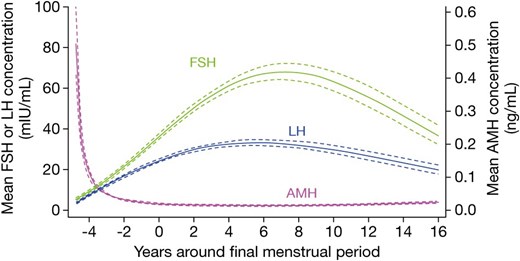
(Peri)Menopausal FSH, LH and AMH values. Hum Reprod Update, Volume 29, Issue 3, May-June 2023, Pages 327-346, https://doi.org/10.1093/humupd/dmac045. FSH, follicle-stimulating hormone; LH, luteinizing hormone; AMH, anti-müllerian hormone.

R 1.5
We recommend biochemical testing for the presence of POI in women under 40 years of age in the presence of menstrual irregularity and/or subfertility and/or vasomotor symptoms; biochemical testing for the presence of perimenopause or menopause can also be considered in women aged 40-45 years. (Good Clinical Practice)
POI is life-changing for a woman. A delay in diagnosis may result in long-term physical and mental health implications and a compromised quality of life. Untreated POI is associated with an increased risk of osteoporosis,58 cardiovascular disease,59 cognitive decline,60 depression61 and sexual dysfunction.62 Early diagnosis is important so that management can be instituted promptly. Therefore, evaluation of menopause/perimenopause should be performed in all women <40 years as well as some aged 40 to less than 45 years old presenting with menstrual irregularity, unexplained subfertility or menopausal symptoms.
Women with early menopause (menopause <45 years) share common risks with women with POI. Although not always as high as the risk of women with POI, the risk of cardiovascular disease,63 osteoporotic fractures,64 dementia,60 as well as all-cause mortality63 is increased in women with early menopause compared to women who experienced menopause at an age older than 45 years. It is therefore suggested that menopause may also be investigated in women aged 40 to less than 45 years who present with symptoms suggestive of perimenopause.
R 1.6
If biochemical testing for perimenopause is considered, we suggest measuring FSH at day 2 to 5 of the menstrual cycle or after an interval greater than 40 days without menstruation. (Good Clinical Practice)
Circulating FSH fluctuates during the menstrual cycle and is lowest in the early follicular phase and rises to a maximum level of about 20 IU/L at ovulation. An FSH value greater than 25 IU/L in early follicular phase or in women with amenorrhoea/oligomenorrhoea is strongly suggestive of perimenopause although it is difficult to define a specific value65 Thus oestradiol should be measured with FSH in order to interpret the result. Although not diagnostic of perimenopause, low levels of AMH and oestradiol in combination with a high level of FSH support perimenopause. Given the fluctuation of FSH, a second measurement of FSH 4-6 weeks later may be required, particularly if pregnancy risk is an issue.
R 1.7
We recommend that, when the medical history and clinical presentation of a woman of reproductive age include interference with the menstrual cycle and/or lead to menopause-like symptoms, other diagnoses should be considered. These may require additional testing. (Good Clinical Practice)
Pregnancy should be considered in women with amenorrhoea of less than 12 months. Thyroid disease (hyper- or hypothyroidism) and hyperprolactinemia can cause menstrual irregularities or amenorrhoea; the work-up might thus include thyroid function and prolactin measurement. Functional hypothalamic amenorrhoea (FHA) and polycystic ovary syndrome (PCOS) are two syndromes associated with amenorrhoea that are important to differentiate since the aetiologies and treatments differ. FHA, a neuroendocrinopathy and the cause of about one-third of cases of secondary amenorrhoea, is typically the result of psychosocial stress, over-exercising and/or disordered eating. The condition can be identified in women with at least three consecutive months of amenorrhoea and low oestradiol, luteinizing hormone (LH) and FSH levels, normal or low LH/FSH ratio as well as low testosterone levels. In contrast, PCOS is frequently associated with an increased LH/FSH ratio and elevated testosterone levels.66 AMH levels are used to discriminate PCOS from other causes of oligomenorrhoea or amenorrhoea.
R 1.8
We recommend that all women with POI are referred to a menopause expert and where possible, a multidisciplinary team. (Good Clinical Practice)
This should include a clinician with specialized knowledge and expertise in the area, understanding the biological, psychological, and social aspects, which should help to avoid delayed diagnosis and facilitate appropriate treatment and also psychologists, physicians with expertise in bone and cardiovascular health, and a gynaecologist. Fertility issues will also need to be considered in some individuals. Oncologists can be consulted as cancer treatments (surgery, radiotherapy and chemotherapy) can induce POI and some cancers are hormone dependent, but others are not.67
POI is a multidisciplinary disease with life-changing physical and psychological impacts for women of reproductive age requiring lifelong management. It is important to avoid delay in diagnosis (see R 1.5) and start appropriate treatment early.58
HRT should aim at restoring oestrogen levels to the premenopausal state and should be prescribed to all women with POI irrespective of the presence of menopausal symptoms unless there is a contraindication for HRT such as hormone dependent cancer. The HRT regimen should be determined based on clinical history and comorbidities. Vaginal oestrogens may also be needed for women who still have symptoms of vulvovaginal atrophy while on systemic HRT. Women on HRT who have symptoms suggestive of hypoactive sexual desire disorder (HSDD) may be candidates for systemic testosterone therapy.50 HSDD in postmenopausal women is the only evidence-based indication for testosterone therapy. Doses should aim at premenopausal physiological testosterone levels. The transdermal route is preferred because of its neutral effect on the lipid profile. Short -term safety data are reassuring, however the long-term safety of testosterone therapy warrants further investigation. For more details about dosages and monitoring we refer to the publication of Davis S et al, 201968
Quality of life, bone, metabolic, cardiovascular, mental and sexual health should be monitored regularly. Sexual dysfunction, depression, dyslipidaemia, diabetes, hypertension and osteoporosis should be investigated and treated, with referral to a specialist if needed.50
In contrast to natural menopause, intermittent ovarian function might occur in women with spontaneous POI. Ovulatory cycles might occur in up to 25% of women, however, the chance of spontaneous pregnancy is small (1%-10%). Women not desiring pregnancy should use contraception, as HRT is not a contraceptive. FMR-1 premutation carriers should receive preconception counselling. Oocyte donation is an established option for fertility in women with POI. Women desiring pregnancy should be referred to a specialist in reproductive endocrinology.69
R 1.9
We suggest that where possible, women in perimenopause, who are under the age of 40 and have apparent contraindications for HRT, are referred to a unit with particular expertise in managing such women. These include, for example, women with a history or high risk of a hormone dependent cancer, thrombotic or cardiovascular high risk, women who have an inadequate response to hormone therapy or those who have significant adverse effects
Women with POI or apparent contraindications for HRT, should be referred to an appropriate unit with particular expertise. This will allow detailed consideration of the risks versus benefits of treatment for each woman.
Women experiencing inadequate response and/or adverse effects related to HRT should also be referred to menopause specialists. In most cases, changing the HRT route of administration and/or dosage is sufficient to improve symptoms in the long-term (see also 2.6). Women should be supported to make a personalised decision on managing their menopause symptoms. Alternatives to pharmacological therapy are available (Table 3).70 Cognitive behavioural therapy has high quality evidence from multiple RCTs supporting its use for menopause,65,66,96,97 so provides an alternative where women are unable to have pharmacological treatment. Hypnosis also has RCT evidence showing reduction in multiple menopause symptoms.98,99 Other complementary therapies with psychological benefit have been studied, but with less consistent results or with weaker evidence.67,68,100-111 Plant-based derivatives for menopause may be widely purchased without prescription and provide options to support women in their healthcare. However, the quality of evidence supporting their use is generally weak or inconclusive.69-72,112 In addition, some products may contain compounds with estrogenic activity or may interact with anticancer therapies (About Herbs, Botanicals & Other Products | Memorial Sloan Kettering Cancer Center). There may also be other herb- drug and herb-herb interactions.112 We consider that diabetes is not a contraindication for MHT unless poorly controlled (see R 3.4).
Alternative non-pharmacological treatments.
| Treatment | Type of evidence considered | Reported benefits |
|---|---|---|
| Therapies associated with psychological benefits | ||
| Cognitive behavioural therapy | RCT | Reduced hot flash distress or interference but not frequency71-73 Improved symptoms of depression and anxiety also reported72,74 |
| Hypnosis | RCT | Reduction in vasomotor symptoms75 Improved sleep quality and sexual function75,76 |
| Biofeedback | Systematic review | Positive effect on menopause symptoms and stress, but low quality evidence and inconsistent results noted in systematic reviews77,78 |
| Relaxation techniques | RCT | Inconsistent effect reported on reduction in vasomotor symptoms79-81 |
| Mindfulness-Based Stress Reduction | RCT | No improvement in vasomotor symptoms82,83 May reduce stress and anxiety, and improve sleep quality and quality of life82,83 |
| Yoga | Systematic review | No improvement in vasomotor symptoms84 Improvement in psychological symptoms of menopause84 |
| Aromatherapy | RCT | Improved vasomotor and psychological symptoms85-88 |
| Physical activity | Systematic review and meta-analysis | Significant effect on vasomotor symptoms severity, mixed results concerning frequency89,90 |
| Ingestion of plant-based derivatives | ||
| Black cohosh | Systematic review | No significant effect on vasomotor symptoms91 Further studies needed to investigate effects on other menopause symptoms |
| Evening primrose oil | RCT | No or minor (non-clinically significant) reduction in vasomotor symptoms92,93 |
| Phytoestrogens | Systematic review | No conclusive evidence of reduction in vasomotor symptoms94 Strong placebo effect observed |
| Maca (Lepidium meyenii) Pollen Extract Dong Quai (Angelica sinensis) | Narrative review | Potential improvements in menopause symptoms but insufficient to recommend usage95 |
| Treatment | Type of evidence considered | Reported benefits |
|---|---|---|
| Therapies associated with psychological benefits | ||
| Cognitive behavioural therapy | RCT | Reduced hot flash distress or interference but not frequency71-73 Improved symptoms of depression and anxiety also reported72,74 |
| Hypnosis | RCT | Reduction in vasomotor symptoms75 Improved sleep quality and sexual function75,76 |
| Biofeedback | Systematic review | Positive effect on menopause symptoms and stress, but low quality evidence and inconsistent results noted in systematic reviews77,78 |
| Relaxation techniques | RCT | Inconsistent effect reported on reduction in vasomotor symptoms79-81 |
| Mindfulness-Based Stress Reduction | RCT | No improvement in vasomotor symptoms82,83 May reduce stress and anxiety, and improve sleep quality and quality of life82,83 |
| Yoga | Systematic review | No improvement in vasomotor symptoms84 Improvement in psychological symptoms of menopause84 |
| Aromatherapy | RCT | Improved vasomotor and psychological symptoms85-88 |
| Physical activity | Systematic review and meta-analysis | Significant effect on vasomotor symptoms severity, mixed results concerning frequency89,90 |
| Ingestion of plant-based derivatives | ||
| Black cohosh | Systematic review | No significant effect on vasomotor symptoms91 Further studies needed to investigate effects on other menopause symptoms |
| Evening primrose oil | RCT | No or minor (non-clinically significant) reduction in vasomotor symptoms92,93 |
| Phytoestrogens | Systematic review | No conclusive evidence of reduction in vasomotor symptoms94 Strong placebo effect observed |
| Maca (Lepidium meyenii) Pollen Extract Dong Quai (Angelica sinensis) | Narrative review | Potential improvements in menopause symptoms but insufficient to recommend usage95 |
Alternative non-pharmacological treatments.
| Treatment | Type of evidence considered | Reported benefits |
|---|---|---|
| Therapies associated with psychological benefits | ||
| Cognitive behavioural therapy | RCT | Reduced hot flash distress or interference but not frequency71-73 Improved symptoms of depression and anxiety also reported72,74 |
| Hypnosis | RCT | Reduction in vasomotor symptoms75 Improved sleep quality and sexual function75,76 |
| Biofeedback | Systematic review | Positive effect on menopause symptoms and stress, but low quality evidence and inconsistent results noted in systematic reviews77,78 |
| Relaxation techniques | RCT | Inconsistent effect reported on reduction in vasomotor symptoms79-81 |
| Mindfulness-Based Stress Reduction | RCT | No improvement in vasomotor symptoms82,83 May reduce stress and anxiety, and improve sleep quality and quality of life82,83 |
| Yoga | Systematic review | No improvement in vasomotor symptoms84 Improvement in psychological symptoms of menopause84 |
| Aromatherapy | RCT | Improved vasomotor and psychological symptoms85-88 |
| Physical activity | Systematic review and meta-analysis | Significant effect on vasomotor symptoms severity, mixed results concerning frequency89,90 |
| Ingestion of plant-based derivatives | ||
| Black cohosh | Systematic review | No significant effect on vasomotor symptoms91 Further studies needed to investigate effects on other menopause symptoms |
| Evening primrose oil | RCT | No or minor (non-clinically significant) reduction in vasomotor symptoms92,93 |
| Phytoestrogens | Systematic review | No conclusive evidence of reduction in vasomotor symptoms94 Strong placebo effect observed |
| Maca (Lepidium meyenii) Pollen Extract Dong Quai (Angelica sinensis) | Narrative review | Potential improvements in menopause symptoms but insufficient to recommend usage95 |
| Treatment | Type of evidence considered | Reported benefits |
|---|---|---|
| Therapies associated with psychological benefits | ||
| Cognitive behavioural therapy | RCT | Reduced hot flash distress or interference but not frequency71-73 Improved symptoms of depression and anxiety also reported72,74 |
| Hypnosis | RCT | Reduction in vasomotor symptoms75 Improved sleep quality and sexual function75,76 |
| Biofeedback | Systematic review | Positive effect on menopause symptoms and stress, but low quality evidence and inconsistent results noted in systematic reviews77,78 |
| Relaxation techniques | RCT | Inconsistent effect reported on reduction in vasomotor symptoms79-81 |
| Mindfulness-Based Stress Reduction | RCT | No improvement in vasomotor symptoms82,83 May reduce stress and anxiety, and improve sleep quality and quality of life82,83 |
| Yoga | Systematic review | No improvement in vasomotor symptoms84 Improvement in psychological symptoms of menopause84 |
| Aromatherapy | RCT | Improved vasomotor and psychological symptoms85-88 |
| Physical activity | Systematic review and meta-analysis | Significant effect on vasomotor symptoms severity, mixed results concerning frequency89,90 |
| Ingestion of plant-based derivatives | ||
| Black cohosh | Systematic review | No significant effect on vasomotor symptoms91 Further studies needed to investigate effects on other menopause symptoms |
| Evening primrose oil | RCT | No or minor (non-clinically significant) reduction in vasomotor symptoms92,93 |
| Phytoestrogens | Systematic review | No conclusive evidence of reduction in vasomotor symptoms94 Strong placebo effect observed |
| Maca (Lepidium meyenii) Pollen Extract Dong Quai (Angelica sinensis) | Narrative review | Potential improvements in menopause symptoms but insufficient to recommend usage95 |
SECTION 2: general introduction to treatment with MHT/ HRT
Diagnostic protocol prior to MHT/HRT introduction
Before introducing any type of hormone therapy (MHT or HRT), it is necessary to determine the indication and the presence of absolute or relative contraindications in order to create a tailored approach that will be the safest and most effective. A detailed medical history is essential, with a focus on possible contraindications or drug interactions. Patients must be asked about symptoms, comorbidities (thromboembolic events, metabolic diseases, osteoporosis and fractures, psychiatric health), reproductive health including contraceptive needs and menstrual cycle characteristics (bleeding patterns, regularity and any abnormal uterine bleeding), medication use, surgeries, allergies and lifestyle factors (diet, smoking, alcohol use). A detailed family history should include a history of cancers, particularly breast, uterine, ovarian, and colon, and cardiovascular disease/risk factors. A general examination should include weight and blood pressure; gynaecological examination is not necessary before starting MHT if the patient is without additional gynaecological symptoms although, in some countries pelvic, breast and thyroid examination may be performed, depending on the screening protocols for breast and cervical cancer or the presence of relevant symptoms.
Essential components and recommendations are listed in Table 4.
Clinical assessments prior to introduction of HRT/MHT113-118.
| Medical history | Blood tests | Additional investigations | Follow up |
|---|---|---|---|
| Menopausal symptoms (VMS, sleep, mood disorders) Comorbidities Menstrual cycle characteristics (bleeding patterns, regularity) Medications (past and current) and supplements Lifestyle factors, including social determinants of health Personal history; emphasis on past obstetric history, parity, mode of delivery, (gynaecological) surgeries, CVD, osteoporosis, cancers Family history; mothers’ age at menopause, CVD, osteoporosis, cancers | Desirable for general health assessment: Complete blood count Fasting blood glucose Renal function Liver function Lipid status (may depend on the country's policy) Optional: FSH (<45 years) Thyroid function Vitamin D Additional evaluation for those with POI is often undertaken (see section on POI) | Weight/height Waist circumference Blood pressure If indicated: Pelvic/breast examination Thyroid examination Mammography Bone densitometry Pap smear/HPV screening | Check-in after 3 months, thereafter 1-2 year basis: Evaluation of symptoms Blood pressure Changes in health status (risk/benefit profile) |
| Medical history | Blood tests | Additional investigations | Follow up |
|---|---|---|---|
| Menopausal symptoms (VMS, sleep, mood disorders) Comorbidities Menstrual cycle characteristics (bleeding patterns, regularity) Medications (past and current) and supplements Lifestyle factors, including social determinants of health Personal history; emphasis on past obstetric history, parity, mode of delivery, (gynaecological) surgeries, CVD, osteoporosis, cancers Family history; mothers’ age at menopause, CVD, osteoporosis, cancers | Desirable for general health assessment: Complete blood count Fasting blood glucose Renal function Liver function Lipid status (may depend on the country's policy) Optional: FSH (<45 years) Thyroid function Vitamin D Additional evaluation for those with POI is often undertaken (see section on POI) | Weight/height Waist circumference Blood pressure If indicated: Pelvic/breast examination Thyroid examination Mammography Bone densitometry Pap smear/HPV screening | Check-in after 3 months, thereafter 1-2 year basis: Evaluation of symptoms Blood pressure Changes in health status (risk/benefit profile) |
VMS, vasomotor symptoms; CVD, cardiovascular disease; FSH, follicle-stimulating hormone; POI, primary ovarian insufficiency; HPV, human papilloma virus.
Clinical assessments prior to introduction of HRT/MHT113-118.
| Medical history | Blood tests | Additional investigations | Follow up |
|---|---|---|---|
| Menopausal symptoms (VMS, sleep, mood disorders) Comorbidities Menstrual cycle characteristics (bleeding patterns, regularity) Medications (past and current) and supplements Lifestyle factors, including social determinants of health Personal history; emphasis on past obstetric history, parity, mode of delivery, (gynaecological) surgeries, CVD, osteoporosis, cancers Family history; mothers’ age at menopause, CVD, osteoporosis, cancers | Desirable for general health assessment: Complete blood count Fasting blood glucose Renal function Liver function Lipid status (may depend on the country's policy) Optional: FSH (<45 years) Thyroid function Vitamin D Additional evaluation for those with POI is often undertaken (see section on POI) | Weight/height Waist circumference Blood pressure If indicated: Pelvic/breast examination Thyroid examination Mammography Bone densitometry Pap smear/HPV screening | Check-in after 3 months, thereafter 1-2 year basis: Evaluation of symptoms Blood pressure Changes in health status (risk/benefit profile) |
| Medical history | Blood tests | Additional investigations | Follow up |
|---|---|---|---|
| Menopausal symptoms (VMS, sleep, mood disorders) Comorbidities Menstrual cycle characteristics (bleeding patterns, regularity) Medications (past and current) and supplements Lifestyle factors, including social determinants of health Personal history; emphasis on past obstetric history, parity, mode of delivery, (gynaecological) surgeries, CVD, osteoporosis, cancers Family history; mothers’ age at menopause, CVD, osteoporosis, cancers | Desirable for general health assessment: Complete blood count Fasting blood glucose Renal function Liver function Lipid status (may depend on the country's policy) Optional: FSH (<45 years) Thyroid function Vitamin D Additional evaluation for those with POI is often undertaken (see section on POI) | Weight/height Waist circumference Blood pressure If indicated: Pelvic/breast examination Thyroid examination Mammography Bone densitometry Pap smear/HPV screening | Check-in after 3 months, thereafter 1-2 year basis: Evaluation of symptoms Blood pressure Changes in health status (risk/benefit profile) |
VMS, vasomotor symptoms; CVD, cardiovascular disease; FSH, follicle-stimulating hormone; POI, primary ovarian insufficiency; HPV, human papilloma virus.
Prescribing of hormone therapy should be in the context of a woman's personal and family history (understanding her risk factors), symptoms, treatment goals and values, and current screening. Assessment will be based on individual risk factors; additional blood tests may be requested. Indication for bone mineral density measurement (BMD) depends age, risk factors and according to availability/costs of services.
R 2.1
We recommend that a holistic approach is taken for women during perimenopause and menopause, not having a sole focus on HRT/ MHT. (Good Clinical Practice)
Menopause occurs in the context of a woman in midlife and all that this entails. Women commonly have clusters of menopause symptoms which can be characterized,119 and treatment regimens should be personalized to address individual needs. Thus, we cannot consider therapeutic options for singular symptoms without considering the entirety of the person experiencing these symptoms. For example, women are important contributors to the global economy, and menopause symptoms impact a woman's ability to be fully present at work and to participate in the workforce120 for the duration that she chooses rather than one that is dictated or influenced by the severity of menopause symptoms that she may (or may not) experience. In addition, race, ethnicity and social economic status appear to influence the experience of menopause,121 likely due to disparities in social determinants of health. Thus, the therapeutic approach should include not only symptom management, but also an assessment of general health and the psychosocial factors influencing health, as treatment of menopause symptoms will impact a woman's quality of life and subsequently her ability to engage in lifestyle modifications which may impact and reduce her risk for chronic diseases. Therefore, menopause management, the use of MHT, and chronic disease prevention should be considered in the context of the individual woman. Women should be counselled on strategies for chronic disease prevention, including the importance of a healthy diet, regular exercise, adequate sleep, stress management, and avoidance of tobacco and excessive alcohol use. Increasing age and the perimenopause have also been identified as risk factors for cardiovascular disease (CVD),122 making CVD risk assessment and modification of risk factors for CVD essential as part of a clinical visit for midlife women.
R 2.2
We recommend that women in peri- and post-menopause who are appropriate candidates for MHT can be managed in primary care according to recognized guidelines
There is a large evidence base regarding the risks and benefits of MHT and the profile is well-established. If health care professionals are uncomfortable with managing menopause symptoms, communication with an expert should be considered since this may avoid the need for referral.
R 2.3
We recommend that before starting HRT/MHT women are well-informed about the benefits and risks of treatment and other options in order to facilitate shared decision making. (Good Clinical Practice)
Initiation of MHT requires a comprehensive discussion of potential risks and benefits, taking into account a woman's medical and family histories as well as her personal preferences. Shared decision-making is an important component of this dialogue. Considering these factors, MHT use, including the formulation, dose and route of administration as well as the duration of therapy can be individualized.
R 2.4
We recommend, if indicated, in women with a uterus, to start MHT with a preparation combining oestrogen and progestogen. (⊕⊕⊕⊕)
Oestrogen therapy alone, when not balanced by a progestogen or progesterone, can stimulate the growth of the endometrium, increasing the risk of abnormal uterine bleeding, endometrial hyperplasia and cancer.123 The risk of endometrial cancer increases with oestrogen treatment alone dependent on dose and duration of treatment (OR/HR 1.45-4.46),124 while oestrogen in a continuous combined regimen with progestogen even reduces the risk of endometrial cancer (OR/HR 0.24-0.72).124 Consequently, women who have not had a hysterectomy should also be prescribed a progestogen to provide endometrial protection.125 For low-dose vaginal oestrogen, a progestogen is not indicated; however, endometrial safety has not been studied in clinical trials beyond one year.126
Systemic oestrogen can be administered orally or through transdermal patches, spray, gels, and implants. The availability of these different preparations varies within and between countries. In Europe, administration of oestradiol is preferred over administration of conjugated equine oestrogens (CEE) as being body identical and therefore more “natural”. Different progestogens exhibit different effects on the endometrium, the breast and the cardiovascular system.127 MHT can be administered in a continuous combined regimen where both oestrogen and progestogen are given daily. When a cyclic scheme is preferred, women with an intact uterus should receive a progestogen for 12-14 days every month to protect the endometrium and ensure withdrawal bleeding. Table 5 gives an overview on various available MHT/HRT preparations and whether a sequential or continuous combined regimen is preferred. The potential benefits of so-called “bioidentical hormone therapy“, often used to promote non-licensed compounded hormone therapy, can almost always be achieved using conventionally licensed products that contain ‘body identical hormones’ unless there is an intolerance or allergy. These include oestradiol, progesterone, and testosterone. This flexibility in licensed treatment options empowers healthcare professionals to find the best solution for each patient supported by extensive clinical trials. Compounded non-government approved bioidentical hormone therapies prepared by a compounding pharmacist using a provider's prescription may combine multiple hormones (oestradiol, oestrone, oestriol, dehydroepiandrosterone, testosterone, progesterone) and may be administered in nonstandard or untested routes, such as subdermal implants, pellets, or troches.
MHT/ HRT preparations and regimens this table refers to women with natural menopause as young women (ie, those under 40 years) may require higher doses of HRT.55 This may vary with availability of preparations in different countries.
| Lowest dose | Highest dose (MHT) | Safe high dose (HRT) | Equivalent doses | |
|---|---|---|---|---|
| ORAL OESTROGEN (always use with progestogen in women with uterus) | ||||
| Oestradiol valerate | 0.5 mg | 2 mg | 4 mg | 2 mg E2 valerate = 0.625 mg conjugated oestrogen |
| Oestradiol hemihydrate | 0.5 mg | 2 mg | 4 mg | |
| 17β oestradiol | 0.5 mg | 2 mg | 4 mg | |
| Conjugated oestrogen | 0.3 mg | 1.25 mg | 1.5 mg | |
| Conjugated oestrogen/bazedoxifenea | conjugated oestrogen 0.45 mg/ 0.45 mg /bazedoxifene 20 mg | conjugated oestrogen 0.45 mg / bazedoxifene 20 mg | - | |
| Oestriol | 1 mg | 2 mg | 2 mg | |
| TRANSDERMAL OESTROGEN (always use with progestogen in women with uterus) | ||||
| Oestriol | 0.5 mg | 2 mg | 2 mg | 4.59 mg E2H skin spray = 1.5 mg E2H gel = 100 mcg E2H skin patch |
| Oestradiol hemihydrate skin spray | 1.53 mg/1 spray | 4.59 mg/3 sprays | 4.59 mg/3 sprays | |
| Oestradiol hemihydrate gel | 0.5 mg | 1.5 mg | 1.5 mg | |
| Oestradiol hemihydrate skin patch | 25 mcg | 100 mcg | 100 mcg | |
| Lowest dose | Highest dose (MHT) | Safe high dose (HRT) | Equivalent doses | |
|---|---|---|---|---|
| ORAL OESTROGEN (always use with progestogen in women with uterus) | ||||
| Oestradiol valerate | 0.5 mg | 2 mg | 4 mg | 2 mg E2 valerate = 0.625 mg conjugated oestrogen |
| Oestradiol hemihydrate | 0.5 mg | 2 mg | 4 mg | |
| 17β oestradiol | 0.5 mg | 2 mg | 4 mg | |
| Conjugated oestrogen | 0.3 mg | 1.25 mg | 1.5 mg | |
| Conjugated oestrogen/bazedoxifenea | conjugated oestrogen 0.45 mg/ 0.45 mg /bazedoxifene 20 mg | conjugated oestrogen 0.45 mg / bazedoxifene 20 mg | - | |
| Oestriol | 1 mg | 2 mg | 2 mg | |
| TRANSDERMAL OESTROGEN (always use with progestogen in women with uterus) | ||||
| Oestriol | 0.5 mg | 2 mg | 2 mg | 4.59 mg E2H skin spray = 1.5 mg E2H gel = 100 mcg E2H skin patch |
| Oestradiol hemihydrate skin spray | 1.53 mg/1 spray | 4.59 mg/3 sprays | 4.59 mg/3 sprays | |
| Oestradiol hemihydrate gel | 0.5 mg | 1.5 mg | 1.5 mg | |
| Oestradiol hemihydrate skin patch | 25 mcg | 100 mcg | 100 mcg | |
| Colour legend |
| Oral synthetic oestradiol |
| Transdermal oestradiol |
| Natural oestradiol |
| Natural progesterone (dydrogesterone is considered a natural since it is an isomer) |
| Synthetic progestogen |
| Equivalent dose |
| Colour legend |
| Oral synthetic oestradiol |
| Transdermal oestradiol |
| Natural oestradiol |
| Natural progesterone (dydrogesterone is considered a natural since it is an isomer) |
| Synthetic progestogen |
| Equivalent dose |
| Lowest dose | Highest dose (MHT) | Safe high dose (HRT) | Equivalent doses | |
|---|---|---|---|---|
| SEQUENTIAL PROGESTOGEN (from day 12 to day 26 of menstrual cycle) | ||||
| Micronized progesterone | 200 mg | 300 mg | 300 mg | 200 mg micronized P4 = 10 mg |
| Dydrogesterone | 10 mg | 10 mg | 15 mg | |
| Norethisterone acetate | 1.25 mg | 5 mg | 5 mg | |
| Transdermal norethisterone acetate | 0.140 mg/day | 0.250 mg/day | 0.250 mg/day | |
| Medroxyprogesterone acetate | 5 mg | 10 mg | 10 mg | |
| CONTINUOUS PROGESTOGEN (daily) | ||||
| Micronized progesterone | 100 mg | 200 mg | 200 mg | dydrogesterone = 5 mg norethisterone acetate = 10 mg MPA |
| Dydrogesterone | 2.5 mg | 10 mg | 10 mg | |
| Norethisterone acetate | 0.1–0.5 mg | 2.5 mg | 2.5 mg | |
| Transdermal norethisterone acetate | 0.140 mg/day | 0.250 mg/day | 0.250 mg/day | |
| Medroxyprogesterone acetate | 5 mg | 10 mg | 10 mg | |
| Drospirenone | 2 mg | 2 mg | 2 mg | |
| Tibolone | 2.5 mg | 2.5 mg | 2.5 mg | |
| Levonorgestrel (patch with oestradiol) | 0.015 mg/day | - | - | |
| Levonorgestrel intrauterine device | 20 mcg/day | - | - | |
| Lowest dose | Highest dose (MHT) | Safe high dose (HRT) | Equivalent doses | |
|---|---|---|---|---|
| SEQUENTIAL PROGESTOGEN (from day 12 to day 26 of menstrual cycle) | ||||
| Micronized progesterone | 200 mg | 300 mg | 300 mg | 200 mg micronized P4 = 10 mg |
| Dydrogesterone | 10 mg | 10 mg | 15 mg | |
| Norethisterone acetate | 1.25 mg | 5 mg | 5 mg | |
| Transdermal norethisterone acetate | 0.140 mg/day | 0.250 mg/day | 0.250 mg/day | |
| Medroxyprogesterone acetate | 5 mg | 10 mg | 10 mg | |
| CONTINUOUS PROGESTOGEN (daily) | ||||
| Micronized progesterone | 100 mg | 200 mg | 200 mg | dydrogesterone = 5 mg norethisterone acetate = 10 mg MPA |
| Dydrogesterone | 2.5 mg | 10 mg | 10 mg | |
| Norethisterone acetate | 0.1–0.5 mg | 2.5 mg | 2.5 mg | |
| Transdermal norethisterone acetate | 0.140 mg/day | 0.250 mg/day | 0.250 mg/day | |
| Medroxyprogesterone acetate | 5 mg | 10 mg | 10 mg | |
| Drospirenone | 2 mg | 2 mg | 2 mg | |
| Tibolone | 2.5 mg | 2.5 mg | 2.5 mg | |
| Levonorgestrel (patch with oestradiol) | 0.015 mg/day | - | - | |
| Levonorgestrel intrauterine device | 20 mcg/day | - | - | |
aNot to be combined with progestogen, since the bazedoxifene component reduces the risk of endometrial hyperplasia that can occur with the conjugated oestrogens component.
E2, oestradiol; E2H, oestradiol hemihydrate; P4, progesterone; MPA, medroxyprogesterone acetate
MHT/ HRT preparations and regimens this table refers to women with natural menopause as young women (ie, those under 40 years) may require higher doses of HRT.55 This may vary with availability of preparations in different countries.
| Lowest dose | Highest dose (MHT) | Safe high dose (HRT) | Equivalent doses | |
|---|---|---|---|---|
| ORAL OESTROGEN (always use with progestogen in women with uterus) | ||||
| Oestradiol valerate | 0.5 mg | 2 mg | 4 mg | 2 mg E2 valerate = 0.625 mg conjugated oestrogen |
| Oestradiol hemihydrate | 0.5 mg | 2 mg | 4 mg | |
| 17β oestradiol | 0.5 mg | 2 mg | 4 mg | |
| Conjugated oestrogen | 0.3 mg | 1.25 mg | 1.5 mg | |
| Conjugated oestrogen/bazedoxifenea | conjugated oestrogen 0.45 mg/ 0.45 mg /bazedoxifene 20 mg | conjugated oestrogen 0.45 mg / bazedoxifene 20 mg | - | |
| Oestriol | 1 mg | 2 mg | 2 mg | |
| TRANSDERMAL OESTROGEN (always use with progestogen in women with uterus) | ||||
| Oestriol | 0.5 mg | 2 mg | 2 mg | 4.59 mg E2H skin spray = 1.5 mg E2H gel = 100 mcg E2H skin patch |
| Oestradiol hemihydrate skin spray | 1.53 mg/1 spray | 4.59 mg/3 sprays | 4.59 mg/3 sprays | |
| Oestradiol hemihydrate gel | 0.5 mg | 1.5 mg | 1.5 mg | |
| Oestradiol hemihydrate skin patch | 25 mcg | 100 mcg | 100 mcg | |
| Lowest dose | Highest dose (MHT) | Safe high dose (HRT) | Equivalent doses | |
|---|---|---|---|---|
| ORAL OESTROGEN (always use with progestogen in women with uterus) | ||||
| Oestradiol valerate | 0.5 mg | 2 mg | 4 mg | 2 mg E2 valerate = 0.625 mg conjugated oestrogen |
| Oestradiol hemihydrate | 0.5 mg | 2 mg | 4 mg | |
| 17β oestradiol | 0.5 mg | 2 mg | 4 mg | |
| Conjugated oestrogen | 0.3 mg | 1.25 mg | 1.5 mg | |
| Conjugated oestrogen/bazedoxifenea | conjugated oestrogen 0.45 mg/ 0.45 mg /bazedoxifene 20 mg | conjugated oestrogen 0.45 mg / bazedoxifene 20 mg | - | |
| Oestriol | 1 mg | 2 mg | 2 mg | |
| TRANSDERMAL OESTROGEN (always use with progestogen in women with uterus) | ||||
| Oestriol | 0.5 mg | 2 mg | 2 mg | 4.59 mg E2H skin spray = 1.5 mg E2H gel = 100 mcg E2H skin patch |
| Oestradiol hemihydrate skin spray | 1.53 mg/1 spray | 4.59 mg/3 sprays | 4.59 mg/3 sprays | |
| Oestradiol hemihydrate gel | 0.5 mg | 1.5 mg | 1.5 mg | |
| Oestradiol hemihydrate skin patch | 25 mcg | 100 mcg | 100 mcg | |
| Colour legend |
| Oral synthetic oestradiol |
| Transdermal oestradiol |
| Natural oestradiol |
| Natural progesterone (dydrogesterone is considered a natural since it is an isomer) |
| Synthetic progestogen |
| Equivalent dose |
| Colour legend |
| Oral synthetic oestradiol |
| Transdermal oestradiol |
| Natural oestradiol |
| Natural progesterone (dydrogesterone is considered a natural since it is an isomer) |
| Synthetic progestogen |
| Equivalent dose |
| Lowest dose | Highest dose (MHT) | Safe high dose (HRT) | Equivalent doses | |
|---|---|---|---|---|
| SEQUENTIAL PROGESTOGEN (from day 12 to day 26 of menstrual cycle) | ||||
| Micronized progesterone | 200 mg | 300 mg | 300 mg | 200 mg micronized P4 = 10 mg |
| Dydrogesterone | 10 mg | 10 mg | 15 mg | |
| Norethisterone acetate | 1.25 mg | 5 mg | 5 mg | |
| Transdermal norethisterone acetate | 0.140 mg/day | 0.250 mg/day | 0.250 mg/day | |
| Medroxyprogesterone acetate | 5 mg | 10 mg | 10 mg | |
| CONTINUOUS PROGESTOGEN (daily) | ||||
| Micronized progesterone | 100 mg | 200 mg | 200 mg | dydrogesterone = 5 mg norethisterone acetate = 10 mg MPA |
| Dydrogesterone | 2.5 mg | 10 mg | 10 mg | |
| Norethisterone acetate | 0.1–0.5 mg | 2.5 mg | 2.5 mg | |
| Transdermal norethisterone acetate | 0.140 mg/day | 0.250 mg/day | 0.250 mg/day | |
| Medroxyprogesterone acetate | 5 mg | 10 mg | 10 mg | |
| Drospirenone | 2 mg | 2 mg | 2 mg | |
| Tibolone | 2.5 mg | 2.5 mg | 2.5 mg | |
| Levonorgestrel (patch with oestradiol) | 0.015 mg/day | - | - | |
| Levonorgestrel intrauterine device | 20 mcg/day | - | - | |
| Lowest dose | Highest dose (MHT) | Safe high dose (HRT) | Equivalent doses | |
|---|---|---|---|---|
| SEQUENTIAL PROGESTOGEN (from day 12 to day 26 of menstrual cycle) | ||||
| Micronized progesterone | 200 mg | 300 mg | 300 mg | 200 mg micronized P4 = 10 mg |
| Dydrogesterone | 10 mg | 10 mg | 15 mg | |
| Norethisterone acetate | 1.25 mg | 5 mg | 5 mg | |
| Transdermal norethisterone acetate | 0.140 mg/day | 0.250 mg/day | 0.250 mg/day | |
| Medroxyprogesterone acetate | 5 mg | 10 mg | 10 mg | |
| CONTINUOUS PROGESTOGEN (daily) | ||||
| Micronized progesterone | 100 mg | 200 mg | 200 mg | dydrogesterone = 5 mg norethisterone acetate = 10 mg MPA |
| Dydrogesterone | 2.5 mg | 10 mg | 10 mg | |
| Norethisterone acetate | 0.1–0.5 mg | 2.5 mg | 2.5 mg | |
| Transdermal norethisterone acetate | 0.140 mg/day | 0.250 mg/day | 0.250 mg/day | |
| Medroxyprogesterone acetate | 5 mg | 10 mg | 10 mg | |
| Drospirenone | 2 mg | 2 mg | 2 mg | |
| Tibolone | 2.5 mg | 2.5 mg | 2.5 mg | |
| Levonorgestrel (patch with oestradiol) | 0.015 mg/day | - | - | |
| Levonorgestrel intrauterine device | 20 mcg/day | - | - | |
aNot to be combined with progestogen, since the bazedoxifene component reduces the risk of endometrial hyperplasia that can occur with the conjugated oestrogens component.
E2, oestradiol; E2H, oestradiol hemihydrate; P4, progesterone; MPA, medroxyprogesterone acetate
These compounded bioidentical therapies lack adequate safety, efficacy, and high-quality pharmacokinetic data to provide adequate evidence of safety and efficacy. There is insufficient evidence to support the overall clinical utility and safety of compounded bioidentical hormone therapy for the treatment of menopause symptoms.128
Consider compounded bioidentical hormone therapy only if intolerance to a government-approved therapy, such as an allergic reaction or a medical need for a non-government-approved dose or formulation. Documentation should include medical indications for compounded bioidentical hormones over government-approved therapies.128
Micronized progesterone, given in an oral dose of 200 mg/day for 12 days per 28-day cycle was as effective as the same regimen using 10 mg/day medroxyprogesterone acetate (MPA), or 2.5 mg MPA/day for 28 days. The outcome assessed was the avoidance of endometrial hyperplasia which followed administration of 0.625 mg/day CEE129 alone. These data on the safety of progesterone on the endometrium were supported by more recent studies although limited to 1 (or 2) years in length.127,130
In addition, considering breast and cardiovascular safety profiles, micronized progesterone or dydrogesterone appear to be most favourable.35,131 Current evidence does not suggest that micronized progesterone or dydrogesterone increase the risk of venous thrombosis and maybe associated with a lower risk of breast cancer compared to that noted with other oral progestogens.132 Finally, the levonorgestrel-releasing intrauterine device provides contraception and protection against endometrial hyperplasia; its activity lasts 5 years.133
In some countries, a combination oestrogen/selective oestrogen modulator (SERM) is available as MHT without a progestogen which combines CEE with the SERM bazedoxifene to treat VMS, maintain bone density. In trials up to 2 years, no increase was seen in breast tenderness, breast density, or bleeding compared to placebo and significantly less than with an active comparator conjugated equine oestrogen with medroxyprogesterone acetate.134-136
R 2.5
We recommend, if indicated, in women without a uterus, to start MHT with a preparation with oestrogen alone. (⊕⊕⊕○)
Oestrogens are administered as monotherapy in women who have had a hysterectomy and are similarly effective on vasomotor symptoms.137 There is no therapeutic benefit in administering a progestogen to women who have had a hysterectomy as progestogens are used to oppose oestrogen stimulation of the endometrium, except in cases of endometriosis. Therefore, although beyond the scope of this guideline, in women with a history of endometriosis, starting with a combination of oestrogen and progesterone or tibolone can be considered, regardless of whether they still have their uterus. Oestrogens, particularly conjugated equine oestrogen alone has been shown to have less impact on the risk of breast cancer compared to the combined oestrogen/progesterone regimen and varies by the type of progesterone used (see R 3.8).138
R 2.6
We recommend that in women treated with MHT for symptoms, treatment effects should be re-evaluated after 3 months. In case of an inadequate response, adverse effects or intolerability, dose and formulation should be re-evaluated. (Good Clinical Practice)
Depending on the response of symptoms to dose and individualized risk factors, the dose of hormone therapy can be adjusted after a trial of 3 months (Figure 5: Evaluation and treatment algorithm). If the response is inadequate with persistent symptoms or there are adverse events or difficulty tolerating either the oestrogen or progestogen, the dose can be adjusted in accordance with the licensed range (depending on the country). Intolerance of a route of administration or a type of oestrogen or progestogen can be handled by trying a different route of administration or type of therapy, as there are many licensed options available to women.
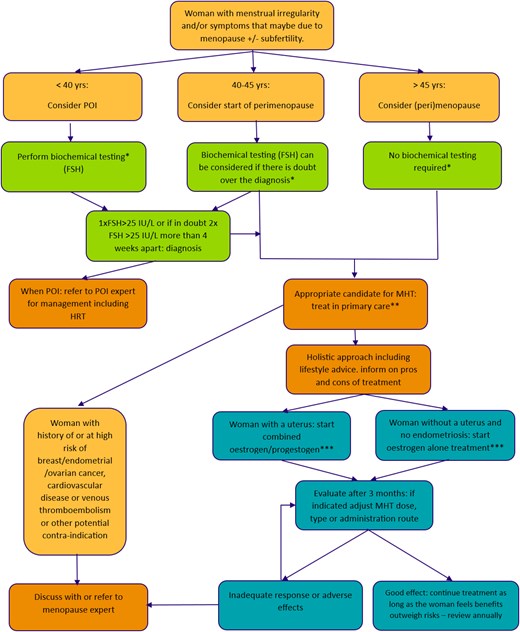
Evaluation and treatment algorithm. POI, premature ovarian insufficiency; FSH, follicle-stimulating hormone; HRT, hormone replacement therapy; MHT, menopausal hormone therapy. *consider additional biochemical testing for diagnoses other than menopause when a woman's medical history and clinical presentation are suggestive of other causes of menstrual cycle irregularities and/or menopause-like symptoms (see Table 6 on differential diagnosis). ** see Table 4 for possible assessments before introducing MHT. *** see Table 5 for available hormonal preparations.

Differential diagnosis for POI and early menopause. The conditions listed below may present in a similar way in some instances.
| Conditions interfering with menstrual cycle | Vasomotor symptoms differential diagnosis |
|---|---|
| SECONDARY TO ENDOCRINOPATHIES | SYSTEMIC DISEASES |
| Functional hypothalamic amenorrhoea (intensive physical activity, restrictive eating, stress) (in up to 3%-4% of the female population96,97) Thyroid disorders (hyper-/hypothyroidism) (in up to 4% of the female population98-100) Prolactinoma (or other pituitary tumours) (in up to 0.03% in the female population101) Polycystic ovary syndrome (in up to 13% of the female population102) Adrenal tumours (Cushing syndrome, pheochromocytoma, adrenocortical carcinoma) Nonclassical congenital adrenal hyperplasia (in up to 1% of the female population103) | Hyperthyroidism (in up to 2% in the female population100) Allergies and immunological diseases (eg, systemic mastocytosis) Mood disorders (eg, generalized anxiety disorder, panic disorder) Obstructive sleep apnea syndrome (in up to 12% of the female population104) Rosacea (in up to 5.9% of the female population105) Pheochromocytoma (in less than 0.03% of the female population106) Acromegaly (in less than 0.01% of the female population107) Medullary carcinoma (in up to 0.03% of the female population108) Carcinoid tumours (in less than 0.01% of the female population109) Infectious etiologies (TBC, HIV) Malignancy (lymphoma) |
| METABOLIC | |
| Eating disorders or gastrointestinal/malabsorption disease (anorexia, bulimia, drastic weight gain, obesity, celiac disease) (in up to 9% of the female population110) Systemic illness and weight loss (cancer, infections) | |
| MISCELLANEOUS | |
| Pregnancy Cancer treatment Postsurgical complications (eg, Asherman syndrome) (in up to 5% of the female population111) Environmental factors and professional exposure (shift workers) Drug induced (eg, antidepressants, neuroleptics, metoclopramide) | MEDICATIONS |
| Gonadotrophin-releasing hormone agonists (eg, leuprolide) Clomiphene MOA Tricyclic antidepressants Ca-channel blockers SSRI Chemotherapy Opiates Systemic antimycotics Aromatase inhibitors SSNR Food additives (monosodium glutamate, sulfites) Diaphoretic drugs Microsoft Word—Diaphoretic_Drugs_2009 2.doc |
| Conditions interfering with menstrual cycle | Vasomotor symptoms differential diagnosis |
|---|---|
| SECONDARY TO ENDOCRINOPATHIES | SYSTEMIC DISEASES |
| Functional hypothalamic amenorrhoea (intensive physical activity, restrictive eating, stress) (in up to 3%-4% of the female population96,97) Thyroid disorders (hyper-/hypothyroidism) (in up to 4% of the female population98-100) Prolactinoma (or other pituitary tumours) (in up to 0.03% in the female population101) Polycystic ovary syndrome (in up to 13% of the female population102) Adrenal tumours (Cushing syndrome, pheochromocytoma, adrenocortical carcinoma) Nonclassical congenital adrenal hyperplasia (in up to 1% of the female population103) | Hyperthyroidism (in up to 2% in the female population100) Allergies and immunological diseases (eg, systemic mastocytosis) Mood disorders (eg, generalized anxiety disorder, panic disorder) Obstructive sleep apnea syndrome (in up to 12% of the female population104) Rosacea (in up to 5.9% of the female population105) Pheochromocytoma (in less than 0.03% of the female population106) Acromegaly (in less than 0.01% of the female population107) Medullary carcinoma (in up to 0.03% of the female population108) Carcinoid tumours (in less than 0.01% of the female population109) Infectious etiologies (TBC, HIV) Malignancy (lymphoma) |
| METABOLIC | |
| Eating disorders or gastrointestinal/malabsorption disease (anorexia, bulimia, drastic weight gain, obesity, celiac disease) (in up to 9% of the female population110) Systemic illness and weight loss (cancer, infections) | |
| MISCELLANEOUS | |
| Pregnancy Cancer treatment Postsurgical complications (eg, Asherman syndrome) (in up to 5% of the female population111) Environmental factors and professional exposure (shift workers) Drug induced (eg, antidepressants, neuroleptics, metoclopramide) | MEDICATIONS |
| Gonadotrophin-releasing hormone agonists (eg, leuprolide) Clomiphene MOA Tricyclic antidepressants Ca-channel blockers SSRI Chemotherapy Opiates Systemic antimycotics Aromatase inhibitors SSNR Food additives (monosodium glutamate, sulfites) Diaphoretic drugs Microsoft Word—Diaphoretic_Drugs_2009 2.doc |
MOA, monoamine oxidase inhibitor; SSRI, selective serotonin reuptake inhibitor; SSNR, serotonin-norepinephrine reuptake inhibitor.
Differential diagnosis for POI and early menopause. The conditions listed below may present in a similar way in some instances.
| Conditions interfering with menstrual cycle | Vasomotor symptoms differential diagnosis |
|---|---|
| SECONDARY TO ENDOCRINOPATHIES | SYSTEMIC DISEASES |
| Functional hypothalamic amenorrhoea (intensive physical activity, restrictive eating, stress) (in up to 3%-4% of the female population96,97) Thyroid disorders (hyper-/hypothyroidism) (in up to 4% of the female population98-100) Prolactinoma (or other pituitary tumours) (in up to 0.03% in the female population101) Polycystic ovary syndrome (in up to 13% of the female population102) Adrenal tumours (Cushing syndrome, pheochromocytoma, adrenocortical carcinoma) Nonclassical congenital adrenal hyperplasia (in up to 1% of the female population103) | Hyperthyroidism (in up to 2% in the female population100) Allergies and immunological diseases (eg, systemic mastocytosis) Mood disorders (eg, generalized anxiety disorder, panic disorder) Obstructive sleep apnea syndrome (in up to 12% of the female population104) Rosacea (in up to 5.9% of the female population105) Pheochromocytoma (in less than 0.03% of the female population106) Acromegaly (in less than 0.01% of the female population107) Medullary carcinoma (in up to 0.03% of the female population108) Carcinoid tumours (in less than 0.01% of the female population109) Infectious etiologies (TBC, HIV) Malignancy (lymphoma) |
| METABOLIC | |
| Eating disorders or gastrointestinal/malabsorption disease (anorexia, bulimia, drastic weight gain, obesity, celiac disease) (in up to 9% of the female population110) Systemic illness and weight loss (cancer, infections) | |
| MISCELLANEOUS | |
| Pregnancy Cancer treatment Postsurgical complications (eg, Asherman syndrome) (in up to 5% of the female population111) Environmental factors and professional exposure (shift workers) Drug induced (eg, antidepressants, neuroleptics, metoclopramide) | MEDICATIONS |
| Gonadotrophin-releasing hormone agonists (eg, leuprolide) Clomiphene MOA Tricyclic antidepressants Ca-channel blockers SSRI Chemotherapy Opiates Systemic antimycotics Aromatase inhibitors SSNR Food additives (monosodium glutamate, sulfites) Diaphoretic drugs Microsoft Word—Diaphoretic_Drugs_2009 2.doc |
| Conditions interfering with menstrual cycle | Vasomotor symptoms differential diagnosis |
|---|---|
| SECONDARY TO ENDOCRINOPATHIES | SYSTEMIC DISEASES |
| Functional hypothalamic amenorrhoea (intensive physical activity, restrictive eating, stress) (in up to 3%-4% of the female population96,97) Thyroid disorders (hyper-/hypothyroidism) (in up to 4% of the female population98-100) Prolactinoma (or other pituitary tumours) (in up to 0.03% in the female population101) Polycystic ovary syndrome (in up to 13% of the female population102) Adrenal tumours (Cushing syndrome, pheochromocytoma, adrenocortical carcinoma) Nonclassical congenital adrenal hyperplasia (in up to 1% of the female population103) | Hyperthyroidism (in up to 2% in the female population100) Allergies and immunological diseases (eg, systemic mastocytosis) Mood disorders (eg, generalized anxiety disorder, panic disorder) Obstructive sleep apnea syndrome (in up to 12% of the female population104) Rosacea (in up to 5.9% of the female population105) Pheochromocytoma (in less than 0.03% of the female population106) Acromegaly (in less than 0.01% of the female population107) Medullary carcinoma (in up to 0.03% of the female population108) Carcinoid tumours (in less than 0.01% of the female population109) Infectious etiologies (TBC, HIV) Malignancy (lymphoma) |
| METABOLIC | |
| Eating disorders or gastrointestinal/malabsorption disease (anorexia, bulimia, drastic weight gain, obesity, celiac disease) (in up to 9% of the female population110) Systemic illness and weight loss (cancer, infections) | |
| MISCELLANEOUS | |
| Pregnancy Cancer treatment Postsurgical complications (eg, Asherman syndrome) (in up to 5% of the female population111) Environmental factors and professional exposure (shift workers) Drug induced (eg, antidepressants, neuroleptics, metoclopramide) | MEDICATIONS |
| Gonadotrophin-releasing hormone agonists (eg, leuprolide) Clomiphene MOA Tricyclic antidepressants Ca-channel blockers SSRI Chemotherapy Opiates Systemic antimycotics Aromatase inhibitors SSNR Food additives (monosodium glutamate, sulfites) Diaphoretic drugs Microsoft Word—Diaphoretic_Drugs_2009 2.doc |
MOA, monoamine oxidase inhibitor; SSRI, selective serotonin reuptake inhibitor; SSNR, serotonin-norepinephrine reuptake inhibitor.
This flexibility in licensed treatment options empowers healthcare professionals to find the best solution for each patient supported by extensive clinical trials. Approved hormone therapy, including oestradiol, oestrone, and micronized progesterone, is often known as body identical therapy and is regulated and monitored for purity and efficacy, dispensed with package inserts containing extensive product information, and includes adverse events.
The optimal duration of systemic MHT should be determined considering ongoing benefits, potential risks and personal preferences. The limited evidence available does not indicate whether it is better to taper down or to stop abruptly, and likewise there is no convincing evidence regarding the duration for which MHT should be taken.139 In other words, limits on duration of use are arbitrary. Treatment should continue for as long as the woman and her GCP feel that benefits outweigh the risks for her.139 Vaginal low-dose oestrogen preparations for women with genitourinary symptoms can be continued long-term. Data on safety profiles for breast, endometrial and cardiovascular health are reassuring.126 Women with POI should receive HRT at least until the average age of menopause, which is 51 years in mainly White populations, and then be reevaluated periodically.55
R 2.7
We recommend taking into account individual characteristics and comorbidities when prescribing MHT and also, preference, availability and costs when choosing between transdermal and oral preparations. (Good Clinical Practice)
The following women can be considered for MHT since they are considered low risk for major adverse cardiovascular events with initiation of MHT for the treatment of menopausal symptoms.140
under 60 years of age or within 10 years of menopause onset,
have a 10-year estimated atherosclerotic cardiovascular disease risk less than 5% using locally accepted risk calculation charts.
do not have an increased risk of breast cancer or personal history of VTE
those with an increased risk of VTE or intermediate risk of CVD (eg, obese, controlled diabetes, older women) should be prescribed transdermal oestradiol
However, in the USA and in Europe over 50% of women over age 55 years have at least one chronic medical condition,141 which makes decision-making around MHT more complex. This guideline provides recommendations considering several risks and benefits accompanying MHT use taking individual characteristics and comorbidities of the women into account.
R 2.8
We recommend HRT in POI irrespective of the presence of vasomotor—or other climacteric symptoms as the multimodal benefits clearly exceed the risk. HRT should be continued until the anticipated age of natural menopause and then the ongoing prescription reevaluated periodically. (Good Clinical Practice)
POI is associated with an increased risk of type 2 diabetes mellitus,142 cardiovascular disease,59 osteoporosis58 and cognitive decline.60 Unless contraindicated, HRT should be recommended for all women with POI and preferably, prescription continued at least until the age of anticipated menopause (for references see ESHRE Guideline on POI55). Oestrogen replacement aims to restore serum oestradiol levels towards the range of the mid-follicular phase. Women with an intact uterus should receive a progestogen for 12-14 days every month to protect the endometrium and ensure withdrawal bleeding or a continuous combined regimen.50 HRT has not been shown to increase the risk of breast cancer in women under 50 years beyond the age-adjusted risk of normally menstruating women.65
R 2.9
We recommend initiating MHT in women within 10 years of natural menopause onset or under 60 years for bothersome menopausal symptoms such as vasomotor or other climacteric symptoms. (⊕⊕⊕○) Women should also be informed that MHT prevents bone loss and reduces fracture risk and may have positive effects on the cardiovascular system. (Good Clinical Practice)
VMS consisting of hot flashes and night sweats have been associated with poor health outcomes,143,144 cardiovascular risk burden,145 poor sleep quality, reduced quality of life,146 irritation, bone loss147 and difficulty in concentration. However, despite VMS being the most common clinical feature of perimenopause and menopause (75% occurrence) and the most common reason menopausal women seek medical attention,146 it is estimated that only 25% or less of these women are prescribed MHT.116
Although VMS may start during the perimenopause, the most severe VMS appear within 1-2 years after the final menstrual cycle and can last up to 12 years in 10% of cases.148-150 The average persistence of VMS is around 7.4 years, with the higher frequency of VMS associated with increased cardiovascular, bone and cognitive risks.151-154
The extent of the reduction in coronary and all-cause mortality associated with taking MHT in a low-risk population is under debate. Some studies suggest significant benefit155-159 but it is not currently advised to introduce MHT for the sole purpose of primary or secondary prevention of cardiovascular disease/coronary artery disease. Further information is included below R 3.3. For effects on bone, see R 2.11.
Different pharmacotherapeutic agents are proven to be effective for treating VMS, however, MHT remains the most effective.160 Standard dose or low dose MHT (CEE 0.3 mg; oral 17β oestradiol ≤0.5 mg; or oestradiol patch 0.025 mg) have proven to be very effective for VMS treatment161 with reduction of the incidence of hot flashes by 75% and their severity by 87%.137 Progesterone and progestogens (MPA, megestrol acetate) have also been proven effective for VMS treatment (see Clinical Question III) with lesser efficacy but possibly lower risk of breast cancer.162 In case of MHT cessation, VMS recur in 50%-87%, but usually in lower intensity163 with no difference in recurrence rate between sudden or gradual discontinuation.164 It is not known yet whether the treatments differ in their impact on associated cardiovascular risks.160
There are other pharmacological treatments for VMS including those acting through the KNDy neurons (NK-3 and NK-1,3 receptor blockers, the SSRIs, SSNIs, Gabapentin, Oxybutinin; see165 for an overview), fezolinetant and elinzanetant which have been found effective in phase 3 RCTS.166,167 Also, non-pharmacological treatments for VMS are available and are listed in Table 3 above.
R 2.10
We suggest that for women with symptoms of vulvovaginal atrophy local or systemic MHT can be considered depending on the presence of other symptoms. Local oestrogen is usually started alone but can be administered with systemic MHT if needed. (⊕⊕○○)
Menopause is associated with sexual dysfunction, dyspareunia, decreased libido and lubrication and an overall decrease of sexual satisfaction.168-170 Symptoms of vulvovaginal atrophy (VVA) including vaginal dryness, burning, itching and dyspareunia are caused by oestrogen deficiency and affect about 50% of postmenopausal women.171 VVA is part of the genitourinary syndrome of menopause (GSM), which is also associated with urinary tract problems, such as frequent urination, urge incontinence and recurrent urinary tract infections.172 Symptoms of VVA may be lifelong and can have a major impact on interpersonal relationships and quality of life.173
Systemic MHT or local vaginal oestrogen may ameliorate sexual symptoms due to VVA174 (see Clinical question I), however unless it arises from the relief of VVA, it does not generally have an effect on sexual interest, arousal and orgasmic response.175 In menopausal women with low libido, transdermal oestrogen therapy may be preferred, due to the fact that oral MHT can increase sex hormone binding globulin (SHBG) and a decreased testosterone bioavailability.174,176 Androgen replacement therapy is also available in some countries although not in Europe. It is therefore not routinely recommended before conventional MHT has been tried.68 No matter which modality of androgen therapy is used in menopausal women, it results in testosterone level increase177 although this should not exceed the physiologic levels found in a premenopausal women.
R 2.11
We suggest that in women without symptoms of perimenopause/ menopause who are under 60 years of age, MHT initiation might be considered for bone protection. (⊕⊕○○)
Postmenopausal osteoporosis primarily results from long-term oestrogen deficiency, leading to accelerated bone loss. Controversy abounds about whether MHT should be used first line to prevent or treat osteoporosis and its effectiveness and safety if used to prevent osteoporotic related fractures.
RCTs demonstrate prevention of bone loss in postmenopausal women who did not have significant bone loss or osteoporosis.20,178 Many oral and transdermal oestrogen preparations, alone or combined with progestogens, the selective oestrogen receptor modulator bazedoxifene with conjugated equine oestrogens (CEE), and tibolone, have been approved in various countries to prevent osteoporosis.179,180 Oral and transdermal oestrogen therapies appear to have similar effects on bone mineral density (BMD).180 Lower-than-standard doses of oestrogen with and without progestogen have shown improvements in BMD but lesser improvement than standard dose.180 Based on observational data, women who experience POI are recommended to take MHT until the age of natural menopause to reduce the risk of osteoporosis.180 Relatively rapid bone loss and loss of protection from fracture occur after discontinuation of hormone therapy,181 which can be prevented by switching to a bisphosphonate or another antiresorptive agent.182 No rebound fractures were seen in the Women's Health Initiative RCTs after stopping MHT.183 The potential bone benefits of hormone therapy should be weighed against the reported risks.184
MHT is not considered a first line treatment for postmenopausal women with established osteoporosis. In the Women's Health Initiative (WHI) trial, in women not selected on the basis of bone density or osteoporosis, oestrogen alone or combined with progestin reduced the overall risk of clinical fracture (oestrogen alone hazard ratio [HR] at 7 years, 0.71; 95% CI, 0.64-0.80 and oestrogen/progestin: HR at 5 years, 0.76; 95% CI, 0.69-0.83) and hip fracture (oestrogen: HR at 7 years, 0.65; 95% CI, 0.45-0.94 and oestrogen/progestin: HR at 5 years, 0.67; 95% CI, 0.47-0.96) compared with placebo.20,178 The quality of fracture evidence from the WHI is limited by enrolment of fewer women ages 50-59 at baseline (2357 Oestrogen/progestin and 1674 oestrogen alone)185 when women are most likely to consider hormone therapy to relieve vasomotor symptoms. In addition, the WHI study was not designed to study osteoporosis, and excluded women with prior osteoporotic related fracture being treated with hormone therapy, thus excluding many women with severe osteoporosis; thus, the risk-benefit profile for these women is less certain.184 In the prospective cohort Million Women Study,186 current users of hormone therapy (all types, formulations, and routes of administration with oestrogen alone or oestrogen combined with progestogen) were found to have a significantly lower risk of fracture than nonusers (RR 0.62, 95% CI 0.58-0.66). The protective effect was seen for all types of MHT. In addition, a systematic literature review performed in this guideline clearly illustrates that fewer women in MHT groups experience total fractures and hip or vertebral fractures than in control groups (Figure 3).
In a pooled analysis from phase 3 trials in young postmenopausal women with normal or low BMD, bone density changes versus placebo for bazedoxefine combined with conjugated oestrogens were 2.3% and 1.4% at the lumbar spine and total hip, respectively187; however, no fracture data are available for the combination, only for bazedoxifene alone which significantly reduced the incidence of vertebral fracture and increased spine BMD at 3 and 7 years.188 A network meta-analysis demonstrated tibolone prevented vertebral and nonvertebral fractures but not hip fractures,189 with concern of cancer recurrence in women with a history of breast cancer and stroke in women over 60 years of age.190
MHT has not been tested in RCTs carried out in women with established osteoporosis. Consequently, oestrogen has not been approved as a treatment for osteoporosis. A network meta-analysis found that oestrogen-progestin effectively prevented vertebral, nonvertebral, and hip fractures.189 However, increased efficacy was found with bone-specific agents, such as teriparatide, abaloparatide, denosumab, and romosozumab, over hormone therapy or tibolone. Thus bone specific agents are recommended as first line treatment in postmenopausal women with established osteoporosis.
For a more in-depth discussion of osteoporosis diagnosis, prevention and treatment options, please see the International Osteoporosis Foundation (IOF) European guidance for the diagnosis and management of osteoporosis in postmenopausal women.191
SECTION 3: specific conditions
The presence of obesity, diabetes, history or high risk of breast cancer (Bc), history of cardiovascular disease (CVD) or venous thromboembolism (VTE) is likely to make women and/or their primary care professionals unwilling to consider MHT due to anticipated risks of treatment. However, further discussion is warranted as described in the sections below.
Age
R 3.1
We suggest a targeted approach to MHT continuation in women over 60 yrs. We suggest taking into account the effect on VMS and/or other climacteric symptoms, the changing benefit-risk profile with age and effect on bone and personal preferences. (Good Clinical Practice)
Age alone should not be the sole reason to discontinue MHT.192,193 Instead, decision making on continuation of the use of MHT beyond the age of 60 years and/or 10 years past the onset of menopause is dictated by the continued presence of bothersome menopause symptoms or for reduction of bone loss not adequately addressed by other non-hormonal options and taking into account personal preferences and quality of life. It is notable that the risk-to-benefit ratio of the use of MHT is influenced by age because age is a risk factor for cardiovascular disease and for breast cancer. However, MHT is not an anti-aging strategy and should not be used for chronic disease prevention aside from fracture risk reduction. If a decision is made to continue MHT longer-term, a non-oral route of administration should be considered at the lowest dose needed to achieve treatment goals with periodic reassessment of comorbidities and the ongoing need for MHT in collaboration with a woman's primary health care professional.
VTE
R 3.2
We recommend that, if in a woman with a previous VTE, HRT/MHT is indicated after individual risk—benefit assessment, transdermal low dose oestrogen should be used. (⊕⊕⊕○)
The route of administration of HT appears to be important when considering risk for VTE. Whereas oral HT increases risk, when administered by the transdermal route of administration it does not increase risk above baseline. Oral oestrogens undergo first-pass metabolism in the liver, which results in an increase in coagulation factors, triglycerides and C-reactive protein, adverse changes that may affect cardiovascular and thromboembolic disease risk.194-197 Mostly observational and some RCT data suggest that oral, but not transdermal oestrogen is associated with increased VTE risk.198-200 Additionally, the type of progestogen used for endometrial protection may also impact risk of VTE, with micronized progesterone and pregnane derivatives (including dydrogesterone, medrogestone, chlormadinone acetate, cyproterone acetate, and possibly medroxyprogesterone acetate) associated with no increased risk (OR 0.7; 95% CI, 0.3 to 1.9 and OR 0.9; 95% CI, 0.4 to 2.3, respectively) although not all studies give consistent results. This contrasts with norpregnane derivatives (nomegestrol acetate and promegestone), which have been associated with a nearly 4-fold increased risk (OR 3.9; 95% CI 1.5 −10.0).198 Similarly, a systematic review demonstrated that, in contrast to norpregnane derivatives, micronized progesterone in combination with oestrogen, was not associated with either primary or recurrent VTE risk.201 Although RCT data are lacking, lower doses of oral HT may be associated with less risk for VTE than higher doses.202 Limited data suggest that tibolone is not associated with increased risk for VTE.190,202,203
Decision making regarding the use of MHT in a woman who has had a VTE is complex and takes into consideration the risk for recurrent VTE. Risk of recurrence is influenced by numerous factors including the presence of a thrombophilia, whether the VTE was provoked or unprovoked, and lifestyle factors. Expert opinion suggests that women with a history of VTE considering MHT use should be seen by a menopause expert. Existing evidence does not support testing women for the presence of a thrombophilia before starting MHT based on a family history of VTE and no or unknown thrombophilia.204
Cardiovascular disease
R 3.3
MHT should not be used primarily for primary or secondary prevention of cardiovascular disease (CVD). (⊕⊕⊕○)
Cardiovascular disease (CVD), including coronary artery disease (CAD), represents one of the leading causes of death in the female population.205 Partly because of premenopausal oestrogen exposure, women are protected against CVD during their reproductive years. During perimenopause the risk for CVD increases gradually. Strong evidence shows a higher risk of CAD and CVD in women with premature or early onset menopause.63 The relationship between CVD and MHT is complex and understanding has evolved over the years.
Oestrogen therapy was associated with a lower CVD risk in several observational studies.206 In 1991, the Nurse's Health Study demonstrated a reduction in coronary heart disease and CVD mortality in women using oestrogen. In general, observational studies have included younger women than in the RCTs, which led to the timing hypothesis. Age-stratification analyses from the WHI trials found that MHT reduced CHD and all-cause mortality in women aged 50-59 years, but increased CHD in older women.155,185 This has been confirmed in other studies.156-158 The reduction in coronary and all-cause mortality in a low-risk population is consistent around 30%.159 A nationwide database study from Finland evaluating oestradiol-based regimens in MHT users observed a reduction in mortality from CHD in MHT users, suggesting that the beneficial effects of oestrogens are not specific to the type of oestrogen prescribed.207
Initiating MHT in women over 60 years of age, or in women with prior CVD, should be individualized given the potentially increased CVD risk. In the Heart and Estrogen–Progestin Replacement studies (HERS and HERS II), use of CEE/MPA failed to show a reduction in the risk for nonfatal myocardial infarction (MI), CHD as well as the incidence of unstable angina, peripheral arterial disease, stroke and transient ischemic attack in the population of women with established CAD; furthermore, use of CEE/MPA was associated with increased risk for MI in the first year and CAD deaths in the first 3 years.208 Based on these studies, MHT prescribing rates declined.
There was no effect with MHT administration on all-cause mortality, CVD related deaths, non-fatal MI, angina, revascularization, stroke or pulmonary embolism when HRT was used for secondary prevention in a large Cochrane review. There was no strong evidence that MHT overall had an effect on death or death from cardiovascular causes; however in the subgroup analysis in this study, women who initiated MHT prior to 10 years post menopause had lower all-cause mortality and CHD benefit, compared to placebo.156
Hyperlipidaemia and abnormal lipid profiles are a significant risk factor for CVD. The menopausal transition is associated with an unfavourable lipid profile and an increase in lipid parameters resulting in CAD and CVD progression. Scarce available data show that oral MHT is superior to transdermal MHT in LDL-C (low density lipoprotein) and Lp(a) reduction and HDL increase but was also associated with an increase in triglyceride concentration, therefore highlighting transdermal MHT as a safer option for women with hypertriglyceridemia.209 In women with dyslipidaemia, data from small RCTs show that statin and statin + MHT is superior to MHT monotherapy in reducing triglyceride levels and therefore, the combination of transdermal MHT and statin therapy could be considered. MHT alone does not achieve recommended levels of lipids for secondary CVD prevention.210,211 In women with a high CVD risk and dyslipidaemia, MHT should not be introduced.212
In general, MHT is contraindicated in women with existing CHD, including myocardial infarction (MI). Although it is strongly advised to stop MHT after MI, a meta-analysis showed that the absolute risk of MI, angina or death is low when continuing MHT after the event.213 If MHT is indicated, discussion with a cardiologist should take place. A recent systematic review summarized the risks of MHT in women with pre-existing CVD, with varying frequency of cardiovascular risk factors.211 Most of the studies examined CEE combined with MPA and were conducted in women >60 years. Compared to placebo, MHT did not show any significant effect on non-fatal MI (7 RCTs), CVD death (6 RCTs) or stroke (5 RCTs).211 However, these data were of low quality and insufficient to recommend the use of MHT for secondary CVD prevention.
Cardiovascular risk factors such as elevated blood pressure, lipid levels and glucose levels should always be optimized according to CVD guidelines before systemic MHT can be considered.140,214 Transdermal low dose MHT is preferred when cardiovascular risk factors are present.
Diabetes
R 3.4
We recommend that well-controlled diabetes is not considered a contraindication for MHT use; transdermal oestrogen is the preferred choice. (⊕⊕⊕○)
There is no evidence for a negative effect of MHT on diabetes risk. Overall, the current use of MHT is linked with a lower risk for new-onset diabetes mellitus and better control of diabetes (see below).
Body composition changes become apparent from the stage of late perimenopause;215,216 fat mass (total and visceral) increases, lean mass decreases and energy expenditure decreases during the menopausal transition.216-219 Baseline adiposity and race may affect the magnitude of body composition changes.220 The changes in body composition and the ensuing increase in insulin resistance during the menopausal transition increase the risk of Type 2 diabetes mellitus (T2DM).221
MHT exerts a favourable effect on body composition,222,223 with a decrease in visceral adipose tissue, body mass index, and android fat distribution, but there is no benefit observed for lean body mass.224,225 In the Kronos Early Estrogen Prevention Study (KEEPS) trial, weight and waist circumference increases were prevented by MHT, prescribed orally or transdermally during 4 years.226
A meta-analysis has shown that the use of MHT decreases insulin resistance by 13% and the incidence of T2DM by 30%227 and women on MHT have a lower risk of developing T2DM.228 The beneficial metabolic effect induced by oestrogen is likely mitigated by use of progestogens; women on oestrogen monotherapy had lower risk of incident DM compared to women treated with CEE or 17β-oestradiol plus MPA.229,230 Progestogens like dydrogesterone or micronized progesterone may not adversely affect glucose metabolism.231,232
Concerning women with pre-existing DM, MHT has been shown to decrease blood glucose levels by 11.5%, and HOMA-IR by 35.8%.227 There is a reduction in HbA1c and fasting blood glucose levels in women on active treatment as compared to placebo.233,234 A recent meta-analysis including 19 trials with a total of 1412 women showed that in women with DM at baseline, the use of MHT compared to women who were not on hormone treatment reduced HbA1c levels (average −6.08 mmol/mol, 95% CI: −8.80 to −3.36) as well as fasting glucose levels (average, −1.15 mmol/L, 95% CI: −1.78 to −0.51).235 This beneficial effect in HbA1c and fasting glucose levels was not evident in women on treatment with transdermal-only preparations when compared to controls.235 This suggests that careful thought must be given to the route of administration of the MHT.
Temporarily reduced bioavailability of oral contraception after dose escalation of tirzepatide has been reported.236 The clinical impact of this or other GLP-1 containing agents for MHT is not known.
Hypertension
R 3.5
In women with well-controlled hypertension there is no contra-indication for MHT; transdermal oestrogen is the preferred choice. (⊕⊕○○) We recommend MHT not be initiated in the presence of uncontrolled hypertension. (Good Clinical Practice)
Lower levels of oestrogen in menopause may contribute to development of hypertension through several mechanisms such as systemic inflammation, alteration of the renin-angiotensin-aldosterone (RAAS) system, vascular tone, kinin-kallikrein system, sympathetic system and atrial natriuretic peptide (ANP). Furthermore, menopause is also accompanied by changes in body composition, development of metabolic syndrome, obesity and arterial stiffness adding further to the genesis of.237-240 CVD risk factors should be treated according to local protocols. Lifestyle advice, particularly regarding diet and exercise should be given.
Despite discrepancies in study designs, available evidence shows that in normotensive menopausal women, oestrogen therapy alone or combined with progestogen has a neutral on blood pressure.241,242 In hypertensive women, both oral and transdermal oestrogen therapy demonstrated a neutral effect in some studies, while in the WHI study, CEE (in combination with MPA or alone) increased blood pressure. Transdermal oestrogen was associated with a lower risk of hypertension development in comparison to oral oestrogen.243-248 Currently, it is not advised to commence MHT in the setting of uncontrolled hypertension.140
Stroke
R 3.6
We recommend that MHT is not used to prevent stroke. (⊕○○○)
Observational trials on the use of MHT and the risk of stroke have shown either a protective effect or an increased risk, whereas RCTs and meta analyses in general show an increased risk for stroke. A recent meta-analysis observed an increased risk for stroke (17 trials, 37 272 women, RR 1.17, 95% CI 1.05 to 1.29, P = .027).249 A systematic review calculated that use of MHT led to 52 more cases of stroke per 10 000 persons.250 Also, the stroke risk associated with MHT seems to be higher when initiated at older ages (further from start of menopause and MHT started over age 65). The first year of MHT use was associated with a significantly increased risk of any stroke (HR, 2.12 [95% CI, 1.66-2.70]), ischemic stroke (HR, 1.93 [95% CI, 1.05-3.57]), and subarachnoid haemorrhage (HR, 2.17 [95% CI, 1.25-3.78]).251 Cochrane observed that continuous combined MHT increased the risk of stroke after 3 years’ use: from 6 per 1000 to between 6 and 12 per 1000 and oestrogen only MHT increased the risk of stroke after 7 years’ use from 24 per 1000 to between 25 and 40 per 1000.184 Overall, the use of MHT seems to result in an increase up to 40% of ischemic stroke, but the actual event rate is low.159 Low/standard dose transdermal oestradiol has a neutral effect on stroke risk, while higher doses may have an adverse effect.252 There is controversial evidence of increased risk of haemorrhagic stroke with MHT administration. Although the increased risk of ischemic stroke within one year of initiation of MHT is most likely related to the procoagulant effect of oral MHT, the mechanism for increased risk of subarachnoid haemorrhage is much less clear and deserves further study.
Migraine
R 3.7
We suggest that in women with an indication for MHT and a history of migraine with aura, transdermal oestrogen is recommended. (⊕○○○)
Two large cross-sectional studies253,254 have shown that MHT was associated with increased risk of migraine, OR 1.42 (95% CI 1.24-1.62). Transdermal oestrogen is reported to be less likely associated with migraine headaches compared with oral conjugated oestrogens.255 Meta-analyses have reported approximately 2-fold increased stroke256-258 risk associated with MHT usage in women with migraine and aura. However, migraine is most common in women aged under 50 years, so the safety of MHT in women with migraine and aura (which has a higher stroke risk compared with migraine without aura259) is not known. There are little available data investigating differential risks between oral and transdermal oestrogens on stroke risk in migraine with aura. However, the superior overall cardiovascular safety of transdermal MHT (R 3.2, R 3.5), makes it preferable to use transdermal administration for treating menopause in women with migraine and aura.260 Provocation of migraine symptoms appears dependent on levels of oestrogen exposure. For this reason, using the minimum dosage of transdermal oestradiol can be considered in women with migraine and aura.260
Breast cancer
R 3.8
We recommend that all women initiating MHT are informed about the increased risk for breast cancer. (Good Clinical Practice)
The lifetime risk of breast cancer in the Western world is more than 10%, and 70%-80% of all breast cancers are hormone sensitive.261 There is scientific support that combined oestrogen-progestogen treatment in women of normal menopausal age produces a duration-dependent increase in the risk of breast cancer, while the risk with oestrogen alone is less than combined HRT.114,115,138,139,262,263 Furthermore, the breast cancer risk is lower with sequential treatment with progestogen compared to continuous combined treatment. Other factors of importance are type of progestogen, time of initiation of treatment in relation to menopause, and patient characteristics. However, women with POI on HRT have no increased risk of breast cancer beyond the age-adjusted general population risk. Data on breast cancer risk dependent on type of treatment is described below.
Combined oestrogen-progestogen treatment
Oestrogen must always be given in combination with progestogen to women with an intact uterus (see R 2.4). In the largest RCT, the Women's Health Initiative study (WHI), continuous combined treatment with CEE and MPA increased the risk of breast cancer by an additional nine cases per 10 000 woman-years after a mean of 5.6 years of treatment compared with placebo.185 A meta-analysis based on all available epidemiologic data until 2019 showed a gradual increase in breast cancer risk with a relative risk (RR) of 1.60; 95% CI 1.52-1.69 for the first four years of use which increased to RR 2.08; 95% CI 2.02-2.15 after 5-14 years of use.263 This increased risk is in line with other risk factors for breast cancer, such as obesity, high alcohol intake and low physical activity264 although the impact of MHT is less in obese than lean women. In the meta-analysis, the increased risk of breast cancer persisted for at least ten years after discontinuation of treatment. Furthermore, the meta-analysis showed that the risk was higher for continuous treatment with progestogen compared to sequential treatment.263
Epidemiological data further suggest that the risk of breast cancer may be lower with MHT containing natural progesterone or dydrogesterone (structurally similar to progesterone) compared to synthetic progestogen.131,265,266 Tibolone is a synthetic substance with oestrogenic, progestogenic and androgenic properties that has shown varying breast cancer risk in epidemiological studies.203,263,267,268 However, in a Cochrane report based on four randomized studies, there was no increased risk of breast cancer with tibolone in women with no history of breast cancer (very low-quality evidence), while tibolone increases recurrent breast cancer rates in women with a history of breast cancer (moderate-quality evidence).190 The impact of levonorgestrel-releasing hormone IUD on breast cancer risk is unclear. A meta-analysis based on seven observational studies showed an increased risk of breast cancer, especially for women over 50 years old (OR 1.52; 95% CI 1.34-1.72).269 However, data was lacking on previous use of oral contraceptives and concomitant use of MHT.
Body mass index (BMI) affects breast cancer risk in women using combined MHT so that obesity (BMI > 30) is associated with a significantly lower attributable risk compared to women who do not have obesity.263
Oestrogen only treatment
Women who have no uterus can be offered oestrogen-only treatment (see R 2.5). The increase in breast cancer risk with oestrogen alone, particularly conjugated equine oestrogen, is non-significant or considerably less compared with combined treatment.270 In fact, the WHI-study showed a non-significant reduced risk of invasive breast cancer after an average of 7.2 years of treatment with oestrogen alone, corresponding to seven fewer cases of breast cancer per 10 000 woman-years and HR 0.79; 95% CI 0.61-1.02.185 Long-term follow-up (>20 years) of the same study showed continued reduced breast cancer incidence with oestrogen alone (HR 0.78; 95% CI, 0.65-0.93),271 as does a recent meta-analysis.138 On the other hand, several observational studies show a small increased risk of breast cancer,263,272,273 while others show a neutral effect.274 Thus, the precise effect of oestrogen alone therapy on the risk of breast cancer is currently still unclear.
R 3.9
We recommend that systemic MHT is not used in women with a history of breast cancer. Considerations include factors such as age and individual characteristics of the tumour. (⊕⊕○○)
Combined MHT is contraindicated in women with a history of breast cancer.114,264 Two randomized trials have investigated breast cancer recurrence with MHT and have shown conflicting results. The HABITS study was stopped prematurely due to an increased risk of recurrence in MHT-users compared to nonusers after a median follow-up of 2.1 years (relative hazard (RH) 3.5, 95% CI 1.5-7.4),275 whereas the Stockholm trial showed no increased risk of recurrence with MHT use after a median follow-up of 4.1 years (RH 0.82, 95% CI 0.35 to 1.9)276 and 10.8 years (HR 1.3; 95% CI 0.9-1.9).277 However, this study showed an increased risk of breast cancer in the contralateral breast (HR 3.6; 95% CI 1.2-10.9).277 MHT may be considered in exceptional circumstances with patients who have insufficient relief of climacteric symptoms from non-hormonal alternatives after consultation with their oncologist, and after careful information on benefits and risks.
Hereditary predisposition for breast cancer is not a contraindication to MHT but should be taken into account in counselling. A meta-analysis based on three cohort studies and 1100 patients showed that MHT use in women who are carriers of BRCA1 and BRCA2 mutations and who have undergone prophylactic salpingo-oophorectomy does not increase the risk of breast cancer (HR 0.98; 95% CI 0.63-1.52).278 In women after risk-reducing salpingo-oophorectomy in premenopause and with no previous history of breast cancer, MHT is recommended up to the age of natural menopause.264
POI is associated with a decreased risk of breast cancer and there is no additional risk for breast cancer with HRT279,280 over that for women of the same age who have normal ovarian function.
R 3.10
We suggest that low dose vaginal oestrogen, dosed to treat vaginal issues, can be considered in women with a history of breast cancer and genitourinary symptoms if other non-hormonal therapies are ineffective. (⊕○○○)
Symptoms of genitourinary symptoms including dyspareunia and urinary tract problems can have a major impact on life quality and are reported by 50%-75% of women receiving adjuvant endocrine therapy and/or chemotherapy for breast cancer.281 Treatment with aromatase inhibitors is associated with more severe symptoms than tamoxifen.281 The recommended first line treatment is non-hormonal lubricants and moisturizers due to the risk of systemic absorption by local oestrogen.171 Lubricants based on water, oil, silicone or hyaluronic acid are usually used in association with sexual activity, whereas moisturizers containing polycarbophil-based polymers are used on a more regular basis.171 When non-hormonal therapies are ineffective, vaginal hormone therapy could be considered, such as low dose local oestradiol, estriol, the latter being a less potent oestrogen or DHEA which is converted to oestrogen and with the lowest effective dose.171 Studies do not support systemic absorption after 8 weeks of treatment with vaginal oestrogen.282,283 Cohort studies have shown no increased risk of breast cancer recurrence in women with a history of breast cancer using vaginal oestrogen for genitourinary symptoms.284-286 A recent systematic review and meta-analysis confirmed no increased risk of breast cancer recurrence or breast cancer mortality in these women.287 The decision of using vaginal oestrogen in these women should be taken in collaboration with the woman's oncologist.
Endometrial cancer
R 3.11
We suggest that initiation of MHT can be considered in women with a history of early stage endometrial cancer who are considered disease free. (⊕○○○)
Women with a history of endometrial cancer and menopausal symptoms should primarily be recommended non-hormonal treatment for symptom relief. If this treatment is insufficient, systemic MHT could be considered in women with a history of early-stage endometrial cancer who are considered disease free by their oncologist. A meta-analysis based on one randomized study and five observational studies showed no increased risk of recurrence in female survivors of endometrial cancer treated with MHT.288,289
Ovarian cancer
R 3.12
We suggest that the risk for ovarian cancer is not a major determinant for the decision to initiate MHT or not. (⊕○○○)
The incidence of ovarian cancer is about ten times lower than that of breast cancer.290 There are conflicting results regarding the risk of ovarian cancer with MHT use. A meta-analysis of epidemiological studies demonstrated a moderately increased risk of ovarian cancer by four years ongoing or recently stopped MHT use (RR 1.37; 95% CI 1.29-1.46), particularly of serous and endometroid ovarian cancer.291 There was no difference between combined hormone therapy and oestrogen alone. In contrast, the randomized WHI-trial showed no increased risk after 5-6 years of treatment with combined MHT (HR 1,41; 95% CI, 0,75-2,66).185 However; after 20 years of follow-up, the WHI-study showed that CEE alone increased ovarian cancer incidence and ovarian cancer mortality, while CEE plus MPA did not.292 Therefore, this might be taken into account when weighing ongoing benefits and potential risks in women with longer duration of MHT (see R 2.6).
R 3.13
We suggest that initiation of MHT can be considered in women with (a history of) certain subtypes of ovarian cancer. (⊕○○○)
MHT appears to be safe in women experiencing menopausal symptoms and (a history of) ovarian cancer. A systematic review and meta-analysis comprising more than 1500 women with ovarian cancer showed no increased risk of cancer recurrence with MHT and instead a reduced risk of death in ovarian cancer (OR 0.47; 95% CI 0.28-0.80).67,293 However, caution should be considered for women with oestrogen receptor positive ovarian cancer such as serous cancer and granulosa cell tumours. It is therefore appropriate to make decisions about MHT in consultation with the woman's oncologist.
Mood and cognition
R 3.14
We recommend not to routinely use MHT to treat clinical depression in perimenopause/menopause. (⊕○○○)
Cross-sectional studies have reported that the prevalence of depressive symptoms is higher during perimenopause and menopause transition compared with premenopause. For example, 45% to 68% of perimenopausal women have elevated depressive symptoms compared with 28% to 31% of premenopausal women.294,295 Some longitudinal studies have also observed increased risk of depressive symptoms during perimenopause.296-298 A recent network meta-analysis of 70 RCTs (n = 18 530) that oral oestrogens (SMD −0.54; 95% CI −0.90 to −0.10) and tibolone (SMD −0.64 95% CI −1.11 to −0.12) reduced depressive symptoms compared with placebo.299 The most efficacious treatment for depressive symptoms during menopause was a combination of fluoxetine plus MHT (SMD −1.59; 95% CI −2.64 to −0.50). However, subgroup analysis in women >1 year after menopause onset failed to show efficacy for any form of MHT (with or without fluoxetine) compared with placebo. A subgroup analysis of only perimenopausal women showed efficacy for transdermal oestrogen to improve depressive symptoms (SMD −0.95; 95% CI −1.77 to −0.14). A recent RCT of 172 perimenopausal and early postmenopausal reported that 12 months of transdermal oestradiol and intermittent micronized progesterone reduced risk of developing depressive symptoms compared with placebo (17.3% vs 32.3%).300
Cognitive symptoms such as “brain fog” are commonly reported by women during menopause.301,302 However, RCT data does not support the use of MHT to improve cognitive performance. The WHI Memory Study WHIMS measured mini-mental state examination (MMSE) in 7150 of women aged >65 years randomized to placebo or CEE with or without MPA for 5-7 years.35 As expected, participants performed better following repeated MMSE testing; however, MMSE was significantly more likely to be 2SD below the mean in the placebo arm. A recent meta-analysis of RCTs investigating the effects of MHT on cognitive measures was conducted. This concluded that MHT was associated with reduced cognition compared with placebo (SMD −0.04; 95% CI −0.08 to −0.01), and that the reduction in cognitive function was only observed in women with aged >60 years.303 However, most participants in this meta-analysis were from WHIMS, questioning its power to aggregate findings with other studies.
In summary, perimenopause is a risk factor for depressive symptoms, and MHT can reduce depressive symptoms during this time. However, RCT data (dominated by WHIMS) suggest a paradoxical reduction in MMSE compared with placebo in older menopausal women. Effects of MHT on cognition in women aged <65 years (who represent the vast majority of women taking MHT) remain unclear.
Dementia
R 3.15
We recommend that MHT is not used to prevent or treat dementia. (⊕○○○)
Menopause is commonly associated with increased cardiometabolic risk factors for dementia.304 Animal studies suggest that oestrogen has neuro-protective effects, which lead to the discussion of the potential for oestrogen supplementation to reduce dementia risk.305 The WHI Memory Study (WHIMS) remains the only RCT investigating the effects of MHT on dementia risk. CEE plus MPA doubled risks of all-cause dementia in women aged >65 years (40 vs 21 cases; HR 2.05. 95% CI 1.21-3.48; P = .01), but CEE alone was not associated with increased dementia risk (28 vs 19 cases; HR 1.49. 95% CI 0.83-2.66; P = .18). A “critical window” hypothesis has been proposed since some observational studies have reported reduced risks of Alzheimer's disease (Ad) in the youngest women taking MHT.306 In 2020, two meta-analyses investigated the association of MHT with overall dementia risk and Ad. Wu et al. suggested that Ad risk was slightly increased in women taking MHT (OR 1.08, 95% CI 1.03-1.14, I2: 69%) and similar results were observed with overall dementia risk; increased Ad risk only persisted for the first 5 years of taking MHT, while MHT use longer than 10 years was associated with a reduced Ad risk.307 In contrast to Wu, a meta-analysis by Song et al. concluded that Ad was reduced with MHT use (OR 0.67, 95% CI 0.58-0.78, P < .001); subgroup analysis failed to identify patient age or treatment duration as significant sources of heterogeneity of results.308 Divergent results of these meta-analyses illustrate the likely contributions of MHT type, participant age at MHT initiation, and study design (cross-section, cohort or RCT) on results. National, UK and Danish nested case-control studies have recently been published, but also yield differing conflicting results on dementia risk.309,310 Existing studies are limited by the long delay between age of menopause and onset of dementia, with studies having short term follow-up and comorbidities which may have changed. The effects of HRT on dementia risk in women with POI are not known.311
In summary, there are no consistent data to support MHT for dementia prevention, and some forms may increase dementia risk in women when it is initiated >65 years of age.
SECTION 4: future research
Menopause, a pivotal transition in a woman's life, significantly influences health. Understanding its impact is paramount. Future research will not only unveil new insights but also pave the way for improved treatments, thereby enhancing the overall health and well-being of menopausal women.
Potential areas of research identified by the working group included:
Studying different types of progestogens, including progestin IUDs, and their long-term effects on the endometrium, breast, bone, and cardiovascular system. Although the IUD is primarily considered to have a local effect, some progestin is absorbed, and thus longer term studies are needed to understand its effects.
Oestrogen was shown in the Women's Health initiative to reduce fractures (with and without progestin) in women not identified as having high fracture risk. However, it has not been studied for its effects on women with high fracture risk. This knowledge gap underscores the urgency of determining the effect of hormone therapy on fracture risk stratified by BMD, particularly for those already diagnosed with osteoporosis.
Transdermal oestrogen appears safer for venous thrombosis and stroke risk than oral hormone therapy. However, the absence of head-to-head trials is a significant gap in our understanding, although it is unlikely that there will be further large RCTs in the future and it will be necessary to rely on observational studies and registry data of longer duration.
It is crucial to conduct these trials to determine if there is any difference in breast cancer risk between transdermal versus oral oestrogen, thereby filling a critical knowledge void.
The Women's Health Initiative followed women who were, on average, 63 years of age for approximately 5 years for those in the oestrogen/progestin arm and 7 years for oestrogen alone. However, there are limited data on long-term use of MHT greater than 5-7 years for morbidity and mortality, particularly for those women initiating MHT before the age of 60 or within 10 years of menopause and for those using lower doses, progesterone instead of progestin, transdermal compared to oral, or oestradiol compared to CEE. Thus, additional studies with longer-term follow up are needed for morbidity and mortality in populations using doses, routes of administration, and formulations more commonly used today.
Current data on cognition and effects of hormone therapy at preventing or accelerating Alzheimer's disease when initiated less than 10 years from menopause are limited. Also data for POI are lacking, and if there is any difference between surgical or natural menopause at an early age. Studies are needed to show if hormone therapy directly or indirectly affects cognition and risk for dementia.
RCT data are needed to determine the effects of MHT on other age-related disorders (sarcopenia, joints, auto-immune disease).
Longitudinal data are needed on the risks and benefits of the use of supraphysiologic dosing, such as that seen with pellets, regarding risks and benefits regarding breast, bone, cardiovascular, and cognitive effects.
The impact of the use of testosterone for effects other than on libido needs to be studied.
Acknowledgments
The guideline authors express their gratitude to Rachel Weiss for critically reviewing the manuscript from a patient's perspective. Furthermore, the authors would like to thank and acknowledge Nick Panay, Margaret Rees and Richard Santen for their expert review. We are also grateful for all the valuable and critical comments of members of the European Society of Endocrinology. In addition, the authors would like to thank dr. J.W. Schoones for his help in conducting the literature searches.
Supplementary material
Supplementary material is available at European Journal of Endocrinology online.
Funding
This work is supported by the European Society of Endocrinology.
Authors’ contributions
Mary Ann Lumsden (Conceptualization [lead], Methodology [equal], Supervision [equal], Validation [equal], Writing—original draft [equal], Writing—review & editing [equal]), Olaf Dekkers (Conceptualization [equal], Data curation [equal], Formal analysis [equal], Investigation [equal], Methodology [lead], Supervision [equal], Validation [equal], Writing—original draft [equal], Writing—review & editing [equal]), Stephanie Faubion (Conceptualization [equal], Data curation [equal], Investigation [equal], Validation [equal], Writing—original draft [equal], Writing—review & editing [equal]), Angelica Lindén Hirschberg (Conceptualization [equal], Data curation [equal], Investigation [equal], Validation [equal], Writing—original draft [equal], Writing—review & editing [equal]), Channa Jayasena (Conceptualization [equal], Data curation [equal], Investigation [equal], Validation [equal], Writing—original draft [equal], Writing—review & editing [equal]), Irene Lambrinoudaki (Conceptualization [equal], Data curation [equal], Investigation [equal], Validation [equal], Writing—original draft [equal], Writing—review & editing [equal]), Yvonne Louwers (Conceptualization [equal], Data curation [equal], Investigation [equal], Validation [equal], Writing—original draft [equal], Writing—review & editing [equal]), JoAnn Pinkerton (Conceptualization [equal], Data curation [equal], Investigation [equal], Validation [equal], Writing—original draft [equal], Writing—review & editing [equal]), Antoan Stefan Sojat (Conceptualization [equal], Data curation [equal], Investigation [equal], Validation [equal], Writing—original draft [equal], Writing—review & editing [equal]), and Leonie van Hulsteijn (Conceptualization [equal], Data curation [equal], Formal analysis [equal], Investigation [equal], Methodology [supporting], Project administration [lead], Validation [equal], Visualization [equal], Writing—original draft [equal], Writing—review & editing [equal])
References
Author notes
Conflict of interest: See Appendix 1 for conflicts of interest.