 https://orcid.org/0000-0001-8594-1448
Abstract
A phase II trial reported clinical benefit over 28 weeks in patients with idiopathic pulmonary fibrosis (IPF) who received zinpentraxin alfa.
To investigate the efficacy and safety of zinpentraxin alfa in patients with IPF in a phase III trial.
This 52-week phase III, double-blind, placebo-controlled, pivotal trial was conducted at 275 sites in 29 countries. Patients with IPF were randomized 1:1 to intravenous placebo or zinpentraxin alfa 10 mg/kg every 4 weeks. The primary endpoint was absolute change from baseline to Week 52 in FVC. Secondary endpoints included absolute change from baseline to Week 52 in percent predicted FVC and 6-minute walk distance. Safety was monitored via adverse events. Post hoc analysis of the phase II and phase III data explored changes in FVC and their impact on the efficacy results.
Of 664 randomized patients, 333 were assigned to placebo and 331 to zinpentraxin alfa. Four of the 664 randomized patients were never administered study drug. The trial was terminated early after a prespecified futility analysis that demonstrated no treatment benefit of zinpentraxin alfa over placebo. In the final analysis, absolute change from baseline to Week 52 in FVC was similar between placebo and zinpentraxin alfa (−214.89 ml and −235.72 ml; P = 0.5420); there were no apparent treatment effects on secondary endpoints. Overall, 72.3% and 74.6% of patients receiving placebo and zinpentraxin alfa, respectively, experienced one or more adverse events. Post hoc analysis revealed that extreme FVC decline in two placebo-treated patients resulted in the clinical benefit of zinpentraxin alfa reported by phase II.
Zinpentraxin alfa treatment did not benefit patients with IPF over placebo. Learnings from this program may help improve decision making around trials in IPF.
Clinical trial registered with www.clinicaltrials.gov (NCT04552899).
Previously, a phase II trial of patients with idiopathic pulmonary fibrosis (IPF) showed a treatment benefit with zinpentraxin alfa versus placebo.
During the phase III STARSCAPE trial, treatment with zinpentraxin alfa did not benefit patients with IPF, and the trial was terminated early after a prespecified futility analysis. However, post hoc analyses of FVC data of the phase II and STARSCAPE trials highlighted the importance of interrogating the data at the patient level. Specifically, identifying and examining influential outliers and selecting appropriate methodologies for data analysis are crucial to correctly interpreting the results of clinical trials in patients with IPF.
Introduction
Idiopathic pulmonary fibrosis (IPF) is a chronic, progressive, fibrosing lung disease of unknown cause, characterized by a definite or probable usual interstitial pneumonia (UIP) pattern on high-resolution computed tomography (HRCT) of the chest and/or lung biopsy (1–3). Two antifibrotic therapies, pirfenidone and nintedanib, are approved for the treatment of IPF and slow the rate of FVC decline (4–7). Although these antifibrotics demonstrate clinically meaningful functional outcomes, improvement of disease symptoms is limited, side effects are frequently reported, and the overall prognosis for patients with IPF remains poor (4, 8–13). There remains an unmet need for treatments that can, either alone or in combination, further slow or halt the progression of fibrosis (11), improve quality of life and symptoms, and offer alternatives for patients who cannot tolerate current antifibrotics.
Pentraxin-2 is a naturally occurring circulating plasma protein constitutively synthesized in the liver (14, 15). It shows antifibrotic activity in vitro and in preclinical models of fibrotic diseases, likely via the regulation of monocyte-derived cells (macrophages, fibrocytes) that control fibrotic processes (15–19). Furthermore, patients with IPF have been reported to have reduced plasma pentraxin-2 concentrations that correlate with disease severity (18).
Zinpentraxin alfa (previously known as PRM-151) is a recombinant form of human pentraxin-2 produced in Chinese hamster ovary cells (19) and, like endogenous pentraxin-2, has broad antifibrotic activity in preclinical models of fibrotic diseases via the modulation of monocyte differentiation (20, 21). In a phase II, randomized, double-blind, placebo-controlled trial (NCT02550873), treatment with zinpentraxin alfa versus placebo appeared to slow mean FVC decline and stabilize mean change in 6-minute-walk distance (6MWD) over 28 weeks in patients with IPF, the majority of whom (78.4%) were receiving concurrent antifibrotic treatment (22). The findings of this trial and its subsequent open-label extension (OLE) formed the rationale for the phase III STARSCAPE program (22, 23).
STARSCAPE was a 52-week, phase III, randomized, double-blind, placebo-controlled trial (NCT04552899) of zinpentraxin alfa in patients with IPF that aimed to demonstrate the efficacy and safety of zinpentraxin alfa treatment. The development program also included an OLE study (NCT04594707). Here, we report the findings of the STARSCAPE trial, which was terminated early after a failed futility analysis. We also report post hoc analyses of the phase II trial to provide further context for the phase III results. Some of the results of this trial have been previously reported in the form of an abstract (24).
Methods
Trial Design
STARSCAPE was a 52-week phase III, multicenter, randomized, double-blind, placebo-controlled, pivotal trial aiming to investigate the efficacy and safety of zinpentraxin alfa in patients with IPF. Patients were randomized 1:1 to receive a placebo or zinpentraxin alfa 10 mg/kg by intravenous infusion over 50–70 minutes on Days 1, 3, and 5, and then once every 4 weeks for 48 weeks. At the end of the 52-week double-blind period, patients could enroll in an OLE study.
This trial was conducted in full conformance with the International Council for Harmonization E6 guideline for Good Clinical Practice and the principles of the Declaration of Helsinki, or the applicable laws and regulations of the country in which the research was conducted, whichever afforded the greater protection to the individual. The trial protocols were approved by the respective Institutional Review Boards before trial initiation at each site. All patients provided written informed consent before participation in the trial.
Patients
The trial was conducted at 275 sites in 29 countries globally. Eligible patients were 40–85 years of age, with a documented diagnosis of IPF according to the 2018 American Thoracic Society/European Respiratory Society/Japanese Respiratory Society/Latin American Thoracic Association Clinical Practice Guideline (2). They also had a percent predicted FVC (%FVC) of ≥45%, an FEV1/FVC ratio of >0.70, a percent predicted Dl CO (corrected to hemoglobin or uncorrected) range of ≥30% and ≤90% during screening, and a 6MWD of ≥150 m with use of ≤6 L/min of supplemental oxygen while maintaining oxygen saturation of ≥83% during the 6-minute-walk test at screening.
Objectives and Endpoints
The primary efficacy objective was to demonstrate superiority of 10 mg/kg zinpentraxin alfa versus placebo, and the primary efficacy endpoint was absolute change from baseline to Week 52 in FVC (milliliters). Secondary endpoints are described in the online supplement. The primary safety objective was to confirm the safety and tolerability of 10 mg/kg of zinpentraxin alfa administered every 4 weeks relative to matching placebo. Safety endpoints included the incidence and severity of adverse events (AEs), infusion-related reactions, and AEs of special interest and the proportion of patients permanently discontinuing trial treatment because of AEs.
Post Hoc Analysis of Phase II FVC Data
A post hoc analysis of the FVC data from the phase II trial explored the impact of extreme FVC decline observed in a small number of patients on the efficacy results. The impact of these influential (outlier) data points on estimates of the within-treatment arm mean FVC changes and the difference in mean change between arms was estimated using the prespecified phase III STARSCAPE linear mixed effects model with and without these outliers and by visualizing patient-level data.
Additional methods related to IPF diagnosis, concomitant medication, randomization and masking, formulation, trial assessments, statistical analysis, and post hoc analyses can be found in the online supplement.
Results
Patients
The study was conducted between March 17, 2021, and February 10, 2023. A total of 664 patients were randomized to receive a placebo (n = 333) or zinpentraxin alfa (n = 331); patient disposition is shown in Figure 1. Four patients did not receive any dose of study drug, and one patient assigned to the placebo group received a partial dose of zinpentraxin alfa so was included in the zinpentraxin alfa group for safety analyses. Termination of the trial was announced by the sponsor on November 30, 2022, after the prespecified futility analysis, which showed no treatment benefit of zinpentraxin alfa over placebo. Patient enrollment was completed when the trial was terminated, and a total of 106 patients (16%) completed the trial.
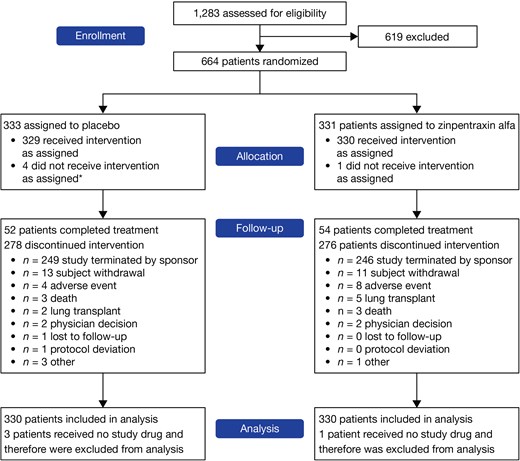
CONSORT flow diagram. *One patient in the placebo arm received a partial dose of zinpentraxin alfa. This patient was included in the full analysis set in the zinpentraxin alfa group for safety analyses and in the placebo group for the efficacy analyses.

Mean (SD) treatment exposure during the trial was 26.7 (18.3) weeks, with a median (minimum, maximum) treatment exposure of 19.3 (4.0, 55.0) weeks for the placebo arm and 26.6 (18.6) weeks and 17.0 (4.0, 54.3) weeks, respectively, for the zinpentraxin alfa arm. In addition, mean (SD) infusions during the trial were 8.6 (4.6) for the placebo arm and 8.6 (4.7) for the zinpentraxin alfa arm. In total, 19.5% (64/329) of placebo-treated patients and 21.8% (72/331) of zinpentraxin alfa–treated patients received treatment at the Week 48 visit (see Figure E1 in the online supplement).
Baseline demographic and disease characteristics are shown in Table 1 and were balanced between the two arms. Mean (SD) disease duration was 3.48 (2.47) years for the placebo arm and 3.28 (2.30) years for the zinpentraxin alfa arm. Mean (SD) duration of prior antifibrotic therapy exposure was 2.70 (1.83) years for the placebo arm and 2.67 (1.83) years for the zinpentraxin alfa arm, and 67.6% (223/330) of patients in the placebo arm and 70.3% (232/330) in the zinpentraxin alfa arm had a history of tobacco use.
Baseline Demographics and Characteristics (Full Analysis Set)
| Placebo (n = 330) | Zinpentraxin Alfa (n = 330) | All Patients (n = 660) | |
|---|---|---|---|
| Age, yr, mean (SD) | 70.5 (7.6) | 70.8 (7.3) | 70.7 (7.5) |
| Male sex, n (%) | 261 (79.1) | 270 (81.8) | 531 (80.5) |
| Race, n (%) | |||
| Asian | 56 (17.0) | 52 (15.8) | 108 (16.4) |
| Black or African American | 4 (1.2) | 1 (0.3) | 5 (0.8) |
| White | 267 (80.9) | 273 (82.7) | 540 (81.8) |
| Multiple | 0 | 1 (0.3) | 1 (0.2) |
| Unknown | 3 (0.9) | 3 (0.9) | 6 (0.9) |
| Hispanic or Latino, n (%) | 27 (8.2) | 19 (5.8) | 46 (7.0) |
| Region, n (%) | |||
| China | 15 (4.5) | 15 (4.5) | 30 (4.5) |
| North America | 90 (27.3) | 88 (26.7) | 178 (27.0) |
| Europe | 142 (43.0) | 143 (43.3) | 285 (43.2) |
| Latin America | 6 (1.8) | 6 (1.8) | 12 (1.8) |
| Rest of world | 77 (23.3) | 78 (23.6) | 155 (23.5) |
| Tobacco use, n (%) | |||
| Smoked | 223 (67.6) | 232 (70.3) | 455 (68.9) |
| Never smoked | 107 (32.4) | 98 (29.7) | 205 (31.1) |
| Concurrent IPF medication use, n (%) | |||
| Nintedanib alone | 145 (43.9) | 144 (43.6) | 289 (43.8) |
| Pirfenidone alone | 130 (39.4) | 129 (39.1) | 259 (39.2) |
| None | 55 (16.7) | 57 (17.3) | 112 (17.0) |
| Biopsy available at screening | 26 (7.9) | 28 (8.5) | 54 (8.2) |
| Duration of prior antifibrotic therapy exposure, yr, mean (SD) | 2.70 (1.83) | 2.67 (1.83) | 2.69 (1.83) |
| (n = 297) | (n = 296) | (n = 593) | |
| Time from IPF diagnosis to randomization, yr, mean (SD) | 3.48 (2.47) | 3.28 (2.30) | 3.38 (2.39) |
| (n = 329) | (n = 327) | (n = 656) | |
| FVC volume, ml, mean (SD) | 2,804.3 (760.7) | 2,867.5 (763.0) | 2,835.8 (761.9) |
| (n = 329) | (n = 328) | (n = 657) | |
| %FVC, mean (SD) | 77.09 (17.14) | 77.89 (16.50) | 77.49 (16.82) |
| (n = 329) | (n = 328) | (n = 657) | |
| Hemoglobin-corrected %Dl CO, mean (SD) | 51.66 (14.78) | 51.73 (17.73) | 51.69 (16.32) |
| (n = 313) | (n = 318) | (n = 631) | |
| 6MWD, m, mean (SD) | 401.4 (104.5) | 404.4 (114.3) | 402.9 (109.5) |
| (n = 320) | (n = 324) | (n = 644) | |
| Oxygen use, n (%) | |||
| Yes | 29 (8.8) | 26 (7.9) | 55 (8.3) |
| Unknown | 301 (91.2) | 304 (92.1) | 605 (91.7) |
| UIP based on central HRCT read, n (%) | |||
| n | 330 | 328 | 658 |
| Definite UIP | 118 (35.8) | 123 (37.5) | 241 (36.6) |
| Probable UIP | 203 (61.5) | 200 (61.0) | 403 (61.2) |
| Other | 9 (2.7) | 5 (1.5) | 14 (2.1) |
| UCSD-SOBQ score, mean (SD) | 29.9 (22.6) | 28.9 (22.2) | 29.4 (22.4) |
| (n = 271) | (n = 276) | (n = 547) |
Definition of abbreviations: 6MWD = 6-minute-walk distance; %Dl CO = percent predicted Dl CO; %FVC = percent predicted FVC; HRCT = high-resolution computed tomography; IPF = idiopathic pulmonary fibrosis; UCSD-SOBQ = University of California San Diego Shortness of Breath Questionnaire; UIP = usual interstitial pneumonia.
Baseline is defined as the patient’s last known observation before initiation of trial drug.
Efficacy
There was no statistically significant difference between treatment arms in the primary endpoint of absolute change from baseline to Week 52 in FVC (placebo: −214.89 ml; zinpentraxin alfa: −235.72 ml; P = 0.5420; Figure 2A and Table E1) and in the secondary efficacy endpoints of absolute change from baseline to Week 52 in %FVC (placebo: −5.75; zinpentraxin alfa: −6.22; P = 0.5707; Figure 2B and Table E1) and 6MWD (placebo: −24.19 m; zinpentraxin alfa: −33.64 m; P = 0.3842; Figure 2C and Table E1). Furthermore, time to disease progression did not differ between treatment arms, with median (95% confidence interval) time to progression being 8.2 (6.5 to 10.9) months for patients receiving placebo and 6.6 (5.6 to 9.1) months for patients receiving zinpentraxin alfa (hazard ratio [95% confidence interval], 1.15 [0.91 to 1.47]; P = 0.2512). The breakdown of contributing events is shown in Table 2. Of note, most of the earliest contributing events were a ≥15% relative decline in 6MWD (placebo: 67% [83/124]; zinpentraxin alfa: 66% [92/140]). However, within-patient variability for 6MWD, assessed via the estimated SD of the residual around the 6MWD trajectory, was high at 50 m.
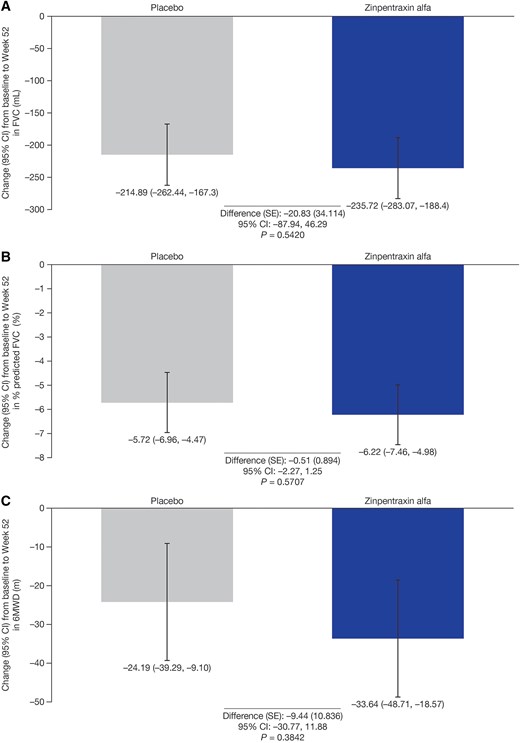
Absolute change from baseline to Week 52 in (A) FVC, (B) percent predicted FVC (%FVC), and (C) 6-minute-walk distance (6MWD) (full analysis set). Estimates for 6MWD are from analyses with a random coefficient regression model using unstructured covariance matrix of random intercept and random slope. The following terms are included in the model: age, sex, height, time, treatment × time, concurrent idiopathic pulmonary fibrosis (IPF) treatment, and region for FVC and 6MWD; time, treatment × time, concurrent IPF treatment, and region for %FVC. CI = confidence interval.

Patients with Disease Progression (Full Analysis Set)
| Placebo (n = 330) | Zinpentraxin Alfa (n = 330) | |
|---|---|---|
| Patients with disease progression | 124 (37.6) | 140 (42.4) |
| Earliest contributing event | ||
| Death | 2 (0.6) | 1 (0.3) |
| Decline in %FVC | 39 (11.8) | 47 (14.2) |
| Decline in 6MWD | 83 (25.2) | 92 (27.9) |
Definition of abbreviations: %FVC = percent predicted FVC; 6MWD = 6-minute-walk distance.
Data are presented as n (%). Disease progression is defined as first occurrence of ≥10% absolute decline in %FVC, ≥15% relative decline in 6MWD, or death.
In addition, there was no difference between treatment arms in the other secondary endpoints of change from baseline to Week 52 in University of California San Diego Shortness of Breath Questionnaire, St. George’s Respiratory Questionnaire, and Dl CO, or time to first respiratory-related hospitalization, first acute exacerbation of IPF, or all-cause mortality (Table E2). Notably, the results of the futility analysis were consistent with the final analysis (Table E3).
Safety
Overall, 72.3% (238/329) of patients receiving placebo and 74.6% (247/331) of patients receiving zinpentraxin alfa experienced at least one AE, with the most common being coronavirus disease (COVID-19) (17.9%; n = 118), cough (12.3%; n = 81), and diarrhea (10.5%; n = 69) (Table 3). Of note, no AE had a difference in incidence of ≥2% between treatment arms. A total of six patients (1.8%) in the placebo arm and nine patients (2.7%) in the zinpentraxin arm discontinued trial treatment because of an AE. The incidence of AEs of special interest were generally comparable between groups; the most common were acute or suspected exacerbation of IPF (placebo: 4.3% [n = 14]; zinpentraxin alfa: 3.6% [n = 12]) and suspected infusion-related reaction, with National Cancer Institute common terminology criteria for adverse events Grade ≥2 (placebo: 1.5% [n = 5]; zinpentraxin alfa: 3.6% [n = 12]).
Overview of AEs and Most Common Adverse Events (≥3% of Total Patients) (Safety Population)
| Placebo (n = 329) | Zinpentraxin Alfa (n = 331) | |
|---|---|---|
| Patients with ≥1 AE | 238 (72.3) | 247 (74.6) |
| Patients with AEs leading to | ||
| Trial treatment discontinuation* | 6 (1.8) | 9 (2.7) |
| Trial treatment interruption | 14 (4.3) | 12 (3.6) |
| Withdrawal from the trial | 3 (0.9) | 4 (1.2) |
| Patients with serious AEs | 40 (12.2) | 46 (13.9) |
| Leading to trial treatment discontinuation | 2 (0.6) | 7 (2.1) |
| Leading to trial treatment interruption | 4 (1.2) | 4 (1.2) |
| Patients with related AEs | 68 (20.7) | 67 (20.2) |
| Leading to withdrawal from treatment | 3 (0.9) | 5 (1.5) |
| Leading to trial treatment interruption | 1 (0.3) | 8 (2.4) |
| Serious related AEs | 3 (0.9) | 4 (1.2) |
| Deaths | 4 (1.2) | 5 (1.5) |
| Patients with ≥1 AE with fatal outcome | 4 (1.2) | 4 (1.2) |
| Patients with severe AEs (at greatest intensity) | 54 (16.4) | 54 (16.3) |
| Patients with AESIs | ||
| Acute or suspected exacerbation of IPF (all grades) | 14 (4.3) | 12 (3.6) |
| Suspected infusion-related reaction with NCI CTCAE Grade ≥2 | 5 (1.5) | 12 (3.6) |
| Suspected anaphylactic or hypersensitivity reactions (all grades) | 2 (0.6) | 1 (0.3) |
| Elevated ALT/AST in combination with either elevated bilirubin or clinical jaundice | 1 (0.3) | 0 (0.0) |
| Suspected transmission of infectious agent by the study drug | 0 (0.0) | 0 (0.0) |
| Most common AEs (≥3% of total patients) | ||
| COVID-19 | 58 (17.6) | 60 (18.1) |
| Cough | 38 (11.6) | 43 (13.0) |
| Diarrhea | 34 (10.3) | 35 (10.6) |
| Infusion-related reaction | 29 (8.8) | 32 (9.7) |
| Dyspnea | 22 (6.7) | 28 (8.5) |
| IPF | 17 (5.2) | 21 (6.3) |
| Fatigue | 14 (4.3) | 17 (5.1) |
| Headache | 13 (4.0) | 16 (4.8) |
| Upper respiratory tract infection | 16 (4.9) | 12 (3.6) |
| Weight decreased | 13 (4.0) | 10 (3.0) |
| Bronchitis | 8 (2.4) | 14 (4.2) |
| Dizziness | 11 (3.3) | 9 (2.7) |
| Pneumonia | 10 (3.0) | 10 (3.0) |
Definition of abbreviations: AE = adverse event; AESI = adverse event of special interest; ALT = alanine transaminase; AST = aspartate transaminase; COVID-19 = coronavirus disease; IPF = idiopathic pulmonary fibrosis; NCI CTCAE = National Cancer Institute common terminology criteria for adverse events.
Data are presented as n (%).
* Reasons for discontinuation in the placebo group were infusion-related reaction (n = 2), cough (n = 1), COVID-19 pneumonia (n = 1), metastatic prostate cancer (n = 1), and pancreatic carcinoma (n = 1). Reasons for discontinuation in the zinpentraxin alfa group were infusion-related reaction (n = 3), IPF (n = 2), acute respiratory failure (n = 1), femur fracture (n = 1), muscle injury (n = 1), and non–small cell lung cancer (n = 1).
A total of 20.7% (68/329) of patients receiving placebo and 20.2% (67/331) of those receiving zinpentraxin alfa experienced at least one treatment-related AE, most commonly infusion-related reaction (all grades; 8.8% [n = 29] and 9.4% [n = 31], respectively). Serious AEs were experienced by 12.2% (40/329) and 13.9% (46/331) of patients in the placebo and zinpentraxin alfa arms, respectively. Four deaths (1.2%) were reported in the placebo arm (IPF, n = 3; COVID-19 pneumonia, n = 1) and five deaths (1.5%) in the zinpentraxin alfa arm (IPF, n = 2; acute respiratory failure, n = 2; cardiac arrest, n = 1). There was no association between AE incidence and background therapy (data not shown). Only three patients recorded anti-drug antibodies, precluding any analysis of AEs based on anti-drug antibody status.
Post Hoc Analysis of FVC Data from the Phase II Trial
In the prior phase II study, mean unadjusted change from baseline to Week 28 in FVC was −157.14 ml for patients receiving placebo and −126.87 ml for those receiving zinpentraxin alfa; however, median changes from baseline (which are more robust to outliers) were −100.00 ml and −120.00 ml, respectively. The change in the direction of the estimated treatment effect when using median versus mean as a summary measure was one indication that a few outliers were driving the apparent treatment effects in phase II. Boxplots of per-patient FVC slopes (ml/yr) revealed that three patients had an FVC decline of >1,000 ml/yr; the two with the greatest measured decline (>2,000 ml/yr) were in the placebo arm, which had a large impact on the estimated mean FVC decline in the placebo arm (Figure 3). Boxplots of FVC slopes showed that, except for the outliers, the distribution of the FVC slopes visually appeared similar across treatment arms, indicating a lack of treatment effect.
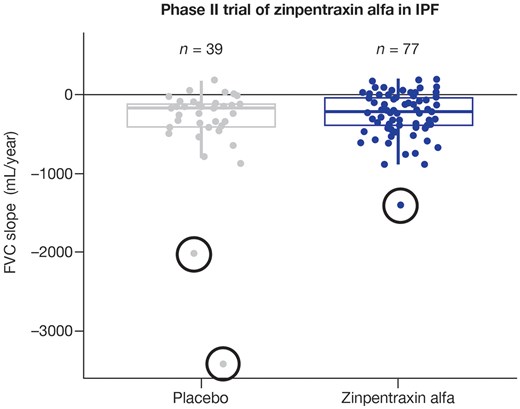
Post hoc analysis of phase II FVC data: distribution of FVC slopes (ml/yr) by assigned treatment arm. Boxplots show the interquartile range of FVC slope (ml/yr), and data points in the boxplots represent individual patients who were treated with placebo or zinpentraxin alfa. Horizontal lines represent the median FVC slope in each arm. Circled data points show the three patients (two from the placebo arm, one from the zinpentraxin alfa arm) who had an FVC decline of >1,000 ml/yr. IPF = idiopathic pulmonary fibrosis.

Analysis of the FVC data with the prespecified phase II linear mixed effect model resulted in a difference in mean FVC decline of 81.8 ml (P = 0.0076; Table E4 and Figure E2). Post hoc analysis of the FVC data from the phase II trial based on the prespecified model used in the STARSCAPE analysis gave an estimated decline over 28 weeks of 213.04 ml and 129.92 ml for the placebo and zinpentraxin alfa arms, respectively, with a difference in mean FVC decline between treatment groups of 83.1 ml, which is comparable with the phase II model (Table E4 and Figure E2). In contrast, repeating the analysis using the STARSCAPE model but excluding data from the three patients with extreme FVC decline (>1,000 ml/yr decline) resulted in a much smaller difference in mean FVC decline between treatment groups of only 18.2 ml (P = 0.5346; Table E4 and Figure E2). The smaller estimated treatment effect was due to the removal of the two influential data points in the placebo arm, leading to a reduction in FVC decline at Week 28 from 213.04 ml to 135.37 ml.
Discussion
In this phase III trial of patients with IPF, no differences were observed between treatment with placebo and zinpentraxin alfa for any of the efficacy endpoints, and the trial was terminated after the prespecified futility analysis showed no treatment benefit of zinpentraxin alfa over placebo. It is noteworthy that, apart from trial termination, no other major reasons for trial discontinuation were identified, and zinpentraxin alfa was generally well tolerated.
Regarding the design of STARSCAPE, considerable measures were taken to minimize the potential impact of the COVID-19 pandemic. Such mitigations included enrollment of patients from a large number of countries and sites to allow steady recruitment, measures to maintain patient and staff safety during trial visits, and ensuring that procedures were in place for patients who were unable to attend a trial site in exceptional circumstances. For those unable to attend trial visits, home spirometry was considered as an alternative to on-site spirometry; however, it was discounted because of technical challenges with home spirometry (i.e., variability in measurements and generation of outliers, malfunction of the algorithm used to generate daily spirometry readings, small number of observations for some patients, connectivity issues, etc.), which were reported in previous interstitial lung disease clinical trials (25–27). Furthermore, during STARSCAPE, it was not considered appropriate to administer infusions at home because of the unapproved, investigational nature of zinpentraxin alfa. Ultimately, a patient population meeting trial criteria was selected for enrollment, and despite the challenges of the ongoing COVID-19 pandemic, there were no issues with trial conduct. Also, COVID-19 vaccinations were becoming available to patients by the start of the trial and were permitted as concomitant medication. Therefore, the circumstances around the COVID-19 pandemic did not affect the ability of the trial to provide a clear answer on the utility of zinpentraxin alfa in IPF.
The phase II trial had several limitations that were carefully considered and accounted for when designing the STARSCAPE trial. First, phase II enrolled a relatively small number of patients (placebo: n = 39; zinpentraxin alfa: n = 78) and had insufficient power to explore secondary endpoints such as Dl CO and 6MWD, which, for this reason, were considered exploratory in nature (22). Because of the encouraging results observed for 6MWD in phase II and the potential for it to be an important measure of prognosis in IPF, 6MWD was included in STARSCAPE as a key secondary endpoint (22, 23, 28, 29). However, a within-patient variability of 50 m was observed in STARSCAPE for 6MWD, indicating that a ≥15% relative decline in 6MWD may not have been an appropriate disease progression threshold for a population with an average baseline 6MWD of around 400 m. The intriguing signal observed for 6MWD in phase II was not replicated in STARSCAPE, demonstrating the challenges and risks of interpreting results from small phase II trials, especially when it comes to exploratory endpoints. Another noteworthy difference between the two trials was that adjudication of potential cases of acute IPF exacerbations, respiratory hospitalizations, and deaths were assessed in STARSCAPE, with the aim of mitigating the potential limitations or bias associated with local review in the phase II trial. Patient baseline characteristics were broadly similar between phase II and STARSCAPE. However, compared with phase II, fewer patients in STARSCAPE were receiving pirfenidone (39.2% vs. 52.6%) and more patients were receiving nintedanib (43.8% vs. 25.9%); overall, 17.0% of patients in STARSCAPE and 21.6% in phase II were not receiving antifibrotic therapy (22). In addition, patients in STARSCAPE had shorter mean 6MWD (401.4–404.4 m vs. 434.8–457.7 m) and higher mean %FVC (77.1–77.9% vs. 67.4–67.7%), compared with patients in phase II (22).
In the phase II trial, a large unexpected FVC decline that occurred in two patients in the placebo group greatly impacted the calculated mean values and, hence, the outcome of that trial when zinpentraxin alfa was compared with placebo. Therefore, it appears that a small number of patients in the placebo arm of the phase II trial drove the overall efficacy results in favor of the zinpentraxin alfa arm. Learning from this, it is important to consider how FVC data and treatment effects are analyzed and interpreted in the presence of outliers, not just in IPF trials but in other therapy areas in which FVC is used as an endpoint. Currently, there is no standardized way to deal with outliers; therefore, regardless of how outliers are generated, caution should be taken in how they are handled, and researchers should be aware of whether estimated treatment effects are driven by a few patients. We propose that patient data should also be carefully monitored and investigated during the trial to have full confidence in the quality of the data.
Another important challenge to consider in IPF clinical trials is handling of missing data because of death, as missing data can result in low statistical power, and processing them in the wrong way can result in overestimating or underestimating values, generate outliers, and significantly impact outcomes (30, 31). During STARSCAPE, it was recommended by regulators to impute missing FVC assessments after death with low values that indicate treatment failure, such as 0 ml. However, such imputation would have led to extreme FVC decline in those individuals who died and, therefore, would have introduced a number of influential data points into the data. It is often stated that imputation to 0 ml after death is a conservative approach, but it could just as easily be anticonservative if there was an imbalance in non–IPF-related deaths between groups. In studies in which deaths are expected to be rare, one option is to treat deaths with a hypothetical strategy and assess the impact of doing so with sensitivity analyses (32). Another option is to change the estimand to the difference in FVC decline for patients who survive the trial and analyze all-cause mortality separately, which is usually a secondary endpoint. An alternative strategy involves using joint modeling and combining longitudinal data, such as serial FVC measurements, with time-to-event data, such as mortality, to account for the missing data (33). This methodology has been successfully applied in previous retrospective studies for the analysis of longitudinal changes in FVC in patients with IPF and progressive fibrosing interstitial lung disease (34, 35).
Although linear mixed effects models are commonly used in IPF trials (36), there may be other alternatives that offer more rigorous and transparent estimation and inference. Alternative approaches include combining a multiple imputation approach with a simple analysis of covariance model with FVC slope as the outcome, or to perform time-by-time analysis of covariance. These approaches bypass the complexity of the fixed and random effects in a linear mixed effects model, while incorporating the longitudinal nature of the data in straightforward estimation and inference procedures that are robust to model misspecification. In STARSCAPE, time to disease progression was a composite endpoint including death; however, its contribution to the analysis results may be limited, as it is not easy to choose cutoffs that indicate disease progression (37). Adding to this, if deaths are rare, most of the earliest events contributing to disease progression will be decline in pulmonary function test, which is more powerfully analyzed in its original, continuous form.
The challenges associated with analysis of FVC data highlighted here add to a wider ongoing debate regarding the appropriateness of standalone endpoints such as FVC as a primary endpoint in clinical trials. Despite FVC being an established clinical endpoint, there is a need to consider alternative endpoints, such as composite endpoints that include “feels, functions, survives” measures or include FVC as a component (38).
A major limitation of this study is that, although patient enrollment was completed, because the trial ended early, only 16% of patients completed the trial, and most patients had <6 months of data.
In addition, a possible source of heterogeneity in the data may have arisen from the required change in the manufacturing process of zinpentraxin alfa, which happened after approximately 50% of the patients were enrolled for STARCAPE. However, most of the data in the final analysis (and all data in the futility analysis) were from patients who received the zinpentraxin alfa produced through the original manufacturing process, and those who did receive the new preparation only received it between June and November 2022. Hence there was relatively limited exposure overall to the new preparation and limited impact on the observed clinical outcomes.
Conclusions
Although well tolerated, no clinical benefit of zinpentraxin alfa over placebo was observed in the STARSCAPE trial in patients with IPF. The main learnings from this program are that it is important to examine and visualize the data at the patient level, look for outliers that may impact the estimated treatment effect, and establish appropriate methods of analyses where such data may be present. These learnings should be carefully considered and applied to the design of new trials in patients with IPF to maximize their value.
Acknowledgment
The authors thank the STARSCAPE trial participants. Medical writing support, under the direction of the authors, was provided by Kirsty Muirhead, Ph.D., and Nikoleta Tzioutziou, Ph.D., of CMC AFFINITY, a division of IPG Health Medical Communications, funded by F. Hoffmann-La Roche, Ltd., in accordance with Good Publication Practice (GPP 2022) guidelines.
Footnotes
Supported by F. Hoffmann-La Roche, Ltd.
Author Contributions: Substantial contributions to conception or design of the work: L.R., Y.I., V.C., R.G.J., C.S., T.J.C., F.J.M., J.B., N.K., G.R., and S.L.F.W. Data acquisition: L.R., C.S., F.J.M., N.K., and S.L.F.W. Data analysis: L.R., C.S., F.J.M., J.B., N.K., G.R., and S.L.F.W. Data interpretation: L.R., V.C., R.G.J., P.K.J., C.S., T.J.C., S.D.N., F.J.M., J.B., G.R., and S.L.F.W. All authors were involved in drafting or critically reviewing the manuscript for important intellectual content and approved the final version.
Data sharing statement: Qualified researchers may request access to individual patient-level data through the clinical study data request platform (https://vivli.org). Further details on Roche’s criteria for eligible studies are available here (https://vivli.org/members/ourmembers). For further details on Roche’s Global Policy on the Sharing of Clinical Information and how to request access to related clinical study documents, see https://www.roche.com/innovation/process/clinical-trials/data-sharing.
This article has a related editorial.
A data supplement for this article is available via the Supplements tab at the top of the online article.
Originally Published in Press as DOI: 10.1164/rccm.202401-0116OC on February 14, 2024
Author disclosures are available with the text of this article.
References
Author notes
Nikhil Kamath and Fernando J. Martinez contributed equally to this work.