 https://orcid.org/0000-0002-2294-1368
Abstract
Public health scholars are increasingly interested in the Marxist concept of alienation to explain the existence of health inequities. Marx’s use of the term stresses the crucial role of political economic structural factors in creating alienation. This article reports on a narrative review of literature that used Marx’s theory of alienation and focuses on the mental and/or physical health effects of alienation. Our search resulted in 34 relevant articles. Collectively, they demonstrate the ongoing relevance of the concept of alienation to the creation of health inequities in contemporary society. Alienation results from the structure of class relations which are reflected in poor working conditions in which people do not receive the true worth of their labour and are alienated from themselves, others and nature. Alienation affects both workers and managers with effects resulting from their class positions. Consumption has also been identified as a cause of alienation particularly seen through the ceaseless advertising to persuade people to consume objects which do not yield satisfaction. Consumption creates alienation when bodies are commodified, and health services run for profit. We conclude that alienation is highly relevant to contemporary public health advocacy and practice by focusing attention on structural causes of health inequities.
Enables understanding of structural causes of rising mental distress and illness
Alienation explains part of the reason for physical and mental health inequities
Examines how alienation stemming from employment and consumption affect health
Exemplifies the importance of class analysis to contemporary health promotion as a way of explaining increasing mental illness
Introduction
There is increasing interest among public health scholars in the Marxist concept of alienation to explain the existence of health inequities (Muntaner et al. 2015, Øversveen and Kelly 2022). Marx held that alienation was an inevitable aspect of capitalist society for both workers and capitalists (Marx 1976 (1867)). The health impacts stemmed from the type of work (especially factory work in the 19th century) and from alienation’s impact on social relationships. Marx (2012 (1844)) saw alienation resulting in an individual’s lack of fulfillment or self-realization in capitalist society. This conception of alienation involves individuals’ separation from their ‘species-being’. He says because labour is external to the worker ‘he does not affirm himself but denies himself, does not feel content but unhappy, does not develop freely his physical and mental energy but mortifies his body and ruins his mind’ (p. 72). This, in Marx’s view, results in self-estrangement especially, but not exclusively, for the working classes. In sum as Ollman (1971) says alienation is not just about bad working conditions but rather about a deep estrangement of human beings from their own nature because of how capitalist production organizes labour.
The nature of capitalist society has changed significantly since Marx wrote in the 19th century. Industrial production in high income countries has given way to a growth in service industries and individual entrepreneurs to firms and trans-national corporations. Mass production in unhealthy factories, however, remains a feature of production in low and middle-income countries and has been associated with significant adverse health impacts (Quintero Santofimio et al. 2024). Employment conditions in all countries continue to have a large impact on health (Benach et al. 2014).
The concept of alienation has not only been used by Marxists but also in social psychology following a tradition of research stemming from the work of Melvin Seeman in the 1950s (Seeman 1959). His work shifted significantly from the Marxist ideas. He saw alienation as a psychological and subjective phenomenon rather than a sociological concept in which alienation is an objective condition resulting from a capitalist’s appropriation of the profits derived from employees’ produced surplus (Marx 2010 (1867)). Seeman individualized the concept of alienation and did not give the concept any basis in economic and social class. In this article, we focus on Marxist interpretations of alienation.
As public health has come to recognize the importance of social and commercial determinants of health (Commission on Social Determinants of Health 2008, Gilmore et al. 2023), the rediscovery of Marxist theory and its importance to examining the social and economic basis of health is long overdue. The literature on commercial determinants of health is rapidly expanding (Thomas et al. 2024, Islam et al. 2025), and alienation theory is important in explaining how aspects of these determinants affects health. Alienation has relevance to both the productive aspects of commercial determinants primarily through employment conditions and consumption particularly through marketing and other practices of commercial entities, especially trans-national corporations (Korten 1995). Most recently, digital determinants of health, including the rapid development of AI, have a strong commercial aspect (Lupton 2025) and have been identified as affecting health in multiple ways (Holly et al. 2025) some of which are likely alienating through employment lost and impacts of using the technologies (van Kessel et al. 2025).
Given the increase in consumption since the 19th century and its relationship to social inequality, we have also included alienation stemming from consumption in our review. The changing nature of consumption in contemporary society means a political economy analysis of the historical development of consumerist society is required. Sweet (2011) maintains that in a consumer-focused society, material goods provide the basis for social evaluation and therefore become an important medium by which inequalities are experienced. Modern forms of corporate and market-oriented economic life requires an over-identification with forms of consumption which require a ‘conformity of personal, aesthetic, and other values and norms that promote elevated forms of consumption and preferences’ (Thompson 2022) (p. 140). Socially and economically patterned consumption has become increasingly complex, as new ways of driving mass consumption have been developed, including through the pervasiveness of social media, and are an important feature of contemporary capitalism.
Marxist theory has not been widely used by public health scholars. An outstanding exception is the work of Navarro (2002) whose scholarship has consistently shown the value of using Marxist theory to explain disease patterns and health inequities. Some public health civil society organizations have also named capitalism as a threat to health, most notably the People’s Health Movement (2000) in its foundational document the People’s Charter for Health. Alongside the interest in alienation, public health scholars have also developed the concept of commercial determinants of health (Kickbusch et al. 2016, Mialon 2020, Gilmore et al. 2023). Some of these scholars have explicitly linked these determinants to problems with capitalism, most prominently Freudenberg (2021) who emphasizes the role of trans-national corporations in producing and marketing unhealthy foods and beverages. The concept of alienation appears to have much to offer the commercial determinants of health scholarship but to date the two literatures have not been linked in any systematic way. Given this, our narrative review examines the use of Marx’s theoretical concept of alienation in recent public health literature.
Methods
Our narrative review covers peer reviewed literature published in the last 20 years. We searched in June 2024 on Scopus, PubMed, Web of Science, ProQuest and the Public Health Database, using the keywords ‘‘alienation theory’ OR alienation’, AND ‘health’, AND ‘equity OR inequality’, OR ‘disparities OR ‘social determinants.’’ In databases where searches yielded a high number of results, shorter search strings, such as ‘alienation theory’, AND ‘health’, AND ‘equity OR inequality’ were used to generate more targeted results. To complement this strategy, an additional search (using a shorter search string) was made using Google Scholar in July 2024, because, although its algorithm lacks transparency, searches in Google Scholar can produce highly relevant literature not captured in the other databases. A manual search of reference lists was also made in July and August 2024.
Studies were screened for relevance in Covidence, where literature that used Marx’s theory of alienation and had some focus on the mental and/or physical health effects of alienation was included. Literature that did not engage with Marx’s theory of alienation or had little or no focus on health and/or alienation was excluded. It is important to note that some of the excluded literature did discuss alienation in relation to health; however, they were based on Seeman’s (1959, 1967, 1975, 1991) work, which does not take broader structures into account. Some of the articles that used Marxist theories interpreted the theory in a variety of ways, and it was not uncommon for authors to refer to Marxist structural concepts of alienation but then also discuss alienation in terms of an individual’s psychological state. In this narrative review, we are interested in examining how the concept of alienation contribute to understanding of social and commercial determinants of health, which means investigating how alienation theory is being used as a bridge between the individual and the structural (see Crinson and Yuill 2008), which Seeman’s work does not do. Alienation is a theory, which links structural factors—such as employment conditions under capitalism to impacts on individuals such as mental distress and disconnection from others but does not locate the problem in individuals but rather in the features of institutions and organizations.
This comprehensive search (see PRISMA diagram in Fig. 1) yielded 34 relevant studies. This literature was then coded for subject, context and study type, and whether they discussed alienation in relation to processes of production and/or consumption, and how feelings of alienation were linked to health. The inclusion and exclusion criteria and codes were determined through discussion among the authors.
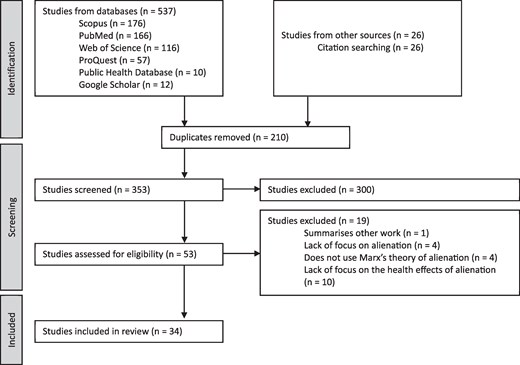
PRISMA diagram Marxist alienation and social and commercial determinants of health literature.

Results
The 34 papers were diverse in their content (described in the Supplementary File), covering a broad range of topics. We discuss these under three headings: production and alienation, consumption and alienation, and how alienation directly impacts on health and wellbeing.
Production and alienation
Given our search strategy, most papers presented a classic Marxist view seeing alienation as a process arising from the way in which social relations are structured under the capitalist mode of production, where the worker is separated from the product of their labour, the labour process, their fellow human beings and themselves (Crinson and Yuill 2008, Bambra 2011, Dai 2017) creating feelings of powerlessness, isolation and disconnection from society (Øversveen and Kelly 2022).
Our literature commonly noted that alienation is still applicable to contemporary work conditions in 21st century capitalism (Swain 2012, Ferguson 2017, Alaimo et al. 2023) with some arguing neoliberalism has increased it (Lavalette and Ferguson 2018). Manufacturing and production line work are still a global reality (Lavalette and Ferguson 2018) and the work-related health problems Marx wrote about remain (Swain 2012) although the nature of employment in post-industrial economies has changed (Prins et al. 2015).
Phrases used to describe this process were labour, work, or occupational alienation (e.g. Bambra 2011, Nair and Vohra 2012, Alaimo et al. 2023). In addition to discussing specific work contexts or professions, such as manufacturing (Shantz et al. 2014, Dai 2017), de-industrialization (Scheiring and King 2023), eldercare (Kim 2023), social work (Yuill 2017, Lavalette and Ferguson 2018, Yuill 2018, Yuill 2024), agricultural work (Bridi 2022) journalism (Alaimo et al. 2023), and academia (Nawab and Owais 2024), a few of the papers look at social class and/or workers across a range of jobs (Prins et al. 2015, Sawyer and Gampa 2020, Soffia et al. 2022).
The reviewed literature suggests that alienation is mediated by class position, age, ability, gender, race, and job (in)security (Bambra 2011, Swain 2012, Sawyer and Gampa 2020, Bridi 2022, Alaimo et al. 2023, Fraser 2023, Nawab and Owais 2024), and some authors included an intersectionality analysis (Farfán-Santos 2019, Bridi 2022, Øversveen and Kelly 2022, Alaimo et al. 2023, Fraser 2023) arguing this increases susceptibility to alienation and intensified its impacts. Øversveen and Kelly (2022) say this is ‘because alienation is related to powerlessness and estrangement from others and oneself— conditions that both capitalism and oppression as a whole produces due to the unequal distribution of social power’ (p. 450).
Moreover, while alienation can be typically understood in terms of occupations that produce material goods, such as factory workers, alienation is, as Lavalette and Ferguson (2018) (p. 207) say, ‘scarcely less extreme’ for work that produces intangible goods, such as care, health, and social care work, a view supported by others (Yuill 2018, Kim 2023). Collyer (2015) argues that under capitalism care work is alienating, commodified and marketised. Marx did not account for gender in his theory of alienation, but we found accounts of the intersection of gender with class in the literature. Highly feminized care work continued to be undervalued in terms of finance and prestige (Øversveen 2022, Kim 2023). Alaimo et al. (2023) argued that this led people (of all genders) working in those industries to feel dissatisfaction and to disassociate from their work because of the intersection between alienating work environments and the gender oppression which structures the workplace, modes of production and workers’ lives. Thus, ‘even care labour is a means of generating surplus value to enrich the owners or agency coordinating the services of care workers’ (Kim 2023) (p. 3). Although Kim (2023) argues that the lens alienation brings to care work shifts the focus of analysis onto the workplace as the source of the alienation and so moves the burden to employers to improve worker wellbeing outcomes this is unlikely to happen given the structural constraints of capitalism.
The failure to actualize workers’ sense of self and have control is a characteristic of care work under capitalism. The most instructive example of this was Yuill’s (2018) account of social workers, who bring to work their ‘compassionate self’ (p. 280), but cannot actualize it, because of the autonomy-stripping imposts of managerialism, reporting requirements, and funding mechanisms that diminish their control and scope to do caring work, to the point that the report becomes the object produced by labour, not helping people. Thus, the social workers, stripped of control over their work and ability to actualize their compassionate self, became alienated. This led to poor health outcomes, including physical ill health and fatigue, and burnout symptoms due to ‘a fragmenting of the lifeworld, where labour is set aside as not being capable of providing the affirmation of self’ (p. 286). Alienation was only combatted by those moments where workers could realize their compassionate self. The author notes that the disillusionment and lack of wellbeing was ‘found in the structures and power relations of the workplace and not in the deficiencies of the individual social worker’ (p. 287).
These examples illustrate how, for Marx, it was not just the kind of work that people did that affected their health, it was also the relations of power and control that structured the workplace (Swain 2012). Accordingly, control is a key theme in the literature on work alienation, and a lack of control over the labour process is consistently identified as detrimental to worker health (Crinson and Yuill 2008, Bambra 2011, Yuill 2011, Swain 2012, Lavalette and Ferguson 2018, Das 2023). It effects workers’ lives because, as Ferguson (2017) suggests, ‘loss of control begins in the workplace but shapes every aspect of life under capitalism, whether economic, political, social or emotional’ (p. 125).
Consumption and alienation
While Marx mainly theorized the alienation of production, we found a few theoretical articles that focused on consumption, alienation and health (Scambler 2007, McDonnell et al. 2009, Collyer 2015, Matthews 2019) and one thesis which considered housing (Fraser 2023). Fraser (2023) examines older women experiencing homelessness in light of the housing affordability crisis and provides insights into the psychosocial impacts of class oppression and lack of material resources necessary for a flourishing life.
Collyer (2015) maintains that human labour itself becomes a commodity under market capitalism and people are now invoked to consume capitalist commodities through alienating processes. The manufacturing of ‘needs’ that were non-existent prior to capitalism, results in ever increasing consumption. However, people sometimes fail to question their need for such products or even the rationale for their presence in the ‘market’. Collyer (2015) notes people cannot see that it is the market that determines what will be available for consumption, and when confronted with a plethora of ‘choice’, what is obscured from the consumer is the inequality in labour market relations through which these commodities are produced and the vested interests hidden behind these choices.
Collyer (2015) also notes that ‘Marxian analysis combined with feminism makes evident the fact that under capitalism, our bodies become a project that is to be shaped, transformed and produced—we are commodified—but also alienated’ (p. 53). Examples illustrate the gendered impacts of these alienating processes, including cosmetic surgery, medicalization of pregnancy and pregnant bodies, social media, body image, the objectification of women’s bodies, and the commodification of sexuality (Collyer 2015, Lavalette and Ferguson 2018). Scambler (2007) notes that contemporary culture is embedded in an ideology of consumption, which has an intimate connection between aspirational consumerism and the human body. Being healthy is reduced to ‘feeling’ healthy, which reduces to ‘looking’ healthy and thus engaging in the ‘body work’ which may or may not amount to being healthy.
Consumer goods are markers of social prestige and are ‘consumed’ to identify with a particular social position or as a marker of aspiration (Matthews 2019). The relentless pursuit of substituting old for new products and the drive for meeting unattainable standards, leads to a loss of meaning, and a society characterized by degradation and emptiness (Matthews 2019). While the need for identity and creative fulfilment results in an insatiable desire to consume, this rarely achieves personal satisfaction. Matthews (2019) maintains that satisfaction is rarely achieved through consumption and that what is really being consumed is an ‘artificial idea, that imbues our existence with meaning’ (Mahutga et al. 2025) (Section Materialism and the Search for Identity and Creativity, Para 3).
Healthcare has also been commodified by the introduction of market principles. Technologically driven forms of curative medicine developed by trans-national corporations for private profit strains healthcare systems and increases inequity of access (McDonnell et al. 2009). The focus is on treating individual consumers’ health needs while obscuring preventative ‘upstream’ measures that address structural causes of ill-health underpinned by economic and social causes (McDonnell et al. 2009). Health thus becomes a commodity to be bought and sold, with new medical ‘needs’ continuously devised in the pursuit of profit and people are pressured to consume these commodities (Collyer 2015).
This commodification of healthcare extends to care work which generates surplus value for business owners or agencies but not for the care workers (Kim 2023). Furthermore, care recipients receive care as a commodity rather than as a part of basic social infrastructure affordable for all (Kim 2023). Accordingly, care work under capitalism also leads to the alienation of service users, leading to poor outcomes for them as well as workers (Farfán-Santos 2019, Kim 2023). The privatization of social care services has removed the provision of ‘collectively consumed’ state services. Instead, these services become commodities, which confront people as ‘alien objects’ that they access as a ‘consumer’, but over which they have no control (Lavalette and Ferguson 2018) (p. 204)
Health and wellbeing and alienation
The previous sections touch on the health and wellbeing impacts of alienation, and here we explore these in more detail. Our search strategy means nearly all the articles in our review drew links between alienation and mental and/or physical health impacts and theorized that the origins of poor health stemming from alienation can be found in the capitalist mode of production and consumption and its corresponding political and social structures. The Supplementary File provides an overview of the 34 articles reviewed and the links they draw to health and wellbeing.
Bambra (2011) notes that in Euro-American countries industrial employment has decreased while the service sector has increased; however, these changes have not reduced the prevalence of alienation or its health effects. Bambra departs from a classic Marxist analysis when she maintains that health impacts have moved from predominantly material influences to psychosocial ones even though such impacts are those that Marx predicts will result from the structural conditions of capitalism. Her work is an example of research that hovers between a Marxist and Seeman approach and tends to underplay the nature of capitalism and the fact that it results in alienation for everyone in society.
Matthews (2019) observes, in contemporary capitalist societies ‘the deterioration of mental well-being is a standard response to wage labor’ (p. 55), to the extent that poor mental health has been normalized. Marxist theory would see this position as inevitable because of the very nature of capitalism and the ways in which it removes people from life sustaining relations with themselves, others and nature. Similarly, Sawyer and Gampa (2020) (p. 200) note that alienation produces both direct (physical) and indirect (psychosocial) health effects wherein ‘the objective social separation of workers from the production process has a subjective corollary in the psychological experience of work alienation. The literature highlights the central role that alienation plays in harming workers’ health (Crinson and Yuill 2008, Das 2023) while emphasizing that its effects also extend beyond the workplace into society more broadly (Øversveen and Kelly 2022), with Nair and Vohra (2012) demonstrating that alienation cannot be explained by other related concepts, and must be taken into account due the serious consequences it can have for workers’ health, including psychosis and suicide.
In addition to the lack of control over the labour process that was discussed earlier, the literature also emphasizes that a lack of personal fulfilment and experiencing work as meaningless are key aspects of alienation linked to poor mental health under capitalism (Matthews 2019, Øversveen and Kelly 2022). In their critique of Graeber’s bullshit jobs theory, for example, Soffia et al. (2022) draw on data from the European Union to demonstrate that alienation theory is more powerful in explaining why workers experience their jobs as useless and experience poor wellbeing as a result.
Other literature demonstrated that relational approaches are more effective in explaining the health impacts of capitalism than stratification-ist approaches like socioeconomic status (SES) (Eisenberg-Guyot and Prins 2022). Prins et al.’s (2015) study, for example, which draws on data from private, government, and non-profit sectors workers in the USA, found that individuals in the middle of the social hierarchy, such as managers and supervisors, are more likely to experience higher rates of anxiety and depression than others. Occupying what are identified as contradictory class locations ‘because they embody aspects of both ownership and labour’ (p. 1356), these workers may be required to implement policies over which they have little control while also having to navigate stressful interpersonal encounters with subordinates, leading to poorer mental health outcomes relative to those above or below them (Prins et al. 2015). They note that this nonlinear relationship cannot be adequately explained by SES, indicating a need to look more closely at the relational processes of domination and exploitation when studying health inequities (Prins et al. 2015). The importance of relational approaches was also illustrated through Sawyer and Gampa’s (2020) study, which demonstrated that only a Marxist class measure ‘consistently predicted both alienating working conditions and work alienation across studies’ (p. 213).
Matthews (2019) points out that, in 21st century capitalism, growing levels of job insecurity mean that work is having greater impacts on people’s health, as ‘neoliberal reforms have left many workers with progressively more precarious jobs and less protections, guaranteed benefits, and hours of employment’ (p. 57). This observation is supported by some of the empirical studies, which link downsizing, workplace restructuring and austerity measures to increased levels of alienation (Nawab and Owais 2024). In their research on knowledge workers, for example, Nawab and Owais’s (2024) study at a Pakistan university shows that institutional downsizing contributed to high levels of competition and rivalry among visiting faculty, where the ‘perpetual struggle for stability fuels self-hatred and depressive tendencies rooted in the inability to secure dignified employment for our families’ (p. 521).
Using Marx’s four forms of alienation as a framework, Nawab and Owais (2024) identified self-alienation arising from the insecurities inherent in visiting faculty positions as a ‘vital source of alienation’ (p. 515), which—combined with alienation from the academic community—caused significant psychological distress. Their study shows that the precarious, demoralizing, and toxic work environment in which visiting faculty become ‘permanent visiting teachers’ (p. 517) resulted in ‘unhealthy coping strategies’ (p. 519) like drug addiction (Nawab and Owais 2024).
The overall picture emerging was summed up by Matthews (2019) who argues that ‘capitalism is crucial to determining experience and prevalence of mental well-being’ (p. 50). We found multiple mentions of the factors underpinning alienation suggesting the pathway to mental and physical health impacts stemming from living in a capitalist society. The words used to describe elements of these pathways are shown in the word cloud in Fig. 2.
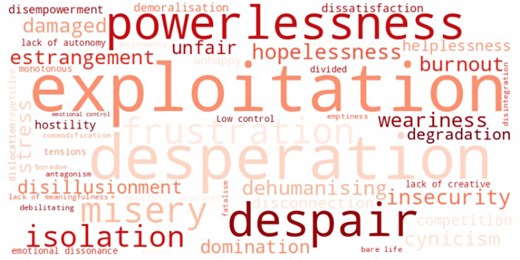
Word cloud of descriptors used in articles concerning health impact.

McDonnell et al. (2009) argue that a political economy approach can be linked with psychosocial theories of the causes of ill health which focus on emotions and health. They maintain these approaches are not necessarily incompatible with Marxist materialist understandings of health and that Marx’s theory of alienation provides the theoretical link between the two sets of theories (p. 59). Similarly, Bambra (2011) posits that the political economy concept of alienation forms an essential backdrop to understanding how the psychosocial work environment produces stress but does not expand the discussion to broader structural features of the economy and the inevitability of alienation under the structural conditions of capitalism.
Feminist theorists have extended Marx’s class analysis to examine how gender is a compounding factor in the health and wellbeing impacts of alienating processes and relations (Eisenberg-Guyot and Prins 2022, Alaimo et al. 2023, Fraser 2023). This literature demonstrated how Marx’s theory of alienation can explain gendered oppression and inequality under capitalism, because although gender is not an explicitly articulated theme in Marx’s work, as Das (2023) explains, he ‘does not ignore racial and gender oppression in his analysis of society’ (p. 409) although his critique of capitalism is based centrally on class relations. Feminist political economists have since demonstrated that gender and class hierarchies are intertwined (Cohen and van der Meulen Rodgers 2021).
Gender, is seen as a mediating factor in relation to alienating processes of production and consumption, and the physical and mental health impacts (Dai 2017, Eisenberg-Guyot and Prins 2022, Alaimo et al. 2023, Das 2023, Fraser 2023). For example, Alaimo et al. (2023) on journalism noted ‘job-oriented stressors are experienced differently across lines of social and professional identity’ (p. 7) and that female journalists are more likely to experience higher levels of stress and burnout due to gender dynamics within and outside their workplaces. Journalists’ psychological stressors were found to be further accentuated by the sense of alienation they felt from lack of institutional support and declines in their role autonomy and agency (Alaimo et al. 2023). Bambra (2011) maintains that psychosocial stressors contribute to health inequities because they affect women more than men and lower socio-economic groups more than those in higher social groups.
Eisenberg-Guyot and Prins (2022) also note the historical emphasis in work and health scholarship has been on men working long hours in physical jobs, but recently there has been more focus on women and the double and triple shifts of paid and unpaid labour and resulting health consequences. Das (2024), as Marx did, concludes in his consideration of health impacts of alienation from production that work under capitalism has adverse implications for family life given the stresses that are induced. Their study of married female workers at a cake factory in Vietnam, where workers ‘had no time for caring and playing with their children’ (p. 148), showing the importance of considering how broader societal structures impact worker’s lives. The result is stressed family lives and insufficient time for child rearing and other family care functions, all of which have health impacts.
Commentators Eisenberg-Guyot and Prins (2022) and Muntaner and O’Campo (1993) note the limitations to the largely psychosocial models which do not explicitly address class relations and other structural factors. They give the example of how the demand–control model focuses on the individual relationships linking work environments and health. The model does not address class relations and power dynamics and how they influence job demands, complexity, and authority, and how broad social and economic conditions and the balance of power between labour and capital influence the employment conditions.
Scheiring and King (2023) quote research by Case and Deaton (2020), which compares workers’ declining health in the North American rust belt with similar declines in Eastern Europe following the fall of the Berlin wall. Both are characterized by despair, which leads to suicides, and alcohol and drug abuse among less-educated people, especially men. Scheiring and King (2023) found that deindustrialization in the Hungarian rust belt resulted in job and income loss, increased exploitation, social inequality, and the disruption of services. In turn these led to material deprivation, job strain, fatalism, increased domestic workload, anomie, community disintegration, and alienation, which are sources of psychosocial stress, through which deindustrialization gets embodied as ill health and dysfunctional health behaviour.
Reports from migrant tobacco farmers in Ontario, Canada recounted the highly repetitive character of their tasks and the lack of control over what and how they do the work, which was reminiscent of accounts of 19th century factory workers (Bridi 2022): Their accounts show the lack of control: ‘The boss makes all the decisions…we meet in the morning, he tells us what we will be doing that day…we don’t have a choice about what we are going to do’; the boring nature of the work: ‘After a while the work makes you numb, it’s mindless…I’m young now, but what will happen to me when I’m older and I can’t do the hard work?’; and the direct perceived health effects: ‘The first couple of months were depressing. My body was aching and I felt tired all the time and did nothing except sleep and work’. These workers also reported that the only interest of the boss was making money from tobacco and that their health suffered as a result.
Most of the literature saw the alienating impacts of work having most health impact on people in lower social classes. Aspects of the psychosocial work environment which can help to foster feelings of self-efficacy and self-esteem (such as supportive social and managerial networks, feelings of autonomy and control over how work is undertaken, and appropriate recognition and reward for contributions made) are more usually experienced by higher grade non-manual staff, with more negative, alienating psychosocial work conditions concentrated amongst manual and lower grade occupations. However, Dai (2017) pointed out that alienation affects everyone in society. He quotes Marx (2012 (1844)) noting that although the propertied class takes advantage from its ownership of private property, alienation derived from that still causes physical and mental degradation.
Discussion
Collectively the reviewed articles demonstrate the ongoing relevance of the concept of alienation to health status and health inequities. The past century has seen an unprecedented growth in life expectancy and living standards for people in most countries. Yet, alongside these favourable trends, the last 40 years has witnessed increasing concern that social and economic inequalities are increasing massively, political cynicism is rising, social disintegration happening with increased rates of loneliness, social isolation and mental illness (Fukuyama 2000, Chancel et al. 2021, Hertz 2021). We conducted our review of the Marxist concept of alienation because it appears to have the potential to explain this disjunction between growing material wealth and the social and economic realities. The literature points to the ways in which the basic structures of capitalist society create the conditions for widespread alienation. They also provide a strong theoretical base to add to the emerging focus on commercial determination of health, which can demonstrate how capitalist enterprises including trans-national corporations, provide poor employment conditions, show little care for workers, prioritize profits, and rely on exploitative supply chains and so contribute to growing health inequities.
Bauman (2013) has emphasized the paradox that people have never been so free but also feel so powerless in the face of humanly created ecological, technological, political, cultural and social change. Despite what is objectively seen as an increase in humanity’s social and material power, Berardi (2017) sees that alienation has increased and that the freedom these seeming advances might be assumed to bring have in fact brought rising rates of mental illness and increasing rates of self-reported loneliness (Hertz 2021). The accounts of alienation in our review such as the tobacco workers in Canada (Bridi 2022), many care workers, the factory workers in Vietnam (Dai 2017), and the victims of deindustrialization in Hungary (Scheiring and King 2023) provide insights into why this is the case.
One evident gap in the literature was examination of the public health impacts of the alienation created by processes of consumption. We found literature discussing the pressures to consume and how this may be alienating but no studies which examined the pathways from alienating consumption to health and wellbeing impacts. Yet, the very nature of consumption under capitalism where the producers of consumption goods and services are aiming to extract profit from their activities lead to practices which alienate consumers. The extent of this was shown in the Australian Royal Commission into Misconduct in the Banking, Superannuation and Financial Services Industry (Hayne 2019) which documented the heavy toll of such extractivist practices on people such as exploitation of farmers during drought and customers sold inappropriate and damaging financial products. A further way in which the search for profits means frustration for consumers is the extent of automated systems and the need to spend their time navigating these always on the terms of the producers of the goods and services.
Much public health literature concentrates on describing inequities rather than proposing solutions. When health promotion solutions are suggested, people living in poverty are seen as the problem and lifestyle solutions proposed (Whitehead and Popay 2010). The literature we reviewed using Marx’s theory of alienation points to a deeper analysis of how inequities will be reduced through a root and branch consideration of society’s economic and social structure. As Øversveen and Kelly (2023) say, Marxist class analysis cannot be reduced to an explanation of economic inequality but has to be seen as a struggle over the conditions of social development. Their analysis makes it evident why Marxist analysis is not used more widely by health promotion academics and practitioners—doing so requires the fortitude to stand up to existing power structures and argue for dismantling of the very basis of capitalist society—unregulated markets. The revival of interest in Marx has also included renewed attention to class analysis as an explanation of increasing economic inequality, social fragmentation, and political unrest. Øversveen and Kelly (2023) note that, somewhat paradoxically, however, the perspective that has traditionally been most associated with class analysis—Marxism—has largely been absent from these debates. Yet, its potential to understand the roots of health inequities offers vital insights for public health measures to reduce these. The reluctance of public health scholars to use Marx likely has its roots in the desire of public health to be ‘apolitical’ in a world in which Marx is associated with revolution and socialism and communism, ideas particularly deeply unacceptable in the US since the days of McCarthyism. Members of the Trump administration have condemned academics on the basis they are ‘Marxists’ (Foster 2025).
Our review indicates that for people living under capitalism, alienation stems from many different directions: workplaces, unequal distribution of social power, commodification of bodies, social media, the displacement and deskilling of labour due to technological automation and the privatization or corporatization of previously public institutions and services. The portrayals of alienation we found are resonant of Marx (2010 (1867))’s own account in Capital:
‘….capital makes no difficulty about “justifying” the conditions partly dangerous, partly degrading, to which it confines the working and domestic life of the labourer, on the ground that they are necessary for profit. It is the same thing when capital “abstains” from protective measures against dangerous machinery in the factory, from appliances for ventilation and for safety in mines’ (p. 660).
Implications of the review for public health practice
Marx’s work was always concerned with the possibility of creating better societies. Ro (2012) comments:
‘In capitalism, he sees a form of social organization in which powerful economic forces take on the character of natural forces or “the fate of the ancients.” Marx insists on reminding us that the powers and relations that govern our world are historical products and products of our activity. His purpose in doing so is to suggest that that men and women are not condemned by supernatural or natural forces to suffer their conditions of domination for eternity. (p. 12)’
Thus, Marxist analysis is concerned with how capitalist societies can be transformed to eliminate alienation. Classic Marxist theory holds that until capitalism is no longer the mode of production alienation will remain because of the basic dynamic of two classes of people: those holding the means of production (capitalist) and those being exploited to produce the surplus value so that profits flow to the capitalists. Das (2024) the literature on alienation and that on social determinants of health needs to be more linked. One of the difficulties of doing this is that the alienation literature largely comes out of a Marxist framework whereas much of the social determinants of health literature depends more on conceptual frameworks that are not explicitly political (de Leeuw et al. 2021) and reflect social democratic rather than Marxist ideas. An example is the framework advanced by the Commission on Social Determinants of Health (2008), which explained pathways in an apolitical manner and so didn’t, for example, mention capitalism. Similarly, the 2025 WHO World Report on the Social Determinants of Health Equity (World Health Organization 2025) does not mention capitalism in its analysis. Joining these analyses with the theory of alienation would suggest more clearly the need to question capitalism. Some public health literature has promoted ‘wellbeing economies’ (Wellbeing Economy Alliance 2025), which call for a reform rather than replacement of capitalism and do not deal with the processes of capital accumulation which are inevitable under a capital mode of production.
Marx viewed alienation as inevitable under capitalism precisely because of the domination of a capital owning class and the inevitable class struggles involving exploitation, domination, and powerless workers with very poor working conditions. Many of our reviewed articles described the continuation of such working conditions. However, workers’ struggles have produced better working conditions under capitalism. Ferguson (2017) notes ‘when working class people gain a sense of their collective power, it can have a very positive effect on their health’ (pp. 133–134). Trade unions have enabled improved working conditions and fought for better working conditions and continue to do so despite legislative constraints on their powers and membership in many countries (Muller and Raphael 2023) and the fact modern employment is reliant on global supply chains which restricts the right to strike and recruitment of members (Mahutga et al. 2025). Legislation improving working conditions (occupational health and safety, maximum working hours, the right to holiday leave) has made a difference to workers’ health but has not eliminated alienation and they are alleviating a situation in which capital has nearly all the power and where people are inevitably exploited through processes of production and consumption. These measures are a means of capital conceding some ground to continue with exploitative practices. Until the fundamentals of the capitalist system are changed then alienation will persist. The rapid changes in technology, the power accumulation this is allowing (Varoufakis 2024) and artificial intelligence (AI) (Morley 2023) are creating new sources of alienation that are currently only barely understood and not covered in the literature we reviewed. One recent article that suggested that AI may reduce alienation (Sidorkin 2025) used Marx’s analysis but was devoid of the question of who will control and profit from AI.
There are extensive debates in Marxist literature about how capitalism can be transformed. Most centrally, they focus on changing the ownership of the means of production. For health promoters this poses the question of how they might best work towards a world in which production processes are controlled by those involved in them. As alienation results from the entire system, very significant change will be required. This change is particularly hard as the activities of capital are strongly supported by the state (The EReNSEP Writing Collective and Lapavitsas 2023). States support capital to shape the distribution of employment, income, housing, food, health services, and ecological conditions (Borras 2025, McGibbon 2025). Trade unions, progressive social and environmental movements challenge these conditions and argue for alternatives, but they are under-resourced and disadvantaged in a society that exerts hegemonic controls over debate (Kurmelovs 2024). Antonio Gramsci used the term ‘hegemony’ to connote a ‘congruence of material and ideological forces that enables a coalition of interests to maintain a dominant position in society’ (Levy 1997, p. 129). This means dominant group views are internalized by subordinate groups, so that they become ‘common sense’ and taken-for-granted conception of the world, rarely challenged and equates the status quo with the ‘natural order of things’ (Gramsci 1978). It is rare for Marxist political economics to be taught to health promoters but doing so would enable then to understand what political forces are driving ill health (Lynch 2023). Without this understanding of the structural causes of physical and mental illness health promotion will only be able to deal with the tip of the iceberg not the causes lying under the surface.
A full understanding of the political economy of health poses dilemmas for health promoters, as to accept the political economy of alienation means the only option left is to struggle for the replacement of capitalism and use health promotion knowledge to determine what a society free of unequal power relationships and its inevitable exploitation might look like. Taking this position in the Trump’s United States would be career threatening where dissent from an extreme neoliberal view seems to risk professional expulsion from public service and university employment or study. However, health promotion practice is inevitably political (Baum and Sanders 2011), and health promotion practitioners need to decide if they are willing to take positions that are contrary to those in power.
Conclusion
Our review of Marxist inspired literature on alienation and health and wellbeing has shown that alienation remains relevant to public health in the 21st century. Both theoretical and empirical work highlights the ways in which processes of production and, to a lesser extent, consumption profoundly impact peoples’ health and wellbeing. The underlying cause of alienation is the motivation of profit extraction allowed under capitalism and the concentration of capital in the hands of a few. Health promotion practice and advocacy needs to argue for a society in which production and consumption are socialized and individuals are not alienated but rather meaningfully connected with others and the natural world.
Acknowledgements
None other than funding.
Author contributions
F.B.: Conceptualization, Data curation, Formal analysis, Funding acquisition, Methodology, Project administration, Supervision, Writing—original draft, Writing—review & editing; J.L.-D.L.: Formal analysis; Investigation, Writing—original draft, Writing—review & editing; J.A.: Conceptualization, Formal analysis, Methodology, Writing—original draft, Writing—review & editing; T.F.: Conceptualization, Funding acquisition, formal analysis, Methodology, Writing—original draft, Writing—review & editing; C.M.: Conceptualization, Formal analysis, Methodology, Writing—original draft, Writing—review & editing; M.v.d.B.: Conceptualization, Formal analysis, Funding acquisition, Methodology, Writing—original draft, Writing—review & editing.
Frances Baum (Conceptualization, Formal analysis, Funding acquisition, Funding acquisition, Investigation, Investigation, Methodology, Methodology, Supervision, Supervision, Writing—original draft, Writing—original draft, Writing—review & editing, Writing—review & editing), Jaye Litherland-De Lara (Formal analysis, Investigation, Writing—original draft, Writing—review & editing), Julia Anaf (Conceptualization, Formal analysis, Investigation, Writing—original draft, Writing—review & editing), Toby Freeman (Conceptualization, Formal analysis, Funding acquisition, Methodology, Writing—review & editing), Connie Musolino (Conceptualization, Funding acquisition, Investigation, Methodology, Writing—original draft, Writing—review & editing), and Miriam van den Berg (Conceptualization, Funding acquisition, Investigation, Methodology, Writing—original draft, Writing—review & editing)
Supplementary material
Supplementary material is available at Health Promotion International online.
Conflicts of interest
The authors declared no potential conflicts of interest with respect to the research, authorship, and/or publication of this article.
Funding
This work was supported by the following sources: F.B., J.A., T.F., C.M.’s time was funded by NHMRC GNT 2009323, J.L.-D.L. by grant from Faculty of Arts, Business, Law and Economic, University of Adelaide, and M.v.d.B. by Medical Research Future Fund 47134493.
Data availability
A supplementary file with details of each article in the review and content related to health is available.