 https://orcid.org/0000-0002-8614-2485
Abstract
The emergence of 4IR technologies has been presented as holding the promise of drastic transformations both in the structures of productive systems and in the concomitant skills composition of the economies of the future. Using a customized technology organization environment (TOE) framework, this study analysed qualitative data on the adoption of 4IR technologies in the South African airline industry to shed light on its drivers, patterns, constraints and concomitant effects on labour market dynamics. Our findings identified cost reduction and international competitiveness strategies as the main drivers of technology adoption, while lack of commensurate infrastructure constitutes one of the main constraints. Employment displacement has remained limited but will likely increase as the transition to automated 4IR technologies intensifies. For technology policy, our findings suggest that successful transition to 4IR technology adaptation requires integrated strategies for intensifying digitalization, green energy sources and the stimulation of efficient alternatives to carbon-intensive air travel.
1 Introduction
The emergence of the fourth industrial revolution (4IR) technologies appears to form the peak of economic changes experienced in the course of successive technological paradigm shifts that the world has gone through (Carvalho et al. 2018; Schwab 2017). The expected shifts in production and interaction processes resulting from combinations of technologies are estimated to be even more transformative than those produced by previous industrial revolutions (World Economic Forum (WEF) 2016). The 4IR involves innovation-based on combinations of connections and collaborations, data and high-efficiency analysis, as well as a fusion of various technologies and human capital in a production system driven by frontier innovations such as artificial intelligence, 3D printing, robotics, biotechnology, blockchain technology, digital devices, smart factories, autonomous vehicles, intelligent machines, big data analytics and virtual reality (McGinnis 2023; Schwab 2017).
The new social and economic environment enabled by the advent of the 4IR is also expected to create dilemmas among economic stakeholders and requires drastic changes in productive skills, with considerable implications for labour market dynamics. Of particular concern is the threat of work displacement, especially for low-skilled workers, as an increasingly important fraction of human labour might be replaced by machines and automation (Brynjolfsson and Mcafee 2014). It is namely feared that changes in production systems may entail a bias towards highly technical and digital skills, thereby displacing the demand for low-skilled and mid-level skilled occupations (WEF 2020). On the other hand, some analysts expect the expansion of the 4IR to increase production output and shore up economic growth, thereby creating employment and new job opportunities (e.g. Fukuyama 2018; Keidanren 2018; Norton 2017). Despite the high stakes placed on 4IR technologies, however, there is hardly any empirical evidence of the effects of their adoption in South Africa. The purpose of this study is precisely to contribute to bridging this gap, by garnering empirical data through discussions with business enterprises involved in the adoption of these technologies. It focuses on the dynamics and impact of 4IR technologies in the airline industry in South Africa. The guiding research question in this study is: What are the patterns, drivers and constraints of 4IR technology adoption in the South African airline industry and the exploration of how does the adoption dynamics affect firm performance, skills intensity and employment outcomes? Ultimately, the research aims to gather evidence of the implications of 4IR adoption for firm performance, skills intensity, employment growth and operational as well as environmental sustainability. In practice, the conducted case study reports relevant field evidence to shine a light on three main technology adoption dimensions: 1) drivers and enablers of 4IR technology adoption, 2) main obstacles/constraints on adoption, 3) effects of adoption on operations and implications for skills requirements, firm performance, employment dynamics, and sustainability.
The technology adoption analysis is structured around a customized analytical lens of the technology organization environment (TOE) framework proposed by Tornatzky and Fleischer (1990). Our research approach makes use of rigorous analysis of data collected from first-hand sources to shed light on the patterns, drivers, constraints, costs and potential benefits that characterize the adoption of 4IR technologies in the South African airline industry. Implications for employment and labour productivity, industry performance, skills development, energy and carbon footprint, as well as the structural transformation are equally explored to derive potential policy recommendations.
The rest of this paper is structured as follows: the next section presents key theoretical considerations on technology adoption and diffusion to provide a context to the 4IR adoption process. Section 3 explains our methodological approach and study design. The fourth section provides the findings on the drivers and constraints of 4IR technology adoption. Section 5 discusses the views of respondents on the impact of 4IR technology adoption on the labour market dynamics, shifts in productive skills requirements, income distribution and environment sustainability. The final section concludes and provides key policy recommendations for industry players and policymakers.
2 Theoretical considerations on technology adoption and diffusion
2.1 Skills and capabilities for 4IR adoption in the airline industry
The fourth industrial revolution is defined by the World Economic Forum (2016) as the advent of ‘cyber- physical systems’ that require novel human and machinery competencies in the production processes. For the announced potential of the 4IR technologies to be transformed into actual economic opportunities in South Africa, the different players in the airline industry need adequate technological capabilities that enable them to absorb technologies developed outside the country (Cohen and Levinthal 1990; Narula 2004). Those capabilities are usually dependent on the supply of adequate levels and quality of human capital, which enables firms to identify, select and acquire externally developed complex technologies, which in turn require adaptive competence to internalize them and put them to profitable use (Cohen and Levinthal 1990).
Factors related to the size of the firm as well as its organizational structure and corporate culture can also contribute to influencing its ability to successfully adopt new technologies (Lall 1992). Similarly, the attitude adopted by firms towards learning is also a critical indicator of technological capabilities (Bell and Pavitt 1993; Kim 1997). Likewise, the ability to learn is part of organizational capabilities, as it reflects companies’ attitude towards new ideas, as well as the eagerness to adopt them (Rousseva 2006). Human capital related capabilities include managerial skills, technical competence of workers as well as collective impact skills and efficiency of employees.
Requisite capabilities also include the ability to marshal the financial resources needed to finance the acquisition (Lall 1992; Habiyaremye and Ziesemer 2006). Operational or production capabilities refer to the efficiency with which existing personnel can expedite the operational tasks with current production methods. They include skills in quality control, equipment maintenance as well as adaptive competence enabling the company to manage adversity and respond to external shocks (Habiyaremye 2021). Linkage capabilities refer to the skills needed to exchange information, resources and technology with subcontractors, consultants, suppliers and technology institutions for strengthening the productive efficiency of the firm and enhancing its capacity to manage and diffuse its productive technologies (Lall 1992).
2.2 Technology adoption and diffusion: Drivers and obstacles
The literature on innovation diffusion has suggested several microeconomic factors that influence the adoption decision at the firm and individual levels and therefore affect both the adoption rate and the speed of diffusion. In his diffusion of innovation (DOI) model, Rogers (1995) proposed five of such factors having direct implications for the adoption and diffusion dynamics: 1: relative advantage over existing alternatives; 2: compatibility with established social norms; 3: implementation complexity of the new technology; 4: trialability (opportunity to experiment with the technology before adopting it); 5: observability (opportunity to see the technology in action in other firms).
Other important factors are financing and adoption costs as well as availability of complementary resources and skills (Hall and Khan 2003). On the other hand, uncertainty, insufficient political support, weak adoption networks and resistance of already established firms can constitute diffusion obstacles (Foxon and Pearson 2008). For newly developed technologies to successfully diffuse, the capacity of potential adopters to absorb them in their operations and production systems also plays a crucial role (Cohen and Levinthal 1990; Narula 2004; Habiyaremye and Ziesemer 2006).
Institutional factors, such as regulatory and market-related policies can equally hinder or catalyse innovation diffusion (Katz and Allen 1982; North 1990; Hofstede 1997; Talegeta 2014).
The literature on technology adoption determinants has made use of a plethora of theoretical frameworks as well as a multiplicity of empirical techniques to characterize the patterns and dynamics of adoption among users in different settings. Pierpaoli et al. (2013), for example, proposed a conceptual analytical lens based on two main facets of the ex-ante technology acceptance model (TAM) (Davis 1989), which combines the perceived usefulness (PU) of the technology with considerations regarding the perceived ease of use (PEU) as the basis to explain actual adoption behaviour. Perceived usefulness is defined as ‘the degree to which a person believes that using a particular system would enhance his or her job performance’, while perceived ease of use is defined as ‘the degree to which a person believes that using a particular system would be free of effort’ (Davis 1989:320). This model has significant overlaps with Rogers’ (1995) diffusion of innovation theoretical factors. Other technology adoption models used in empirical studies include the theory of reasoned action (TRA) (Ajzen and Fishbein 1980), the theory of planned behaviour (Ajzen 1985), which is an extension of TRA, and the TOE model (Tornatzky and Fleischer (1990) mentioned in the introduction.
The TOE framework, adopted in the present study, offers a taxonomy of factors affecting the adoption and implementation of new technologies by categorizing them into three main contextual dimensions, namely the technological dimension (e.g. technology characteristics and complementary technological infrastructures), organizational characteristics (e.g. organizational culture and managerial attributes), and the environmental context (e.g. competitive pressure, industry characteristics, regulatory frameworks). As represented in Fig. 1, these main contextual domains exert a mutual influence in a dynamic process, while their different elements can either foster or hinder the technology adoption process (Aboelmaged 2014). The TOE framework does not prescribe a fixed set of factors to use for an empirical analysis of the adoption and deployment of new technologies; its strength as an empirical tool resides mainly in its flexibility and adaptability to different disciplines (Aboelmaged 2014). In this context, some elements of absorptive capacity such as technical skills and the ability to select and implement externally developed technology can be conceived as part of the technological competence dimension, while others, such as the structure of communication and knowledge sharing as well as managerial competence are consistent with the organizational dimension of the TOE framework. Likewise, the five factors of the DOI model can be easily integrated into the technological factor category of the framework as technology characteristics. An augmented framework explicitly integrating elements of TOE and DOI can also be conceived for a broader analysis (Huang et al. 2025; Sibanda 2025). The present paper applies the TOE as the most robust framework for investigating the drivers and patterns of 4IR technology adoption in the airline industry in South Africa. In the technological dimension, we base our analysis on two main considerations: technology infrastructure (Weill and Broadbent 1998) and technological competence (Abdinnour-Helm et al. 2003; Lin and Lin 2008; Ifinedo 2011). The third broad aspect of technology availability is subsumed in the technology infrastructure, since most of the technologies under discussion are mainly dependent on shared-use platforms at the airports. The availability of a common infrastructural platform plays a critical role in fostering the adoption and implementation process (Weill and Broadbent 1998), while the capacity of an organization to understand, adopt, use and modify externally developed technological knowledge increases its propensity to adopt and implement new technologies in their operations (Cohen and Levinthal 1990; Lin and Lin 2008). Regarding the organizational dimensions, our focus is on perceived benefits of 4IR technology adoption (enhancing competitiveness, efficiency of operations, cost reduction and operational flexibility, system integration), expected adoption risks and challenges (such as implementation costs, organization restructuring, compatibility with other organizational processes) and managerial characteristics (such as optimism, innovativeness and attitude towards risk) (Rogers 1995; Aboelmaged 2014). While perceived benefits provide the motivation for technology adoption, expected risks and challenges tend to dampen the adoption enthusiasm, while managerial attributes such as innovativeness and risk aversion also play a key role in the adoption decision, especially in its timing relative to their competitors (Awa et al. 2017; Van den Berg and Van der Lingen 2019; Matsepe and van der Lingen 2022). Less emphasis is put on firm size in this analysis, since many of the technologies considered for the airline industry are in shared use at the airports. As for the environmental contextual dimension, we focus our attention on the role of competitive pressure, the regulatory framework and government incentives for 4IR related innovations. Competitive pressure often serves as the impetus for technology adoption, especially if the new technology is perceived as having the potential to increase operational efficiency or enhance the quality of the provided service (Matsepe and van der Lingen 2022). Likewise, favourable regulations and government incentives can provide a conducive contextual drive to adopt the new technologies, while bureaucratic complexities and lack of government support can act as adoption impediments (Tornatzky and Fleischer 1990; Aboelmaged 2014). These different influences are schematically summarized in Fig. 1 as a customized TOE framework.
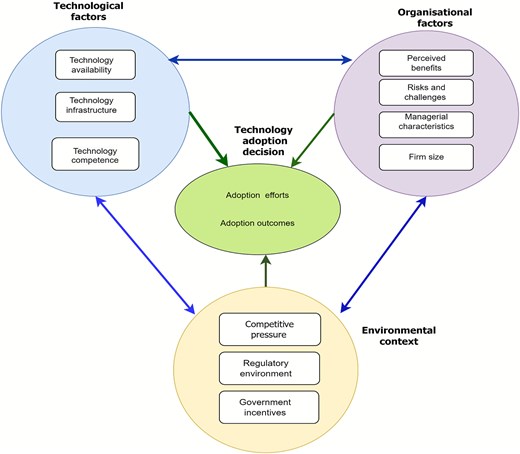
TOE framework for 4IR technology adoption in the airline industry in South Africa (source: Authors).

2.3 Nature of technological change and effects on labour input
Recent discussions on the potential impact of 4IR technologies have portrayed them as being sufficiently disruptive for their adoption and diffusion to herald a technological paradigm shift (Philbeck and Davis 2018). This implies that the combination of such technologies is expected to modify, not only the technological and production ecosystems of the coming decades, but also the way our societies shape and manage social interactions as well as socio-economic values. The introduction and diffusion of new products or new production methods in an economy paves the way for technical progress, which constitutes the primary source of long-term economic growth (Schumpeter 1947; Romer 1990; Aghion and Howitt 1992). Technical change leads to output growth through its effects on increasing factor productivity, i.e. by enabling firms to produce more with the same inputs or keep the production level constant with reduced input level (Jackson 1982). Technical progress can therefore be either capital-augmenting or labour-augmenting in its short-term manifestations, but in the long run, its asymptotic direction points towards a purely labour-augmenting balanced growth path (Acemoglu 2003). The associated increase in labour productivity has complex implications on labour-market dynamics as well as the skills requirements to match the new tasks made necessary by new production techniques (Acemoglu and Restrepo 2018). While the supply shock provoked by labour saving automation systems can often lead to technological unemployment if other sectors fail to absorb surplus labour (see e.g. Acemoglu and Restrepo 2017), some theoretical models in this framework, such as the one put forward by Ziesemer (2001), postulate that increased adoption and diffusion of digital and automation technologies have the potential to lead to higher wages and lower unemployment rates in the long run. This study framed the adoption of 4IR technologies in the perspective of labour-augmenting technological change and analyses its labour-market effects within the structural transformation context of a developing economy (see e.g. Schlogl and Sumner 2020; Andreoni et al. 2021). It is important to highlight that new technology adoption does not function in isolation and only works effectively within a conducive institutional and industrial policy framework (Lall 1992). Likewise, for the benefits of any technology adoption to materialize and generate tangible socio-economic impact, significant diffusion of the new technology is necessary, as pointed out by Hall and Khan (2003), while isolated cases of technology adoption are more likely to lead to increase in income inequality, as illustrated by Lahiri and Ratnasiri (2007).
3 Methodology: Study design, sampling and data collection
In order to gain in-depth insights into the effects of technology adoption on the dynamics of skills requirements at firm level, we took the case study approach and attempted to gather as much pertinent data as possible from each of the firms with which we interacted. Semi-structured interview guides were designed and used to garner key elements of this information with the view to analyse it using a qualitative approach.
This case study took a ‘deep-dive approach’, i.e. it involved a series of in-depth interviews with industry executives, and within them, with key resource persons deemed to possess significant information in relation to technology adoption and organizational functioning of the industry in question. The data collection process consisted of intensive semi-structured interviews with representatives of the main airline companies operating in South Africa, as well as representatives of industry associations and infrastructure providers. Providers of ancillary handling services and executives of the feeding tourism industry were also included in the data collection.
The initial sampling targeted the whole population of domestic and international airline companies operating on the main South African airports. We also included Airports Company South Africa (ACSA) as the primary infrastructure provider on most domestic and international airports in the country, because of the crucial role that it plays as the enabler of technologies. Airline industry association executives were equally targeted for interviews.1 Likewise, we also targeted the representative of the tourism industry because of their close proximity with the airline industry and the potential influence that the tourism association may have on technology adoption in the airline industry, due to shared customers. Key informants were chosen on the basis of the influential managerial positions and responsibility roles they held within the corporate governance of their respective companies or organizations. The data gathering process took place between the beginning of December 2021 and the end of August 2022.
Contact with domestic and international airline companies operating in South Africa was arranged with the help of the head of research and innovation at ACSA. This process yielded a data collection from a total of 15 in-depth interviews, involving nine representatives of airline companies, one representative of ancillary handling service providers two interviews with representatives of industry associations, one representative of the infrastructure providers and one with an executive of the tourism board. Regarding airline representatives, interviews were conducted with local and regional managers of domestic and international airline companies. Because of the COVID-19 related restrictions at the time of the inception of the data collection process, many interviews had to be conducted via online connection (Zoom and MS Teams applications). When conditions allowed, interviews were conducted through face-to-face conversations.
The collected data were mostly qualitative in nature and reflect the subjective perceptions of key informants with regards to the technology characteristics, organizational characteristics of their respective companies as well as the estimated implications of technology adoption. In this exploratory approach, the identified drivers and enablers signalled by industry players help explain the observed and planned adoption choices, while the perceived obstacles are understood to justify why some technologies have still not been adopted, despite their potential relative advantage (cost reduction and usefulness to passengers) and ease of use. The analysis of interview data was carried out in light of the background information on technology adoption in general and the dynamics of the airline industry in a global context. Despite unavoidable limitations due to the limited number of company executives we were able to interview, the use of the deep-dive approach enabled us to gather significant insights into the patterns and dynamics of 4IR technology adoption in this industry.
4 Drivers, patterns and dynamics of 4IR technology adoption in SA airline industry
Table 1 provides a summary of our findings regarding drivers and constraints to 4IR technology adoption in the airline industry in South Africa, grouped according to the TOE framework dimensions. Findings are subsequently described in more details following the same taxonomy.
Summary TOE drivers and constraints of 4IR technology adoption in SA airline industry.
| Contextual dimension | Favourable influence | Constraint | Unknown |
|---|---|---|---|
| Technological | -Technology availability -Some technologies are fairly developed and already in use overseas -Technological competence: sufficient skills base | -Absence of common advanced infrastructure -Absence of compatible technologies -Some technologies still in pre-deployment maturation stage -Scarcity of technological competence | -New technological infrastructure -Training of local skills to run and maintain highly sophisticated digital systems |
| Organizational | Expected benefits -Cost reduction -Operational efficiency -international competitiveness -Sustainable & health friendly solutions -Connection to overseas assets | -Investment costs -Scale of operations insufficient to recoup investments -Adaptive restructuring costs -Financial distress -Financial leverage structure -Centralized decision making | -Investment prudence -Attitude towards risks |
| Environmental | -Government support -Clear regulations -Post-Covid-19 recovery -Collaboration with external operators -External risks | -Privacy protection -Ownership of digital data -high unemployment \ &low labour costs -Immigration laws impeding sourcing of foreign skills | -Labour displacement effects -Environment protection -Development of alternative transport (e.g. HST) to optimize CO2 |
| Contextual dimension | Favourable influence | Constraint | Unknown |
|---|---|---|---|
| Technological | -Technology availability -Some technologies are fairly developed and already in use overseas -Technological competence: sufficient skills base | -Absence of common advanced infrastructure -Absence of compatible technologies -Some technologies still in pre-deployment maturation stage -Scarcity of technological competence | -New technological infrastructure -Training of local skills to run and maintain highly sophisticated digital systems |
| Organizational | Expected benefits -Cost reduction -Operational efficiency -international competitiveness -Sustainable & health friendly solutions -Connection to overseas assets | -Investment costs -Scale of operations insufficient to recoup investments -Adaptive restructuring costs -Financial distress -Financial leverage structure -Centralized decision making | -Investment prudence -Attitude towards risks |
| Environmental | -Government support -Clear regulations -Post-Covid-19 recovery -Collaboration with external operators -External risks | -Privacy protection -Ownership of digital data -high unemployment \ &low labour costs -Immigration laws impeding sourcing of foreign skills | -Labour displacement effects -Environment protection -Development of alternative transport (e.g. HST) to optimize CO2 |
Summary TOE drivers and constraints of 4IR technology adoption in SA airline industry.
| Contextual dimension | Favourable influence | Constraint | Unknown |
|---|---|---|---|
| Technological | -Technology availability -Some technologies are fairly developed and already in use overseas -Technological competence: sufficient skills base | -Absence of common advanced infrastructure -Absence of compatible technologies -Some technologies still in pre-deployment maturation stage -Scarcity of technological competence | -New technological infrastructure -Training of local skills to run and maintain highly sophisticated digital systems |
| Organizational | Expected benefits -Cost reduction -Operational efficiency -international competitiveness -Sustainable & health friendly solutions -Connection to overseas assets | -Investment costs -Scale of operations insufficient to recoup investments -Adaptive restructuring costs -Financial distress -Financial leverage structure -Centralized decision making | -Investment prudence -Attitude towards risks |
| Environmental | -Government support -Clear regulations -Post-Covid-19 recovery -Collaboration with external operators -External risks | -Privacy protection -Ownership of digital data -high unemployment \ &low labour costs -Immigration laws impeding sourcing of foreign skills | -Labour displacement effects -Environment protection -Development of alternative transport (e.g. HST) to optimize CO2 |
| Contextual dimension | Favourable influence | Constraint | Unknown |
|---|---|---|---|
| Technological | -Technology availability -Some technologies are fairly developed and already in use overseas -Technological competence: sufficient skills base | -Absence of common advanced infrastructure -Absence of compatible technologies -Some technologies still in pre-deployment maturation stage -Scarcity of technological competence | -New technological infrastructure -Training of local skills to run and maintain highly sophisticated digital systems |
| Organizational | Expected benefits -Cost reduction -Operational efficiency -international competitiveness -Sustainable & health friendly solutions -Connection to overseas assets | -Investment costs -Scale of operations insufficient to recoup investments -Adaptive restructuring costs -Financial distress -Financial leverage structure -Centralized decision making | -Investment prudence -Attitude towards risks |
| Environmental | -Government support -Clear regulations -Post-Covid-19 recovery -Collaboration with external operators -External risks | -Privacy protection -Ownership of digital data -high unemployment \ &low labour costs -Immigration laws impeding sourcing of foreign skills | -Labour displacement effects -Environment protection -Development of alternative transport (e.g. HST) to optimize CO2 |
4.1 Technology factors
4.1.1 Technological infrastructure for the SA airline industry
With the TOE framework as a theoretical background, we interviewed a dozen executives and managers representing various operators in the South African air transport industry, regarding the expected effects of adopting the newest technologies in their operations. The primary thrust for adopting advanced airport technologies is aimed to increase operational efficiency by minimizing the time that each aircraft remains in the hangar, i.e. out of active operation, and to allow for smoother passenger flows. Major airports in South Africa are equipped with the most modern technological infrastructure for world-class navigation and flight control systems to ensure a safe traffic for aircrafts of any modern size, ranging from regional jets to the superjumbo A380.
The infrastructure provider (ACSA)‘s ambition is to provide world class airport technologies to ensure a seamless air travel to passengers, but remarks from airline operators and ground handling service providers suggest that the technologies they deploy closely follow global leaders in the domain, but cannot afford to be at the cutting edge of the technological frontier because of the limited scale of operations (interview with overseas airline executives, July 2022). Below, we provide a short overview of technologies deployed at the main South African airports along with examples of leading technologies already in use at some leading airports overseas:
Booking system
Most respondents we interviewed indicated that their airlines use the AMADEUS global distribution system. Such a system enables user airline companies and travel agents to manage their flight inventory and offer the best deals to their customers. AMADEUS is one of the preferred network-based reservation systems globally.
2) Smart check-in
All major airports in South Africa have shared self-service check-in kiosks allowing passengers to print their own boarding passes and avoid long queues. The airline industry is evolving towards the intensification of smart check-in facilities that incorporate facial recognition and self-service bag drop services. Smart check-in system is designed to allow passengers to drop their bags without having to go to the baggage-drop counter, which can help reduce congestion and delays during busy times. During the Covid-19 pandemic, ACSA had intensified the use of touchless screening services with mobile devices to ensure a secure flow for passengers with minimal contagion risks. This kind of technology is expected to save money in the long run through increased check in efficiency and accuracy.
3) Security screening
South African airports have adopted advanced security technologies to help keep airports safe for passengers and pubic. The use of sophisticated X-ray machines enables airport security personnel to spot any potentially dangerous objects on passengers or in their cabin luggage, while the use of biometrics and facial recognition helps to ensure that only authorized passengers and personnel get access to restricted areas. For enhanced security checks, the CT scanning technology uses X-rays to create a three-dimensional image of a person’s body, which enables security personnel to easily identify any objects that may be concealed.
4) Baggage handling and tracking system
The automated baggage handling system (BHS) used on South African airports is based on automated departure control systems (DCS) using baggage reconciliation system (BRS) and hold baggage screening (HBS) technologies. Baggage transfer with conveyor belts to and from aircrafts relies on HBS and a sort-allocation computer (SAC) system with tilt trays, which automatically directs luggage to the correct dump on the basis of the allocation obtained from the flight planning module. Actual baggage loading and unloading remains a manual handling operation primarily based on human labour.
The state-of-the-art in baggage tracking systems includes the use of radio-frequency identification (RFID) tracking technology. RFID tags are small computer chips that use radio waves to transmit data, thereby enable the tracking of objects by corresponding readers. They provide an optimal tracking system for passenger luggage on long-distance flights, even when it gets lost or stolen in transit. The safety and efficiency of baggage handling can also be considerably increased by the use of robotic loaders as already demonstrated by its utilization by Saga Airport (Japan).
5) Immigration control & boarding
The current immigration processing system at South African airports relies mainly on immigration officers to control passengers’ documents with the help of a centralized computer system. Expansion in the adoption of biometrics and facial recognition technology could enable immigration control to reduce the clearance process time. Such systems use artificial intelligence to identify passengers by matching their photos against records in airport databases. The processing of passengers’ documents is thereby rendered more accurate and can be executed faster. As of November 2022, the Department of Home Affairs had launched a pilot project aimed to capture biometric data at South Africa’s international airports in order to implement its Enhanced Movement Control System (EMCS) at all ports of entry. This pilot will initially run at Lanseria International Airport, OR Tambo International Airport, King Shaka International Airport and Cape Town International Airport to test its functionality before extending it to other airports.
4.1.2 Technological competence: Skills and capabilities
A successful transition to the 4IR technology-driven operating environment requires a commensurate adaptation in skills supply in order to meet the needs of such a technological setting. Observations from our interview respondents suggest that for the needs of the airline industry, training for the new skills needs can be done without disrupting ongoing operations.
The set of technical skills required to run the new technological systems became more complex as departure control system and security check moved to digitalized systems.
Some of the required skills had to be imported from abroad owing to the limitations of highly technical skills supply from the South African vocational and technical training institutions. The inflow of foreign skilled workers has however remained rather limited because of the complexities of the work permit processing requirements and red tape. As a consequence, some operators report frustrations about their inability to source the needed talents from abroad, while they cannot be easily sourced from local supply either. Technical experts for running and maintaining the AI systems, for instance, are readily available abroad, but find it difficult to obtain work visas even when they are critically needed to run such systems in South Africa. While the issue of importing foreign workers into a country with an effective unemployment rate of more than 40% remains contentious, for the needs of post-Covid-19 recovery, the discussion needs to shift to marshalling all necessary resources and skills to give a new impulse to the industry. Respondents envision a recovery that will create more jobs, and therefore consider that bureaucratic simplification is needed to enable the inflow of foreign talents required to implement the adoption of complex technological systems, such as AI and big data analytics.
4.2 Organizational factors
4.2.1 Organizational and managerial attributes
Our discussions with industry executives and managers probed their attitudes towards innovation and 4IR technology adoption. They also sought to understand their general expectations about the transformative outcomes of the 4IR technology adoption for their respective companies and for the South African economy. All airline managers and executives involved in this study expressed a high degree of inclination towards innovation and technology adoption. They mostly feel constrained by the limitations of relatively obsolete infrastructural platforms currently in use in South Africa. For some of the airlines based overseas, the interviewed executives also indicated the limitations they face in adopting technology locally, owing to a centralized decision making system often steered from overseas headquarters.
The representatives of the state-owned infrastructure provider as well as the executives of the ground handling operations have similarly very favourable attitudes towards innovation and are only limited in their propensity to innovate by the degree of compatibility with local infrastructural platforms. With respect to attitude towards risks, the industry is characterized by a high priority attached to security and the necessity to comply with all relevant aviation regulations and prescriptions. Notwithstanding their apparent enthusiasm about the new operational possibilities expected to emerge from the mainstreaming of 4IR technologies, many respondents among industry executives expressed an inclination for prudence when it comes to new investments in 4IR-related technological and physical infrastructure by making conditional on rational expectation of the long-term evolution of the travel market within regulatory and environmental constraints. In sum, observed managerial attributes are expected to support the adoption of 4IR technologies in a coordinated and environmentally friendly rhythm, which balances the demands of the country’s labour market structure and the estimated changes in efficiency of business operations.
4.3 Environment factors
4.3.1 Industry structure and competitive pressure
Before the COVID-19 pandemic, the airline industry in South Africa was characterized by a sizeable number of domestic and international operators, with regular scheduled services to and from three main international hubs (Johannesburg, Cape Town and Durban), in addition to 6 main domestic service airports (Port Elizabeth, East London, George, Bloemfontein, Kimberley and Upington). Lanseria Airport is a privately owned alternative infrastructure that also offers domestic flight services. The air transport infrastructure comprises other public and private airports with international standards, but they offer less frequent services. The grounding and subsequent liquidation of Comair in June 2022 (which accounted for 40% of the country’s domestic seat capacity before its financial distress), as well as the financial restructuring of South African Airways (SAA) meant a considerable reshuffle of the domestic air transport industry. In the wake of the crippling restrictions, the industry counts 4 main domestic operators and 36 international operators. Domestic airline companies coordinate their operations through their Airlines Association of Southern Africa, (AASA), while international operators cooperate though the Board of Airline Representatives of South Africa (BARSA). The most important hub for domestic and international flight services remains O. R. Tambo International Airport (JNB) with a total of 40 operators, while Cape Town International Airport (CPT) accommodates all 4 main domestic operators and 13 international operators. As for King Shaka International Airport (DUR), it currently offers services for only 3 of the 4 domestic and 3 international operators. The current recovery trajectory of the airline industry in South Africa reflects post-pandemic trends of global air transport. While the global airline industry experienced a considerable drop in passenger flights and a 20% drop in cargo transport when drastic pandemic restrictions were first imposed in April 2020, cargo transport has recovered most of its lost ground, while domestic passenger transport revenues are still 18.6% below their pre-pandemic levels, according to ACSA (2023). Revenues from international passengers are still 35% below their pre-pandemic levels. The envisaged recovery strategies include increased digitalization of airlines and airport service systems, increased interconnectivity and standardization of digital platforms, resource optimization through the expansion of self-service tools, green airports that adopt renewable energy sources and optimize energy consumption, more digitalized security systems and transformation of airports into social hubs by diversifying the array of services offered to passengers.
4.3.2 Regulatory and institutional framework
The various operations and processes involved in running the airline industry require a coherent regulatory framework because of the security implications they represent for travellers, for the personnel and for the public at large. Air transport and airport ground operations fall under the regulatory authority of the Department of Transport (DoT), while the control of emigration and immigration on international travellers fall under the Department of Home Affairs (DHA). For the use of biometrics, for example, ethical considerations of who owns and controls access to personal information are critical to the implementation of related technologies while guaranteeing optimal protection of privacy for the users. The implementation of biometrics, face recognition systems as well as e-gates in security control relies on databases controlled by the DHA, with the understanding that the state control guarantees the necessary privacy protection. As an autonomous state-owned enterprise in charge of managing the main country airports, ACSA also plays a pivotal role in the regulatory framework. All new technological systems need to obtain the required approval by the regulatory authorities before they can be implemented. Collaboration and coordination between these various entities is therefore essential for the success of 4IR technology adoption. Some of our respondents expressed frustrations about the slow responsiveness and the complexity of bureaucratic procedures in their dealings with the DoT to implement new technologies in their operations (interview with airline executive, August 2022). The institutional setting is generally favourable to business and technological development, with different entities around the Department of Science and Innovation and the Department of Trade and Industry readily equipped to facilitate and support innovation.
4.3.3 Exogenous risks
The airline industry in South Africa is currently confronted with various challenges, ranging from the slump caused by the Covid-19 pandemic to the threat of high energy prices amid sanctions against Russia for its military operations in Ukraine, the growing social polarization, the threat of expanding poverty, as well as soaring unemployment rates. Through its innovative technologies, the 4IR is perceived as offering solutions to many of these challenges by driving efficiency in production (Fukuyama 2018; Keidanren 2018; Norton 2017). However, its differentiated adoption throughout the globe also increases the risk of widening the gap between technologically advanced countries and technological laggards, which may lead to job destruction for low-skilled workers and a subsequent worsening of income inequality measures (Norton 2017; Schwab 2017; Speringer and Schnelzer 2019). Changes in production systems may entail a bias towards high technical and digital skills, thereby displacing the demand for low-skilled and mid-level skilled occupations. The supply of needed technical skills cannot be assumed to follow automatically as some technical specializations are critically low and need to be sourced from abroad. This has the potential for employment displacement if no measures are taken to reorient productive skills and adapt them to the changing requirements of the new technological environment.
5 Estimated effects of 4IR technology adoption in the SA airline industry
5.1 Patterns of technology-enabled transformation
New automated and digitally connected networks of production systems, brought about by innovative 4IR technologies, are estimated to generate positive social changes by transforming the ways and the speed with which firms and households interact, not only in the workplace, but also in the daily behaviour within the private sphere. Most of our respondents envision the adoption of security scanning technology capable of providing 3-dimensional images of the content of luggage as an indispensable evolution, implying a much quicker detection of security threats. Improved efficiency in security control operations is expected to play a key role in accelerating the technology-enabled transformation, namely through behavioural changes resulting from improved security.
All international and domestic airline operators interviewed indicated to see a significant potential in the adoption of 4IR technologies and in increasing digitalization to improve travelling experience and the efficiency of ground-handling operations. While some of the most advanced technologies have already been tested in South Africa (for example, e-gates at Cape Town International Airport) or in the main hubs of foreign companies operating in South Africa (ex. Schiphol in the Netherlands), the most sophisticated technologies remain on a future agenda. Ultimately, they consider such technology adoption as an essential move to gain international competitiveness. Among the technologies estimated to have high transformative potential, a synthesis of insights from our interviews indicates the following:
Expanding the use of biometrics, e-gates and face-recognition systems to improve immigration procedures and streamline incoming passenger flows: the three main hubs connecting South Africa to international destinations are currently in the process of implanting the biometrics and e-gates systems, but these are not yet functional. The system is expected to be operational in the coming months.
The self-baggage-drop-in system is expected to be implemented at all major South African airports, but the migration from labour-intensive to fully automated systems will take several years, owing to as a result of cost considerations and technology maturation prospects.
The use of big data to archive passengers’ profiles and to improve travelling experience is primarily driven by data accumulated in overseas operations.
The adoption of autonomous vehicles at the airports, whose demand has significantly increased during Covid-19 for reducing the contagion risk, requires significant investments in appropriate infrastructure. This technology-enabled service is not yet available, but it is envisioned by ACSA.
Digitalization and automation of sanitary checks required since the Covid-19 pandemic are also expected to reduce the risk of airport congestion. The digitalization and the increasing automation of cargo handling operations, with particular interest for the digitalization of goods classification and the potential adoption of 3D scanners to optimize cargo loads: these require related but not identical technologies in comparison to passenger air transport. They can be expected to yield considerable gains in efficiency and drive logistic costs down in the medium to long term.
The use of drones for cargo handling is another technological development that airlines operators expect to intensify in the future. Drones are expected to increase accuracy and efficiency of cargo handling, for example by speeding up the collection of light packages for delivery to or from cargo warehouses.
The deployment of AI for predictive modelling and management decision support systems for light operations make it possible to connect all available data and propose centralized solutions. AI and machine learning tools are also deployed in chatbots capable of responding to individual customer queries and providing tailored passenger information. A partnership has been concluded with a US company to create a library of images and build AI-based algorithms for a quicker identification of threats.
The capacity of integrated systems to constantly connect the baggage information to the corresponding passenger also reduces the risk of baggage loss. This in turn will streamline the security control and enable to relax some of the restrictions put on liquids and on electronics equipment in cabin luggage for example (Amies 2022).
The vision of the future configuration powered by automation includes the introduction and expansion of self-driving airside car mobility system. However, many airline operators are of the opinion that a backup system in the form of traditional mobility and baggage loading equipment with manual handling personnel will remain needed for a long period before the operating environment moves to full automation.
5.2 Operations and production costs
The operational changes brought about by increased digitalization have been mostly incremental. For instance, some operators find it challenging to adopt the most advanced computer systems for fear of system incompatibility because ACSA airport management computers are still running on legacy systems. In certain cases, they manage to build workaround systems that enable them to bypass some of the inhibiting technical challenges associated with the older systems. Such compatibility issues are an inhibitor of technological modernization, which limits the speed at which operators can move to fully integrated information systems. Since the technological shifts induced by Covid restrictions, the trend has been to strive to an app-based system relaying on information access through tablets and phones, individually accessible by passengers.
In the absence of integrated information systems, transit can remain challenging, especially as regards the transfer of baggage between airline operators, which may sometimes require passengers to retrieve their luggage at transit airports and have to check-in twice. The introduction of integrated systems not only helps reduce such problems, but has also the potential to lead to significant cost reduction as people and resources can be redirected to other operational tasks (interview with airline company executives, July 2022). One airline operator asserted that the shift to digital and virtual revenue management system has enabled the company to halve their costs. Artificial intelligence systems centralized in the main (overseas) operation control headquarters of some international airlines have been successfully deployed in management decision support to optimize operations and minimize costs. Some international operators have also conducted pilot projects to use robots to guide passengers in their overseas hubs. Such technology is also being tried for loading baggage on aircraft (interview with overseas airline company executive, July 2022).
5.3 Change in skills requirements
The introduction of common use self-service terminal equipment has facilitated the efforts to tackle long queues, but has not led to a dramatic change in productive skills requirements among respondent airline operators. A large portion of the operating tasks is still carried out using traditional check-in counters, especially since the self-baggage drop-in system is not operational yet. While future technology uptake is expected to require the acquisition of more advanced skills to ensure an optimal system administration and maintenance, airline and ground handling operation executives expect the current skills mix to persist in the foreseeable future, especially since the labour market conditions with high unemployment rates make automation less profitable than it would be if labour costs were high. Together with government policies that favour labour-absorbing production systems, high investment requirements and low profitability explain why many do not feel the drive to invest considerable resources in automated systems.
5.4 Employment outcomes and implications for income distribution
The introduction and widespread access to common use self-service kiosks have contributed to increased efficiency of the passenger service and led to cost savings at the airports where they were implemented. Even as many passengers are able to self-check-in, some number of airport personnel will remain needed to provide back-up assistance for passengers who may not be very familiar with the digitalized system or in case of malfunction. The expected intensification of biometrics and self-bag-drop-off kiosks could instead lead to shifts in employment and a reorientation of skills requirement towards a higher demand for advanced skills for the control of digital systems, while the demand for traditional skills is expected to slump. Airline and ground handling operators expect that by the time AI is widely adopted to facilitate passenger flow and security management the demand for skills will also move towards more sophisticated capacity to control and maintain such systems, which will take place at the expense of some of personnel within the current skills mix. Considering the labour market characterized by relatively cheap labour costs and a high unemployment rate in South Africa, robotization has not been prioritized in local operations. Because of the incremental approach to the introduction of new systems, new technology adoption in the airline industry has been structured in a way to enable employees to adapt to operating methods with adequate skills training with only limited employment loss (interview with airline company executive, July 2022). More significant employment loss was due to the heavy impact of Covid-19 on air travel, especially with the resulting collapse of several domestic operators. A change in skills demand favouring more advanced technical skills is likely to result in exacerbating income inequality as the few highly skilled workers land in good paying jobs, while the demand for low skilled work falls. Without a reskilling and well-structured labour redeployment programme, the intensification of 4IR technologies in SA threatens to increase income polarization in an economy that is already among the most inequal in the world.
5.5 Operational sustainability and environment protection
Air transport is among the most carbon-intensive activities, with an estimated average of 90 kilogram of CO2 emission per passenger per hour of flight. Emission data for 2020 suggest that the aviation industry accounts for 2.5% of global carbon dioxide emissions (Ritchie 2020). To mitigate the consequences of this intensity, efforts have been invested in the development of fuel-efficient engines and aircraft designs. Moreover, investments have been committed for the development of biofuels that can be used on existing aircraft engines without modification. Airline companies renewing their fleet with more fuel-efficient aircrafts or using fuel produced from renewable energy sources are signalling their commitment to reducing their environmental impact. Even though there are obvious limitations in what airline operators can use as alternative forms of propulsion, especially for large, long-haul airliners, the use of clean energy such as green hydrogen batteries and electric engines can still be intensified for the airport fleet of vehicles and towing (push- back) trucks. Interview respondents also reflected on the possibility of using a different propulsion system with clean energy for taxying, which would still contribute to reducing the carbon footprint. They estimate the related fuel consumption to be high enough for significant gains to be made with such an alternative propulsion system. Because of the high costs involved in the investment transition is likely to be slow in the absence of good coordination, because the required investments provide a first-mover disadvantage. Increased collaboration among airline operators and coordination with the infrastructure provider will be highly necessary.
6 Conclusion and recommendations
6.1 Key contribution and summary of key findings
This study has contributed to the literature on 4IR technology adoption by providing an exploratory analysis of the adoption dynamics based on first-hand accounts of innovation drivers and obstacles experienced by key players in the South African airline industry. Air transport being one of the industries in which the adoption of 4IR technologies may create great opportunities for significant efficiency gains and transformative social changes, this exploration has considerable significance for technology policy. In the SA airline industry, the pattern and rate of 4IR technology adoption was found to be positively driven by the technological lead observed in advanced countries, the favourable attitude of industry executives towards innovation, and the capacity to source the requisite technically skilled personnel, either locally or from abroad. However, while the overall distribution of digital skills in the sector is fairly good, high-skilled professionals such as aviation engineers, supply chain managers and specialized data analysts are rather scarce and bureaucratic simplification in critical skills visa processing is desirable to facilitate a seamless sourcing of the necessary skills for technology adoption. Despite considerable efforts by the infrastructure provider to invest in advanced physical and digital infrastructure platforms, technological infrastructure compatibility still constitutes a non-negligible limitation on the rate of 4IR adoption. While most airline and handling operations executives who participated in the study appear to have a clear picture of the potential benefits offered by such technologies and have seen them in action at major air transport hubs outside South Africa, they mostly consider them as an aspirational goal for their operations in South Africa in the near future. ACSA, the main infrastructure provider, has indicated that considerable budgets were already reserved for infrastructure modernization, including the deployment of digital and biometrics systems to ensure higher passenger and cargo flow efficiency as well as enhanced security. The high cost of investments and the centralization of investment decision making at some airline companies are some of the other obstacles to the adoption of 4IR technologies, considering the large scale of operation needed to recoup such investments. The regulatory environment is not perceived as constituting a sizeable constraint to adoption, although the slow responsiveness of the bureaucratic apparatus is perceived as causing unnecessary delays. As for the environmental factors, practical concerns such as fuel and staff shortages (particularly aggravated by the lay-offs caused by the Covid-19 crisis) financial difficulties (such as the financial distress that crippled SAA and led to the liquidation of Comair), institutional fragmentation, represent significant obstacles. Likewise, additional structural and ethical considerations importantly affect investment decisions (ex. data availability following the application of the POPI act). Regarding the labour market effects, whereas technological change can be expected to lead to shifts in skills requirements and jobs displacement, this study has not uncovered any significant labour displacement resulting from the gradual adoption of 4IR technologies in the airline industry so far. However, concerns were expressed in relation to the job displacement that may occur in the future as technology adoption intensifies. The smooth transition to digital and automated systems was made possible by adapting to the changing skills mix requirement through new skills training and reconversion of existing employees. Most job losses so far came from the heavy restrictions imposed on air travel during the Covid-19 pandemic: employment recovery to the pre-Covid-19 levels will be conditional on the post-pandemic rebound of the travel and tourism industries. Although job losses due to the Covid-19 pandemic worsened the already highly skewed income distribution (with low-skilled workers being disproportionately affected), no significant job losses were reported by our respondents to be associated with the adoption of advanced technologies by their companies. Finally, environmental and climate change consciousness may prompt many airline operators to direct more attention to the adoption of green energy both for the aircrafts and for the fleet of ground transportation, baggage handling and towing vehicles. Respondents agree that despite the limitations imposed by the requirement of the jet engines for long-haul air transportation, the future of the airline industry must be greener, through efficiency gains and the diversification of energy sources in ground operations.
6.2 Policy implications and recommendations
In light of global trends in the technological advance of aviation and air transport industries, the South African airline industry will have to make strategic choices, including investments in smart technology adoption not only to overcome existing weaknesses and bottlenecks, but also to create a new impetus for overall profitability and sustainability of the sector. In particular, five areas are identified as being of crucial importance for policy formulation:
1) Modernization of airport infrastructure as a platform for new technology adoption.
The technological content and the amenities of airport infrastructure play a key role in determining the set of technologies airline operators can adopt in their operations. For the expected recovery of the South African airline industry to harness the benefits of the smartest technologies, the infrastructure provider needs to strive for a more profound modernization of existing airport facilities by adopting the best practices that enable digitalization and automation. Without adequate technological infrastructure, airline operators could remain constrained in their ability to deploy efficient technologies in SA, despite having the means to apply them in major trend-setting overseas hubs. As such transformation requires considerable investments, careful analysis of the long-term benefits of this transition is necessary to ensure positive returns and spillover benefits.
2) Digitalization and automation
This will have to cover multiple operations across the board, from self-service check-in and bag-drop to baggage handling in the airport, but also departures and transfers integration as well as cargo services. Advance in these fields may allow seamless passenger flows, avoid congestion and improve the comfort and the security of the travel experience. However, the sustainability of all future innovations will have to be examined from all perspectives, including financial feasibility, the possibility of labour-displacing effects and the privacy implications of increasing data-handling.
3) Pre-emptive intersectoral skills planning
South Africa will have to undertake some fundamental transformation in the area of local digital skills. The relatively low level of available digital skills literacy remains a daunting challenge to the country’s aspiration to harness 4IR as a source of technological transformation. Moreover, even though the potential benefits of increased adoption of 4IR technologies are obvious, intensification of digitalization and automation may lead to labour displacement and to changes in skills requirements in a country already plagued by extremely high rates of unemployment and skills mismatch. Policymakers will have to anticipate the trajectory of technological change with its employment effects and provide the necessary support for strengthening labour absorption in sectors that are less prone to automation. While a successful adoption of 4IR technologies requires specific skills that demand advanced training, reskilling of negatively affected employees is also essential to facilitate their absorption in the so-called automation-resistant sectors. A close collaboration between the industry, the SETAs and the Department of Higher Education and Training (DHET) will be necessary to ensure both an adequate supply of skills required to adopt and operate these new technology systems and a reorientation towards new growth sectors.
4) Environmental sustainability
The contribution of the industry to global emissions and its environmental sustainability will be an essential consideration for the sustainability of the sector. The level of competitiveness of individual companies and national industries will be largely determined by how green their future transformations will be. In this regard, smart technological development may help achieve important steps in terms of fuel-efficiency, reduction of current emissions, improvement of waste cycle management and the wider use of clean, green energies. Achieving a greener air travel will also require a shift in travel habits to reduce the passenger mileage, as technology alone will not be enough. The development of alternative travel infrastructure such as the high-speed rail service offers one the most credible alternatives to alleviate the environmental impact due to the crowding of air travel.
5) Policy and institutional coordination
Better institutional coordination and policy alignment will be necessary at several levels. For example, to improve immigration procedures, a closer collaboration between airport authorities and the DHA will become very important. In order to secure increasing sustainability and adopt smarter, greener technologies, a commitment of all stakeholders from all operations (airlines, ground handling and cargo) will be strictly necessary. Matters related to infrastructure innovations will require more effective collaboration between all airlines, the Air Traffic Navigation Centre (ATNS), ACSA, and the Department of Transport.
6.3 Study limitations and avenues for further research
The data collection process for this study took place directly in the aftermath of Covid-19-related restrictions, whereby most respondents had developed a preference for online interviews. Of the 15 interviews reported, only three were face-to-face, which limited our possibilities for in-situ observation. Moreover, some of the discussed technologies were still in their initial phases of deployment or simply in planning A follow-up study to evaluate the labour market and socioeconomic implications the automated systems have become fully operational would generate additional insights into how technology diffusion impacts social change.
Acknowledgements
The funding support of the DSI and the NRF through Grant Number 98627 and Grant Number 110691 for the South African Research Chair in Industrial Development supported the research underlying this article.
Author contributions
Alexis Habiyaremye (Conceptualization, Data curation, Formal analysis, Investigation, Methodology, Project administration, Validation, Writing—original draft), Lorenza Monaco (Conceptualization, Data curation, Investigation, Project administration, Validation, Writing—original draft).
Conflict of interest. None declared.
Funding
None declared.
Data availability
Interview recordings pertaining to this study are protected by confidentiality agreement in accordance with the ethics guidelines of the University of Johannesburg. Anonymised transcripts can be obtained from authors upon request.
Footnotes
Domestic airlines are interconnected through their business association Airlines Association of Southern Africa (AASA), while international airlines coordinate their collaboration through the Board of Airline Representatives on South Africa (BARSA).
References
Katz, R., and Allen, T. J. (
Schumpeter, J. A. (