 https://orcid.org/0000-0002-9299-9709
Abstract
Critics caution that drones dehumanize targets. Does this affect public support for drone strikes, and if so, how? We address this question through a survey administered to a representative sample of Americans. We examine two forms of dehumanization—animalistic (equating humans to animals) and mechanistic (equating humans to inanimate objects)—while varying between semi-autonomous and fully autonomous drones. We find that dehumanization shapes public support, but its effects depend on how targets are represented and engaged. Support is highest when semi-autonomous drones are used against animalistically dehumanized targets and lowest when fully autonomous drones engage mechanistically dehumanized targets. More broadly, support increases when humans retain responsibility for violence and declines when responsibility shifts to autonomous systems. We also show that instrumental, normative, and operational considerations shape attitudes, while emotion appears to matter more for support under animalistic rather than mechanistic dehumanization. These findings provide insights into public opinion, emerging technologies, and AI-enabled warfare.
Los críticos advierten que los drones deshumanizan a los objetivos. ¿Tiene esto algún efecto sobre el apoyo público a los ataques con drones? y, en caso afirmativo, ¿de qué manera? Abordamos esta cuestión mediante una encuesta realizada a una muestra representativa de ciudadanos estadounidenses. Analizamos dos formas de deshumanización, la animalista (que equipara a los humanos con animales) y la mecanicista (que equipara a los humanos con objetos inanimados), variando entre drones semiautónomos y totalmente autónomos. Observamos que la deshumanización influye sobre el apoyo público, pero sus efectos dependen de cómo se represente a los objetivos y de cómo se los ataque. El nivel de apoyo es mayor cuando se utilizan drones semiautónomos contra objetivos deshumanizados desde un punto de vista animalista, y menor cuando los drones totalmente autónomos atacan objetivos deshumanizados desde un punto de vista mecanicista. En términos más generales, el apoyo aumenta cuando los seres humanos conservan la responsabilidad de la violencia y disminuye cuando la responsabilidad pasa a los sistemas autónomos. Además, demostramos que las consideraciones instrumentales, normativas y operativas influyen sobre las actitudes, mientras que la emoción parece tener mayor importancia para el apoyo en casos de deshumanización animalista que en casos de deshumanización mecanicista. Estos hallazgos ofrecen información valiosa sobre la opinión pública, las tecnologías emergentes y la guerra basada en la inteligencia artificial.
Les critiques mettent en garde sur les drones, car ils déshumaniseraient les cibles. Cela a-t-il un effet sur le soutien public aux frappes de drones et, le cas échéant, lequel ? Nous répondons à cette question à l’aide d’un sondage sur un échantillon représentatif d’États-Uniens. Nous examinons deux formes de déshumanisation—animaliste (mettre sur un pied d’égalité humains et animaux) et mécaniste (mettre sur un pied d’égalité humains et objets inanimés)—tout en nous intéressant aux drones semi-autonomes et complètement autonomes. Nous remarquons que la déshumanisation façonne le soutien public, mais ses effets dépendent de la représentation des cibles et de la façon dont elles sont attaquées. Le soutien est plus fort lorsque les drones semi-autonomes sont employés contre des cibles déshumanisées de façon animaliste et plus faible quand des drones complètement autonomes s’attaquent à des cibles déshumanisées de façon mécaniste. Plus largement, le soutien augmente quand des êtres humains assument la responsabilité de la violence et diminue quand la responsabilité incombe à des systèmes autonomes. Nous montrons aussi que des considérations instrumentales, normatives et opérationnelles façonnent les attitudes, tandis que les émotions semblent compter davantage pour le soutien dans le cas d’une déshumanisation animaliste que d’une déshumanisation mécaniste. Ces résultats nous renseignent sur l’opinion publique, les technologies émergentes et les pratiques de guerre fondées sur l’IA.
In 2023, the Campaign to Stop Killer Robots (2023) warned of the dangers of unmanned aerial systems, or drones, given their capacity to “dehumanize” targets. Campaigners argued that drones reduce targets to data points and lower the threshold for the use of force. Such concerns are not unfounded. Officials overseeing US drone strikes have described targets as “subhuman,” equating targets to animals. In other instances, US officials have visually stripped targets of their distinguishing human features, such that targets are equated to inanimate objects like blips on a targeting console.
As drone use has proliferated, scholars have begun to consider how dehumanization can shape public support for strikes against combatants (French and Jack 2015; Sharief 2020; Johnson 2025). Such support constitutes an accountability mechanism for how democracies make decisions surrounding the use of force (Kreps and Kriner 2025). One concern is that by framing combatants as subhuman, drones introduce a moral hazard encouraging political officials to use them in ways that may harm civilians (Smith 2020; Lin-Greenberg 2026). Advancements in drone technology, especially countries’ adoption of early-stage autonomous platforms relying on artificial intelligence (AI), have exacerbated this and related concerns.
While existing research demonstrates a relationship between group-based hatred, dehumanization, and the legitimization of violence toward out-groups (Bar-Tal 2000; Halperin 2008), the relationship between dehumanization and public support for drone strikes lacks empirical analysis. To the extent scholars consider dehumanization in the context of drones, they have studied how undermining the “human dignity” of targets shapes public attitudes toward drone strikes and observed ambiguous results (Rosendorf, Smetana, and Vranka 2023; del Valle and Lara 2026). These findings echo research showing that the effect of dehumanization on public support toward drones is shaped by moral and instrumental logics, such that dehumanizing language enhances support when the public perceives strikes as morally justified (Rai, Valdesolo, and Graham 2017; Smith 2020). When considering the effects of targets’ race, sex, and gender role on public support for strikes, scholars have also found that such support is motivated by a lack of information about targets’ identities (Lushenko 2025; Lushenko, Carter, and Bose 2025). These findings suggest that how much the public knows about a target, or the degree to which it is humanized, shapes attitudes toward drone strikes.
This line of inquiry raises an important question: does the dehumanization of targets shape public support for drone strikes? In this article, we test whether and to what degree variation in the way targets are dehumanized can influence public support for drone strikes. We administer a pre-registered survey experiment among a representative sample of Americans, varying the form of dehumanization and type of drone. We consider two mechanisms through which targets are dehumanized—by equating targets with animals (animalistic) and inanimate objects (mechanistic). While the former involves the derogatory framing of targets, the latter relies on visual symbols that strip them of their humanity. We examine the relationship between these mechanisms and the type of remote platform employed. We consider both human-operated high- and medium-altitude long-endurance drones and next-generation drones that incorporate AI. These two factors—forms of dehumanization and types of drones—inform our survey design, leading us to integrate both text- and image-based scenarios.
Our analysis of the data reveals several findings. We observe that the dehumanization of targets enhances public support for drone strikes. This effect is shaped by how a target is framed and the type of drone employed. We find that respondents are more supportive of a strike against an animalistically dehumanized target using a human-controlled, or semi-autonomous, drone. Public support declines when a fully autonomous drone with less human oversight is used to strike a target that is mechanistically dehumanized. These results enhance our understanding of how perceptions of human control can shape public attitudes toward novel technologies on the battlefield, including AI.
We also begin to probe how exposure to dehumanizing frames can influence public support for drone strikes. The data suggest that dehumanization can psychologically distance the public from targets in different ways. We find that negative emotional responses shape public support when targets are animalistically rather than mechanistically dehumanized. On the other hand, mechanistic dehumanization encourages a colder, strategic evaluation, especially when strikes are conducted by fully autonomous drones with less human oversight. However, the specific pathways underlying such a strategic evaluation are not fully captured by the mediators we examine, indicating the need for more study. Despite this variation, our findings also suggest that instrumental, normative, and operational considerations shape public support for strikes against dehumanized targets. Such support seems to be conditioned by a complex set of beliefs regarding the legitimacy of drone warfare (Lushenko and Raman 2024).
Our study makes several contributions. We propose and test a theory of dehumanization and drone warfare that allows scholars to further explore public opinion surrounding the use of force. This advancement reflects Smith’s concern that “a theory of dehumanization will be most informative (and useful) if it’s focused on a single, distinctive phenomenon, rather than a plurality of loosely related ones” (2020, 21). Conceptually, we bridge a large body of scholarship in social-psychology that tests the effects of dehumanization on public opinion, such as workplace attitudes (Christoff 2014; Schultz et al. 2025), with the literatures on emerging technologies drawn from critical race studies (Benjamin 2019), critical security studies (Bode et al. 2023), philosophy (Smith 2020), post-colonialism (Sethi 2011), international security (Horowitz 2010), and science and technology studies (Winner 1977). Methodologically, we use a text- and image-based survey to test how different dehumanizing frames shape public attitudes toward drone strikes.1 We therefore enhance the internal validity of our results while striving to balance information equivalency across our vignettes, since our survey best approximates animalistic and mechanistic dehumanization mechanisms.
The remainder of this article unfolds in five parts. First, we introduce a theory that differentiates between forms of dehumanization and types of drones, which informs testable expectations about public support for strikes. Next, we discuss our research design. We then outline our results. We conclude by summarizing the contributions and implications of our findings.
A Theory of Dehumanized Warfare
Dehumanization is the practice of perceiving others as less than human, or subhuman (Smith 2020). This practice informs the perception and treatment of specific groups across a range of discriminatory, predatory, and violent actions (Smith 2020; McIntosh 2025). Such actions include genocide, dispossession of native lands, racial segregation, and labor exploitation (Jardina and Piston 2023). By reducing designated populations to animals (Fanon 1961), or militarized threats (Topak 2023), dehumanization has been harnessed to legitimize such actions.
Despite its widespread use, the concept of dehumanization remains contested. Some scholars argue that the term is simultaneously “too specific” and “too vague” (Winner 1977, 12), while others question its “logical coherence” and analytical utility (Rosendorf, Smetana, and Vranka 2023, 13). Measuring dehumanization is challenging because it requires researchers to infer how individuals represent and understand others (Luft 2023). Critics argue that apparent instances of dehumanization may simply reflect informational cues or rhetorical strategies rather than genuine beliefs about others’ (in)humanity. Here, derogatory language serves as a communicative device rather than evidence that individuals regard targets as subhuman. Following Smith (2026), we contend that researchers should take seriously the testimonies and actions of perpetrators, victims, and observers when assessing dehumanization. Doing so does not require treating every derogatory statement as evidence of dehumanization. Rather, it recognizes that speech-acts, visual representations, and behaviors can reflect and reinforce beliefs about targets’ moral status. In the case of drone warfare, targets are represented by language and imagery that shape how the public understands and evaluates strikes.
Forms of Dehumanization
Research shows that dehumanization can take animalistic or mechanistic forms (Haslam 2006). Animalistic dehumanization equates humans to animals, thereby denying humans cognitive characteristics such as self-control, critical thinking, and rationality (Christoff 2014). By characterizing others as “inferior,” animalistic dehumanization generates negative emotions such as contempt, disgust, and hatred, creating psychological distance (Johnson 2025, 33). Existing research demonstrates how such negative emotions can serve as a central force in motivating and sustaining support for the use of force and legitimize killing (Halperin 2008; McIntosh 2025). By placing individuals into “extreme, negative social categories that are excluded from human groups considered as acting within limits of acceptable norms and/or values,” animalistic dehumanization can contribute to the legitimization of violent actions toward an out-group (Bar-Tal 2000; Halperin 2008, 732). In the wake of the 2023 Hamas attack, Israeli Defense Minister Yoav Gallant declared a siege of Gaza, stating “we are fighting human animals” (Fabian 2023). Verbal depictions and stories can curtail empathy and activate emotions that shape public attitudes toward leaders’ decisions surrounding the use of force (Kraitzman, Etienne, and Albarracin 2025, 2).
Mechanistic dehumanization strips humans of distinguishing features, such as phenotypical characteristics of sex and race. This form of dehumanization equates humans to inanimate objects—data, machines, and robots (Brison et al. 2023). As a result, mechanistic dehumanization is commonly referred to as “algorithmic,” “digital,” or “technological” (Schultz et al. 2025). Like animalistic dehumanization, mechanistic dehumanization results in psychological distancing from targets, but through “cold indifference” (Johnson 2025, 33). Modern technologies, such as drones, increase the physical distance between combatants and may exacerbate this trend. The US drone program has arguably dehumanized targets through both the data-driven nature of killing and the reduction of targets to a technical task or problem to be managed, similar to “weeds or pests” (Renic and Schwarz 2023, 332). Indeed, these operations have been likened to a “gardener’s vision of war; a war of pest control” (Renic 2018, 59). The enhancement of drones with AI is also thought to expand the ability of actors to “prosecute dehumanized targets anywhere in the world” (Suchman quoted in King 2025, 10).
Both animalistic and mechanistic forms of dehumanization have been adopted by political and military officials to frame out-groups as subhuman and justify aggression toward them (Bar-Tal 2000). During the ascendancy of papal power in the thirteenth century, “a process of Christianising reason” defined Jews and Muslims refusing to convert to Catholicism as “no longer human,” further legitimizing their killing (Aktürk 2024, 104). The negative, racialized framing of the Japanese by Russian society and the officer corps contributed to the illusion that the Russo-Japanese War would be “an easy, colonial expedition” (Mercer 2023, 20). More recently, the language surrounding nuclear non-proliferation points “to ‘mad mullahs’ and other ‘rogue’ regimes as the primary threats to international peace” (Bustamante 2024, 760). To entrench pontifical imperialism during the thirteenth century, the Catholic Church also relied on the mechanistic dehumanization of Jews and Muslims “by forcing them to wear badges and to reside in designated areas,” turning people into categorized, controllable objects (Aktürk 2024, 106).
Animalistic and mechanistic characterizations are also evident in the discourse surrounding US drone strikes. Policymakers have referred to targets as “barbarians,” “camel jockeys,” “prairie dogs,” “sand n******,” “savages,” and “ragheads” to legitimize strikes (Mayer 2009). Such language is especially common when strikes occur in undeclared theaters of operations that are not sanctioned by the United Nations. President Barack Obama and Secretary of War Pete Hegseth, for example, have referred to the Islamic State as “barbarians” and “savage” (Fermor 2021; Botelho 2025). The term terrorist has had a similarly dehumanizing effect during US drone strikes (Bachman and Holland 2019). While the term is not overtly attached to a particular racial, ethnic, or religious group, it is nevertheless “highly reductive—caricatural—in its characterization of motives and morality” (McIntosh 2021, 596). Recent scholarship also examines how drones distance decision-makers and their public audiences from targets, “presenting victims as relatively featureless, unnamed persons to be counted and aggregated” (Oddo, Mozafari, and Kirsch 2024, 8). Repeated exposure to terms such as “terrorist” and representations of warfare through drone footage can lessen the cognitive impact of strikes, making violence appear routine (McIntosh 2025).
In sum, animalistic and mechanistic dehumanization can enhance the propensity to kill by psychologically distancing operators, staffs, commanders, policymakers, and the public from targets (Table 1) (Johnson 2025). Scholars have characterized such distancing as “remote intimacy” (Gusterson 2019), “epistemic distance” (Vilmer 2023), or “distant proximities” (Rosenau 2003). While useful, these characterizations do not distinguish how psychological distance manifests across different forms of dehumanization. Existing research suggests that each form of dehumanization operates through a distinct frame that emphasizes unique aspects of targeting and engages different motivations (Chong and Druckman 2007; Kapadia 2018). Animalistic dehumanization relies on rhetorical frames associated with emotional motivations and psychological distancing characterized by anti-empathy. Mechanistic dehumanization, by contrast, relies on symbolic frames associated with cognitive motivations, or microfoundations, and psychological distancing characterized by indifference (Kertzer 2017; Fisk, Merolla, and Ramos 2019; Lin-Greenberg 2022). Thus, while both forms of dehumanization deny targets full humanity and can shape support for killing, psychological distance manifests differently across animalistic and mechanistic dehumanization.
Differentiating animalistic and mechanistic dehumanization.
| Form | Frame | Motivation | Psychological Distancing |
|---|---|---|---|
| Animalistic | Rhetoric | Emotion | Anti-empathy |
| Mechanistic | Symbols | Cognition | Indifference |
Drones and Human Oversight
The terrorist attacks of 9/11 ushered in an era of remote warfare characterized by greater operational standoff between opponents (McDonald 2021). High- and medium-altitude long-endurance drones (known as HALE and MALE, respectively) were utilized for surveillance and strike operations by the US during the “Global War on Terror.” Despite their cost and substantial organizational requirements, HALE and MALE drones such as the MQ-9 Reaper enhance force protection while removing combatants and reducing collateral damage, including civilian casualties (Schneider and MacDonald 2025). Notwithstanding the lack of survivability of HALE and MALE drones during interstate conflicts, these capabilities are largely reusable and provide persistent overwatch (Boyle 2020). Drones also offer important political dividends. Unlike ballistic and cruise missiles, drones allow officials to circumvent democratic accountability and public oversight for their use while reducing the potential for crisis escalation (Lin-Greenberg 2026).
While most drones are semi-autonomous, meaning they are controlled by humans, some countries have experimented with Collaborative Combat Aircraft (CCA) with onboard AI. Lethal autonomous weapon systems (LAWS), such as the US Air Force’s loyal wingman, incorporate AI to identify, track, and engage targets without human oversight. These rule-based AI systems are designed for procedural tasks, such as targeted killing, and informed by ostensibly representative data (Horowitz 2018). While these systems are at an early stage of development and testing, they have garnered substantial attention. Policymakers, practitioners, and war theorists often argue that LAWS constitute a shift in the character of war, or how countries fight, and they have leveled the playing field between opposing parties during conflicts in Libya, Mali, Nagorno-Karabakh, and Ukraine (Boyle 2026). Notably, public perceptions of drones and autonomy often fail to align with policies that govern their use (Rzazade 2025). Policymakers have also cashiered the term “human control” in favor of “appropriate human judgment,” which emphasizes human oversight at the point of capability design and manufacturing since some drones do not satisfy the human control standard (Hicks 2023). Thus, many would argue that the term “fully autonomous” inaccurately describes platforms such as CCA, given that they still rely on a degree of human oversight. Despite this reality, the public tends to perceive and characterize AI-enabled drones as fully autonomous, which informs our survey design (Scharre 2018; Firlej and Taeihagh 2021).
Dehumanized Warfare
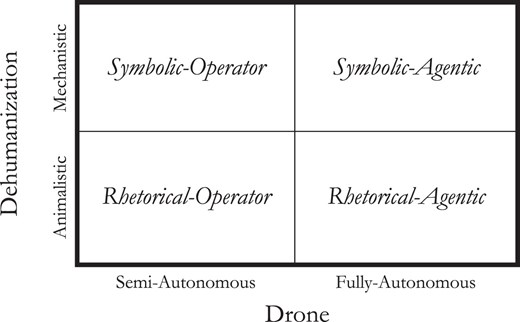
We theorize that the combination of animalistic or mechanistic dehumanization with a drone providing more or less human control informs four patterns of dehumanized warfare that may shape public support for strikes (Figure 1). Rhetorical-operator warfare combines animalistic dehumanization with a semi-autonomous drone. In this scenario, strikes against dehumanized targets occur with a higher degree of perceived human oversight. “In the loop” operators, staffs, commanders, and policymakers use derogatory and totalizing rhetoric to deny targets’ humanity and legitimize strikes. Such rhetoric is often harnessed to justify killing (Cooter 2025, 15), especially when the target belongs to an out-group (Kteily et al. 2015; Smith 2020). Polling data indicate high public support for US drone strikes against targets that are alleged to be “extremists” (Kuru et al. 2017). As Lushenko, Carter, and Bose (2025) and Lushenko (2025) show, observers often conflate the guilt of targets with their racial characteristics, which enables dehumanization.
Dehumanized warfare

Symbolic-operator warfare refers to the use of mechanistic dehumanization to legitimize a semi-autonomous drone strike. Targets are visually presented as objects or systems rather than as human beings. Infrared (IR) cameras used for targeting, for example, can strip combatants of their humanity, casting their lives as “destructible” and “ungrievable” (Butler 2009, 31). In this scenario, then, drones operated with human oversight are guided by iconography that represents targets as subhuman. Such psychological distancing may relieve feelings of guilt over aggressive actions (Bandura 2002; Huelss 2025), and even account for aggressive behavior, making it easier to “pull the trigger” (Shane 2009).
Rhetorical-agentic warfare combines animalistic dehumanization with a fully autonomous drone. Political and military officials contend that fully autonomous drones with reduced human oversight allow militaries to engage targets faster than adversaries, thus shortening the sensor-to-shooter timeline and enabling lethal overmatch. In this scenario, “soldiers could sip coffee in their offices, monitoring screens far from the battlefield, as … all kinds of robotic war machines” independently operate (Milley and Schmidt 2024, 32), with war beginning to resemble a video game (Frantzman 2021, 179). One example is the US Army’s Maven Smart System, which “can access sensor data from diverse sources, apply computer vision algorithms to help soldiers identify and choose military targets, and then provide workflow support that enables a request to be approved by the chain of command in order to strike a target” (Probasco 2024, 3). Here, targets’ hostile act and intent, which help justify engagements, are outsourced to machines that are encoded to recognize combinations of pixels rather than expected targeting outcomes (Hardy and Lushenko 2012).
Symbolic-agentic warfare brings together mechanistic dehumanization with a fully autonomous drone. The AI incorporated into fully autonomous drones, as well as the data enabling them, can equate people with machines or objects rather than humans with emotions, individuality, and agency. Such systems also rely on and perpetuate racial and gender biases that can result in perverse outcomes, such as target misidentification (O’Neil 2016; Chandler 2021). We posit that symbolic-agentic warfare is tractable at the strategic through tactical levels of war. Strategically, symbolic-agentic invests AI with latitude to shape operations (Erskine and Miller 2024). Tactically, and presently, symbolic-agentic warfare relates to terminal guidance drones, such as the Ukrainian Vyriy-10. These drones are augmented with AI, which takes over control during the final approach to a target. The AI allows these drones to home in on their targets, thus overcoming electronic countermeasures. Some analysts argue for a greater use of these drones, claiming that “the side that masters and deploys them first will hold significant … advantage” (Goncharuk 2025; Scharre 2026).
Expectations
How do these patterns of dehumanization and human control shape public support for drone strikes? Existing research suggests that animalistic “slurs and epithets” characterizing targets as “racially inferior” and “lower on the animal hierarchy” can make them “less grievable” (Rai, Valdesolo, and Graham 2017; McIntosh 2025, 122, 8514). At the same time, research demonstrates how images that mechanistically dehumanize populations can shape public support for international cooperation (Ghosn and Bayram 2025) and the use of drones (Sharief 2020). Lushenko, Carter, and Bose (2025) show that the degree to which people observe targets can shape their support for US drone strikes. Taken together, this research suggests that animalistic and mechanistic dehumanization may enhance public support for strikes.
Existing research also suggests that perceived human oversight enhances public support for the use of force, including drone strikes (Kreps et al. 2023; Cvetkovic et al. 2024). Conversely, drones with less human oversight or greater autonomy are viewed more critically because of their perceived susceptibility to algorithmic errors and cognitive biases that may result in target misidentification (Horowitz and Khan 2024). Survey research consistently finds that public support declines as operational control shifts from humans to autonomous systems (Horowitz 2016; Arai and Matsumoto 2024; Horowitz and Maxey 2025). Studies further suggest that “national security professionals” often discount responsibility for operational errors when they are attributed to humans rather than machines (Horowitz and Lin-Greenberg 2022; Zwald, Kennedy and Ozer 2025). This body of research therefore suggests that both expert and public audiences prefer human oversight of drones, and that such oversight may increase support for strikes against targets that are animalistically or mechanistically dehumanized.
Whether this preference for human oversight reflects concerns about algorithmic decision-making itself—such as the novelty of AI, accountability, or indiscriminate targeting—or is conditioned by the dehumanization of targets remains unclear. Existing research often conflates animalistic and mechanistic forms of dehumanization (Johnson 2025; Clark 2026; del Valle and Lara 2026) as well as the scope of autonomy incorporated into drones (Renic 2018). Further, claims about drones’ dehumanizing potential often rely on intuition, anecdote, or logic. Renic and Schwarz, for example, emphasize dehumanization outcomes among “both the recipients and dispensers” of US drone strikes without providing empirical evidence of these effects (2023, 323).
Thus, while prior research suggests a public preference for human oversight of drones, there is little theoretical or empirical consensus regarding the relative effects of animalistic and mechanistic dehumanization on public support for strikes. This question is particularly consequential for fully autonomous drones, which remove human oversight from targeting decisions. Accordingly, we do not advance theoretical expectations regarding differences in public support when a fully autonomous drone strikes an animalistically or mechanistically dehumanized target. Rather, we treat these differences in public support as an open empirical question evaluated through our experimental analyses.2 While research suggests that both animalistic and mechanistic dehumanization may increase public support for strikes, existing scholarship also demonstrates a preference for human oversight. We expect that public support will be highest when targets are engaged by semi-autonomous drones under human control, regardless of how they are dehumanized. We therefore advance two empirically testable hypotheses:
H1: Public support will be highest for symbolic-operator warfare.
H2: Public support will be highest for rhetorical-operator warfare.
Animalistic and mechanistic dehumanizing frames may also influence public support toward drone strikes in distinct ways (Gartner and Gelpi 2016). Variation in how observers are psychologically distanced from war can shape public attitudes differently (Choi 2024), including attitudes toward the use of force (Bar-Tal 2000). Animalistic dehumanization is primarily associated with negative emotions, such as anger, contempt, disgust, and hatred (Haslam 2006; French and Jack 2015; Rai, Valdesolo, and Graham 2017; Smith 2020; Luft 2023; McIntosh 2025). Such emotions shape public perceptions surrounding the use of force. Fisk, Merolla, and Ramos (2019), for example, show that anger encourages observers to derogate targets, reducing empathy and increasing support for drone strikes with human oversight. By contrast, mechanistic dehumanization is primarily associated with cognitive beliefs and psychological distancing characterized by indifference toward targets, a form of distancing linked to increased autonomy and algorithmic warfare (Shaw and Akhter 2014; Huelss 2025). The late Pope Francis, for instance, argued that autonomous platforms result in a “cold and detached approach to the immense tragedy of war” (2024, 3). Mechanistic dehumanization may therefore encourage observers to evaluate drone strikes through more detached strategic, legal, and operational assessments of targets. Thus, distinct motivations may shape perceptions of psychological distance from targets. Negative emotions should matter more for public support when targets are animalistically dehumanized, whereas cognitive beliefs and attitudes should be more consequential when targets are mechanistically dehumanized. This distinction informs our final hypothesis:
H3: Negative emotional responses will shape public support when targets are animalistically rather than mechanistically dehumanized.
Research Design
We test these hypotheses using a text- and image-based survey experiment administered to a representative sample of Americans, which previous research suggests provides a reasonable barometer of public attitudes toward the use of force (Erickson 2018; Ghosn and Bayram 2025).3 We recruited 1,500 respondents through Lucid in November 2025, which uses a quota sampling protocol to produce respondent pools that correspond to US demographics.4 Our survey constitutes a 2 × 2 factorial and between-subject design. We randomly assigned respondents to one of four treatment groups that vary how a target is dehumanized, and the type of semi- or fully autonomous drone that strikes the target. We also include a control condition that omits these treatments. Because respondents in control groups may fill informational gaps with assumptions, potentially attenuating treatment effects, we complement treatment-versus-control comparisons with direct comparisons across treatment groups. These analyses reduce reliance on the control condition as the sole reference point and allow us to assess whether differences between experimental conditions are consistent with our theoretical expectations while preserving the advantages of randomization.
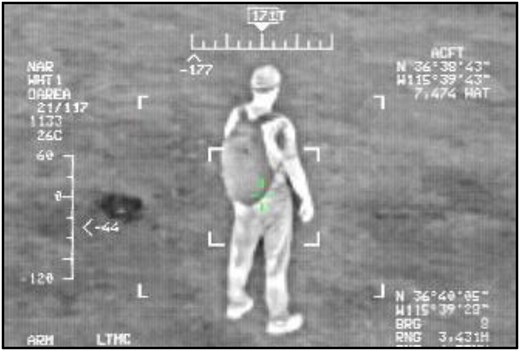
We approximate animalistic and mechanistic dehumanization through text- and image-based vignettes. Respondents are informed that “US intelligence officials have credible information that a terrorist group is preparing to attack US military forces located in a foreign country.” Next, respondents are told that “US intelligence officials use this information to identify a person in a foreign country, who is exhibiting behaviors consistent with preparing to attack US military forces.” Depending on their treatment group assignment, respondents are then instructed that “US intelligence officials refer to this suspect as ‘so savage they are not human—they are like an animal’” or that “the suspect is pictured above,” which refers to an IR image that strips the suspect of human qualities (Figure 2). Respondents are also informed that, “Given this assessment, the US president authorizes a strike against the suspect using a [semi-autonomous/fully autonomous] drone, which is [controlled by a human operator/controlled by artificial intelligence].” Like other survey research in drone warfare studies, we control for the most morally contestable outcome of strikes, civilian casualties, which enhances our intent-to-treat (Regan 2022). Respondents are informed that “The US drone strike removes the suspect and results in no civilian casualties.”
Drone image

Following these treatments, we measure our dependent variable. We ask participants the following question: “Do you support the US president’s use of a drone strike in this setting?” Respondents answer using a five-point Likert and ordinal scale ranging from “strongly support” (5) to “strongly oppose” (1). Using the same measurement strategy, we then assess factors previous scholarship has demonstrated can shape respondents’ overall attitudes toward drones and AI (Kreps 2014; Kreps and Wallace 2016; Kreps et al. 2023). We replicate an approach used by Fisk, Merolla, and Ramos (2019) to ask respondents questions about their emotions, ethnocentrism, ideology, support for the use of force, and perceptions of the legality and morality of strikes. We also examine respondents’ military experience that research shows can affect perceptions about dehumanization and the use of force (McIntosh 2025). We gather these data post-treatment to minimize the possibility that pre-treatment measurement influences respondents’ reactions to our experimental stimuli. While measuring covariates after treatment raises the possibility that experimental exposure could influence respondents’ subsequent attitudes, recent research finds little evidence that post-treatment measurement systematically alters average treatment effects or respondents’ measured attitudes across a range of social, political, and behavioral domains (d’Urso, Bonilla, and Bogdanowicz 2026). Consistent with this expectation, we find no statistically detectable differences across treatment conditions for any of our post-treatment measures, providing no evidence of systematic differences in these covariates (see the Online Appendix).
We further mitigate bias in several ways. First, we enhance our intent-to-treat by defining the operation in terms of a “suspect” versus a “target,” because the latter construction may prime respondents to support the operation. To mitigate social desirability bias, we do not identify the skin color or location of the suspect, reflecting research showing that observers may use the location of a drone strike to proxy for a suspect’s race, which could affect our results (Lushenko, Carter, and Bose 2025). To address potential information equivalency challenges (Dafoe, Zhang, and Caughey 2018), we remove incriminating items from the IR image, such as a weapon, that could shape respondents’ attitudes. Rather, we present an image of a 195-pound male suspect who is wearing pants, a shirt, a beanie, and a backpack, and who is standing in a field with his back facing the drone optic. Such positioning further enhances our intent-to-treat, since physiognomy can skew people’s attitudes (Zebrowitz, Matthew Bronstad, and Lee 2007). Finally, we gauge respondents’ attentiveness, which is useful to assess the robustness of our findings and moves beyond our pre-registration. We account for respondents’ survey completion time and include attention and manipulation checks (Ternovski and Orr 2022). While we hesitate to draw broad generalizations from our findings, especially because we do not inform respondents how drones work, these steps allow us to examine the internal validity of our results (see the Online Appendix).
To evaluate H1 and H2, we compare levels of support for the drone strike across the experimental conditions relative to the control group, reporting descriptive comparisons in the proportion of respondents supporting the operation. We then estimate a two-way analysis of variance (ANOVA) to assess the independent and joint effects of the form of dehumanization and type of drone on public support, followed by two-tailed t-tests and pairwise comparisons to evaluate the statistical significance of mean differences across experimental conditions. To assess the robustness of these findings, we estimate a series of ordinary least squares (OLS) regression models relating treatment assignment to support for the strike while controlling for respondents’ demographic characteristics and other covariates. Finally, we disaggregate the treatment conditions into their component dimensions and estimate models including both the main effects of the form of dehumanization and type of drone, as well as their interaction, to isolate the independent and conditional effects of each experimental factor. To evaluate H3 and explore the microfoundations of public support, we estimate additional OLS regression models with interaction effects. We then conduct causal mediation analyses to evaluate the alternative possibility that negative emotion mediates the effect of dehumanization on public support and qualitatively analyze respondents’ open-ended explanations for their support of the operation. Throughout these analyses, we report exact P-values, treat P < .05 as the conventional threshold for statistical significance, and characterize P-values between .05 and .10 as suggestive evidence. We therefore interpret findings in light of the magnitude, direction, precision, and robustness of the estimated effects rather than statistical significance alone (Rainey 2014; Bassan-Nygate et al. 2025).
Results
Main Results
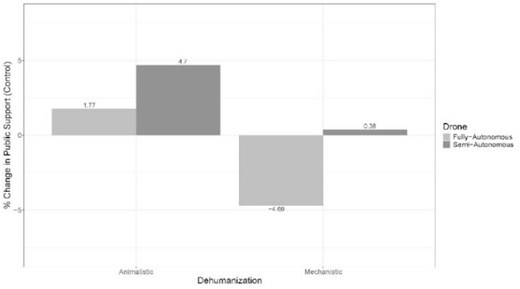
Overall, our results provide support for H2 and H3. First, we observe that respondents were the most supportive of a strike against an animalistically dehumanized target using a drone with increased human oversight, or rhetorical-operator warfare. Figure 3 shows that relative to the control group, respondents’ support increases for three patterns of dehumanized warfare—rhetorical-operator (4.70 percent), rhetorical-agentic (1.77 percent), and symbolic-operator (0.38 percent). Respondents were least supportive of a strike against a target represented by an IR image that was engaged by a fully autonomous drone. Respondents’ support decreases for symbolic-agentic warfare by nearly 200 percent (−4.69 percent) compared to their support for rhetorical-operator warfare (4.70 percent).
Percent change in respondents’ support for a US drone strike

We explore the statistical significance of these descriptive findings for H2 in three ways. As discussed above, we first perform a two-way ANOVA. Overall, and when pooling respondents across all experimental conditions, we observe heightened public support for the US drone strike in terms of animalistic versus mechanistic dehumanization (P = .007) and a semi-autonomous versus fully autonomous drone (P = .046) (see the Online Appendix). These findings align with our descriptive findings.
Next, Figure 4 displays mean levels of respondents’ support for patterns of dehumanized warfare relative to the control group, which is reflected by a dashed line. We compare respondents’ level of support for the US drone strike between each treatment group and the control group using two-tailed t-tests. The outcomes suggest that respondents support rhetorical-operator warfare (P = .08) but not symbolic-agentic warfare (P = .10). We also find that respondents’ support is not statistically significant for the remaining patterns of dehumanized warfare—symbolic-operator (P = .89) and rhetorical-agentic (P = .53). These results are consistent with pairwise t-tests where we compare respondents’ mean levels of support across treatment groups, reflecting concern for a weak control group. We find statistically significant differences for public support between rhetorical-operator and symbolic-agentic warfare (P < .001) and between rhetorical-agentic and symbolic-agentic warfare (P = .02), with suggestive evidence for differences between rhetorical-operator and symbolic-operator warfare (P = .10) and between symbolic-operator and symbolic-agentic warfare (P = .08).
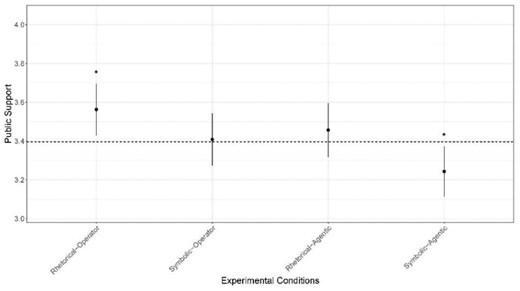
Respondents’ mean level of support for a US drone strike. Vertical I-bars represent 95 percent confidence intervals. *P < .10, **P < .05, ***P < .01.

Our OLS regressions reinforce these results for H2. Table 2 shows the association between dehumanized warfare and public support for the US drone strike as coefficients. Our baseline model offers support for H2, and the data support our novel finding for symbolic-agentic warfare across increasingly robust models. According to Model 1 in Table 2, our baseline model, we observe a substantively and statistically suggestive increase in respondents’ support for rhetorical-operator warfare (β = 0.167, P < .10). When adding more controls—including for demographics (2), ideology (3), instrumental, normative, and operational factors (4), and military experience (5)—we observe that symbolic-agentic warfare has the greatest effect on public support for the US drone strike. We find a substantively and statistically significant decrease in respondents’ support, which is consistent in our most robust model (4) that incorporates all relevant factors (β = −0.175, P < .05). This finding is most pronounced for respondents with military experience (β = −0.431, P < .05), echoing McIntosh’s study of dehumanizing practices among the US military. Here, servicemembers are conditioned to kill adversaries for state interests through a “refusal to acknowledge the full relational humanity of … those on whom potentially deadly violence is inflicted” (McIntosh 2025, 19).
OLS regression results for public support for dehumanized warfare.
| (1) | (2) | (3) | (4) | (5) | |
|---|---|---|---|---|---|
| Rhetorical-operator | 0.167+ | 0.148 | 0.147 | 0.067 | −0.137 |
| (0.096) | (0.096) | (0.095) | (0.070) | (0.256) | |
| Symbolic-operator | 0.013 | 0.020 | 0.018 | −0.069 | −0.203 |
| (0.096) | (0.095) | (0.094) | (0.069) | (0.231) | |
| Rhetorical-agentic | 0.061 | 0.044 | 0.034 | −0.040 | −0.471* |
| (0.097) | (0.096) | (0.096) | (0.071) | (0.227) | |
| Symbolic-agentic | −0.152 | −0.182+ | −0.182+ | −0.175* | −0.431* |
| (0.096) | (0.095) | (0.095) | (0.070) | (0.214) | |
| Sex | −0.065 | −0.066 | −0.018 | −0.071 | |
| (0.060) | (0.060) | (0.044) | (0.145) | ||
| Age | 0.047* | 0.044* | 0.028+ | 0.061 | |
| (0.020) | (0.020) | (0.015) | (0.049) | ||
| Race | 0.081*** | 0.078*** | 0.058*** | 0.012 | |
| (0.021) | (0.021) | (0.016) | (0.049) | ||
| Education | −0.003 | 0.002 | 0.008 | −0.015 | |
| (0.025) | (0.025) | (0.018) | (0.066) | ||
| Income | 0.048* | 0.050* | 0.023 | −0.073 | |
| (0.022) | (0.022) | (0.017) | (0.054) | ||
| Ideology | 0.029* | 0.022* | 0.012 | ||
| (0.015) | (0.011) | (0.036) | |||
| Ethnocentrism | 0.008* | 0.010 | |||
| (0.004) | (0.014) | ||||
| Emotion | −0.008* | −0.004 | |||
| (0.003) | (0.014) | ||||
| Morality | 0.441*** | 0.488*** | |||
| (0.027) | (0.097) | ||||
| Consequentialism | 0.279*** | 0.347*** | |||
| (0.029) | (0.097) | ||||
| Force | 0.111*** | −0.004 | |||
| (0.027) | (0.092) | ||||
| US Congress | 0.034 | 0.012 | |||
| (0.025) | (0.080) | ||||
| International law | −0.008 | −0.110 | |||
| (0.025) | (0.080) | ||||
| Years of experience | 0.198+ | ||||
| (0.105) | |||||
| SOF experience | −0.058 | ||||
| (0.190) | |||||
| Deployments | −0.007 | ||||
| (0.074) | |||||
| Combat | 0.445* | ||||
| (0.181) | |||||
| Observations | 1,500 | 1,500 | 1,500 | 1,500 | 147 |
Note: +P < .10, *P < .05, **P < .01, ***P <.001 (standard errors in parentheses). Our preregistration anticipated exclusions based on manipulation check performance and survey completion time but did not specify operational thresholds. Because defining those thresholds after data collection would require post-hoc analytical decisions, we retain all respondents in the primary analyses to avoid specification-dependent exclusions and report exclusion-based analyses as robustness checks in the Online Appendix.
These findings are consistent when decomposing treatment groups into their component factors. Relative to fully autonomous drones and mechanistic dehumanization, semi-autonomous drones seem to increase public support for the strike (β = 0.165, P < .10), while animalistic dehumanization also increases support (β = 0.213, P < .05). The interaction effect between semi-autonomous drones and animalistic dehumanization is negative and statistically insignificant, indicating that their effects do not condition one another but are additive. Substantively, these findings suggest that the type of drone and form of dehumanization independently shape public support for the strike, reinforcing our broader findings regarding rhetorical-operator and symbolic-agentic warfare (see the Online Appendix).
Our OLS regressions also let us identify other factors that may shape respondents’ attitudes toward the dehumanization of targets and human oversight in remote operations. As reflected across Models 2–4 in Table 2, we find that respondents’ race, ethnocentrism, and ideology affect their support for the US drone strike. Importantly, research shows that ethnocentrism and ideology are precursors for dehumanization (Smith 2020, 6). When controlling for all factors, we find that respondents’ race has a marginal impact on their attitudes for dehumanized war, as reflected in Model 4 (β = 0.058, P < .001). Non-Black respondents seem to support patterns of dehumanized warfare more than their Black counterparts, suggesting that the latter group may perceive US drone strikes as racialized. This finding is supported by the effects of respondents’ ethnocentrism, which enhance attitudes of support for dehumanized warfare according to Model 4 (β = 0.008, P < .05). Despite the smaller effect size, this speculative finding echoes research showing that more ethnocentric Americans disproportionately shape public support for the “democratic peace” (Rathbun, Parker, and Pomeroy 2024) and US drone strikes (Lushenko, Carter, and Bose 2025). Ideology also shapes public support for drone warfare when targets are dehumanized. Conservative respondents show more support for the strike (β = 0.022, P < .05), reinforcing research that conservatives are “hawkish” on foreign policy (Kertzer, Brooks, and Brooks 2021). In sum, we find that heterogeneous effects can shape public support for drone warfare when targets are dehumanized, reflecting the complexity of attitudes toward modern warfare.
Microfoundations and Emotion
To explore factors that may underlie these findings, we triangulate quantitative and qualitative methods. We first use OLS regressions and causal mediation analysis. Next, we interrogate respondents’ deliberation on what shapes their support for the US drone strike.
Our OLS regressions reveal that respondents’ support for drone strikes when targets are dehumanized is shaped by a range of factors. In Model 4, support for the use of force abroad, for example, enhances such support (β = 0.111, P < .001). One respondent noted, “the president is the nation’s leader and the commander-in-chief of the military can take what actions are necessary.” Another respondent argued that the “president should be able to do whatever it takes to save the nation.” We also observe that respondents are more likely to support drone strikes against dehumanized targets when they believe there is a moral obligation to use drones (β = 0.441, P < .001). This echoes scholarship finding that “dehumanizers are usually highly … morally engaged with people whom they dehumanize” (Smith 2020, 92). One respondent argued, “I believe that we should be able to protect our soldiers and innocent people in other countries by eliminating a terrorist before they attack us or other innocents.” This outcome is also consistent with survey research finding that perceptions of morality shape public opinion for US drone strikes (Lushenko, Carter, and Bose 2025).
We also find that consequentialism, or an emphasis on soldiers’ protection, strongly shapes public opinion (β = 0.279, P < .001). Here, dehumanization results “in what the perpetrators see as a life-and-death struggle against a deadly enemy” (Smith 2020, 28). One respondent poignantly stated, “to protect military personnel on our land or abroad is the most important thing our president can do to save the lives for people who put their own lives on the line for us.” Finally, we observe that operational experience, namely longer military commitments (β = 0.198, P < .10) and combat (β = 0.445, P < .05), seem to shape public support for dehumanized warfare further echoing McIntosh’s research.
Although our OLS results provide little evidence that emotion independently shapes support for dehumanized warfare, a different pattern emerges when estimating interaction effects. In the Online Appendix, we show that the interaction between animalistic dehumanization and an overall emotion index is positively associated with public support for the US drone strike (β = 0.023, P < .05), whereas the interaction between mechanistic dehumanization and emotion is not statistically significant (β = 0.010, P > .10). The emotion index aggregates nine emotional responses: fear, anger, anxiety, bitterness, contempt, disgust, hatred, resentment, and worry. Examining individual emotions reinforces this finding. Compared to mechanistic dehumanization, animalistic dehumanization interacts with several emotions—including fear (β = 0.188, P < .05), anger (β = 0.212, P < .001), and bitterness (β = 0.124, P < .10)—and is associated with increased support for the strike. Causal mediation analyses provide no evidence that the effect of animalistic dehumanization on public support operates through greater negative emotion. In the Online Appendix, we show that neither the overall emotion index (ACME = −0.003, P = .792) nor individual emotions significantly mediate the effect. Together, these results support H3, indicating that negative emotions shape, rather than mediate, the relationship between dehumanization and public support.
Do other factors mediate public support for drone strikes, particularly in the case of our novel finding for symbolic-agentic warfare? To address this question, and similar to our approach for H3, we use causal mediation analyses adopting the Baron and Kenny (1986) method to estimate the indirect effect transmitted by potential factors on respondents’ overall attitudes. We estimate parallel mediation models comparing respondents treated by rhetorical-operator and symbolic-agentic warfare. This approach provides the sharpest contrast between models of dehumanized warfare while avoiding reliance on a potentially weak control condition. Consistent with our survey design, we construct four mediators representing plausible post-treatment pathways: emotion, legitimacy, strategic-utility, and worldview (Chaudoin, Gaines, and Livny 2021). We estimate indirect effects using the R mediation package with nonparametric bootstrapping and 5,000 simulations to generate confidence intervals for the average causal mediation effect (Imai, Keele, and Tingley 2010; Tingley et al. 2014). We measure emotion using our index variable. Legitimacy combines respondents’ beliefs about international law and elected officials’ moral obligation to use drones, reflecting legal-rational and normative evaluations of operations (Lushenko and Carter 2025). Strategic-utility captures respondents’ beliefs about the effectiveness of force and great powers’ special managerial responsibilities for global order. Finally, worldview measures respondents’ broader ideological and group-oriented dispositions through a combination of political ideology and ethnocentrism.
Our analysis provides little evidence that these pathways significantly mediate public support when respondents are treated by symbolic-agentic warfare. The strongest indirect effect emerges for the strategic-utility pathway (ACME = 0.01, P = .30), which falls short of conventional statistical significance thresholds. These findings are robust across multiple specifications, including models that compare symbolic-agentic warfare with the control group, other treatment groups, and a pooled sample of all treatment groups and the control group (see the Online Appendix). Taken together, our results suggest that the treatment effect is not meaningfully transmitted through the emotional, legitimacy, strategic-utility, or worldview pathways examined here. Rather than rejecting these mechanisms outright, our probationary findings indicate that the available data provides limited leverage for identifying indirect effects through these pathways or that alternative pathways influence public support for symbolic-agentic warfare not captured by our quantitative analysis. To explore this possibility, we turn to respondents’ open-ended explanations and examine how they reason through their support for the US drone strike.
Replicating an approach adopted by Lin-Greenberg (2022), we use respondents’ open-ended explanations to gain additional leverage over the microfoundations of public support. Respondents were asked to explain the factors they considered when evaluating their support for the US drone strike. We hand-coded responses into thirteen categories inductively derived from the broader literature on drones and emerging military technologies (Rogers 2024), replicating an approach used by Lushenko, Carter, and Bose (2025) (see the Online Appendix). These categories capture a range of instrumental, normative, operational, and technological considerations, including perceptions of threat, civilian casualties, legality, presidential authority, dehumanization, and AI. We cautiously interpret these responses. Given high levels of support for US drone strikes, respondents may exhibit social desirability bias by offering post-hoc justifications that align with widely accepted national security narratives. Responses may also have been influenced by contemporary events, particularly US drone strikes in the Caribbean against alleged narcotraffickers under Operation Southern Spear. Several respondents appeared to reference these operations. One stated that “we are blowing up drug dealer ships and that is totally legal,” while another argued that “the president is making America great again by getting rid of these drug rats coming in from South America and China—blow them out of the water.”
The open-ended responses suggest that support for the drone strike is shaped by multiple considerations (Table 3). Instrumental concerns are featured prominently, particularly perceptions of threat to the United States and beliefs regarding presidential authority. Respondents frequently justified support on the grounds that the operation eliminated a danger to national security or reflected the president’s responsibility to protect the nation. One respondent argued, “eliminating a threat to the United States is very important.” Another contended, “the president should be able to do whatever it takes to save the nation.” Normative considerations also regularly appeared, especially concerns about minimizing civilian casualties and conducting operations discriminately. One respondent noted that the drone strike “protected civilians from being killed.” Operational considerations also emerged, with respondents emphasizing the quality and credibility of intelligence used to identify a target. One respondent stated that the “quality of intelligence gathered” shaped support, relating to the doctrinal—and legal—concept of positive identification of combatants.
Respondents’ justifications by treatment groups and the control group.
| Capability | Civilian Casualties | Force Protection | Intelligence | Legality | Non-Lethal Options | Normative | Perceived Threat | Presidential Authority | Sovereignty | Animalistic | Mechanistic | Artificial Intelligence | |
|---|---|---|---|---|---|---|---|---|---|---|---|---|---|
| Control | 11.4% n = 23 | 12.4% n = 25 | 4.0% n = 8 | 16.8% n = 34 | 5.0% n = 10 | 1.0% n = 2 | 0.5% n = 1 | 24.3% n = 49 | 23.3% n = 47 | 1.5% n = 3 | 0.0% n = 0 | 0.0% n = 0 | 0.0% n = 0 |
| Rhetorical-operator | 5.7% n = 11 | 13.9% n = 27 | 4.1% n = 8 | 13.9% n = 27 | 6.2% n = 12 | 2.6% n = 5 | 0.0% n = 0 | 22.7% n = 44 | 20.6% n = 40 | 1.0% n = 2 | 8.2% n = 16 | 0.0% n = 0 | 1.0% n = 2 |
| Rhetorical-agentic | 6.7% n = 13 | 10.9% n = 21 | 4.7% n = 9 | 11.4% n = 22 | 7.3% n = 14 | 0.5% n = 1 | 0.5% n = 1 | 23.3% n = 45 | 19.7% n = 38 | 0.5% n = 1 | 10.9% n = 21 | 0.0% n = 0 | 3.6% n = 7 |
| Symbolic-operator | 3.3% n = 7 | 11.7% n = 25 | 7.5% n = 16 | 15% n = 32 | 6.1% n = 13 | 3.3% n = 7 | 0.5% n = 1 | 30.4% n = 65 | 14% n = 30 | 0.5% n = 1 | 0.9% n = 2 | 5.6% n = 12 | 1.4% n = 3 |
| Symbolic-agentic | 7.4% n = 16 | 8.8% n = 19 | 8.3% n = 18 | 18.4% n = 40 | 5.5% n = 12 | 2.3% n = 5 | 0.5% n = 1 | 21.7% n = 47 | 12.9% n = 28 | 0.9% n = 2 | 0.9% n = 2 | 7.4% n = 16 | 5.1% n = 11 |
At the treatment-group level, we note two important findings. First, respondents exposed to animalistic forms of dehumanization—including rhetorical-operator and rhetorical-agentic warfare—were more likely to invoke dehumanizing language when describing the target. Respondents referred to the suspect as “an animal” and “a danger to everyone.” Second, respondents assigned to symbolic-agentic warfare were more likely to reflect on the role of AI in targeting decisions. For some, the combination of IR imagery and machine autonomy reduced their support for the strike. As one respondent noted, “I was thinking of supporting this until I realized it was fully automated,” while another argued that “letting a machine make the ultimate decision seems cowardly and irresponsible.” Notably, these concerns appeared less frequently among respondents exposed to rhetorical-agentic warfare, suggesting that derogatory and totalizing epithets may attenuate concerns about autonomous targeting by shifting attention away from the technology and toward the perceived character of the target. Together, these findings offer one plausible explanation for why our causal mediation analyses did not identify statistically significant indirect effects when interrogating symbolic-agentic warfare. Respondents appear to reason through a diverse set of considerations, including concerns about autonomy, AI-enabled targeting, and machine decision-making, that are not fully captured by the emotional, legitimacy, strategic-utility, and worldview pathways we quantitatively examined.
Discussion
These results offer new evidence of how variation in dehumanizing frames and human oversight shape Americans’ support for drone strikes. However, these findings should also be interpreted with caution. We examine respondents’ attitudes toward a US drone strike at a discrete time and for discrete circumstances, begging questions about the longevity of public perceptions and generalizability of our findings. Indeed, the public generally observes the mechanistic dehumanization of targets after they are struck by drones, as reflected by the Trump administration’s operations against alleged narcotraffickers. Also, our vignettes did not expose respondents to patterns of dehumanization and human oversight by name. It is possible that respondents did not understand such patterns as we intended.5 Finally, we did not ask respondents where they thought the drone strike took place, meaning we cannot rule out the possibility that Americans’ beliefs about previous and ongoing conflicts shaped their attitudes. Respondents occasionally inferred that the operation was against alleged narcotraffickers in the Caribbean, though our scenarios did not mention this context.
Despite these limitations, our results make several contributions. Theoretically, we bridge large bodies of scholarship that examine the effects of dehumanization on attitude formation and public perceptions of human oversight in remote operations. Doing so allows us to consider how drones can contribute to and exacerbate the othering of individuals in a manner that essentializes them. We introduce and empirically test an original typology of forms of dehumanization and drone warfare that allows us to account for the unique mechanisms that may deny a target’s humanity as well as the degree of human oversight for strikes.
Methodologically, by integrating text- and image-based survey approaches, we more closely approximate how the public encounters dehumanization in practice (Dafoe, Zhang, and Caughey 2018; Harris and Lin-Greenberg 2025). While this approach enhances the ecological validity of our vignettes, it also raises questions about information equivalence. This concern is common in image-based survey experiments—including studies of militarized policing (Mummolo 2018), humanitarian intervention (Chu and Lee 2023), and AI-enabled military targeting (Shandler, Gross, and Shereshevsky 2026)—where differences in informational content may shape respondents’ interpretations and, consequently, treatment effects and external validity (Dafoe, Zhang, and Caughey 2018; Kreps and Roblin 2019; Kane 2024). These concerns are particularly relevant for mechanistic dehumanization wherein targets are intentionally stripped of individual features. We cannot fully disentangle whether respondents reacted to the absence of targets’ identifying information itself or to targets’ mechanistic dehumanization more broadly. These features are inherently intertwined in real-world representations of mechanistic dehumanization, making this an important limitation of our design and a promising avenue for future research.
Nonetheless, our findings contribute novel insights into how variation in the form of dehumanization and type of drone shapes public support for the use of force, especially in democracies (Kreps and Kriner 2025). First, we find that the dehumanization of targets shapes public support for drone strikes. However, this effect varies, depending on how targets are framed and engaged. Rhetorically framing targets with derogatory and totalizing epithets, especially when this practice is paired with a semi-autonomous drone that retains human oversight, seems to increase public support for strikes. Higher public support for this rhetorical-operator form of warfare echoes existing research on the implications of human control for public and military support toward AI across domains, such as targeting, policing, and surgery (Kreps et al. 2023; Lushenko 2026; Lushenko and Sparrow 2026; Shandler, Gross, and Shereshevsky 2026). This finding also reinforces research on the dehumanizing potential of necropolitical language (Mbembe 2019). On the other hand, we observe that when targets are mechanistically dehumanized and the drone has less human oversight, public support for strikes also seems to decline. Respondents appear more reluctant to support strikes when targets are represented through image-based forms of dehumanization, as opposed to derogatory descriptions, particularly when targeting decisions are delegated to autonomous systems. Decreased support for this symbolic-agentic form of warfare contradicts the belief that the public is likely to support use of force decision-making when “fighting shifts from military robots under the control of combatants to military robots as combatants” (Renic 2018, 66).
Second, our findings demonstrate substantive variation in public willingness to support acts of violence and slip into a “dehumanizing mindset” (French and Jack 2015; Smith 2020, 6, 173). We find that variation in drone autonomy and forms of dehumanization can psychologically distance the public from targets in distinct ways and shape support for US drone strikes. Negative emotional responses shape public support when targets are animalistically dehumanized, consistent with anti-empathy toward targets that are rhetorically framed, such as during rhetorical-operator warfare. When interrogating symbolic-agentic warfare, specifically, we find limited evidence that emotion accounts for respondents’ attitudes. Although strategic calculations exhibit the largest indirect effect among the mediators we examine, our analysis provides insufficient evidence that any measured mediator significantly transmits support. Instead, respondents’ open-ended explanations suggest that concerns surrounding autonomy, accountability, and machine decision-making may play a more important role.
Our findings also highlight the range of potential mechanisms through which dehumanization can shape public perceptions of drone warfare. One possible interpretation is that different forms of dehumanization produce distinct forms of psychological distancing with contrasting consequences for public opinion. Animalistic dehumanization may increase psychological distance by intensifying respondents’ emotional engagement with targets, particularly through anger, thereby undermining empathy during drone strikes. By contrast, mechanistic dehumanization may increase respondents’ psychological distance by encouraging them to coldly abstract targets, thus fostering indifference toward drone strikes. When paired with fully autonomous drones, however, this abstraction may encourage respondents to consider questions of accountability, autonomy, and human oversight. Our mediation analysis of this form of symbolic-agentic warfare shows that public attitudes are not fully explained by the emotional, legitimacy, strategic-utility, or worldview pathways we examined, pointing instead to alternative mechanisms that warrant further investigation (Kreps et al. 2023). It may be the case that concerns about preserving human responsibility over the use of force help explain the comparatively lower level of public support for fully autonomous drone strikes. If so, respondents may view autonomous systems as weakening the moral link between decision-makers and operational outcomes, even when such systems comply with international humanitarian law and avoid targeting of civilians. Future research is needed to more directly evaluate these potential mechanisms.
Conclusion
These results have implications for policy and future research. Our data suggest that a strategy of dehumanization has distorted elected officials’ understanding of public support for drones. Since 9/11, the ease with which remote operations lend to the dehumanization of targets has enhanced the appeal of drones, encouraging their use. US officials have used semi-autonomous drones to strike targets characterized by derogatory and totalizing epithets, and our analysis shows that the public supports this form of rhetorical-operator warfare. Presently, the US military is pursuing drones with reduced human oversight, seeking to leverage a first-mover advantage (Ding 2025). However, our analysis shows that Americans may not support these capabilities, at least initially, and particularly when their use is justified by the mechanistic dehumanization of targets resulting in symbolic-agentic warfare. Policymakers must balance the tradeoffs between these two patterns of dehumanized warfare in terms of public opinion. Essentializing targets through speech-acts that animalistically dehumanize them may enhance public support for drones with less human oversight but may not ensure democratic safeguards such as public accountability.
Researchers can also extend our study. First, how generalizable are our results across military communities? Scholars could study how soldiers perceive the dehumanizing potential of drones. Our results suggest heterogeneous effects for attitudes among respondents with military experience, especially in terms of the manner and length of service. Dehumanization may also contribute to moral injury among drone operators, suggesting that our results can inform the study of ethical reflection among the military (Fischer 2025). Scholars could also replicate our study cross-nationally, investigating how variation between war and peace may moderate public opinion. Second, how does variation across other conditions shape attitudes toward dehumanized warfare? Does the type of conflict, strike platform, munition, objectives, policies, approval authority and their ideology, and outcomes shape public attitudes (Rzazade 2026)? To what extent do drones contribute to the dehumanization of targets compared to other technologies, including missiles and manned aircraft? Does variation in the race of the target, as well as its sex, gender role, and location, moderate public attitudes? How does the combination of animalistic and mechanistic dehumanization also shape public support? Besides addressing these questions, researchers could build on our findings while employing more precise definitions of autonomous systems as the technology and associated policy frameworks evolve. Finally, though support is a useful litmus test for public opinion, AI-enhanced technologies impose normative and military readiness questions. This suggests that scholars could explore perceptions of legitimacy and trust among the public and military for dehumanized warfare (Lushenko and Raman 2024; Lushenko and Sparrow 2026).
Acknowledgments
We would like to thank the participants of workshops convened at the University of New South Wales in September 2025, University of Pennsylvania in October 2025, IS-ISSS in October 2025 at John Hopkins University, Cornell University in February 2026, Pontifical University of Saint Thomas Aquinas in Rome, Italy, in March 2026, International Studies Association in Columbus, Ohio, in March 2026, The Australian National University in Canberra, Australia, in June 2026, and American Political Science Association in Boston, Massachusetts, in September 2026. We would also like to thank Jennifer Alessi, Kathryn Brimblecombe-Fox, Keith Carter, Bridgid Hickman, Jamie Hickman, Michael Horowitz, Sarah Kreps, Janet McIntosh, Mitt Regan, Maciej Urbaniak, and two anonymous reviewers for feedback on earlier drafts of this article, as well as the exceptional editors. The views expressed in this article are those of the authors and do not reflect the official policy or position of the US Government, Department of War, or Departments of the Army and Navy.
Funding
This research was funded by a University of New South Wales—Cornell University Global Research & Impact Program (GRIP) grant.
Conflicts of Interest
We have no conflicts of interest to report.
Data Availability
The data underlying this article are available on the ISQ Dataverse at https://dataverse.harvard.edu/dataverse/isq.
Author Biography
Paul Lushenko is a Lecturer at Cornell University and Senior Fellow at Cornell University's Tech Policy Institute. He is also a Professorial Lecturer at The George Washington University.
Srinjoy Bose is an Associate Professor at the University of New South Wales and Senior Fellow at Cornell University's Tech Policy Institute.
Shira Eini Pindyck is a Visiting Scholar at the University of Pennsylvania Perry World House.
Footnotes
For empirical research focusing solely on animalistic dehumanization, see Luft (2023) and Rai, Valdesolo, and Graham (2017).
This approach is consistent with recent studies, including research examining concepts that are similarly challenging to measure, such as local consent during US military interventions (Dill, Myers, and Schubiger 2026).
The Institutional Review Board approved this study and it was pre-registered. However, we did not outline theoretical expectations, including the anticipated direction of outcomes (see the Online Appendix).
Research suggests that this sampling protocol enables experimental effects replicating those found with probability-based sampling techniques (Coppock and McClellan 2019). Lucid’s quota sampling protocol is conditioned on respondent age, gender, ethnicity, income, and location.
Only 42 and 37 percent of respondents acknowledged having sufficient knowledge of semi- and fully autonomous drones.