 https://orcid.org/0000-0002-7065-4662
Abstract
This paper reviews and contrasts electromagnetic field (EMF) theories of consciousness with traditional neural and functionalist accounts of phenomenal space and its contents. Conscious experience is unified yet differentiated, intentional, reportable, and capable of influencing behaviour. These properties, available only from a first-person perspective, must correspond to distinct states or processes in an underlying physical substrate. Conventional neural and functionalist theories explain conscious experience through local causal interactions among discrete units and symbolic processing. However, patterns of computation and causal organization exist only from an external observer’s perspective and therefore do not themselves explain subjective experience. In contrast, the brain’s endogenous EMF, which integrates information spatially, provides a plausible substrate for phenomenal unity. Evidence linking EMF dynamics to conscious states and contents is abundant, particularly from EEG studies showing reliable correlations despite attenuation of extracranial fields. EMF dynamics may also provide a more stable representation of short-term memory than variable neural firing patterns. Evidence for ephaptic coupling further demonstrates that EMFs influence neural activity, potentially contributing to rapid large-scale neural coordination and fluctuations in firing thresholds. Experimental perturbation of endogenous EMFs can alter conscious experience and modulate oscillations involved in memory consolidation. EMFs can perform field computation through superposition, and a gradual evolutionary origin follows from the adaptive advantages of ephaptic coupling in simpler nervous systems. It is hypothesized that low-frequency oscillations provide the basis of phenomenal space, whereas localized high-frequency oscillations support experiential differentiation. Intentionality is explained by locating the conscious EMF between sensory input and motor output processes.
The explanatory challenge of conscious experience
How conscious phenomenal experience, the subjective awareness of a 3D world and its contents, arises from a physical system built from inanimate atoms and molecules organized into cells and a brain remains a major scientific challenge. Farrell (1950) and the Nobel price-winning physicist Schrödinger (1958) held that objective measurement cannot capture the aspect of subjective consciousness. Similarly, Nagel (1974) in the classic paper ‘What is it like to be a bat?’, stated that consciousness presupposes that ‘there is something it is like’ for an agent to be aware, that has an irreducibly subjective character which cannot be captured by objective, physicalist theories, and Levine (1983) used the term explanatory gap to stress the problem of physicalist theories in explaining phenomenal properties. The problem was restated by Chalmers (1995) as ‘the hard problem’ of consciousness which might be inherently beyond what science can access. But to claim that consciousness cannot be physical could be a category mistake (Ryle, 1949) arising from assigning phenomena to the wrong logical category as when asking ‘where in the brain is the experience of the colour red?’ as if subjective qualities were locatable physical objects. Ellia et al. (2021) further identified the fallacy of misplaced objectivity, which is the assumption that only objective properties are scientifically legitimate. Conscious experience and the distinct objective states in a physical substrate are two descriptions of the same underlying entity, a first-person ‘within view’ and a third-person ‘outside view’. Rejecting this identity will evidently result in reintroducing dualism (Haun & Tononi, 2019). Seth (2021) framed the ‘real problem’ as characterizing, predicting, and controlling the relationship between physical processes and their subjectively observable effects. On this view, progress comes from mapping phenomenology onto biological mechanisms rather than addressing why consciousness exists, constraining the physical substrate underlying conscious experience. Here I provide a conceptual review of contemporary theories that seek to address the real problem of conscious experience: its phenomenologically unified character and distinct contents (i.e. qualia), which is the focus here.
Neural models, built on causal integration, and functional theories built on symbol manipulation approaches face persistent difficulties in accounting for phenomenal unity and intentionality. Instead, theories reframing the physical substrate of consciousness from the high-capacity neural processing to the brain’s self-generated electromagnetic field (EMF), which feeds back into neural activity via ephaptic coupling, offers a coherent account of how phenomenal properties such as unity can emerge (Charman, 1997; Pockett, 1999, 2012, 2013; John, 2002; McFadden, 2002a,b; 2020; 2023a,b; 2025; Fingelkurts & Fingelkurts, 2002; Jones, 2013; Pockett, 2013; Keppler, 2016; Keppler & Shani, 2020; Hales & Ericson, 2022; Ward & Guevara, 2022; Jones & Hunt, 2023). Actually, the patterns and dynamics of the EMF, as measured through the skull by the attenuated EEG signals, is the most reliable physical correlates of conscious states and experience (Eckhorn et al., 1988, 1993; Engel et al., 1991a, b; Gray et al., 1989; Kreiter & Singer, 1996; Fries et al., 1997; Singer et al., 1993; Gallotto et al., 2017). The EMF theory accounts for the rapid large scale neural dynamics, firing threshold fluctuations, and event related potentials (ERP) where the p300 component correlate better with the onset of conscious experience than neural recurrent activity, which is proposed by recurrent processing theory (RPT) (Sergent, 2018; Drissi Daoudi et al., 2019). These EEG patterns and ERPs, although mostly considered just a proxy for neural correlates of conscious experience may instead provide a direct link to its physical substrate. Across mammals, consciousness corresponds to stable neural oscillations such as alpha rhythms, sleep spindles, and hippocampal ripples (Buzsáki, 2013). Intriguingly, comparable synchronized local field potentials associated with sleep and attention also appear in fruit flies, crayfish, and octopuses (Godfrey-Smith, 2020). Only specific spatial organizations of neural tissue with particular connectivity patterns generate such EMF oscillations linked to conscious or proto-conscious experience; most configurations with similar connectivity do not. Why has evolution favoured neural spatial architectures that results in such links between EMF and conscious experience?
The dominant view is the neural doctrine assuming that the conscious mind arises from the large-scale activities of individual discrete neurones, and the target of most research is to find its neural correlates, addressing the easy problem of consciousness (Chalmers, 1995). Networks of discrete neurones integrate information sequentially over time, which is a causal integration through one-way synaptic communication. Computational functionalism is another common view, also aiming at the easy problem by claiming that consciousness is a functional organization focusing on what consciousness does, not what it is and therefore avoid the hard problem altogether (Dennett, 1991). Block (1978, 2025), on the other hand, argues that consciousness depends on specific biological mechanisms rather than abstract computational organization.
Notably, most neural processing unfolds in phenomenal absence, whereas the conscious ‘stream’ as described by James (1892) reflects only a narrow subset of ongoing neural activity (Baars, 1993; Zheng & Meister, 2025). Only specific sensory regions in the brain generate reportable experience (Gray, 1995) whereas large structures, including the cerebellum, amygdala, hippocampus, commissures, and substantial portions of cortex, can be damaged without abolishing consciousness (Morsella et al., 2010). Cortical stimulation likewise shows that frontal activation produces little or no experience, whereas parietal, occipital, and temporal stimulation elicits vivid percepts (Koch, 2018). In addition, motor-related processes remain unconscious: stimulating premotor regions triggers movements without awareness, while parietal stimulation evokes a conscious urge to act (Desmurget & Sirigu, 2009).
Zheng and Meister (2025) estimated that the processing capacity underlying cognition and reportable thought is approximately 10 bits per second, far below the information capacity of sensory processing. A severe capacity limitation is evident also in inattentional and change blindness (Simons, 1996), visual short-term memory (Olsson & Poom, 2005), and the selective nature of visual imagery (Balaban & Ullman, 2025), all of which depend on conscious processing. What distinguishes these processes from those that do not give rise to conscious experience? Any physical account must explain how information is integrated across distributed neural activities and regions, and even across the two visual hemifields into a seamless whole, limited to a single focus at any given moment, filled with a vast repertoire of qualitatively distinct qualia (Baars, 1993). Another central feature of consciousness is intentionality, the fact that consciousness is always ‘about’ something (Husserl, 2001). Mental states are directed towards objects, events, or states of affairs; this directedness is not a computational relation but a phenomenal one, given directly in experience, and provides us with a sense of possessing free will by acting as a result of these intentional states.
These properties of conscious experience fit naturally with EMF theories. Only specific properties of the brain’s self-generated EMF, its coherent oscillations and field patterns, can sustain conscious experience, which is what this field is experienced as from the first person within view.
The physical correlates of experience: the bottom-up approach
The neural doctrine claims that conscious experience is wholly produced by specific neural processes. These are identified through bottom-up searches for the neural correlates of consciousness (NCCs), whereby brain activity is measured in various states or contents of consciousness in order to locate which processes correlate with the experience, or where conscious experience arises (IIT-Concerned et al., 2025). The dominant view is that conscious experience arises from the collective activity of specific populations of interacting neurons (Crick, 1994; Popper, 1978; Libet, 2004). The crucial ingredient may be local loops as in RPT placing consciousness in these loops within and between occipital and temporal cortices, the posterior hot zone (Lamme, 2006, 2015, 2020). It could also be global loops as in global workspace theory (GWT) emphasizing frontal-cortex driven attentional selection for global broadcasting (Dehaene et al., 2006), or synchronized oscillations (Eckhorn et al., 1988, 1993; Engel et al., 1991a, b; Gray et al., 1989; Kreiter & Singer, 1996; Fries et al., 1997; Singer et al., 1993; Lutz et al., 2002; Leon-Carrion et al., 2012; Gallotto et al., 2017). Others argue that conscious perception requires non-cortical structures, such as thalamic–cortical loops (Roy, 2002: Fang et al., 2025), which play a central role in states of impaired consciousness as thalamic injury can induce vegetative states and anaesthetics act strongly on these interactions. Recent work further links thalamocortical feedback to large-scale EMF synchrony and conscious experience (Fang et al., 2025). Also, the brainstem has been proposed as a NCC, specifically the superior colliculus (SC) just below the thalamus, which integrates multimodal spatial and bodily maps and stabilizes perception by filtering out self-generated signals (Merker, 2005). Despite advances in imaging and theory development, the NCC remains elusive (McFadden, 2020; Seth & Bayne, 2022). A wide range of theories and approaches to spatially locate the NCC has been identified (Sattin et al., 2021), and competing theories highlight different locations in the brain (Fig. 1A). A multi-lab study with 250 participants produced mixed results, but slightly favoured the posterior sensory networks as the most likely substrate of conscious experience (Melloni et al., 2023; Finkel, 2023; Lenharo, 2023).
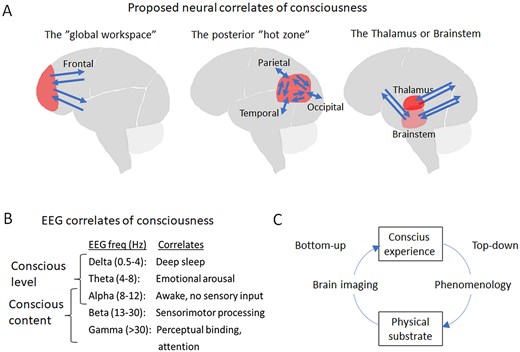
(A) In Global Workspace Theory (GWT), conscious states emerge from recurrent interactions between local processes and a global workspace, often associated with frontal regions, whereas Recurrent Processing Theory (RPT) emphasizes recurrent local processing in parietal, temporal, and occipital cortices, and other proposals highlight thalamocortical loops or brainstem structures as the neural basis of consciousness; (B) EEG oscillatory frequency bands provide reliable correlates of both levels of consciousness (low frequencies) and conscious contents (high frequencies); (C) bottom-up approaches identify the neural processes underlying experience using brain imaging and stimulation techniques, whereas top-down approaches begin with phenomenology to specify possible structural features of the physical substrate underlying conscious experience.

Neural recurrent activity is involved in producing the synchronized firing that produces multiple embedded EEG rhythms. Despite the outward attenuation of the EMF, the weak extracranial EEG oscillatory frequency bands measured by electrodes outside the scalp are the most reliable correlates of conscious states (Engel & Fries, 2016) (Fig. 1B). These rhythms support local and large-scale dynamics linked to conscious processing, whereas asynchronous firing appears not to contribute (Eckhorn et al., 1988, 1993; Engel et al., 1991a, b; Gray et al., 1989; Kreiter & Singer, 1996; Fries et al., 1997; Singer et al., 1993; Gallotto et al., 2017). Although typically considered an indirect proxy for the relevant neural processes, these EEG signals may reflect a core correlate of conscious experience residing in the EMF. Large-scale EMF synchrony arises through constructive interference in recurrent circuits, such as the thalamocortical loops, which enhance coherence (Hunt & Jones, 2023), integrate information across cortical sites to support conscious processing (Llinás, et al., 1998), and generate an integrated field that may underlie phenomenology (Ward, 2011; Ward & Guevara, 2022). Notably, the constructive interference thought to underlie conscious EMF patterns depends on specific spatial configurations of synchronized neural oscillators.
Distinct EEG frequency bands correlate with different conscious states and processes (Samaha et al., 2020; Foster et al., 2016; Sauseng et al., 2005; Thut et al., 2006; Rihs et al., 2007; Mathewson et al., 2011; Baldauf & Desimone, 2014; Bagherzadeh et al., 2020; de Vries et al., 2021; Tallon-Baudry & Bertrand, 1999). Five distinct frequency bands can be identified (Roy, 2002; Engel & Fries, 2016). Among these are delta (0.5–4 Hz) in sleep (Steriade et al., 1993), theta (4–8 Hz) in drowsiness (Mitchell et al., 2008), and alpha (8–12 Hz) in relaxed wakefulness (Klimesch, 1999). Without sensory input, in the eyes-closed state, the information content is at a minimum in the awake brain (Roy, 2002), occipital alpha activity increases during eyes-closed rest and visual imagery, and its magnitude is correlated with the vividness and stability of internally generated scenes (Samaha et al., 2020; Foster et al., 2016). Alpha rhythm’s structure large-scale spatial attention maps without external stimulation (Sauseng et al., 2005; Thut et al., 2006), and track covert spatial attention in the absence of visual input (Rihs et al., 2007). Alpha-band amplitude and phase influence neural near threshold activities and predict whether a visual stimulus will be detected (Mathewson et al., 2011; Baldauf & Desimone, 2014; Bagherzadeh et al., 2020; de Vries et al., 2021). Beta band frequencies (13–30 Hz) are observed during active attention (Engel & Fries, 2010), and gamma (> 30 Hz) oscillations increases during demanding cognitive tasks and object perception (Tallon-Baudry & Bertrand, 1999; Fries, 2009), perceptual binding and attentional control (Sauseng et al., 2005; Siegel, et al., 2012) (Fig. 1B). Across mammals, consciousness aligns with stable oscillatory patterns such as neocortical alpha rhythms, sleep spindles, and hippocampal ripples (Buzsáki, 2013). Comparable rhythmically synchronized local field potentials associated with sleep and attention have also been observed in diverse animals, including fruit flies, crayfish, and octopuses (Godfrey-Smith, 2020).
Low-frequency alpha and beta rhythms typically reflect widespread synchronization, whereas gamma activity marks more localized activities forming segregated regions, largely caused by pyramidal networks. The 40 Hz hypothesis proposes that gamma synchrony is related to perceptual detail and supports perceptual binding, while alpha rhythms provide discrete frames of perception (VanRullen & Koch, 2003). Alpha oscillations are implicated in regulating visual cortical excitability and supporting internally generated representations, making them a plausible substrate for an ‘imagery space’ when sensory input is absent. During focused attention, low-frequency alpha activity provides a background on which feature-specific neuronal populations generate synchronized gamma bursts of varying frequencies, amplitudes, and phases. Together, these findings indicate that spontaneous alpha activity contributes not merely to cortical idling, but to the phenomenal organization of phenomenal visual space itself; it could contribute to the phenomenal experience of empty visual space similar to a carrier wave.
Alpha activity alone appears insufficient for consciousness. Although alpha oscillations persist during anaesthesia, their large-scale synchronization is reduced (Malekmohammadi et al., 2019), and during deep sleep response from TMS becomes trapped locally rather than spread globally (Massimini et al., 2005). Local field potentials also become more spatially extensive when neural activity is correlated across larger regions (Lindén et al., 2011). Together, these findings are consistent with the hypothesis that coherent global alpha-band activity provides a prerequisite canvas for detailed conscious contents.
In addition, attractor trajectories in EEG signals reveal that wakefulness exhibits high-dimensional, chaotic dynamics, whereas anaesthesia collapses activity into low-dimensional, ordered attractors, a distinction far stronger than provided by traditional spectral metrics (Eagleman et al., 2019). Further, the EEG response to a transcranial magnetic stimulation (TMS) (TMS-EEG) is dominated by large-scale recurrent interactions (Momi et al., 2023). The cortical ‘echoes’ from TMS perturbation, as measured by a perturbation complexity index, are simple during anaesthesia or dreamless sleep but complex and widespread in conscious states, and differentiate coma from locked-in syndrome, and dysfunctions in conscious processes in Alzheimer’s disease (Casali et al., 2013; Hagan et al., 2026).
Once considered epiphenomenal, like the smoke from a machine, EMF oscillations as measured by transcranial EEG and MEG, and local field potentials, are now understood to actively structure large-scale neural communication and synchrony alongside the neural activities (Fries, 2005; Buzsáki & Draguhn, 2004; Siegel et al., 2012; Varela et al., 2001). Crucially, oscillations can exert causal influence: entrainment studies show that manipulating alpha activity modulates perceptual detectability depending on its phase at stimulus onset (Gallotto et al., 2017).
Starting from phenomenology: the top-down approach
The ‘top-down approaches’ aim to explain ‘what’ conscious experience is (Oizumi et al., 2014; Tononi et al., 2016, 2025) rather than just identifying its physical correlates. It begins with describing the structural features of conscious experience using phenomenology such as unity of the phenomenal field and the vast number of possible distinct contents. Each phenomenal state can be contrasted to the full set of possible alternative states, with discriminability limited by the resolution or overlap of these possible states (Clark, 2000; Fleming & Shea, 2024; Lau, 2022; Rosenthal, 2010). The physical substrate required to support the structural features of conscious experience is then inferred, constraining neuroscientific theorizing (Fig. 1C). The number of possible distinct experiences sets a lower bound of the required number of distinct physical states (Churchland, 1986).
Quality-space theory taxonomize mental qualities by their relative locations in a multidimensional space mapped by individual’s capacity to discriminate perceptible stimuli such as colours, sounds, or spatial distances (Rosenthal, 2010). Similarity-structures can be derived from psychophysical judgements, as in the construction of subjective colour spaces. Representational similarity analysis (RSA) quantifies such distances in a neural activation space (Fleming & Shea, 2024), capturing variations in perceptual precision, such as the discriminability between colours or acuity in foveal and peripheral vision (Lee, 2021). Neural responses tend to overlap more for nearby than for distant points in this space, a principle that extends to cross-modal correspondences (e.g. between sharp pain and sharp high-pitched tones) and to synaesthesia where the input in one sense modality (e.g. visual shape) produces a conscious experience of another modality or quale (audition or colour).
Integrated information theory (IIT) claims that consciousness is the amount of integrated, irreducible cause-effect information a system generates. Bateson’s notion of information as ‘a difference which makes a difference’ captures how such integrated differences propagate within a system (Bateson, 1972). Consciousness arises in those regions of a global network whose interacting units generate more integrated information (Φ) than any subset of their parts (Tononi, 2004; Koch & Tononi, 2013). A network with lower Φ than its components is not conscious as a whole, even though its parts may be, as suggested in split-brain cases (Oizumi et al., 2014). IIT predicts where high Φ should occur, and temporal-occipital regions and recurrent thalamo-cortical loops fit this profile well (Toker & Sommer, 2019). Phenomenal structure is mapped onto an abstract state-space in a physical substrate with orthogonal axes representing the possible states of causally interacting units (Tononi, 2004; Tononi et al., 2016; Haun & Tononi, 2019). Patterns of connectivity determine the system’s state-repertoire and the range of possible distinct phenomenal experiences (Fig. 2A). Visual empty space has a spatial character with distinct sub regions, creating unions, conjunctions and disjunctions mirrored by the causal structure of a grid network. Figure 2B illustrates a 4-unit grid in which each binary node connects to itself and its neighbours. With full connectivity as displayed in Fig. 2A, no spatial phenomenology could emerge (Haun & Tononi, 2019). Loss or decoupling of units shrinks the experienced space as in spatial agnosia, and the strength of coupling relates to spatial closeness (Song et al., 2017).
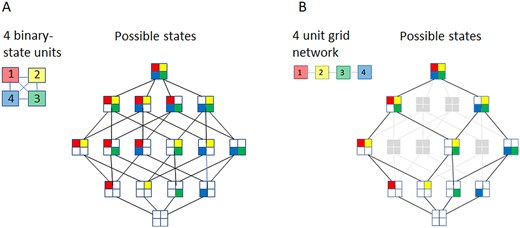
In IIT different phenomenological experiences must be represented by different physical states, and here the physical substrate is composed of four binary state units. (A) The four units are fully connected and could give rise to at most 16 possible experiences. (B) A grid network representing 1D space where only the nearest neighbours are connected to provide a phenomenally spatial character.

The unfolding argument (Doerig et al., 2019) challenges theories such as IIT and RPT, by claiming that any recurrent system can, in principle, be ‘unfolded’ into a feedforward system with the same input–output function. Because empirical observations are based on input–output behaviour, it is argued that causal structure cannot be uniquely established by empirical evidence and therefore such theories are “either false or outside the realm of science. Also, IIT risks over-attribution, counting many artificial systems such as random Boolean networks as conscious (Doerig, Schurger & Herzog, 2021; Doerig et al., 2019). In line with IIT, split-brain patients are thought to contain two conscious agents tied to each hemifield. Whether split-brain patients have one or two conscious experiences is, however, still debated. Callosotomy reduces functional integration, but some unity remains (De Haan et al., 2020). Pinto et al. (2016) showed that split brain patients behave as a single conscious agent. They just cannot integrate information across the visual hemifields, challenging theories predicting two conscious agents.
An empirical proxy to Φ uses TMS–EEG to measure cortical ‘echoes’ reflecting integrated information expressed in the transcranial EMF. TMS–EEG studies show that TMS evokes complex distributed cortical activity only in conscious subjects. However, EEG lacks the spatial resolution to test IIT’s micro-level claims, and the perturbation complexity index is not equivalent to Φ. The complexity of TMS echoes in conscious subjects is also compatible with models linking consciousness to an intact, broadcasting thalamocortical system (Sitt et al., 2013). IIT also predicts that connection strengths between nodes determine phenomenological distance: stronger connections yield greater perceived relatedness and reduced subjective distance. This prediction aligns with studies showing that adaptation can warp phenomenal space by altering neural connectivity (Fu et al., 2002; Hisakata et al., 2016; Song et al., 2017; Jovanovic et al., 2022). Still, it cannot be excluded that stronger neural connections may map onto smaller phenomenological distance by other non-IIT frameworks. Although particular predictions have been fulfilled (Yaron et al., 2022; IIT Wiki, 2024), IIT has been criticized since its core ideas may be beyond scientific reach (Fleming et al., 2023).
A different top-down proposal locates consciousness in the brain’s EMF (John, 2002; Pockett, 2012; Jones, 2013; Keppler, 2016; McFadden, 2020; Keppler & Shani, 2020; Hales & Ericsson, 2022; Ward & Guewara, 2022). The phenomenology of space and its content arises from the spatial organization of the endogenously generated EMF, which spatially integrates information from neural activities. The field’s continuity mirrors the seamlessness of perceived space, though the precise mapping between specific field configurations and specific qualia remains an open scientific challenge. EMF theory suggests why split-brain patients may still function as a single conscious agent despite losing cross-hemifield integration. Low-frequency EMF (alpha or theta) could provide a bridge across a callosotomy gap, whereas high-frequency gamma rhythms cannot bridge the gap. The gamma band is thought to support object integration and attention (Tallon-Baudry & Bertrand, 1999; Fries, 2009; Sauseng et al., 2005; Siegel, et al., 2012). Thus, a unified phenomenal space could be preserved while synchronization across hemispheres is disrupted.
Why functionalism and the neural doctrine fall short
Unity, intentionality, and understanding cannot be accounted for by any abstract computational system as claimed by computational theories (Rescorla, 2015), which gain meaning from a third-person perspective when tied to specific tasks (Jones & Hunt, 2023). Abstractions like ‘integrated information’, ‘symbols’, or ‘states’ are descriptions created by an already conscious observer, raising the symbol-grounding problem: how symbols acquire meaning (Harnad, 1990). IIT identify consciousness with causally integrated information (Φ), but this is a mathematical abstraction treated as ontologically real, which leads to an abstraction fallacy (Lerchner, 2026): mistaking a mathematical description for a physical instantiation. Just as a weather simulation does not produce actual rain, AI systems relying on symbol manipulation do not produce consciousness. Embodied cognition has been suggested as a way to deal with the symbol grounding problem by linking symbol manipulation to the environment through perception action cycles, but even if symbols are linked to the environment, they are still just symbols, still exposed to the symbol grounding problem. Given the symbol grounding problem and abstraction fallacy, computational systems such as AI manipulate states syntactically but do not feel or understand them. While EMF theories offer a potential solution to the symbol grounding problem by replacing abstract symbols with physically instantiated field dynamics, they still face the challenge of explaining how particular field patterns come to be about specific objects and other properties in the environment. A promising approach is to view grounding as emerging from the lawful coupling between field configurations, sensorimotor engagement, and the environment, rather than from the field structure alone.
Although debated, some authors have argued that conscious experience requires a spatially integrated physical substrate rather than merely temporally coordinated distributed processes (McFadden, 2020). Without consciousness, stimuli may still trigger functional behaviour, but there is no phenomenal ‘being towards’ an object; intentionality presupposes consciousness. A zombie agent could behave as if it had intentionality while lacking any experience. It would display ‘as-if’ directedness through symbolic pattern mapping, similar to reflexive behaviours, whereas options and consequences are evaluated or consciously simulated in a workspace in the middle of the perception–action cycle (Merker, 2005) (Fig. 3).
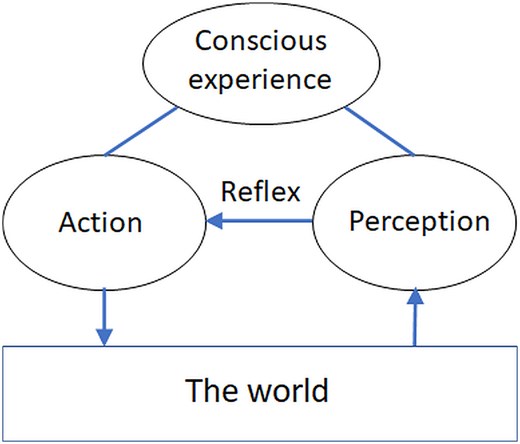
Conscious experience arises in the middle of the perception–action cycle, selectively modulating otherwise largely reflexive perceptual and motor processes.

The sequential causality and emergence problems
One might argue that consciousness is an emergent property of large-scale interactions among neural units, but whereas physical systems allow weak emergence, consciousness seems to require strong, ‘brute’ emergence where subjective experience arises from non-experiential components. Standard or ‘weak’ emergence allows such properties to be explained in terms of the physical characteristics of their constituents using statistical mechanics, as for example temperature, pressure, and entropy emerge from the properties of particles involved in mass behaviour. Consciousness, by contrast, appears to demand a mysterious ‘strong’ or ‘brute’ emergence. Although GWT and IIT have been proposed as solutions to this problem, no consensus has emerged since such attempts to reduce conscious experience to its neural substrate require strong emergence and give rise to the explanatory gap (Levine, 1983; Chalmers, 1995), leading some theorists to conclude that this gap remains unresolved (Keppler, 2016; Strawson, 2006).
Panpsychism, the view that consciousness permeates all constituents of matter although in a minuscule degree, does not solve the problem but instead encounters the combination problem: how do microphenomenal proto-consciousness combine to form macrophenomenal properties (James, 1890; Chalmers, 2016). Also, Schrödinger (1958) noted the impossibility of imagining how a unified conscious mind could emerge from combining conscious cells or their supposed resultants. In addition, consciousness is a property of organized systems, but in panpsychism a part of a system is being given a property that only the whole organized system can have.
The neural doctrine states that the nervous system is composed of discrete neurones that communicate across synapses (Fig. 4A). But how can a vast collection of simple neurones, none understanding the whole, instantiate conscious experience? This impossibility has been explored in science fiction and philosophical thought experiments. In Dnieprov’s novel ‘The Maxwell Equations’ (Dnieprov, 1961), a collection of psychiatric patients solves complex mathematical problems without knowing how or what the problem is. Each patient is trained to perform a simple operation, like adding two numbers, comparing symbols, or following a basic rule while not understanding the overall task. They are then arranged into a vast human ‘computing machine’, passing slips of paper between one another according to their assigned rules. Similarly, Block’s (1978) ‘China-brain’ scenario imagines a large collection of humans functioning as neurons in a nation-sized brain (Fig. 4B). Although such systems could replicate functional behaviour in terms of input–output relations, it has been argued that aggregations of units lack the holistic integration required for unified consciousness. Others, however, have suggested that sufficiently integrated systems may give rise to a novel emergent conscious subject at the level of the whole. But again, this requires strong emergence.
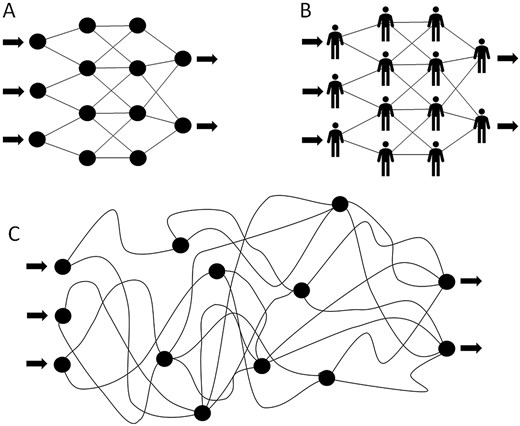
(A) A simple neural network that transforms inputs into outputs through weighted connections, (B) an equivalent network implemented by interactions among individuals following local rules, and (C) a network with preserved input–output processing but scrambled internal connectivity.

One might object that a network composed of individual agents in a nation-sized brain would be far too slow to support processes underlying conscious awareness. However, if we replicated the brain’s connectivity by linking neural units with optical fibres, the units could be distributed across a volume the size of Earth without introducing greater signalling delays than in the original network. Dividing Earth’s volume (≈1012 km3) by the number of neurons in the human brain (≈1011) yields ≈10 km3 per neuron, roughly a 2.2-km cube. Because light travels around the earth in 0.13 s, the propagation speed and spatiotemporal structure of neural signalling could, in principle, be preserved. Also, the spatial relative arrangement of the neurones could be scrambled while preserving their connections (Fig. 4C). Can such network, composed of widely separated and scrambled neurones, possess consciousness with an experience of unity? Replacing neural connections with optical or radio transmission would not alter the system’s functional operations, which are crucial according to the functionalist view. Yet no individual unit, following only local transmission rules, has access to the system-wide state, leaving classical brain models unable to explain the unified, first-person character of experience (McFadden, 2020; Bohm, 1990; Block, 1978). If the physical constituent parts of conscious structures are wholly non-experiential while consciousness is nonetheless real and physical, a fundamental explanatory element is missing to avoid a miraculous brute emergence, or we must accept dualism.
Lashley’s dilemma further points out that sequential synaptic processing is far too slow to account for the brain’s fast, coherent activity patterns. Sensory cortical activity appears in discrete ‘frames’ that shift rapidly and almost simultaneously across regions, showing minimal propagation delay, a dynamic that contradicts the step-by-step nature of classical synaptic transmission (Freeman & Vitiello, 2006). These dynamics resemble systems at criticality, where phase transitions between attractor states reflect the behaviour of large neuronal populations acting as a unified field (Freeman, 2007). These transitions generate amplitude modulated patterns within a few milliseconds, stabilize them for 80–120 msec, and repeat them at alpha–beta frequencies (3–12 Hz) (Freeman & Vitiello, 2006). This cast doubt on the neural doctrine and suggest a fundamentally different explanatory framework. The EMF provide a plausible physical mechanism for the global neural state transitions with negligible propagation delays, and phenomenal unity.
Electromagnetic field theories of consciousness
Gerard (1936) and Köhler and Held (1949) proposed that to explain unity and gestalt formation, brain activity involves fields that form a continuum in electrochemical brain-fields. These fields generated a topological psychophysical isomorphism between brain processes and experience, implicitly allowing the phenomenal field to influence neural dynamics (Lindahl & Århem, 2016). Many authors since then have argued that consciousness must be a field phenomenon rather than an emergent property of discrete causal interactions (Charman, 1997; Pockett, 1999, 2012, 2013; John, 2002; McFadden, 2002a,b; 2023a,b; 2025; Fingelkurts & Fingelkurts, 2002; Jones, 2013; Pockett, 2013; Keppler, 2016; Keppler & Shani, 2020; Hales & Ericson, 2022; Ward & Guevara, 2022; Jones & Hunt, 2023). Neural field theory provides a powerful framework for describing brain activity at the population level where cortical tissue is treated as a continuous medium by using differential equations and wave interference can represent and process information in a distributed way (Coombes, 2006; Effenberger et al., 2025). But this approach is based on mathematical formalisms and lacks a corresponding physical substrate capable of accounting for the fast state transitions and phenomenal character of conscious experience such as unity. The EMF provides this substrate. EMF-based theories of consciousness can be classified as soft dualism, where neural parallel processing proceeds without phenomenality, whereas the brain’s self-generated EMF forms a continuous physical substrate that accounts for both unity and the contents of phenomenal experience. Conscious experience is what the brain’s self-generated EMF feels like from within.
Cortical activity propagates as large-scale travelling waves captured more accurately by models grounded in cortical geometry and resonance than by connectivity (Pang et al., 2023). This suggests wave interference, which enables operations such as superposition, phase interactions, filtering, and pattern recognition, which are real computational primitives, not the symbolic stepwise processes used in digital computing. The neural processing in the brain handles fast, unconscious parallel processing, while consciousness could arise from the brain’s self-generated EMF that integrates information through wave interference and performs field-computation (MacLennan, 2004, 2017). Besides unity and its content EMF theories naturally account for the strong correlates between recurrent activities and synchrony, required to produce EMF waves as measured by EEG frequency bands, and conscious experience. Whereas the EMF performs spatial integration accessible for a first-person perspective, recurrent neural activity and synchrony are third-person neural observables. Critically, lots of recent evidence shows that the low-capacity EMF can nudge the high-capacity computational neural machinery.
Katz and Schmitt (1940) and Arvanitaki (1942) demonstrated EMF-based communication between adjacent neurons, a process Arvanitaki termed ephaptic coupling. Still, the field-based view was largely abandoned after experiments in which insulating mica plates were implanted on the cortical surface of animals, producing minimal behavioural effects (Lashley, 1950; Lashley et al., 1951; Sperry et al., 1955). This was taken to imply that the brain’s EMF was epiphenomenal, like the smoke from an engine. Yet these interventions disrupted only surface waves; deeper structures such as thalamic nuclei or the brainstem could still have been modulated by fields propagating inward towards the brainstem (MacIver, 2022). Moreover, normal behaviour can be supported by unconscious processing, as seen in visually guided action without awareness (Humphrey, 1974; Aleci & Dutto, 2024) and in blindsight, where individuals respond correctly to visual stimuli despite lacking conscious vision (Aleci & Dutto, 2024). The mica-plate studies therefore do not challenge EMF theories of consciousness, since they cannot reveal whether conscious experience itself was altered. Early critiques also argued that endogenous fields were too weak to drive global changes, but they are now known to influence spike timing and population activity (Radman et al., 2007; Reato et al., 2010). Neural activity can propagate through tissue even when synapses are blocked and can cross gaps up to 0.4 mm (Chiang et al., 2019; Qiu et al., 2015; Shivacharan et al., 2019; Zhang et al., 2014). Weak sinusoidal fields within physiological ranges enhance and synchronize neocortical activity (Fröhlich & McCormick, 2010), and ephaptic coupling helps sustain these rhythms (Ye & Steiger, 2015; Anastassiou et al., 2011). The EMF can cause neurons to synchronize their firing, producing coherent oscillations across the network even when neurons are not directly connected (Xu et al., 2018). Fast global state transitions, difficult to explain through synaptic spread alone, may arise from EMF-mediated coupling, a view supported by simulations showing that weak endogenous fields influence neural activity (Cunha et al., 2023). Large-scale oscillatory fields can modulate individual neurons and form feedback loops independent of synapses (Anastassiou & Koch, 2015; Ye & Steiger, 2015), potentially contributing to macroscopic EMF oscillations (Elul, 1971). Also, low-intensity transcranial magnetic stimulation can induce coordinated neural activity (Zmeykina et al., 2020).
Ephaptic interactions may underlie the rapid, nonlinear transitions between large-scale brain states characteristic of critical dynamics, transitions which classical synaptic mechanisms struggle to explain and that have been modelled within dissipative quantum field frameworks (Freeman, 2007; Freeman & Vitiello, 2006, 2007). Spike thresholds in awake animals fluctuate rapidly, deviating from Hodgkin–Huxley model (Hodgkin & Huxley, 1952) describing how neurons generate action potentials by integrating inputs and firing when a specific threshold is reached. This implies inputs beyond standard synaptic transmission (Naundorf et al., 2006), which has been interpreted as evidence for quantum coherence in microtubules (Hameroff & Penrose, 2014). But ephaptic coupling provides a more likely explanation (Cunha et al., 2023): Schrödinger-type equations can be used to describe the brain’s self-generated EMF to explain representations of quantum-like probabilities by complex amplitudes without any involvement of quantum mechanical processes (Khrennikov 2011). The EMF can also align microtubules (Kim et al., 2007) linking large-scale field dynamics to intracellular processes, and this cytoelectric coupling may tune cytoskeletal computation (Pinotsis et al., 2023).
Further evidence for the involvement of EMF in conscious experience and memory has been obtained by externally applied oscillating fields comparable in strength to the endogenously produced. Such fields can modulate cognition (Marshall et al., 2006), and antiphase 40 Hz stimulation can bias bistable perception when targeted to occipital cortex (Strüber et al., 2014), suggesting that periodic stimulation selectively enhances or suppresses neural processes (Fröhlich, 2014). Low-frequency EMFs can also induce visual and tactile sensations (Barnet & Posner, 1941) and modulate hippocampal oscillations involved in memory consolidation (Qiu et al., 2015; Chiang et al., 2019). EEG-signals provide more stable representations of short-term memory content than variable neural firing patterns, being more strongly correlated with what is remembered (Pinotsis & Miller, 2022; Pinotsis et al., 2023). The EMF can coordinate distributed regions involved in memory formation through ephaptic coupling, binding them into engram complexes.
Evidently, the view that the brain’s self-generated EMFs are bare epiphenomena are strongly questioned. Evolution may have exploited the capacity of the EMF to shape near-threshold cortical processing. This resonates with Hofstadter’s (2007) Gödelian strange loop, where the observer and the observed merge into a self-referential system. The CEMI-field theory interprets this intrinsic EMF-to-neuron feedback as the basis of our illusory sense of free will, with EMF modulation of neural activity via ephaptic coupling (McFadden, 2020) potentially forming a global workspace (Fig. 5). The EMF has been likened to the conductor of an orchestra, shaping the neural symphony (Pinotsis & Miller, 2023), or a neural Wi-Fi system (Durand, 2019; López Lloreda, 2023).
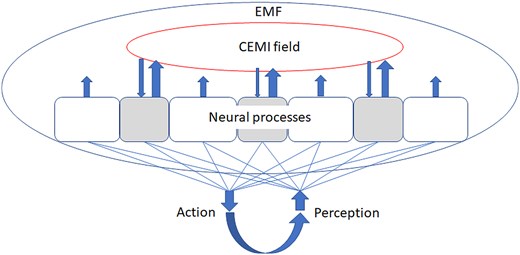
Neural recurrent activity within distributed processing modules generates local oscillatory electromagnetic field (EMF) patterns, while downward arrows indicate proposed ephaptic interactions between EMF states and neural activity; according to the CEMI field theory, these interactions contribute to the integration and broadcasting of information across modules through a field-based mechanism analogous to a global workspace.

Conscious timing and resolution
Although RPT and IIT link consciousness to recurrent activity that occurs around 100–150 ms after stimulus onset (Lamme, 2015), fully attended stimuli can remain unreportable for up to ~ 450 ms (Sergent, 2018), and postdictive effects show that awareness depends on later global integration. This onset of conscious experience aligns with the P300 ERP rather than the faster onset of recurrent activity (Sergent, 2018; Drissi Daoudi et al., 2019). This peak track conscious access more reliably than recurrent processing (Rutiku et al., 2015) (Fig. 6). Arguments that attended stimuli might be consciously experienced yet unreportable are inconsistent, implying simultaneous experience and denial of awareness (Michel & Doerig, 2021). Report is a valid indicator of awareness when attention is directed to the stimulus because attended content is cognitively accessible (Lamme, 2006; Ellia et al., 2021).
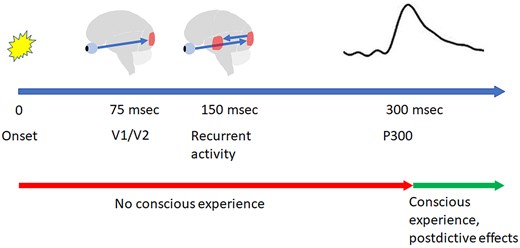
Recurrent activity is a neural correlate of conscious experience, but the onset of conscious experience is delayed relative to the recurrent activity and occurs at the onset of the P300 potential.

VanRullen and Koch (2003) argue that psychophysical evidence show that perception unfolds in frequency-specific epochs, like a camera shutter, with alpha rhythms providing global context or background and gamma rhythms encoding local content. Conscious perception depends on phase-locked neural activity capable of generating coherent EMF waves, and because coherence cannot exceed a single oscillatory cycle, the period T = 1/frequency sets an upper bound on the temporal integration window of a discrete ‘now’. Finite propagation speeds of cortical travelling waves likewise constrain spatial resolution, linking the spatial scale of a conscious moment to the oscillatory frequency sustaining it (Fries, 2005), much like imaging resolution depends on wavelength. In effect, consciousness inherits granular limits from the wavelengths of the underlying EMF rhythms. As noted above, long-wavelength EEG rhythms dominate low-resolution states such as sleep or relaxed wakefulness, whereas higher-frequency oscillations accompany attention, perceptual binding, and coherent object formation. When sensory input is weak, slow non-oscillatory travelling waves integrate information across space in the brain’s default mode (Sato et al., 2012), shaping phenomenal space in the absence of external stimuli.
The EMF within the brain
According to contemporary physics phenomena at biological scales, besides gravity, are EMF interactions. The EMF acts on charged particles through the Lorentz force F = q(E + v × B), where q is the electric charge, E is the electric field, v is the charge velocity, and B is the magnetic field vector. The apparent solidity of matter through our tactile sense is due to electrons repelling each other, and the visual perception of solid objects is mediated by EMF waves in the narrow frequency band classified as light, which spread when interacting with the EMF field of electrons to reach the photoreceptors in the eyes. The brain can likewise be conceptualized as an EMF system (Keppler, 2016), making it a plausible substrate for conscious experience (Hales & Ericson, 2022; Kitchener & Hales, 2022). Quantum electrodynamics further shows that electric and magnetic fields are aspects of a single EMF. The brain’s self-generated EMF is dominated by near-field components that store reactive energy and decay rapidly with distance. The far-field components that radiate energy cannot be generated by the brain because its neural currents oscillate at far too low frequencies.
Transmembrane electric fields drive ionic currents through voltage-gated channels. Dendrites integrate synaptic inputs along their length to produce small electric and magnetic fields; axonal fields are local and travel with the spike (Fig. 7A). Because the synaptic cleft interrupts direct electrical continuity, neurons regenerate signals chemically at each synapse. Nevertheless, extracellular electric fields can extend across the cleft and modulate postsynaptic excitability, providing a non-synaptic link between pre- and postsynaptic processes. Neural oscillations are generated by excitatory–inhibitory loops (Freeman, 1991), which produce corresponding EMF oscillations across micro-, meso-, and macro-scales, culminating in large-scale synchrony across aligned dipoles (Fig. 7B). Local field potentials (LFP) are the local, high-resolution version of the brain’s extracellular voltage fluctuations (0.1–300 Hz) whereas the EEG is the global fluctuations, recorded at the scalp of the field resulting from large scale spatial integration, but smoothed and attenuated by the skull (< 40 Hz due to low pass filtering through the skull). Thus, the EEG is essentially a large-scale spatially averaged low-frequency projection of many LFPs. Empirical evidence shows that the EEG dynamics correlate closely with phenomenal experience, with global amplitude modulations across frequency bands tracking shifts in conscious content (Fig. 7C).
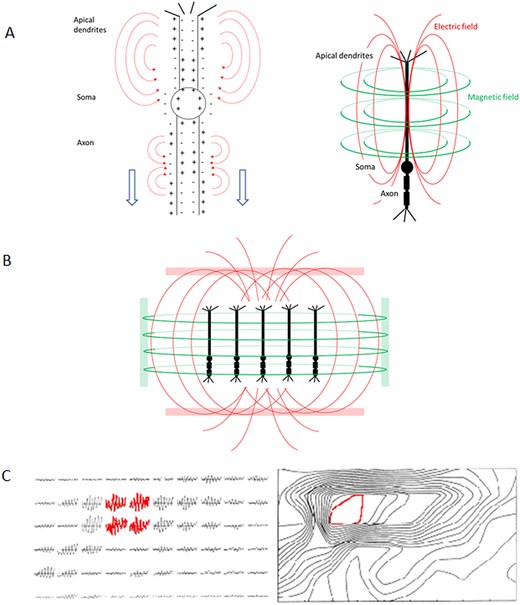
(A) Simplified view of dendritic and axonal potentials and their associated field lines, in which dendrites integrate synaptic inputs and axons generate action potentials once threshold is reached, with dendritic fields extending along the dendrite and axonal fields remaining local and propagating with the spike; (B) synchronized oscillatory firing in five pyramidal neurons whose fields combine through interference to produce maximal constructive summation along the principal electric and magnetic field axes, yielding signals detectable at the scalp; (C) common-frequency carrier wave recorded from 60 EEG electrodes over rabbit olfactory cortex during scent recognition, with scent identity represented in the spatial amplitude pattern of the shared frequency and visualized as a contour map. (C from Freeman 1991; available under the terms of a Creative Commons Attribution License, available at https://creativecommons.org/licenses/by/3.0/).

Synchronized neural firing, as modelled by the Kuramoto model of coupled oscillators (Strogatz, 2000; Schmidt et al., 2015), is not sufficient to generate waves in the EMF. Neurons must also be spatially aligned so that their coherent activity contributes constructively to the field rather than cancelling out (Godfrey-Smith, 2020). Further, large-scale brain dynamics arise primarily from the brain’s geometry and resonance properties rather than from detailed connectivity patterns (Pang et al., 2023). Also, due to the skull and brain anatomy, the EMF waves propagate more effectively inward through the conductive intracranial medium, converging near the thalamus and brainstem. Therefore, ephaptic coupling may be strongest at these loci (MacIver, 2022). This is consistent with thalamus (Fang et al., 2025) or brainstem-centered accounts of the neural correlate of conscious experience (Merker, 2005).
What property of the Brain’s EMF could mediate conscious experience?
The EMF is not naturally partitioned into discrete entities. Consequently, if consciousness is associated with the EMF, an additional account is needed to explain why individual conscious subjects can arise in continuous field systems. Because the brain’s EMF decays rapidly with distance and is further attenuated by the skull, it remains highly localized within the skull. Still, field strength decays continuously rather than terminating at strict boundaries. Subject individuation may consist of topological boundaries within field organization, or some threshold criteria such as coherent oscillations or integrated field information. This could preserve mental privacy (Jones, 2013), and resolve Rosenberg’s (1998) boundary problem (Gómez-Emilsson & Percy, 2023).
The EMF is characterized by its intensity, frequency, oscillation amplitude, and the relative phases of the oscillations, which could all be involved in mediating conscious experience. Accordingly, different versions of field theories have been formulated: attributing conscious experience to ‘integrated information’ in the field (McFadden, 2020; John, 2002; Hales & Ericsson, 2022; Ward & Guewara, 2022; Keppler & Shani, 2020), or ‘field patterns’ (Pockett, 2012) involving amplitude modulations of frequency-specific oscillations (Freeman 1991). Also, a field-‘panpsychism’ has been proposed where high-level consciousness softly emerges from the proto-consciousness inherent in the physical nature of the EMF in itself (Jones, 2013; Keppler, 2016).
Specific qualia may correspond to distinct spatial, topological, or temporal EMF patterns (Pockett, 2012; Gómez-Emilsson & Percy, 2023), and evidence suggests that recognition is encoded through amplitude modulations. Odorants evoke stable amplitude-modulated spatial patterns similar to topographic maps in the olfactory bulb, where each odour produces a distinct spatial pattern expressed as synchronized EEG waves on a shared carrier frequency (Freeman, 1991) (Fig. 7C). Parallel findings in humans show that experienced colour can be predicted from EEG activity (Hajonides et al., 2021), and that reddish hues elicit unusually large amplitudes of gamma-band oscillations in V1 (Shirhatti & Ray, 2018).
Contrary to the integrated information of interacting distinct units, integrated information within the EMF is intrinsically available in a first-person perspective (Barrett, 2014; McFadden, 2020; Ward & Guevara, 2022; Jones & Hunt, 2023). So, the EEG echoes from TMS perturbations, used as an indirect proxy for integrated information (Φ) and conscious states (Casali et al., 2013; Hagan et al., 2026) could directly target the physical substrate of conscious states. Also, EEG phase-space analyses show that wakefulness is characterized by high-dimensional chaotic dynamics, whereas anaesthesia collapses activity into low-dimensional ordered attractors, a contrast stronger than traditional spectral measures (Eagleman et al., 2019). Conscious individuals exhibit spherical attractors that explore a wider complexity landscape, whereas anaesthesia produces flattened attractors consistent with a collapse of information integration at loss of consciousness (MacIver, 2022). Conscious content, or qualia, may arise from rapid transitions between EEG attractor states in phase space (Freeman, 1991). In attentive but stimulus-free states, rabbits show chaotic EEG activity dominated by strange attractors, while familiar odours evoke rapid shifts to more ordered, low-dimensional attractors akin to limit cycles (Skarda & Freeman, 1987).
A form of EMF panpsychism has been proposed where conscious experience depends on a resonant coupling between brain activity and an all-pervasive background zero-point-field (Keppler, 2016; Keppler & Shani, 2020). Disrupting that coupling locally, for example in the somatosensory cortex representing a specific area on the body, should impair conscious perception of that area (Keppler, 2024). So, if the theory is correct, disrupting this resonance should prevent the formation of normal conscious perceptions even if ordinary neural processing remains largely intact. The zero-point fields have a lowest-energy state that still fluctuates with a zero-point energy, which is a feature of quantum mechanics applied to fields such as the EMF. It is proposed that this zero-point energy has a minuscule proto-experience which, in interaction with neural processes in the brain, results in a localized high-level conscious experience. This proposal escapes the problem of brute emergence and aligns with the view of Erwin Schrödinger (Schrödinger, 1958; Hoffman & Pretner, 2022). EMF panpsychism avoids the combination problem (James, 1890; Schrödinger, 1958; Chalmers, 2016): how distinct units with microphenomenal proto-consciousness combine to form macrophenomenal properties. Still, consciousness is a property of specifically organized systems, but the zero-point field does not possess any organization. Conscious content has a structure; it is about something, but the background field lacks such structure.
Our phenomenal field integrates multiple sensory modalities. Sound sources and visual imagery can be localized and formed behind the head (Attneave & Farrar, 1977), whereas high visual acuity is limited to a small foveal area within the visual field (Fig. 8A). The retinal receptor activity is a rapidly shifting pattern due to saccadic eye movements (Fig. 8B). To produce a stable phenomenal world, these motions have to be discounted (Zirnsak & Moore, 2014). The resulting stable phenomenal visual scene corresponds to a structured EMF that encodes objects, motions, colours, and depths within a unified space. Coherent global EMF oscillations at low frequencies may provide us with the phenomenal space, whereas local amplitude modulations in higher frequencies or attractors form patterns that result in the experience of the contents of the phenomenal space.
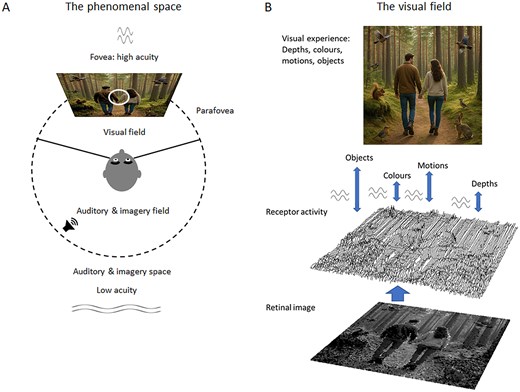
(A) The modality-invariant phenomenal space surrounds the perceiver in all directions and serves as a canvas on which auditory and visual information are represented, with the fovea positioned centrally; (B) the retinal image is processed through multiple specialized maps linked by recurrent interactions between spatial and feature-specific representations of object identity, colour, motion, and depth, with these structured neural activities corresponding to local high-frequency electromagnetic field (EMF) patterns that support conscious feature identification and are bound to specific locations within the phenomenal field through coherent low-frequency EMF activity.

By analogy, just as matter is conceptualized as localized vibrations in fields that extend the whole universe (Strassler, 2024), consciousness may arise from localized specific spatiotemporal EMF patterns. Speculatively, closed-loop field lines may stabilize EMF configurations, exchange information when they collapse, and generate vortical patterns (Irvine & Bouwmeester, 2008). EMF bursts can form long-lived topological structures which could encode stable qualia and the temporal moments of awareness and the roughly three-second psychological present (Arstila & Lloyd, 2014). An even more speculative proposal holds that the modification of Maxwell’s equations to extend in both space and time underlies our sense of time. Episodic memory may then involve re-experiencing past EMF configurations (Reggia, 2025). This aligns with the idea that the ‘flow of time’ is not a property of spacetime but a construct of consciousness.
Evolution and artificial creation of conscious experience
Brains have evolved electrochemical synaptic signalling that provides more complex neural oscillations than purely electrical gap-junctions (Block, 2025), and spatial arrangements that produce coherent EMF oscillations and interference patterns with rich spatial structure. This requires both coherent firing and spatial alignment of cells (Godfrey-Smith, 2020). Other spatial arrangements with identical connectivity would not produce the same EMF dynamics. Also, the cortical geometry results in resonance patterns of travelling brain waves that cannot be explained by the neural connectivity alone (Pang et al., 2023). This could imply that the anatomical geometry itself may contribute to the structure of conscious experience. Evolutionary pressure may thus drive both the neural architecture and spatial structure of the brain to produce EMF that support conscious experience.
Conscious experience is typically associated with the mammalian cortex. Its cortical lamination is an efficient generator of coherent EMF activity tightly associated with conscious experience. But corvids also show cortex-like signatures of consciousness despite lacking layered cortex (Nieder, 2021) suggesting convergent evolution that finds other architectures that can produce coherent EMF activities. Synchronized local field potentials have been observed in insects raising the possibility of rudimentary consciousness in small-brained species (Godfrey-Smith, 2020). EMF theories suggest that once ephaptic coupling appears, selection can optimize the behavioural advantages it confers, and there is evidence for its deep evolutionary roots. In fruit flies, taste-processing neurons modulate one another via ephaptic interactions, allowing sweetness to suppress bitterness (Lee et al., 2025), and the relevant fly channel (HCN) can be replaced by its human analogue (HCN2), implicated in pain perception and likewise dependent on ephaptic coupling (Ambron, 2024).
Evolutionary algorithms on field-programmable gate arrays (FPGAs) demonstrate evolution’s ability to exploit ephaptic interactions. It produced circuits that solved temporal-discrimination tasks through feedback loops using a subset of cells, including several physically disconnected yet functionally essential ones, implying reliance on EMF induction similar to ephaptic coupling (Thompson, 1996; Davidson, 1997; McFadden, 2020). Evolutionary pressures could similarly shape neural systems to harness the brain’s self-produced EMF. Field computations can be evolutionarily advantageous. A small set of field operations applied to the EMF can transform an input map into an output map (MacLennan, 2004). Field summation allows multiple simultaneous inputs to superpose, encoding both location and certainty through amplitude. Field-based computation together with ephaptic coupling offers a compact mathematical framework for neural information processing and for quantum-inspired cognition implemented within the brain’s self-generated EMF (Khrennikov, 2011). Such models account for quantum-interference-like effects in perception of ambiguous figures, violating the law of total probability, and order effects in perception (MacLennan, 2017; Pothos & Busemeyer, 2013; Conte et al., 2009; Tsuchiya et al., 2025). EMF-based computation may also help explain the brain’s energy efficiency: weak fields can bias neurons towards or away from firing, enabling large-scale coordination without costly spikes or long-range wiring (McFadden, 2025), analogous to a transistor using a small input to control a larger current.
Consciousness generates a suitable repertoire of phenomenal states that cannot be freely reassigned without disrupting adaptive behaviour: pain and pleasure cannot be swapped without catastrophic behavioural consequences (Cutter & Crummett, 2025). Evolution clearly tunes experiential states to guide actions that increase fitness, which refutes the epiphenomenalist view. This doesn’t imply that qualia serve perceptual realism (Hoffman et al., 2015). The repertoire of possible experiences corresponds to the distinctions a system can realize. This grows exponentially with the number of interconnected units yet remains bounded by the physical substrate (Albantakis et al., 2023). Even a creature with only two internal states could use them for survival. But turning those states into experiences like pleasure and pain requires a physical substrate capable of generating such phenomenal experiences; however, this relates to the hard problem of consciousness: why certain processes lead to the experience of pain whereas other processes lead to the experience of pleasure.
Conclusion: reframing the physical basis of experience
Whereas neural recurrence and synchrony are recognized as central correlates of conscious experience (Lamme, 2006), they fail to account for phenomenal experiences and are accessible only from a third-person perspective since they rely on sequential causal integration among discrete units. The unity of conscious experience requires spatial integration to provide a from-within perspective, to afford that there is something it is like to have a conscious experience (Nagel, 1974). EMF theories naturally satisfy this requirement: fields integrate information spatially and influence neural activity, enabling conscious contents to become reportable and support efficient behaviour. Conceptually, EMF theories amount to a form of soft dualism between matter and field: neural activity remains the primary engine of perception and action, operating in a phenomenal void. Phenomenal experience arises when this activity generates an appropriate EMF that feeds back into the neural activity through ephaptic coupling.
Properties of EEG, although severely attenuated by the skull, are the most reliable markers of conscious states and contents. Whereas unconscious states are characterized by low-frequency dominance, alpha rhythms accompany conscious states without sensory information. Localized high frequency gamma oscillations track object perception and fine-grained detail (Fries, 2009; Siegel et al., 2012). Attractor dynamics (Eagleman et al., 2019), and perturbational complexity (Casali et al., 2013; Hagan et al., 2026) are also robust indices of consciousness. These EEG markers are thought to reflect the underlying neural activities supporting conscious experience, but EMF theories claim that the field itself is the physical substrate. Moreover, EEG patterns provide more stable representations of short-term memory content than the variable neural firing (Pinotsis & Miller, 2022; Pinotsis et al., 2023), and the onset of conscious perception aligns better with the later P300 ERP than recurrent activity (Sergent, 2018; Drissi Daoudi et al., 2019). It is hypothesized that global and slow alpha rhythms provide us with the phenomenal empty space, and the faster rhythms the sensory modalities such as vision, sound sources, and imagery.
Early field-based proposals (Gerard, 1936; Köhler & Held, 1949) and evidence for axonal field effects and ephaptic coupling (Katz & Schmitt, 1940; Arvanitaki, 1942) were largely dismissed after cortical mica-plate implants produced minimal behavioural change (Lashley, 1950; Lashley et al., 1951; Sperry et al., 1955). Subsequent work, however, demonstrated EMF-driven modulation of excitability and synchrony, synapse-independent propagation, field entrainment of cortical rhythms (Anastassiou et al., 2011; Radman et al., 2007; Bikson et al., 2004; Chiang et al., 2019; Qiu et al., 2015; Fröhlich & McCormick, 2010; Cunha et al., 2023), that weak TMS coordinate population activity (Zmeykina et al., 2020), and externally applied oscillating fields can evoke and bias perception and alter hippocampal oscillations (Barnet & Posner, 1941; Marshall et al., 2006; Strüber et al., 2014; Qiu et al., 2015; Chiang et al., 2019). The phases of slow wave EMF oscillations modulate neural thresholds (de Vries et al., 2021; Bagherzadeh et al., 2020; Mathewson et al., 2011; Baldauf & Desimone, 2014; Tallon-Baudry & Bertrand, 1999; Samaha et al., 2020; Foster et al., 2016; Sauseng et al., 2005; Thut et al., 2006; Rihs et al., 2007) and perceptual detectability (Gallotto et al., 2017). Also, slow travelling waves integrate spatial information under weak input (Sato et al., 2012). Thus, evidence hints that the endogenous EMF acts as a global representational substrate (Pinotsis & Miller, 2022; Pinotsis et al., 2023) likened to ‘neural Wi-Fi’ (Durand, 2019; López Lloreda, 2023). Further, ephaptic coupling challenges synaptic sequence models and may underlie the rapid, coherent transitions between cortical ‘frames’ (Freeman, 2007; Freeman & Vitiello, 2006), and the fast fluctuations in neuronal thresholds (Naundorf et al., 2006), and may contribute to our sense of having free will (McFadden, 2020) and intentionality.
While criteria-based approaches have been subject to criticism (Percy, 2025), the proposal that conscious experience is grounded in the brain’s self-generated EMF appears to meet several of the theoretical criteria discussed by Doerig et al. (2021) and McFadden (2023a). EMF theory aligns with IIT and global workspace models, yet draws a sharper line between conscious and nonconscious systems (McFadden, 2023b). The brain’s self-generated EMF functions analogously to a global workspace: it reflects which neural processes gain conscious access and feeds back onto those processes via ephaptic coupling to influence behaviour (Fig. 5). Since the brain’s self-generated EMF mimics the information structure of the neural interactions, it carries integrated information comparable to that required for conscious experience as proposed by IIT. Only artificial structures or brain architectures that are capable of sustaining coherent oscillations and producing EMF patterns through constructive interference, or integrated information, and feedback to the network activity produce conscious experience. Alternative architectures with similar causal structure producing only deconstructive EMF interference do not result in conscious experience.
Although EMF theories provide a potentially unifying physical framework for consciousness, several challenges remain. More generally, the limited specification of the field properties and mechanisms responsible for conscious experience restricts the empirical testability of current EMF theories. These issues identify important areas for future theoretical development and empirical investigation. Besides being testable, a scientific theory of consciousness must be consistent with established physical principles. Given that physical interactions at biological scales are overwhelmingly electromagnetic, and that the brain itself can be understood as an EMF system, it is reasonable to assume that conscious experience arises from the properties of the EMF dynamics (Keppler, 2016). Recent work frame EMF theories as a promising but still developing research program, yet facing conceptual and methodological challenges (Hunt et al., 2024). More explicit, testable formulations are emerging, though current support derives largely from the natural fit between EMF properties and phenomenal unity, alongside existing correlates. The deep interdependence between neural activity and the surrounding EMF makes it difficult to distinguish their respective causal roles. Nonetheless, mechanisms like rapid wave-interference and large-scale state transitions mediated by ephaptic coupling are unique characteristics of the EMF. However, most EMF-oriented theories do not yet specify conscious field configurations, hindering the formulation of testable predictions. Demonstrating that the EMF is the physical substrate of conscious experience requires experimental designs that selectively manipulate the brain’s self-generated fields, via constructive or destructive interference, without directly altering neural firing. Tonic or phasic field-perturbation experiments in patients with implanted intracerebral electrodes offer one avenue (Roy, 2002). Perturbing the EMF to disrupt the field configurations required for conscious awareness, such as their geometry or coherence (e.g. via TMS or tACS), while leaving neural activity intact, should alter conscious level or content (Pockett, 2012).
Because neural activity and endogenous EM fields are tightly coupled, selectively manipulating one without affecting the other may be difficult. Nevertheless, EMF-based theories predict that local disruption of the brain’s EM field, for example through externally induced interference, should produce corresponding local deficits in conscious experience. For example, disrupting the EMF within the somatosensory cortex representing a specific body region should selectively impair conscious perception of that region while leaving conventional neural processing largely intact (Keppler, 2024). Classical EMF theory attempts to explain unity and feedback to neural activity through classical electromagnetic mechanisms, but it remains agnostic as to whether a purely Maxwellian description is sufficient (Percy & Agarwal, 2026) or if quantum processes such as coupling to the zero-point field (Keppler, 2024) is required. Other controversial proposals include microtubular quantum states (Hameroff & Penrose, 2014; Wiest, 2025).
The neural doctrine, which holds that unity and content arise solely from interactions among discrete neural units, conflicts with the fact that global properties of such systems are accessible only to an external observer, not to the system from within. Schrödinger argued that a unified mind cannot arise from the mere aggregation of conscious cells or their putative outputs (Schrödinger, 1958). Without proto-conscious components, the neural doctrine must instead assume a brute, unexplained emergence, or we have to accept dualism. Classical thought experiments (Block, 1978) expose central caveats of the neural doctrine: it cannot explain phenomenal unity since information is integrated by temporal causal influences, not spatially (McFadden, 2020). By contrast, the brain’s self-generated EMF provides a spatially integrated physical medium that naturally accounts for phenomenal space and supports a wide range of field configurations corresponding to the contents of experience. Throughout history thought experiments have played an important role in physics. Examples are Galileo’s falling bodies, Schrödinger’s cat, and the Einstein–Podolsky–Rosen paradox, which ultimately inspired empirical breakthroughs.
Can EMF theory solve the hard problem: why do certain physical states feel like something from a within perspective? This is a challenge akin to asking what space, matter, time, or the EMF are in themselves. These ontological issues lack satisfying answers, yet this does not prevent us from precisely characterizing entities such as fields and their influences across apparently empty space. Our lack of intuitive understanding of why consciousness arises from a physical substrate such as the EMF mirrors our lack of intuitive understanding of what the EMF is. So, ambitions to solve the hard problem may be unrealistically high. A more empirically tractable scientific project mirrors the aims of other natural sciences: to characterize, predict, and ultimately control the relationship between physical processes and their observable objective or subjective effects. In consciousness research, this corresponds to what Seth (2021) calls the ‘real problem’: moving beyond correlates defined by function or behaviour without drifting into metaphysics. Progress can be made by mapping phenomenological properties onto specific neural and EMF mechanisms without first explaining why consciousness exists at all. As Rosenberg (1998), following Russel (1927), notes: physical theories describe only the structural and relational properties of matter, not its intrinsic nature. Likewise, Maxwell’s equations specify the behaviour of the EMF without telling us what the field is, which parallels the question raised by the hard problem. Just as elementary particles are described as excitations of underlying fields that span the whole universe, consciousness may arise from fluctuations in the brain’s EMF, with complex field topologies or amplitude-modulated patterns encoding the contents of experience.
To conclude, top-down theory building begins with established phenomena and works backward to the principles required to explain them, much as Darwin inferred natural selection from evolutionary patterns or as recent proposals treat cosmic fine-tuning as the outcome of an evolutionary-like process (Hertog, 2023). In this spirit, the proposal advanced here is that the properties of conscious experience arise from a sufficiently complex, self-sustaining EMF that both depends on and modulates the neural processes generating it. This bidirectional coupling constitutes a form of soft dualism and offers a mechanistic route to phenomenal unity that is difficult to achieve in neural-only accounts, where large-scale coherence is visible only from a third-person perspective and unfolds in phenomenal absence. The brain’s endogenously produced EMF provides a plausible physical substrate for binding distributed neural activity into a unified experiential whole. On this view, conscious experience is how this field is felt from the inside. How the universe, life, and the capacity for self-reflective experience emerged from inanimate matter remains a profound open question, but EMF theory outlines one principled way in which unified experience may arise within evolved neural architectures.
Acknowledgements
Study funding: There are no funders to report for this submission.
Author contributions
Leo Poom (Conceptualization [equal], Writing—original draft [equal]).
Conflict of interest
None declared.
Funding
None declared.