Abstract
The density wave theory for the grand-design two-armed spiral pattern in galaxies is successful in explaining several observed features. However, the long-term persistence of this spiral structure is a serious problem since the group transport would destroy it within about a billion years as shown in a classic paper by Toomre. In this paper, we include the low-velocity dispersion component, namely gas, on an equal footing with stars in the formulation of the density wave theory, and obtain the dispersion relation for this coupled system. We show that the inclusion of gas makes the group transport slower by a factor of few, thus allowing the pattern to persist longer – for several billion years. Though still less than the Hubble time, this helps in making the spiral structure more long-lived. Further we show that addition of gas is essential to get a stable wave for the observed pattern speed for the Galaxy, which otherwise is not possible for a one-component stellar disc.
1 INTRODUCTION
The grand two-armed spiral pattern as seen in galaxies such as M81 or M51 makes a striking visual impression. Although these spiral patterns have been studied for over five decades, their origin and persistence are still not fully understood.
It was realized early on that a material spiral feature would get wound up in a few rotation periods, due to the differential rotation in a galactic disc. Since spiral features are commonly seen, it was proposed by several authors starting from B. Lindblad, and others including Lin & Shu (1964, 1966), that at least the grand spiral patterns seen in spiral galaxies are density waves governed mainly by gravity. In this theory, the spiral pattern is claimed to be stationary which gets around the winding problem. Thus, the spiral pattern is claimed to last for times much longer than rotational time-scales. Further, Lin, Yuan & Shu (1969) successfully interpreted some of the observable features of spiral galaxies by this theory. For a good exposition of the density wave theory, see Rohlfs (1977).
However, several questions have been raised about the validity of this theory, such as whether or not these density waves are truly stationary (Toomre 1969), and whether galaxies indeed admit spiral waves as self-consistent modes of oscillation (Lynden-Bell & Ostriker 1967), see Pasha (2004) for a review of this topic. Over the years, many additional aspects have been studied that underline the complexity of the spiral structure, see e.g. the reviews by Toomre (1977), Sellwood (2013), and Dobbs & Baba (2014). Bars have been suggested as a possible mechanisms responsible for the origin of density wave (Sempere & Rozas 1997; Athanassoula 2012). Numerical simulations (Sanders & Huntley 1976; Combes & Gerin 1985) have shown how even a weak barred potential can trigger a spiral perturbation in the gaseous component. A tidal encounter generally leads to a global m = 2 spiral pattern (Zaritsky, Rix & Rieke 1993; Struck, Dobbs & Hwang 2011; Dobbs & Baba 2014). Many galaxies also show flocculent spiral arms which can be explained as being transient, material spiral features that arise due to swing amplification of non-axisymmetric perturbations, as originally proposed by Goldreich & Lynden-Bell (1965), also see Toomre (1981). In many cases, both density waves as well as transient, material spiral arms can co-exist which makes the analysis and application to a particular galaxy more complicated. A galaxy may show more than one pattern speed for m = 2 (e.g. Gerhard 2011). Thus, the subject of density wave theory as applied to galaxies is complex.
In this paper, we will focus on one specific issue, namely the effect of gas on the existence and the group transport of spiral density waves. In a classic paper, Toomre (1969) showed that any packet of such waves moves radially, and towards increasingly shorter wavelengths, with a group velocity that is sufficient to destroy the wave packet itself within a few galactic revolutions. This was a major setback to the persistence of ‘stationary’ density waves as proposed by Lin & Shu (1966). Since it is known observationally that regular, grand spiral features are common, Toomre argued that the presence of a mechanism to regenerate those grand features is required, such as due to tidal forcing, for the density wave picture to be saved. Meinel & Ruediger (1987) addressed the question of persistence of the grand spiral structure by means of a wave packet with vanishing group velocity.
A typical spiral also contains a low-velocity dispersion component, namely gas, in addition to stars. For a more realistic and complete treatment of galactic dynamics, the dynamical effect of gas needs to be taken into account. The addition of gas is shown to make the disc significantly more unstable as shown for local, axisymmetric perturbations (Jog & Solomon 1984a,b; Bertin & Romeo 1988; Jog 1996). In the non-axisymmetric case, gas has a strong effect on the resulting swing amplification (Jog 1992), and it is shown to result in broader arms as observed (Schweizer 1976).
The gas fraction by mass is measured to vary from ∼4 per cent for Sa-type galaxies to ∼25 per cent for Scd-type galaxies (Young & Scoville 1991; Binney & Merrifield 1998). A study using the deep Spitzer survey data (Elmegreen et al. 2011) revealed the trend that early-type galaxies tend to have multiple arms and grand design spiral pattern, while the late-type galaxies show mainly flocculent spiral features. Thus gas fraction may be correlated to the type of spiral structure. Though the response of gas component to spiral density wave has been studied theoretically (e.g. Roberts 1969) as well as observationally for galaxies like M51 (Rand 1993), the role of gas in the frame work of density wave theory has so far not drawn the attention it deserves.
In this paper, we consider gas along with stars in the formulation of the density wave theory, and obtain the dispersion relation for this coupled system. Although the response of interstellar gas to the stellar density wave has been well studied, the role of gas in the group transport has not been considered so far. We find that the addition of gas lowers the group velocity thus allowing the grand design spiral pattern to persist longer. Further, we show that addition of gas permits waves to be real for the observed pattern speed, which otherwise cannot be realized for a one-component stellar disc. Thus, the dynamical effect of gas helps spiral arms to exist and persist longer.
Section 2 contains the details of the formulation of the problem, Section 3 presents the results. Sections 4 and 5 contain the discussion and conclusion, respectively.
2 FORMULATION OF THE PROBLEM
2.1 Dispersion relation for a two-component disc
Here, we treat a galactic disc as a gravitationally coupled two-component (stars plus gas) system, where the stars are taken to be collisionless and characterized by a surface density(Σ0s) and a one-dimensional velocity dispersion, σs, and gas as a fluid characterized by surface density Σ0g and a one-dimensional velocity dispersion or the sound speed, σg. For simplicity of calculation, the galactic disc is assumed to be infinitesimally thin and pressure acts only in the disc plane i.e. in this paper we are interested in gravitational instabilities in the disc plane only. We use cylindrical co-ordinates (R, ϕ, z).
We derive the dispersion relation for such a joint system in the Wentzel – Kramers – Brillouin limit or the tightly wound case, following the procedure as in Binney & Tremaine (1987, hereafter BT87). The small density perturbations are taken to be of type exp [i(ωt − mϕ + kR)] where ω is the frequency, and k is the wavenumber. This simple modal approach assumes a constant pattern speed Ωp = ω/m. However, in a realistic case, the quantities ω and k could vary gradually with radial location and time, as centred around a mode (as in Toomre 1969). Here, the same dispersion relation as obtained for the modes is taken to be valid to describe the behaviour of these general disturbances that can be used to study wave packets with gradually varying properties (e.g. Whitham 1960; Lighthill 1965).
Rafikov (2001) had obtained the dispersion relation for a system comprised of n distinct collisionless systems along with gas for the axisymmetric case (m = 0, see equation 22 in that paper). Thus, the dispersion relation for our case is given as a special case corresponding to n = 1.
2.2 Group velocity for a two-component disc

3 RESULTS
We next investigate how the addition of gas affects the group velocity and hence the radial group transport of a wave packet. Driven by purely theoretical interest, here we carried out the analysis at a fixed radius in the disc varying the gas surface density from 5 to 20 per cent of the stellar surface density. For a real galaxy, at a particular radius one would expect to get a unique ratio of gas to stellar surface density, nevertheless our approach would throw some light on what is likely to happen at those radii for which the observed gas fraction matches with the values considered here in the analysis. We will compare our results with those of Toomre (1969), the latter obtained for the stars-alone case, with Qs = 1. For a two-component case, when Qs = 1, the system will become unstable (Jog & Solomon 1984a), and the group velocity concept is not applicable in that case. Hence, we consider a slightly higher Qs = 1.3 since that leaves the two-component system stable even for higher gas fraction of 20 per cent (Jog 1996). For given Qs and ϵ values, and assuming a certain value for the ratio of dispersions σs to σg (taken to be = 3.5 as observed in the solar neighbourhood; see Narayan & Jog 2002), one can obtain Qg = (0.306Qs)(1 − ϵ)/ϵ. Using these as input parameters, the values of s versus x can be obtained for different gas fraction values.
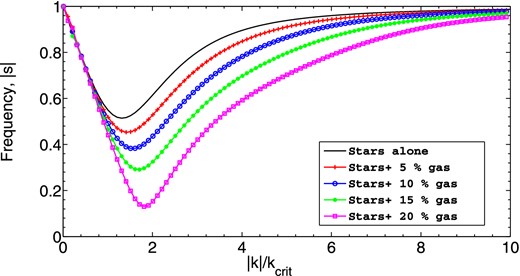
In Fig. 1, we plot the dispersion relation in its dimensionless form for different gas fractions (equation 7), including for the stars-alone case (equation 9). Two points are clear from this figure. First, as more gas is added, the plot for dispersion relation progressively occupies more of the forbidden region between corotation (s = 0) and inner Lindblad resonance (ILR, s = −1), implying that the system becomes more and more prone to being unstable, along the same line as seen for the axisymmetric case (Jog & Solomon 1984a). Secondly, a careful inspection also reveals that in the relatively short branch (high wavenumbers) of the dispersion relation, the plots become moderately flatter as more gas is added to the system.
While the first feature is somewhat expected and relatively well understood, the second point is particularly interesting. As the group velocity is directly related to the slope of these curves (see Section 2), these curves give a clear hint that when gas is included, the radial group velocity of a wave packet whose central wavenumber falls in the region, is likely to decrease, though moderately.
To investigate this issue further, we estimated the value of group velocity at R = 8 kpc for different gas fractions. The values of κ and Ω are calculated from a flat rotation curve with a constant radial velocity of 220 km s−1 at R = 8 kpc near the solar neighbourhood in the Galaxy, obtained from the standard mass model by Mera, Chabrier & Schaeffer (1998). These are: κ = 38.9 km s−1 kpc−1, and Ω = 27.5 km s−1 kpc−1. The pattern speed Ωp for m = 2 is taken to be 12.5 km s−1 kpc−1 as in Toomre (1969), so as to ensure that any variation in results is due to the inclusion of gas. The value of the slope is obtained graphically from the curve of s versus x (Fig. 1) and is calculated at a point x where the line s = constant (for a particular pattern speed) intersects the curve. The value of x corresponding to the higher x or k value is chosen rather than the lower x value since the tight-winding approximation is better satisfied at the shorter wave branch. This gives the value of the group velocity (equation 11), see Table 1 for the results.
Group velocity for various gas fraction values.
| Σ0g/Σ0s | Slope | Group velocity | Time to travel |
|---|---|---|---|
| (km s−1) | 10 kpc (Gyr) | ||
| 0.0 | 0.14 | 8.0 | 1.2 |
| 0.05 | 0.11 | 6.0 | 1.6 |
| 0.10 | 0.10 | 5.5 | 1.7 |
| 0.15 | 0.08 | 4.4 | 2.2 |
| 0.20 | 0.07 | 4.0 | 2.4 |
| Σ0g/Σ0s | Slope | Group velocity | Time to travel |
|---|---|---|---|
| (km s−1) | 10 kpc (Gyr) | ||
| 0.0 | 0.14 | 8.0 | 1.2 |
| 0.05 | 0.11 | 6.0 | 1.6 |
| 0.10 | 0.10 | 5.5 | 1.7 |
| 0.15 | 0.08 | 4.4 | 2.2 |
| 0.20 | 0.07 | 4.0 | 2.4 |
As the gas fraction increases from 0 to 20 per cent, the group velocity is reduced by a factor of 2. Consequently, the time taken by a wave packet to travel a distance of 10 kpc is about two times longer. Even these rough estimates tell us that the addition of gas helps the density pattern to persist for a relatively longer time-scale. This is the main finding of this work. We stress that the quantitative result is not robust as it depends on the slope of the curve measured graphically. For example, for a slightly higher pattern speed of 14 km s−1 kpc−1, the group velocity has a range of 11–4.4 km s−1 as the gas fraction is increased from 0 to 20 per cent, hence the time taken for a wavepacket to travel the same distance of 10 kpc increases almost by a factor of 3. Thus, the results in Table 1 give a typical sense of increase in the lifetime of a spiral pattern on including gas in the picture.
The modern observations of the pattern speed for the Milky Way show higher values, that lie in a range between 17 and 28 km s−1 kpc−1 (e.g. Gerhard 2011; Siebert et al. 2012; Junqueira et al. 2015), with a typical value of Ωp = 18 km s−1 kpc−1. For most of this range of values for Ωp, the value of s in the middle range of the Galaxy is <0.5. For this value of s, the dispersion relation (equation 9) does not admit a real solution for Qs = 1.3. Instead its solution has an imaginary wavenumber, and hence it decays exponentially with radius on scales of ∼ a few λcrit(BT 87, Chapter 6.2). For the solar neighbourhood, with (Σ0s + Σ0g) = 52 M⊙ pc−2 (Narayan & Jog 2002), the value of λcrit is ∼ 6 kpc. This aspect does not seem to be recognized or at least mentioned in the papers which give the observational determination of the pattern speed. Thus, a one-component stellar disc is not adequate to describe the observed pattern, and therefore taking account of gas is essential in order for the density waves to be stable as shown next.
For the recent observed value of the pattern speed of 18 km s−1 kpc−1, the value of the frequency is obtained as s = 0.5. For this value of s, the wavenumber for the s versus x curve for the stars-alone case would be imaginary (see Fig. 1). Note, however, that in contrast, for gas fractions of 10–15 per cent, the curve s versus x does have real solutions for the wavenumber and the slope at these wavenumbers remains nearly constant ∼0.2. The corresponding group velocity is 11 km s−1, comparable to but higher than the values in Table 1. Thus, the time to travel 10 kpc is ∼109 yr. Thus, interestingly, we find that for the observed pattern speed in the Galaxy, the waves for stars-alone case have an imaginary wavenumber, hence are evanescent. For a stable wave solution one needs to take account of gas. Moreover, addition of gas allows somewhat higher pattern speeds which are consistent with observations, to be valid in a galaxy. Since the pattern speed decides the location of resonance points, the inclusion of gas thus allows the corotation to be shifted to an inner radius.
4 DISCUSSION
4.1 Stars: collosionless versus fluid approach
In this paper, we have treated stars as a collisionless system involving no pressure term, as required for a correct treatment of the group velocity. There are some problems in dynamics where the result does not depend critically on whether a fluid or a collisionless representation is used for stars. For example, in the local stability analysis of axisymmetric perturbations in a galactic disc leading to the Toomre Q criterion, results obtained from both approaches match quite satisfactorily. The Toomre Q factors (Toomre 1964) for stars and gas differ by only 7 per cent, with a factor 3.36 replacing π in the denominator for a collisionless case (e.g. BT 87).
However, it is known that the two approaches differ substantially with the system being more bouncy at high wavenumbers in the fluid case as can be seen by the plot of the dispersion relation in the two cases (e.g. fig. 6.14, BT 87; also see Rafikov 2001). We plot the dispersion relation with 15 per cent gas for two cases: first stars as a collisionless system (equation 8 above; and then treating stars as a fluid with the dispersion relation as in Jog & Solomon 1984a), see Fig. 2.
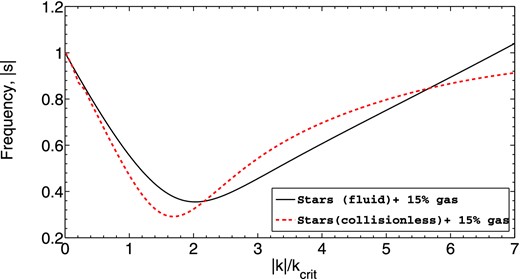

From Fig. 2, it is evident that for the case where the stars are treated as a fluid, the curve for the dispersion relation is steeper than the case where stars are treated as collisionless system and the s values exceed 1 beyond x = 7. In contrast, in the collisonless treatment, the s values are always less than 1 and saturate to 1 at x ≫ 7. Since the technique adopted here to calculate group velocity is strongly dependent on slope of these curves, consequently these two different approaches, using the same gas fraction, are bound to give different estimates for the group velocity.
4.2 Other issues
We would like to caution that, from our result it may appear that with the inclusion of gas by more than 20 per cent or so which is the extreme case considered for this work, may still improve the persistence of the spiral features. But in a real gas-rich galaxy, other processes like swing amplification generating local flocculent spiral features do take place simultaneously. In particular, for gas-rich galaxies it is probably the swing amplification which supersede the grand spiral structure, as evident from the abundance of more flocculent spiral features found in gas-rich Sc-type galaxies.
Another point to note is that the analysis presented here is based on a linear perturbation theory so that the non-linear effects have been neglected. But these non-linear effects could have far-reaching consequences. A recent study using high- resolution N-body simulations (D'Onghia, Mark & Hernquist 2013) showed that the non-linear effects can significantly modify the process of origin and persistence of flocculent spiral features, produced through swing amplification. So, it is worth checking the significance of non-linearity in the frame work of density wave theory with gas treated on equal footing with stars.
5 CONCLUSION
In summary, we have studied the effect of gas by treating a galactic disc as a two-component gravitationally coupled stars plus gas system in the framework of density wave theory. The resulting frequency versus wavenumber curve is flatter which leads to a lower group velocity. The idea of group velocity as an indicator of transport of information is routinely studied in other branches of physics, such as quantum mechanics, however its usefulness is underutilized in astrophysics. In the case of galactic discs, this idea was applied by Toomre (1969) to show that the density waves cannot last for more than ∼109 yr. We have shown that taking account of gas lowers the group velocity by a factor of few, which allows the density waves to last longer, to about few 109 yr. This helps persistence of the spiral structure for a longer time-scale in a gas-rich galaxy, irrespective of the mechanism, such as tidal interaction, that gives rise to the grand two-armed spiral structure.
The second important result from this work is that for the observed pattern speed of ∼18 km s−1 kpc−1 for the Galaxy (Siebert et al. 2012), the solution gives an evanescent wave (i.e. a wave with an imaginary wavenumber) for a one-component stellar disc, hence the wave would disperse radially. We show that it is the inclusion of gas that makes it possible to have a stable wave for the measured pattern speed. The addition of gas thus allows somewhat higher pattern speeds to be valid in a galaxy which otherwise cannot be realized for a one-component stellar disc. Since the pattern speed decides the location of resonance points, the addition of gas thus allows the corotation to be shifted to an inner radius. This could have implications for the angular transport properties due to the spiral pattern.
CJJ thanks DST, Government of India for support through a J.C. Bose Fellowship.
REFERENCES
APPENDIX A: CALCULATION OF THE REDUCTION FACTOR
In some special cases, for example while studying the m = 1 slow modes in Keplerian discs, Tremaine(2001) showed that the reduction factor in the dispersion relation simplifies to one containing only the first term of the infinite sum, hence becomes an explicit relation in s and x(= k/kcrit)(see equation 12 there). But we caution that, in general, such a simplification is not always valid and one has to incorporate more terms of the series to get the actual solution.
Here we illustrate how incorporating further terms of the infinite sum will affect the dispersion relation for a collisionless stellar disc for Q = 1.3.
From Fig. A1, it is seen that with the inclusion of subsequent terms, the solution changes significantly. Allowing more terms of that infinite sum into the solution makes the forbidden region between corotation(s = 0) and ILR (s = −1) reduce up to a certain limit, after that the effect gets saturated. This happens for n = 4. Hence in our calculation (Section 2), we include terms up to n = 4 in the reduction factor F as suggested by this figure. The result shown in Fig. A1 agrees with that in Toomre (1969).
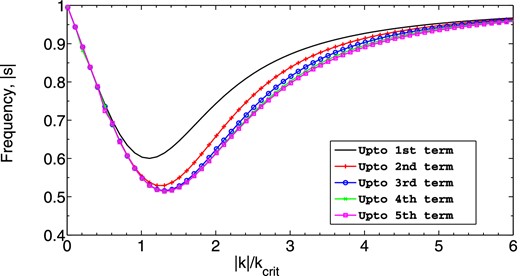
Variation of dispersion relation for collisionless stellar disc with Q = 1.3 while incorporating subsequent terms of the infinite series in the expression for the reduction factor (equation A1). The solution with first four terms matches well with that having first five terms to within 1 per cent, so the series can safely be truncated after the first four terms.
