
1. Introduction
Structuralism in the philosophy of mathematics holds that mathematics is the science of abstract structures. An alternative characterization of the position does not assume structures as the subject matter of mathematics, but rather holds that mathematical theories study only the structural properties of their objects.1 The focus on such properties is closely related to criteria of structural identity of mathematical objects. Specifically, it is often held that objects that share the same structural properties should be identified. For instance, in the context of non-eliminative structuralism, this view figures prominently in recent debates on the identity of structurally indiscernible positions in a pure structure.2
As the present volume shows, there exists a rich and multifaceted mathematical prehistory of these philosophical debates. In particular, one can identify a number of methods and styles of reasoning in 19th-century mathematics that eventually led to a “structural turn” in the discipline.3 The present article will focus on one important strand in the mathematical roots of structuralism, namely Felix Klein’s group-theoretic approach to geometry outlined in his Erlangen program of 1872. Klein’s program is generally acknowledged today as one of the milestone contributions in 19th-century geometry. Moreover, there is a consensus that his novel algebraic approach in geometry—that is, the study and classification of geometries in terms of transformation groups—had a significant impact on the gradual development of geometry into a science of abstract structures.4
Despite the wealth of research on Klein’s program and its significance for subsequent developments in geometry, no close study has so far been dedicated to its specific structuralist underpinnings. In particular, Klein’s work has not yet been discussed through the lens of modern structuralism.5 In the present chapter, I want to fill this gap. In particular, I will address the following questions: how, precisely, did Klein contribute to the development of the structural turn in mathematics? In what sense was his group-theoretic approach to geometry structuralist in character? Finally, in what sense did Klein’s account anticipate the philosophical debates in structuralism mentioned above?
The aim in this chapter is twofold. The first aim is historical in nature and concerns the geometrical background of Klein’s program. In particular, my focus will be on work on duality phenomena in 19th-century projective geometry. The chapter will survey different attempts to justify the principle of duality and then describe two ways in which the principle was generalized in analytic geometry, namely Julius Plücker’s contributions to “general reciprocity” and Otto Hesse’s so-called transfer principles. Roughly speaking, transfer principles were conceived at the time as mappings between geometrical domains that allow one to translate theorems about configurations of the one domain into corresponding theorems about the second domain. As I will argue, Klein’s group-theoretic account in the Erlangen program can be understood as a generalization of this work on reciprocity and transfer principles.
The second aim is more philosophical in character. This is to analyze in closer detail Klein’s structuralist account of geometrical knowledge. I will argue here that his group-theoretic approach is best characterized as a kind of “methodological structuralism” regarding geometry (see Reck and Price 2000). Moreover, one can identify at least two aspects of the Erlangen program that connect his approach with present philosophical debates, namely (i) the idea to specify structural properties and structural identity conditions for geometrical figures in terms of transformation groups and (ii) an account of the structural equivalence of geometries in terms of transfer principles. Both ideas clearly present “structural methods” in the sense specified in Reck and Price (2000).
The article is organized as follows. Section 2 will discuss the geometrical background of Klein’s program. Specifically, different ways to justify the principle of duality in projective geometry are outlined in section 2.1. In section 2.2, I discuss the use of transfer principles in analytic geometry. Section 3 will then turn to Klein’s approach: section 3.1 focuses on his group-theoretic study of geometries in terms of invariants. In section 3.2, I present Klein’s method of “transfer by mapping.” Section 4 will then discuss several structuralist themes underlying Klein’s conception of geometry. Section 4.1 will focus on Klein’s account of geometrical properties and congruence specified relative to a group of transformations. In section 4.2, I discuss how Klein’s use of transfer principles to identify geometries can be generalized to a notion of structural equivalence in category-theoretic terms. Section 5 contains a short summary.
2. Duality and Transfer Principles
The mathematical background of the Erlangen program is known to be rich and multifaceted.6 Klein’s group-theoretic approach in geometry has different roots, including algebraic work on permutations groups by Camille Jordan and Évariste Galois, Arthur Cayley’s invariant-theoretic approach in geometry, as well as Sophus Lie’s parallel work on geometry, to name just a few. A different influence on Klein’s program concerns the development of projective geometry in the 19th century. Particularly relevant here are, as we will see, different contributions to the principle of duality as well as its generalization in work by Plücker and Hesse. In the present section, I will survey these methodological developments in projective geometry and Klein’s reception of them.
2.1. The Principle of Duality in Projective Geometry
Projective geometry, as developed by Jean-Victor Poncelet, Gaspard Monge, Joseph Diez Gergonne, Karl G. C. von Staudt, and Moritz Pasch (among many others), can be characterized as the study of those geometrical properties of figures that remain invariant under certain projective transformations.7 This approach with its focus on projective invariants was certainly relevant for Klein’s subsequent characterization of geometries in terms of their transformation groups. More generally, the development of projective geometry brought with it a certain flexibilization of what count as the primitive elements in a geometry and, in turn, a new focus on geometrical form that clearly stimulated Klein’s approach.
A central innovation in work by Poncelet, Gergonne, and others was the discovery of the principle of duality for theorems in projective geometry.8 In the case of plane geometry, this principle expresses the fact that for every theorem concerning certain projective properties of configurations in the plane, one can formulate a second theorem with a dual (or reciprocal) structure based on the method of dualization, that is, by interchanging the words “point” and “line” as well as the relational expressions of “lying on a line” and “meeting in a point.”9 In order to illustrate this principle, consider the following pair of well-known dual theorems, namely Pascal’s theorem and Brianchon’s theorem.10 The former theorem expresses the following geometrical fact:
Theorem 1: Let A, B, C, D, E, F be six points on a conic that form a hexagon. Then the intersection points of the sides and , and , andandof the hexagon will lie on a line. (See Fig. 1, left diagram.)
Brianchon’s theorem, in turn, states a closely related geometrical fact:
Theorem 2: Let a, b, c, d, e, f be six lines that form a hexagon circumscribing a conic. Then the principal diagonalsandof the hexagon meet in a single point. (See Fig. 5.1, right diagram.)
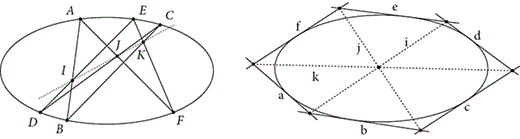
Pascal’s and Brianchon’s theorem

The two theorems express symmetric facts about the projective structure of hexagons relative to a conic section. That is, any concrete incidence relation between points and lines specified relative to one conic can be shown to correspond to a dualized relation between lines and points specified relative to the second conic. Accordingly, the theorems form an instance of the general principle of projective duality: one can deduce Brianchon’s result from Pascal’s result (and vice versa) by the previously mentioned technique of dualization, that is, by interchanging the primitive terms “point” for “line” as well as all the concepts defined in terms of them.
Much work in 19th-century projective geometry was dedicated to the analysis of the principle of duality. Klein’s Vorlesungen über Nicht-Euklidische Geometrie of 1928 contains an interesting retrospective survey of the different approaches to a general mathematical explanation of duality phenomena. In particular, he distinguishes between three accounts in the geometrical literature from the time (see Klein 1928, 38–39). One approach, which Klein labels the “axiomatic justification of the principle of duality,” is ascribed to the works of Gergonne and Pasch. Duality is explained here purely syntactically, in terms of the strictly symmetrical character of the axiom systems describing the projective plane and projective space.
The second approach is more interesting for our discussion and was first formulated in Poncelet’s Traité of 1822.11 Duality (or reciprocity) is specified here based on Poncelet’s theory of poles and polars and in terms of so-called polar transformations. Roughly speaking, polar transformations are dual correlations between figures that can be constructed relative to a given conic section. Based on a given conic, such a correlation will map every point in the plane to a certain line, its polar, and every line to a single point, its corresponding pole.12 The central geometrical property of such transformations is that they preserve the incidence relations between points and lines in a given plane. Following Poncelet, this is usually called the reciprocity between poles and polars: if a point lies on a line, then the pole of the line will also lie on the polar line corresponding to the point (and vice versa).
According to Poncelet, the principle of duality in projective geometry can be directly explained in terms of the theory of poles and polars. More specifically, in the second volume of the book, Poncelet introduces a general method of constructing new configurations from existing ones based on polar transformations. Given the fact that a polar mapping preserves the incidence properties (up to duality) of the original configurations, it follows that the newly constructed figures have a reciprocal structure. Thus, polar transformations induce a dual translation of theorems about one figure into theorems about its reciprocal figure.
As will be shown in the next section, dual transformations such as those described in Poncelet’s polar theory are explicitly discussed in Klein (1872). Moreover, Klein’s subsequent writings on geometry, for instance his second volume of Elementarmathematik vom höheren Standpunkte aus (1925), also contain detailed discussions of “transformations with a change of the spatial element” (Klein 1926, 117). However, in contrast to Poncelet’s original account of 1822, dual transformations are not understood synthetically here, but analytically in terms of coordinate transformations. This brings us to the third way to think about projective duality mentioned in Klein (1928).
The third approach to justify the principle of duality mentioned in Klein’s book is arguably the most relevant one for his Erlangen program. The so-called analytic justification of duality was first formulated by Julius Plücker (1801–1868) in his work on analytic geometry between the late 1820s and the 1840s. Briefly put, Plücker’s approach is based on the analytic representation of geometric concepts in terms of equations.13 Duality (or reciprocity) is discussed most extensively in the second volume of his Analytisch-geometrische Entwicklungen (Plücker 1931). The principle is explained here in terms of the reinterpretation of symmetric equations expressing geometrical configurations.
To illustrate his account, consider the linear equation presenting the concept of straight lines in the plane:
In the standard interpretation of this equation, u,v are treated as constants that determine a collection of points on a line. Plücker’s basic insight was to treat the coefficients u,v instead as “line coordinates” similarly to the point coordinates x,y. Consequently, if x,y are treated as constants and u,v as variables, then the equation determines a collection of lines going through point (x,y). Put differently, whereas the equation f(x,y) = 0 in its usual interpretation presents a collection of points (or a point curve) on a line, the reinterpreted equation f(u,v) = 0 presents a collection of lines or a line curve. Projective duality is explained by Plücker in terms of the possibility of reinterpreting equations in this sense. More specifically, it is a result of the particular form of this and related bilinear equations, that is, of the symmetrical role of the point and line coordinates occurring in them.
Plücker’s geometrical work from the time is known for the introduction of a number of different coordinate systems, including triangle coordinates (in Plücker 1830), homogeneous line coordinates for the plane (introduced in volume 2 of Entwicklungen of 1831), homogeneous plane coordinates, and line coordinates in space (introduced in Plücker 1846).14 A central mathematical motivation for this generalization of the concept of coordinates was to be able to reinterpret analytic equations representing geometrical concepts relative to different coordinate systems. As we saw, precisely this method is also used for the justification of projective duality. Compare Plücker on this purely analytic approach:
Every proof that can be drawn through the connection of general symbols corresponds to two such sentences connected to each other by the principle of reciprocity in case we refer with these symbols to point coordinates at one point and to line coordinates at another point. (Plücker 1931, viii–ix)
According to Plücker, there is thus a direct connection between the reinterpretation of an equation presenting an incidence relation in different coordinates systems and the general idea of “reciprocity” (or “Gergonne-Poncelet duality”).
This generalization of the concept of coordinates also brought with it a certain flexibilization of what counts as the “basic elements of space” in a geometry. The main idea underlying Plücker’s account of duality is to consider other elements than points as the primitive or basic elements in space. We saw that the line equation stated earlier can be interpreted in two ways, namely as presenting lines as collections of points or points as collections of lines. In the first reading, the points are taken as primitive objects and lines are determined as sets of points. In the second reading, lines are the primitive objects, and points are determined as classes of lines.
Plücker’s insight that different objects can serve as the primitive elements of a geometry exercised a strong influence on Klein’s subsequent geometrical work.15 This is documented in several of Klein’s later writings on the topic, which contain detailed discussions of the analytic justification of duality. For instance, Klein comments on Plücker’s approach in the second volume of Elementarmathematik in the following way:
Now it is Plücker’s conception to look upon these u and v as the “coordinates of the line” and as having equal status with the point coordinates x and y, and as being considered, at times, as variable instead of them. . . . Now the principle of duality resides in the fact, that every equation in x and y, on one hand, and in u and v on the other hand, is completely symmetrical. Everything that we said above concerning the duality that is inherent in the axioms of connection resides in this property. (Klein 2016, 70)16
As Klein emphasizes here and in related writings, this insight presupposes the generalized concept of coordinates previously mentioned as well as what he calls “Plücker’s general principle of considering any configuration as a space element and its constants as coordinates.” (Klein 2016, 72)
Compare the following remark in Klein (1926):
With this idea of the arbitrary “element of space” that can be chosen as the starting point of geometry, a complete clarification of the Poncelet-Gergonnian principle of duality is given: since the equation for the incidence of point and straight line (in the space of point and plane) is symmetrical in the two elements, one can interchange the two words in all sentences that are based on the mere connection of the two elements. (124)
Thus, given this new concept of coordinates, any type of geometrical configuration can serve as the basic elements in geometry, including conic sections, lines, planes, and spheres (among other objects). As we will see in the next section, this insight also led Plücker and other geometers to generalize the original version of Gergonne-Poncelet duality.
2.2. Reciprocity and Transfer Principles
According to the analytic account, the projective duality between points and lines in the plane (as well as between points and planes in space) can be explained in terms of the analytic presentation of the incidence relations between these geometrical concepts. Compare again Plücker on this point in System der Geometrie des Raumes of 1846:
Every geometrical relation is to be viewed as the pictorial representation of an analytic relation, which, irrespective of every interpretation, has its independent validity. Consequently, the principle of reciprocity properly belongs to analysis, and only because we are accustomed to . . . express the matter in geometrical language, does it seems to be an exclusively geometrical principle. . . . Understood purely analytically, the principle of reciprocity is naturally also not bound to the dimensions of space or restricted to them. (Plücker 1846, 322)
The account of reciprocity formulated here is thus not just an analytic reformulation of Poncelet’s treatment of duality in synthetic projective geometry, but rather an independent justification with a more general applicability in geometry. Moreover, as Plücker mentions in the preceding passage, the principle is not limited to a particular dimension of the space to be investigated analytically. This insight led him to formulate several alternative generalized notions of reciprocity in his work from the 1820s and 1830s that extend classical Gergonne-Poncelet duality in different ways.17
One such extension concerns the introduction of dualities between other geometrical concepts than points, lines, and planes. For instance, Plücker’s “Über ein neues Coordinatensystem” (1930) contains a discussion of Poncelet’s theory of reciprocity based on the analytic treatment of the concepts of poles and polars. Based on this, Plücker also presents a “generalization” of this theory that applies to higher-order curves. Generally speaking, it is shown here as well as in other publications that one can extend duality to any pairs of geometrical objects with the same dimension-number. Thus, any two geometrical concepts whose analytic representation is based on the same number of independent variables can be shown to have dual properties.18
A second extension of Gergonne-Poncelet duality also introduced in Plücker’s work is usually called “linear reciprocity.” A detailed treatment of it can be found in his System der analytischen Geometrie of 1935.19 The discussion given here concerns the dual correlation between two configurations, where duality is understood in the usual sense that each point and each line in the first figure is mapped to a line and a point in the second, reciprocal figure. Unlike in Poncelet’s account of point-line duality, however, this correspondence is not specified within a single geometrical system, that is, within a given projective plane. Instead, reciprocity is specified here with respect to the interpretation in two coordinates systems, one based on point coordinates and the other based on line coordinates.
Plücker calls two such coordinate systems connected by a polar mapping “reciprocal systems” and describes them as follows:
We see from this in which sense the relation between the two systems is indeed a mutual one. We call such two systems reciprocally related or reciprocal ones and the principle resulting from this kind of relationship, by which the relations of one of two reciprocal systems can be transferred to the other one, the principle of reciprocity. (Plücker 1835, 74)
The principle stated here clearly presents an extension of the kind of inner-system duality introduced earlier by Poncelet. Duality is now expressed analytically as a correlation between geometrical figures in different coordinate systems with different primitive spatial elements and not between figures within a given system.20
A further generalization of classical duality closely related to Plücker’s principle of linear reciprocity concerns so-called transfer principles in geometry. Roughly speaking, these are analytically defined mappings between different geometrical domains that preserve the relevant projective properties of the configurations in question. Interestingly, the term “transfer principle” first occurs in Plücker’s own work in the context of his discussion of reciprocity. In his System der analytischen Geometrie (1935), Plücker argues that his concept of general coordinates implies different transfer principles (Übertragungs-Principe) based on the (re)interpretation of a given analytic equation in different systems. A transfer is described here as a mapping between the elements of different coordinate systems that allows one to construct, based on a given figure, a corresponding figure in another system (see Plücker 1835, vii).
This account of geometrical transfer principles was further developed in subsequent work on analytic geometry, in particular by Ludwig Otto Hesse (1811–1874). Hesse introduced a particular transfer principle in projective geometry in his article “Über ein Übertragungsprinzip” (1866a).21 The principle is based on a mapping between points of the complex projective plane and pairs of points on the complex projective line that preserves the projective structure of these two domains. Hesse informally characterizes his approach as follows:
If one makes to correspond in a univocal way to each point in the plane a pair of points on the straight line and, vice versa, to each pair of points on the straight line a point in the plane, one has a transfer principle that reduces the geometry of the plane to the geometry of the straight line and vice versa. (Hesse 1866a, 15)
The relevant transfer mapping is presented analytically in the following way: Hesse introduces a function from points P = (x, y) in the projective plane to pairs of points p = {λ1, λ2} on the projective line (i.e., the fundamental line) specified by the quadratic equation:22
where A, B, C are linear functions of coordinates x, y.
This mapping between the plane and the fundamental line is structure-preserving in the sense that it preserves the primitive projective “relations between figures” (Figurenverhältnisse) in the two systems. This is established by Hesse in terms of a number of “fundamental theorems” (Fundamentalsätze) that show how primitive projective properties of the objects in the first system correspond to properties of pairs of points on the fundamental line. One such theorem concerns the correspondence between the collinearity of points in the plane and the involution between point pairs on the projective line: any three collinear points correspond to three pairs of points on the projective line that are in involution (and vice versa).23
As a consequence of this and other fundamental principles, it follows that any projective theorem about the configurations of the one domain can be translated into a theorem about the configurations the other domain and vice versa. As in the case of duality, the method of transfer is thus primarily a method of unification in geometry. It allows one to reapply proven results about a given field to the objects of a different field. Or, as Hesse puts it:
The principle of transfer developed here gives the opportunity to discover a large number of new theorems from the geometry of the straight line. It presents a recommendable task . . . to prove these theorems not directly in isolation, but to invent proof methods that let the theorems appear as evident in combination. (Hesse 1866a, 20–21)
Hesse’s method of transfer used for this identification of the projective geometry of the plane with that of the fundamental line is closely related to Plücker’s approach to linear reciprocity. In fact, in his Vier Vorlesungen aus der analytischen Geometrie (1866b), Hesse explicitly mentions Plücker’s method of reinterpreting equations by the substitution of point coordinates by line coordinates. This method provides a duplication of dual theorems based on the reinterpretation of all formulas used in the proof of a theorem. However, Hesse argues:
This is a very cumbersome approach, however, to reach from a given theorem to its corresponding one. Geometry therefore replaces the mediating formulas by transfer principles, through which one can immediately deduce the corresponding theorem from a given theorem. In our case this principle is the well-known law of reciprocity. (Hesse 1866b, 32)
This passage clearly indicates the close connection between Hesse’s understanding of transfer principles and Plücker reciprocity. Whenever a given equation representing a mathematical concept can be reinterpreted in Plücker’s sense, one can also construct a transfer principle that directly maps the objects of the first domain to those of the second domain. In the case of a dual transformations (such as Poncelet’s polar transformations), this transfer principle is the principle of reciprocity in Plücker’s sense. However, Hesse points out, the method is more general than reciprocity and applies also to non-dual mappings, such as the one previously described. Hesse specifies the general principle as follows:
In all cases where two geometrical theorems result from different geometrical interpretations of the same analytic formula, a transfer principle can be discovered that replaces the proving formulas in a large number of cases. (1866b, 32)
Thus, according to him, the possible reinterpretation of a given analytic expression in different coordinate systems indicates the existence of a structure-preserving mapping between them that can also be defined analytically. The fact that theorems about different geometrical objects can be proven from the “the same analytic source” shows that one can construct a mapping between these domains that induces a direct translation between the theorems.
Before turning to a closer discussion of Klein’s Erlangen program in the next section, let me quickly take stock here. Given the methodological developments in projective geometry already surveyed, one can identify two general structuralist ideas implicit in the work of Poncelet, Plücker, and Hesse. The first one concerns a deliberate indifference with respect to the nature of the primitive spatial elements used for the construction of geometrical configurations and instead a focus on their “invariant form.” The second one concerns the emphasis on structure-preserving mappings that allow one to transfer the structure of one geometrical system to a different system. As will be shown in the following section, Klein’s work presents a group-theoretical reformulation and further generalization of both ideas.
3. Klein’s Erlangen Program
Klein’s program was first outlined in his “Vergleichende Betrachtungen über neuere geometrische Forschungen” (1872), a programmatic pamphlet distributed during his inauguration speech at the University of Erlangen.24 Klein presents here a novel method to study and to classify different geometries in terms of their corresponding transformation groups. While there is scholarly debate on the actual impact of Klein’s article for subsequent research in geometry, it is clear that the Erlangen program contributed significantly to a new understanding of the subject matter of geometrical theories.25 In the following, I will restrict my attention to the presentation of some of the key concepts developed in 1872 (as well as in related writings) and discuss how they are related to the developments in projective geometry sketched above.
3.1. A Group-Theoretic Approach
Klein’s approach is motivated by a number of seemingly disconnected fields and methods in 19th-century geometry. Geometry, he writes, “which is after all one in substance, has been only too much broken up in the course of its recent rapid development into a series of almost distinct theories, which are advancing in comparative independence of each other” (1872, 216).26 Klein’s aim in 1872 was therefore to formulate a “general principle” that allows for the comparison and classification of these different geometrical fields. This was, roughly put, the methodological idea that each geometry should be identified with a space and a group of transformations acting on it that leave the relevant geometrical properties invariant.
This algebraic approach to studying the properties of figures clearly brought with it a more abstract conception of the subject matter of geometrical theories. Two issues are noteworthy here. The first point concerns Klein’s specific understanding of a geometrical space. It is clear from Klein (1872) as well as from related writings that space is not primarily meant to be physical or intuitive in his account. Rather, geometries study the configurations in formal “manifolds” of arbitrary dimensions “that have been developed from geometry by making abstraction from the geometric spatial image, which is not essential for purely mathematical investigations” (Klein 1872, 216). Klein gives an explicit characterization of the notion in his article “Über die sogenannte Nicht-Euklidische Geometrie (2. Aufsatz)” (1873), which was also written in 1872:
If variables are given, the infinity to the nth value systems we obtain if we let the variables x independently take the real values from −∞ to +∞, constitute what we shall call, in agreement with usual terminology, a manifold ofdimensions. Each particular value () is called an element of the manifold. (Klein 1873, 116)
The basic spatial elements of a geometry are therefore not genuine geometrical objects such as points or lines, but rather tuples of numbers assigned to the variables in question.27 Klein’s approach is in line here with the purely analytic approach in geometry of Plücker and Hesse discussed in the previous section. As Klein points out in 1872, the reference to genuinely spatial concepts or spatial representation is to be used only for pedagogical purposes. In his own terms, given this purely analytic approach of manifolds, “space-perception has then only the value of illustration” (Klein 1872, 244).
The second issue to be mentioned here concerns Klein’s understanding of the notion of geometrical transformations. In his view, one can take “the totality of configurations in space as simultaneously affected by the transformations, and speak therefore of transformations of space” (Klein 1872, 217). Transformations in this sense can include those between spatial elements of the same kind (such as transformations between points), but also those with a change of spatial elements (such as dual mappings).
While Klein gives only an informal description of such spatial transformations and of the geometrical properties preserved by them, his focus on numerical manifolds suggests that they are also treated analytically. In fact, while Klein remains silent on this issue in 1872, he gives a detailed discussion of the analytic representation of various transformations in related writings. For instance, in his 1873 paper, transformations of manifolds are described analytically in the following sense:
A transformation of a manifold into itself is understood as the process that leads from every element to one corresponding element (or several). One may want to specify the transformation in terms of n equations, in which the corresponding element depends on the respective original one. The type of equations and their respective relation is at first irrelevant for the concept. In the following, we will always presuppose, however, that they are invertible. The inverted equation presents what should be called inverted transformation. (Klein 1873, 117)
Transformations of a space are thus represented as transformations of coordinates within one or between distinct coordinate systems, specified in terms of a number of analytic or algebraic equations describing the functions between the coordinates.28
Klein’s work after 1872 also contains an extensive discussion of the geometrical transformations first mentioned in the Erlangen program. Consider his monograph Elementarmathematik vom höheren Standpunkte aus of 1908. The “analytic presentation” is described here as follows:
The analytic expression of a point transformation is what analysis calls the introduction of new variables,:
We can interpret such a system of equations geometrically in two ways, I might say actively and passively. Passively, it represents a change in the coordinate system, i.e., the new coordinates are assigned to the point with the given coordinates . . . . In contrast with this, the active interpretation holds the coordinate system fixed and changes space. To every point , the point is made to correspond, so that there is, in fact, a transformation of the points in space. It is with this conception that we shall be concerned in what follows. (Klein 2016, 81–82)
Klein’s distinction between an “active” and a “passive” interpretation of the equations presenting a transformation is interesting here. The latter account seems similar to Plücker’s account of linear reciprocity, and more specifically, to Hesse’s analytic presentation of transfer principles between different geometrical fields. The former, active account specifies transformations relative to a given coordinate system as a permutation of all points that also induces a transformation of all configurations in the manifold.
Returning to Klein’s 1872 article, it is plausible to assume that this understanding of analytically defined coordinate transformations within a fixed coordinate system also forms the background of his Erlangen program. Klein argues here that one can view different geometrical fields such as Euclidean or projective geometry as determined by a class of relevant transformations. These are the class of isometries in the first case and the projections (including collineations and dual transformations) in the second case. Moreover, given that the transformations of such a class always have inverses and that any two of them can be merged into a new composed transformation, it follows that these classes—equipped with a suitable composition operator—also form groups in the algebraic sense of the term. Compare Klein on this point:
The most essential idea required in the following discussion is that of a group of space-transformations. The combination of any number of transformations of space is always equivalent to a single transformation. If now a given system of transformations has the property that any transformation obtained by combining any transformations of the system belongs to that system, it shall be called a group of transformations. (Klein 1872, 217)29
Klein mentions a number of geometrical transformations that form a group in this sense: the class of all movements in a given space; the class of rotations relative to a given point; the class of collineations; as well as the group consisting of all linear substitutions that leave the metric properties unchanged. Klein calls the latter group the “principal group” (Hauptgruppe) of a space and the corresponding geometrical discipline “elementary geometry.” Dual transformations in the sense specified in the previous section are also mentioned by Klein in this context. In particular, he argues that while such transformations do not form a group by themselves, the class of collineations and dual mappings does form a group (Klein 1872, 217).
Given this conceptual framework, Klein showed in 1872 that groups of transformations allow one to specify the notion of geometrical properties of configurations in a given manifold. More specifically, his proposal was to characterize the relevant properties of a given geometry in terms of an invariance condition specified relative to a group. Thus, given a geometry X with a transformation group GX, properties of figures are specified as geometrically relevant if they are preserved under the transformations of group GX. This approach is first characterized informally with respect to the invariance relative to the “principal group”:
Geometric properties are not changed by the transformations of the principal group. And, conversely, geometric properties are characterized by their remaining invariant under the transformations of the principal group. For if we regard space for the moment as immovable, etc., as a rigid manifoldness, then every figure has an individual character; of all the properties possessed by it as an individual, only the properly geometric ones are preserved in the transformations of the principal group. (Klein 1872, 218)
As Klein points out, this invariance-based method not only applies to “elementary geometry” of three-dimensional space, but more generally to any geometry of a formal manifold of arbitrary dimensions that can be characterized in terms of a group of transformations.
This shift of attention from concrete figures to manifolds leads to a “generalization of geometry” that is significant in at least two respects. First, Klein’s approach led to the new situation that different (and partly conflicting) geometrical fields were to be treated on equal footing, that is, as equally justified. Or, as Klein puts it, “There is no longer, as there is in space, one group distinguished above the rest by its signification; each group is of equal importance with every other” (Klein 1872, 218). Second, the group-theoretic method implies a radically new conception of the nature of a geometrical theory. A geometry is now conceived as a tuple consisting of a manifold (of a given dimensionality) and a group of transformations acting on this manifold. Consequently, the general task of a geometer is to study those properties of geometrical configurations that are preserved under the transformations in question. Put differently, given this new framework, geometry turns into an invariant theory for the given group:
Given a manifold and a group of transformations of the same: to investigate the configurations belonging to the manifold with regard to such properties as are not altered by the transformations of the group. . . . Given a manifold and a group of transformations of the same: to develop the theory of invariants relating to that group. (Klein 1872, 218–219)30
As we saw previously, the transformations in question are generally understood as coordinate transformations expressed by a number of analytic equations. Consequently, geometrical invariants also have to be specified analytically, namely in terms of equations between coordinates and constants representing a geometrical concept that remain preserved under the transformations of a given group.
While Klein does not give a more detailed discussion of the invariant theory related to his group-theoretic approach in 1872, it is developed in his subsequent work.31 For instance, Klein’s Elementarmathematik contains a section titled “Group Theory as a Geometrical Principle of Classification” where the analytic invariant theory of various geometries is discussed in further detail. Klein shows here that elementary or “metrical” geometry is characterized by the group of certain special linear substitutions corresponding to the principal group specified in 1872. Geometrical invariants are then given by analytic expressions that remain unaltered by such substitutions. In Klein’s terms, “the geometry is thus the invariant theory of these linear substitutions” (Klein 2016, 153).
3.2. Transfer by Mapping
Klein’s main focus in 1872 was not the study of particular geometries in isolation but rather the comparison of different theories in terms of their transformation groups. Thus, group theory was to provide a unifying approach that allowed for the classification of different geometrical systems studied at the time. More specifically, Klein’s idea to introduce an order of generality between different geometries is based on a relation between their transformation groups. Recall that geometries are conceived in Klein’s program as consisting of a manifold and a group of transformations acting on it. Given two such geometries, say A = and B = , geometry B can be characterized as a subgeometry of A if transformation group B forms a subgroup of A. It follows from this that every invariant property studied in A (i.e., relative to the transformations in A) is also an invariant in B but not vice versa. Moreover, all theorems of A turn out to be theorems of B.
Klein discusses a number of geometrical theories in 1872 that can be ordered in this way in terms of the relation of subgroups or group extensions. His general approach is to construct subgroups of a given transformation group by restricting the latter to transformations that leave invariant a given spatial element or a given configuration (such as a conic section). The main example in this respect concerns “elementary geometry,” specified by the principal group of geometrical transformations. It is shown that the group of projective transformations forms an extension of this group. It follows from this that every property of projective geometry is also a property of elementary geometry but not vice versa. Compare Klein on this point:
We inquire what properties of the configurations of space remain unaltered by a group of transformations that contains the principal group as a part of itself. Every property found by an investigation of this kind is a geometric property of the configuration itself; but the converse is not true. (Klein 1872, 220)
Thus, while the projective properties—including metrical properties such as the cross-ratio for a given set of points—are also invariant under the transformations of the principal group, properties such as sameness of lengths of segments are not invariant in the projective setting.32
A second approach to interrelate different geometries in Klein (1872) concerns so-called transfer principles. Such principles are introduced by Klein as a general method to show the equivalence of geometries in section 4, titled “Übertragung durch Abbildung.” The method of “transfer by mapping” is informally characterized here as follows:
Suppose a manifoldness A has been investigated with reference to a group B. If, by any transformation whatever, A be then converted into a second manifoldness, the group B of transformations, which transformed A into itself, will become a group , whose transformations are performed upon . It is then a self-evident principle that the method of treating A with reference to B at once furnishes the method of treating with reference to , i.e., every property of a configuration contained in A obtained by means of the group B furnishes a property of the corresponding configuration in to be obtained by the group. (Klein 1872, 223)
To paraphrase Klein’s approach in modernized terms: consider two geometries, both understood as tuples consisting of a manifold and a group of transformations acting on it, that is, = and = , respectively. A transfer principle between and is a mapping between the manifolds f: A → that induces an isomorphism between the corresponding groups B and acting on them. It follows that every invariant property of configuration in A determined with respect to the transformations in B can be mapped to a corresponding invariant property of configurations in with respect to . Moreover, the transfer principle allows one to translate every theorem of geometry into a corresponding theorem of geometry .
Given Klein’s account of transfers by representation, several points of commentary are in order. First, principles of this form play a crucial role in his general program to classify different geometrical fields investigated at the time. He discusses a number of concrete examples of such principles that connect different theories in his 1872 article. This includes a transfer principle between the “theory of binary forms” given by the group of “∞3 linear transformations” of a straight line and the “projective geometry of systems of points systems on a conic” in the plane (determined by the linear transformations of the conic into itself). The transfer principle in question, Klein argues, preserves the relevant properties of configurations in the two domains. As a consequence, the two geometries are shown to be equivalent:
The theory of binary forms and the projective geometry of systems of points on a conic are one and the same, i.e., to every proposition concerning binary forms corresponds a proposition concerning such systems of points, and vice versa. (Klein 1872, 223)33
This account of transfer principles presented in 1872 is strongly influenced by preceding geometrical research.34 In particular, Klein explicitly refers to Lie’s work as well as to his own article “Über Liniengeometrie und metrische Geometrie” (1872a) for a discussion of another transfer principle connecting line geometry with the metric geometry in four variables. As is shown there, this mapping allows one to “transfer the complete content of metrical geometry to line geometry” and thus induces a “translation into the language of line geometry” (Klein 1872a).
Moreover, the discussion of transfer principles in Klein’s 1872 paper was strongly influenced by the developments in projective geometry surveyed in the previous section, in particular, by Plücker’s and Hesse’s work on generalized reciprocity and transfer principles. Interestingly, in Klein’s article, the very notion of “transfer” is first mentioned in the context of his discussion of the development of projective geometry:
Every space-transformation not belonging to the principal group can be used to transfer the properties of known configurations to new ones. Thus we apply the results of plane geometry to the geometry of surfaces that can be represented upon a plane; in this way long before the origin of a true projective geometry the properties of figures derived by projection from a given figure were inferred from those of the given figure. (Klein 1872, 220–221)35
How are the transfer principles developed in projective geometry related to Klein’s own use of “transfers by mapping”? As we saw, transfers were introduced in Plücker’s and Hesse’s work as mappings between different coordinate systems that induce a translation of the theorems about the projective properties of figures. Klein’s method generalizes such principles in the sense that the structure preserved by them is now expressed group-theoretically, that is, in terms of an isomorphism relation between the groups of transformations associated with two manifolds.36
A third point to mention here also concerns the projective background of Klein’s concept of transfers. Section 5 of the article, titled “On the Arbitrariness in the Choice of the Space Element,” shows that such principles can be used to connect geometries describing manifolds with different spatial elements (Raumelemente) such as points, lines, higher-order curves, etc. Compare Klein on this point:
As element of the straight line, of the plane, of space, or of any manifoldness to be investigated, we may use instead of the point any configuration contained in the manifoldness, a group of points, a curve or surface, etc. As there is nothing at all determined at the outset about the number of arbitrary parameters upon which these configurations shall depend, the number of dimensions of our line, plane, space, etc., may be anything we like, according to our choice of the element. (Klein 1872, 224)
The indifference to the basic nature of geometrical objects expressed here clearly echoes Plücker’s idea of a generalized concept of coordinates and the flexibilization of the basic elements of space that comes with it. As we saw in the previous section, Plücker thought of the dimensionality of a space as determined by the number of independent variables needed to present the basic spatial elements in analytic terms. Thus, for instance, a plane is two-dimensional if points are assumed as the basic elements; it is five-dimensional if conic sections are taken as the basic elements. This is precisely the idea also underlying Klein’s discussion of manifolds in 1872.37
Given this Plückerian account of “spatial elements,” Klein’s central observation is that the choice of the basic elements and thus of the dimensionality of a given manifold is of secondary importance for the investigation of geometries. What is relevant, from a mathematical point of view, are their group of transformations and the algebraic relations between them. Compare again Klein on this central “structuralist” insight:
But so long as we base our geometrical investigation on the same group of transformations, the geometrical content [Inhalt der Geometrie] remains unchanged. That is, every theorem resulting from one choice of space element will also be a theorem under any other choice; only the arrangement and correlation of the theorems will be changed. The essential thing is thus the group of transformations; the number of dimensions to be assigned to a manifold is only of secondary importance. (Klein 1872, 224–225)
A number of concrete examples of geometries of manifolds with different spatial elements are mentioned by Klein whose equivalence can be established in terms of transfer principles. One such example concerns a mapping between the system of pairs of points on a conic and the plane with straight lines as the basic elements. This mapping assigns to each pair of points on a conic the line that intersects the conic at points (and vice versa).38 It thus induces an isomorphism between the group of linear transformations of the conic in itself and the group of linear transformations of the lines in the plane that leave the conic invariant. Interestingly, in the discussion of this and several related results, Klein explicitly mentions Hesse’s work: “The correlation here explained between the geometry of the plane, of space, or of a manifoldness of any number of dimensions is essentially identical with the principle of transference proposed by Hesse (Borchardt’s Journal, vol. 66)” (Klein 1872, 225).
4. Structuralist Themes
The geometrical research surveyed in the last two sections strongly contributed to a general structural turn in 19th-century mathematics. In particular, the systematic use of transformations and transfer principles both in projective geometry and in Klein’s program brought with it a new conception of the subject matter of geometry: geometry was no longer understood as the study of concrete figures in intuitive space, but rather as a theory of abstract forms or invariant properties and thus as a branch of pure mathematics. Klein’s group-theoretic classification of different geometrical fields in terms of transformation groups in 1872 is often considered a culmination point of this development.39
How is the group-theoretic approach in geometry related to modern debates on structuralism? It seems natural to describe Klein’s account as a kind of “methodological structuralism,” a position first introduced by Reck with respect to Dedekind’s foundational work on analysis and arithmetic.40 This account differs from other philosophical theories of structuralism in the sense that it is more concerned with mathematical methodology than with metaphysical issues concerning the nature of structures. As Reck points out, structural methods in modern mathematics usually imply some form of abstraction from the subject matter or the particular nature of the objects described by a mathematical theory (Reck 2003, 371).41
Regarding Klein’s work, one can identify two different types of structural abstraction in his approach to geometry. The first type is specified relative to a given geometry and concerns the abstraction from particular configurations in order to study their invariant properties. The second type is related to Klein’s use of transfer principles. It concerns the abstraction from particular manifolds and their basic spatial elements in order to identify the structural content shared by different geometries. In the remaining part of the chapter, I will analyze these two structuralist ideas in Klein’s work.
4.1. Invariance and Structural Indiscernibility
A central “structuralist” idea underlying the geometrical developments previously sketched concerns the emphasis on invariant properties. Projective geometry in Poncelet’s Traité and in subsequent work was viewed as the study of properties of spatial configurations that remain invariant under different types of projections. Generally speaking, invariance criteria were used as a method to carve out those properties that are geometrically relevant. A second and related idea concerns the notion of the geometrical identity (or congruence) of figures. In Euclidean geometry, two figures are usually taken to be distinct if there exist some metrical properties that allow one to discriminate between them. From a projective point of view, however, the same two figures will be treated as indistinguishable in case there exists a projective transformation between them. Thus, the identity of figures is determined here in terms of a primitive concept of structure-preserving transformations.
Obviously, these two ideas in projective geometry formed an important background for Klein’s own group-theoretic approach. In fact, in his 1872 paper, the issue of projective identity is explicitly mentioned in his discussion of the extension of the “principal group” by projective transformations. As Klein puts it:
But projective geometry only arose as it became customary to regard the original figure as essentially identical with all those deducible from it by projection, and to enunciate the properties transferred in the process of projection in such a way as to put in evidence their independence of the change due to the projection. (1872, 221)
As was mentioned in section 2, the notion of projective identity discussed here was further generalized in work on duality and general reciprocity. Dual mappings between figures based on Poncelet’s theory of poles and polars allow one to identify symmetric incidence relations in a figure that are preserved by such transformations. Moreover, dual figures that share reciprocal properties are usually treated as identical. Compare again Klein on this point:
From the modern point of view two reciprocal figures are not to be regarded as two distinct figures, but as essentially one and the same. (1872, 221)
Thus, in cases of dual figures, geometers abstract also from the particular nature of the basic elements of geometrical figures (e.g., points or lines in the case of plane geometry).
Arguably, the most systematic expression of these structuralist insights regarding the role of invariants and the nature of geometrical identity is developed in Klein’s program. As we saw, both notions are specified here relative to a given group of transformations. Thus, the “elementary” metrical properties of a figure in a given manifold are specified relative to the principal group, its projective properties are specified relative to the extended group of projections and so on. Related to this, a criterion of structural identity is given based on the transformations of a given group.42
Expressed more formally in set-theoretic terms, Klein’s account can be brought into the following form: let be a manifold and a group of transformations acting on :
Definition 1 (G-property): A property of figures in is a -property if is it invariant relative to , i.e., for any : if then for all .
Geometrical properties are conceived extensionally here as classes of configurations of a given manifold. A definition of geometrical identity or congruence of figures can be given within the same framework:
Definition 2 (G-congruence): Two figures , ⊆ M are G-congruent if there exists a transformation f ∈ G such that .
This notion of G-congruence can be viewed as an expression of the structural identity of figures: two congruent figures are identical with respect to their structural content or in terms of sharing the same geometrical properties. Similarly, the notion of a G-property can be taken to express the structural properties of a given geometry in terms of an invariance condition.43
How is Klein’s view related to modern structuralism? Given the preceding discussion, several points come to mind here. First, Klein’s work on invariants under transformation groups seems closely connected to the structuralists’ focus on structural properties of mathematical objects. As mentioned in the introduction, one way to characterize the structuralist thesis is to say mathematical theories describe only structural properties of the objects of their subject domain.44 For instance, Benacerraf’s “What Numbers Could Not Be” (Benacerraf 1965) first emphasized that Peano arithmetic is concerned only with the relations between numbers in ω-sequences and not with particular set-theoretic presentations of them. Klein’s approach is similar to Benacerraf’s emphasis on purely structural properties. In fact, the former’s proposal to think of geometrical properties of figures as invariants relative to a transformation group can be viewed as an early attempt at a mathematically precise characterization of the notion in the context of geometry.
A second point to mention here concerns Klein’s understanding of the congruence of geometrical configurations. His account is similar in several respects to recent philosophical work on structuralist identity criteria. We saw that two figures can be identified, according to Klein, in case there exists a transformation of the elements of a space that maps one figure to the other one. One can think of such “internal” identity criteria specified relative to transformation groups in two ways, either (i) as expressing the sameness of figures in a manifold with respect to their structural properties or (ii) as expressing the identity of the abstract form shared by these figures.45
The first reading connects Klein’s account with recent debates on the identity of structurally indiscernible objects mentioned in the introduction.46 Briefly put, this debate concerns the question whether a version of Leibniz’s principle of the identity of indiscernible objects presents an adequate identity criterion for structural mathematics. The principle in question holds that two mathematical objects are identical in case that they share the same structural properties. More formally, for any two objects X, Y and structural properties P:
Different versions of (PII) have been discussed in mathematical structuralism. For instance, it has been considered as a criterion of the identity of places in structures in Shapiro’s ante rem structuralism.
A related discussion can be found in recent work on a structuralist account of mathematics based on homotopy type theory. Awodey (2014) emphasizes that in mathematical practice, isomorphic objects—that is, objects that share the same invariant properties—are usually not distinguished from each other. He takes the idea of treating isomorphic objects as identical to be a general “principle of structuralism” that should be reflected in any philosophical study of modern mathematics.47 Given Klein’s own remarks on the identity of figures stated previously, his approach seems well captured by Awodey’s understanding of mathematical identity. The identity of mathematical objects is thus not treated as a primitive notion but as a form of mathematical equivalence defined relative to transformation groups.
The second way to interpret Klein’s remarks on congruence, namely as the identity of the abstract shapes of configurations, is also related to non-eliminative structuralism.48 To see this, compare Marquis’s insightful discussion of Klein’s notion of identity based on a distinction between “types” and “tokens”:
One aspect of this criterion of identity has to be emphasized immediately: what we are characterizing with its help are types of geometric figures, not tokens of these figures. . . . Thus, a transformation group specifies the types that are admissible in a geometric space, it determines what there “is” or what can be in a space in an essential way. (Marquis 2009, 20–21)
Thus, according to Marquis, the congruence of figures given by a transformation group induces an identity condition for types of figures. For instance, the study of dual transformations between the figures of a given manifold gives a notion of identity for the duality types of figures. Consequently, one can think of the subject matter of geometry not only in terms of the invariant properties, but also in terms of these congruence types of figures.
This philosophical interpretation of Klein’s approach presents a particular version of structuralism discussed in the recent literature, namely in re structuralism.49 This is, roughly put, the view that mathematical theories describe abstract structures as their subject matter but that these structures do not exist independently of concrete representations instantiating them. One way of thinking about this dependence relation between a structure and its concrete instantiations is again based on the notion of structural abstraction. Thus, abstract structures are said to be gained from concrete mathematical systems by abstracting away all non-relevant properties of the objects in question.50
The Kleinian account of figure types can be understood as a version of in re structuralism concerning the subject matter of a particular geometry. As we saw, the study of a space relative to a group of transformations G allows one to treat the concrete configurations in the manifold as instances (or tokens) of more general figure types. A figure type can be instantiated or exemplified by all figures occurring in the manifold that are congruent relative to G. However, the abstract types do not exist independently of their concrete representations but are functionally dependent on them.51 Moreover, one can think of this dependence relation between types and concrete figures in terms of a notion of abstraction. As Marquis puts this: “A transformation group is a way to abstract types from specific tokens” (2009, 21). Given the set-theoretical reconstruction of his approach, one can characterize this notion of Kleinian abstraction more formally in terms of the following abstraction principle:
Definition 3 (Kleinian abstraction): Given a geometry and the corresponding congruence relation , for any two figures we have
Thus, the types of two figures in a manifold are identical in case that they are congruent relative to the transformation group G.52
4.2. Transfer Principles and Structural Equivalence
The second type of structural abstraction developed in Klein’s program is related to his use of transfer principles. As we saw, his method of transfer by mapping is closely motivated by previous work on the generalization of Poncelet-Gergonne duality by Plücker and Hesse. In Klein’s work, the equivalence of two geometries is formulated in a group-theoretic framework: a transfer is a structure-preserving mapping between two manifolds that induces an isomorphism between the group of transformations acting on the manifolds. As Klein shows, this fact induces a translation between the theorems of the two geometries in question. While his own discussion of transfer principles remains rather schematic in his 1872 article, one can give the following reconstruction of his approach:
Definition 4 (Equivalent geometries): Two geometries <M, G> and are equivalent if there exists a bijection F: M → and a group isomorphism α: induced by F such that for all x ∈ M and for all g ∈ G: F(g(x)) = (α(g))(F(x)).
A transfer principle in this group-theoretic sense is thus a mapping between two manifolds that allows one to construct an isomorphism between two transformations groups that preserves the group actions on the respective manifolds (see Figure 2).53
Given Klein’s approach, two points of commentary are in order here. First, notice that by identifying geometries based on their isomorphic transformation groups, one clearly
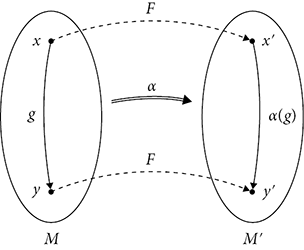
A transfer principle between manifolds M and M'

abstracts from the particular nature of the basic objects of a geometry and instead focuses on its general invariant form. The abstraction involved here is more general, however, than the one described in the previous section. It concerns not the specific character of particular figures in a given manifold, but rather the manifolds themselves. In order to grasp the “real content” of a given geometry, Klein argues, the specific character of the spatial elements in the domain is irrelevant. What is relevant is the structural content of a geometry characterized by its transformations group.54
Moreover, given Klein’s indifference to the basic ontology of geometrical objects, his account of transfer principles can be viewed as a general criterion for the structural equivalence of geometries. To use one of his own examples, the theory of binary forms and the projective geometry of points on a conic are taken to be equivalent in the sense that they share the same structural content, independent of their particular geometrical domains. This sameness of structure is expressed by the fact that their corresponding groups or transformations are isomorphic (or, in Klein’s terms, “similar”).
How is the structuralism implicit in Klein’s account of transfer principles related to contemporary philosophy of mathematics? Surprisingly, there is still yet little discussion on possible criteria of the structural equivalence of mathematical theories in the present debate. As we saw in the previous section, structuralists are mainly concerned with questions regarding the nature of abstract structures and, to a lesser degree, with the question of when two structures should be taken to be equivalent.55 Nevertheless, there is a close connection between Klein’s approach and subsequent developments in category theory. In fact, category theory is often considered as a “conceptual extension” or “generalization” of Klein’s program. Consider, for instance, the following well-known passage from Eilenberg and Mac Lane’s article “General Theory of Natural Equivalences” of 1945:
This may be regarded as a continuation of the Klein Erlanger Programm, in the sense that a geometrical space with its group of transformations is generalized to a category with its algebra of mappings. (237)
The relation between the study of categories and Klein’s program expressed here seems to be this: in Klein’s account, the structure of a geometry is expressed in terms of the group of transformations acting on a given manifold. Similarly, category theory can be understood as the study of particular categories in terms of their objects and structure preserving mappings.56 As in Klein’s account, the category-theoretic study of objects such as graphs or monoids can be understood as the study of the invariant properties expressible in terms of structure-preserving mappings between these objects.
I cannot develop any further here the question in what sense category theory can be viewed as a generalization of Klein’s group-theoretic approach in geometry.57 However, it will be interesting to point to two connections between Klein’s conceptual approach and an account of mathematical structuralism motivated by category theory.58 A first point of contact between Klein’s account and categorical structuralism concerns the indifference with respect to the nature of mathematical objects considered. Categorical structuralists explicitly share Klein’s view that what matters in mathematics are not the particular mathematical objects or their set-theoretic representations but rather their “invariant form.” Thus, the objects in a particular category are not supposed to have any properties other than those specifiable in terms of mappings between them. Compare Awodey on this structuralist conception of objects:
This lack of specificity or determination [of particular objects] is not an accidental feature of mathematics. . . . Rather it is characteristic of mathematical statements that the particular nature of the entities involved plays no role, but rather their relations, operations, etc.—the “structures” that they bear—are related, connected, and described in the statements and proofs of theorems. (2004, 59)
The second point of contact concerns the notion of the structural equivalence of theories. We saw that Klein’s motivation for his Erlangen program was not to study geometries in isolation but to compare different geometries investigated at the time in terms of their transformation groups. Similarly, research in category theory is usually not confined to the isolated study of particular mathematical categories but mainly concerns the study of relations between different categories. The central concept used for this task is that of a functor, i.e., a structure-preserving mapping between categories:
Definition 5 (Functor): A functor between categories C and D is a mapping F:C → D of objects to objects and arrows to arrows such that
A functor is a mapping between two categories that leaves invariant the domain and codomains of mappings, the identity mappings, and the composition of mappings. Consequently, each categorical property specifiable in the one category will be transferred by the functor into a categorical property of the objects in the second category (see Awodey 2010, 8–9).
It seems natural to think of functors as a mathematical generalization of Klein’s notion of transfers. We saw earlier that Klein’s Erlangen program gives an account of the “essential sameness” of geometries in terms of transfer principles. A plausible category-theoretic reconstruction of this Kleinian notion of inter-theoretic equivalence can be given in terms of the concept of categorical equivalence:
Definition 6 (Equivalence of categories): An equivalence of categories C and D consists of a pair of functors E: C → D and F: D → C such that there are natural isomorphisms:59
Given the conceptual similarity between Klein’s program and category theory as a general framework for structural mathematics, one can consider this notion of categorical equivalence as a generalization of Klein’s notion of structural equivalence.60 In both cases, the structure of a given theory is determined by the algebraic properties of mappings or transformations. Moreover, two theories are considered to be identical on a structural level in case there exists a mapping that allows one to transfer the algebraic structure of one theory to the other theory.61
5. Conclusion
Klein’s Erlangen program of 1872 presents a landmark contribution to algebraic reasoning in geometry and, more generally, to the gradual implementation of a structural approach in modern mathematics. The aim in this chapter was to further substantiate these claims and to specify Klein’s particular version of geometrical structuralism. As we saw, his account is based on the systematic use of transformation groups in order to specify the invariants of configurations in a manifold as well as the structural content of geometries.
The chapter focused on two thematic points: the first one was an important strand of the mathematical background of Klein’s program, namely different proposals to generalize the principle of duality in 19th-century geometry. This included Plücker’s purely analytic study of dualities between geometrical configurations of any dimension. It was shown how his approach led to the formulation of different transfer principles in projective geometry. Moreover, Klein developed his own account of geometry in direct continuation with these “structuralist” methods of Plücker and Hesse. Specifically, his approach presents a generalization by group-theoretic means of two ideas first developed in preceding geometrical research, namely (i) the use of structure-preserving mappings in reciprocity and transfer principles and (ii) the focus on invariant form in the analytic presentation of geometrical figures and their properties.
The second aim in this chapter was to connect Klein’s conception of geometry with current debates on structuralism. As we saw, there are at least two points of contact between his ideas and more recent philosophical work. The first concerns Klein’s approach to specify geometrical properties and the notion of congruence (or equivalence) of configurations relative to a given group of transformations. This approach clearly mirrors recent work on structural properties and structural identity conditions for mathematical objects in non-eliminative structuralism. More specifically, building on recent work by Marquis, we saw that Klein’s approach can be interpreted as a version of in re structuralism for geometry, according to which the real subject matter of a geometry consists of abstract figure types specifiable in terms of a congruence relation.
The second point of contact concerns Klein’s proposal to specify the structural equivalence of two geometries based on transfer principles. This approach is closely related to later attempts to think about mathematical objects (and the equivalence of theories) in category-theoretic terms. In particular, a natural generalization of Klein’s “transfer by mapping” approach can be given in terms of the notion of categorical equivalence of categories of theories. This analogy with modern category theory also suggests to treat Klein’s specific geometrical structuralism as a precursor of more recent accounts of categorical structuralism, that is, attempts by Awodey and others to capture the philosophers’ talk about mathematical structures in the language of category theory.
Acknowledgments
This project has received funding from the European Research Council (ERC) under the European Union’s Horizon 2020 research and innovation program (grant agreement No. 715222). Research related to this article was presented at the conference “The Emergence of Structuralism and Formalism” in Prague in 2016, at the workshop “Roots of Mathematical Structuralism” at University of California, Riverside in 2016, at the workshop “Mathematics and Its Philosophy in the 19th Century” at the University of Amsterdam in 2018, as well as at the HOPOS 2018 meeting at the University of Groningen. I would like to thank the respective audiences for their comments. I would especially like to thank Erich Reck, Francesca Biagioli, Eduardo Giovannini, Günther Eder, and Henning Heller for helpful discussions on the topics addressed in this chapter.
References
Awodey, Steve.
Awodey, Steve.
Awodey, Steve.
Awodey, Steve.
Barrett, Thomas, and Hans Halvorson.
Benacerraf, Paul.
Biagioli, Francesca.
Biagioli, Francesca.
Birkhoff, Garrett, and M. K. Bennett
Brannan, David A., Matthew F. Esplen, and Jeremy J. Gray.
Coxeter, H. S. M.
Eder, Günther, and Georg Schiemer.
Eilenberg, Samuel, and Saunders Mac Lane.
Fano, Gino.
Gray, Jeremy J.
Gray, Jeremy J.
Hawkins, Thomas.
Hawkins, Thomas.
Hesse, Ludwig O.
Hawkins, Thomas.
Keränen, Jukka.
Klein, Felix.
Klein, Felix.
Klein, Felix.
Klein, Felix. [
Klein, Felix.
Klein, Felix.
Klein, Felix.
Korbmacher, Johannes, and Georg Schiemer.
Leitgeb, Hannes, and James Ladyman.
Lie, Sophus. 1888–93.
Linnebo, Øystein, and Richard Pettigrew.
Lorenat, Jemma.
Marquis, Jean-Pierre.
McLarty, Colin.
Nagel, Ernest.
Plücker, Julius.
Plücker, Julius.
Plücker, Julius.
Plücker, Julius.
Plump, Mechthild Ulrike.
Reck, Erich.
Reck, Erich, and Price, Michael P.
Resnik, Michael D.
Rowe, David E.
Rowe, David E.
Schiemer, Georg.
Scholz, Erhard.
Shapiro, Stewart.
Shapiro, Stewart.
Torretti, Roberto.
Wussing, Hans. [1984]
These are usually characterized as properties not concerning the intrinsic nature of objects but rather their interrelations with other objects in a system. Compare, for instance, Benacerraf (1965) and Linnebo and Pettigrew (2014).
See, for example, Keränen (2001) and Shapiro (2008). Compare Leitgeb and Ladyman (2008) for a critical discussion of this view.
See the editorial introduction as well as Reck and Price (2000) for a general overview of relevant methodological developments in 19th-century mathematics.
See, e.g., Tobies (1981), Wussing (2007), and Gray (2008).
See, however, Biagioli (2018) for a recent study of the Klein’s structuralism underlying his work on non-Euclidean geometry.
See, in particular, Wussing (2007), Rowe (1989, 1992), and Gray (2008) for detailed studies of Klein’s program and its mathematical background.
See Torretti (1978) and Gray (2005) on the historical development of projective geometry.
The present subsection will closely follow Eder and Schiemer (2018) and Schiemer (2018) in the discussion of the principle of projective duality.
A corresponding principle of duality for solid geometry states that for any theorem of solid projective geometry we get another theorem by interchanging the words ‘point’ for ‘plane’ and ‘plane’ for ‘point’ (as well as of the primitive incidence relations).
See again Schiemer (2018) for a more detailed discussion of this example. I would like to thank Günther Eder for his permission to use the two diagrams in figure 1 in the present chapter.
See again Eder and Schiemer (2018) and Schiemer (2018) for closer discussions of Poncelet’s transformation-based account of duality.
See, e.g., Coxeter (1987) for a modern textbook presentation of polar theory.
See Nagel (1939) and Plump (2014) for closer studies of Plücker’s work. See Lorenat (2015) for a recent study of the priority dispute on the discovery of duality between Poncelet, Gergonne, and Plücker.
See Wussing (2007, 28–30) and Plump (2014) for further details on Plücker’s work on different coordinate systems.
Klein was a student and assistant of Plücker at the University of Bonn until Plücker’s death in 1868. See Rowe (1989) for further details.
A similar discussion is given in Klein’s Vorlesungen über die Entwicklung der Mathematik im 19. Jahrhundert (Klein 1926), now for the related case of the analytic equation presenting straight lines: u1x1 + u2x2 + u2x2 = 0. Here again, it is the case that the coefficients u1,u2,u3 and the coordinates x1,x2,x3 have a strictly symmetrical role in the equation. One can therefore interpret the former as “line coordinates” and the equation as expressing a point determined through a bundle of lines.
See Nagel (1939) and Plump (2014) for detailed studies of Plücker’s generalized notions of reciprocity.
Compare, in particular, Nagel (1939) for a study of this generalized notion of reciprocity in Plücker’s work. Klein’s Elementarmathematik also contains a detailed discussion of Plücker’s notion of reciprocity between different higher-order curves based on the “Plückerian principle” to use arbitrary configurations as the primitive elements of a given space.
See, in particular, Plump (2014) for a detailed discussion of this approach.
Compare again Klein (2016, 71–72) for a discussion of this notion of linear reciprocity.
See Hawkins (1984) for a closer discussion of Hesse’s transfer principles.
The points on the fundamental line are determined in terms of their distance λ from a given point on the line.
A second result states that all double points on the fundamental line correspond to the points lying on a given conic in plane and vice versa (Hesse 1866a, 17–20).
A revised version of the article was published in Mathematische Annalen in 1893 and then again in 1921 in the first volume of Klein’s collected works (Klein [1921–23] 1973). In the following, I quote from the English translation by Haskell published in 1892/1893.
Compare Rowe (1989) on this point. See Wussing (2007) for a study of the influence of Klein’s approach for the subsequent development of abstract group theory. Compare, in particular, Hawkins (1984) and Birkhoff and Bennett (1988) for partly conflicting assessments of the relevance of Klein’s article for subsequent geometrical research.
This is true despite the fact that projective geometry has developed into a fundamental geometrical theory in work by Cayley and Klein in the sense that it not only characterizes the non-metrical properties of configurations but can also be used to represent the metrics of both Euclidean and non-Euclidean geometries. See, in particular, Biagioli (2016) for a discussion of Cayley’s work and Klein’s projective model of non-Euclidean geometry.
In his discussion of manifolds of arbitrary dimensions in 1872, Klein refers both to Hermann Grassmann’s Ausdehnungslehre as well as to Bernhard Riemann’s theory of general manifolds. See Scholz (1980) for a historical survey of the development of the concept.
Sophus Lie’s Theorie der Transformationsgruppen presents the first systematic treatment of the notion of a spatial transformation (Lie 1893). Compare Hawkins (2000) for a detailed study of Lie’s work.
It should be noted that Klein does not state the modern axiomatic conditions for abstract groups here (including the associativity of the group operations and the existence of a neutral element). His specification of the concept of groups of transformations in terms of a closure condition for the composition of transformations is directly based on Jordan’s theory of permutation groups given in his Traité. Compare Wussing (2007, 186) for a detailed survey of Klein concept of groups and his mathematical background.
As is shown in Wussing (2007), Klein’s use of the notion of invariants can be seen as a concession to the earlier invariant-theoretic approach in geometry, e.g., in work by Cayley and Clebsch, that strongly influenced Klein’s own group-theoretic approach.
Lie’s Theorie der Transformationsgruppen contains a detailed presentation of invariants of transformation groups (Lie 1893). Compare also Fano (1907) for a study of the invariants of different transformations groups discussed by Klein and others.
By the same method, Klein shows that various non-Euclidean geometries form subgeometries of projective geometry. See, in particular, Biagioli (2016) and Torretti (1978) on Klein’s discussion of non-Euclidean geometries and the relation to Arthur Cayley’s work a generalized metric. Compare Brannan et al. (2011) for a modern presentation of the hierarchy of Kleinian geometries.
A second, analogous example concerns the elementary geometry of the plane and the projective geometry of a quadratic surface with a given fixed point (Klein 1872, 224).
See, in particular, Rowe (1989) for a detailed study of Klein’s work on transfer principles and its mathematical background.
As he points out, the transfer of geometrical properties is then generalized in work by Poncelet and others in terms of the introduction of dual transformations, i.e., those based on a change of the elements of space that preserve several symmetrical incidence properties (Klein 1872, 221).
Klein, in his 1872 article, does not explicitly use the notion of group isomorphism. However, it is clear from his related writings from the time that this notion or, in his terms, the “similarity” between groups of transformations was assumed in the background of his discussion of transfer principles. See his definition of this notion given in 1873: “Two transformation groups are said to be similar if we can associate the transformations of the one group to the transformations of the other group such that composition of corresponding transformations yields corresponding transformations” (118).
In fact, in a corresponding note in his article, Klein explicitly refers to Plücker’s work on “how to regard actual space as a manifoldness of any number of dimensions by introducing as space-element a configuration depending on any number of parameters, a curve, surface, etc.” (Klein 1872, 245).
See Fano (1907, 358–359) for a detailed analytic presentation of this mapping and the resulting equivalence theorem.
Compare, for instance, Tobies who writes that Klein’s Erlangen program “formed a decisive turning point for the geometry of the 19th century. Klein’s use of the group concept supported approaches to structural mathematical thinking formed at the end of the 19th century. (Tobies 1981, 36–37, my trans.) See, in particular, Biagioli (2018) for a recent study of Klein’s geometrical structuralism.
See, in particular, Reck (2003) as well as Reck and Price (2000) for a more general discussion of the position.
Thus, methodological structuralism can be viewed as the philosophical analysis of styles of reasoning introduced in modern mathematics that allow the mathematician to abstract from particular representations of objects in a system by highlighting their purely structural features or properties.
In a recent analysis of the Erlangen program by Marquis, these two ideas are also emphasized as the philosophically relevant aspects of Klein’s approach: “(Transformation groups) constitute in a precise sense the algebraic encoding of a criterion of identity for geometric objects, or to be more precise for geometric object-types. Second, the same transformation groups also encode a definite criterion of meaningfulness for geometric predicates, or, equivalently, a definite criterion for geometric properties” (Marquis 2009, 12).
Notice that, in both definitions, the notion of geometrical structure assumed here is strongly context-relative. What counts as a structural property of the figures of a manifold depends critically on the particular transformation group associated with a geometry. Analogously, the congruence conditions for figures within a manifold are also specified in a given geometrical context. Thus, for instance, congruence in affine geometry is specified relative to the group of affine transformations; in Euclidean geometry, it is specified relative to the group of isometries, and so on.
Compare Korbmacher and Schiemer (2017) for a detailed study of the notion of structural properties in mathematics and its possible explications.
Compare again Marquis (2009) for a more detailed discussion of this.
Structural properties are characterized here in terms of the notion of isomorphism invariance as well as in terms of the definability in a type theoretic language (Awodey 2014).
See Reck and Price (2000) for a general overview of different structure theories.
Compare Shapiro (1997) for a closer discussion of in re as opposed to ante rem structuralism.
See, in particular, Linnebo and Pettigrew (2014) for a recent systematic study of a form of abstraction based structuralism.
Compare again Marquis on this point: “Working with the transformations amounts to working with types instead of working with tokens. Notice, though, that the transformations are applied to tokens of these types and clearly the existence of the latter depends directly on the existence, or should we say the presence, of the former. Thus, a transformation group indicates the presence of geometric types whose existence depends on the existence of geometric tokens” (Marquis 2009, 21).
Notice that this definition of abstraction is again relative to a given choice of a group of transformations. Thus, what counts as an abstract type of a figure differs relative to different groups. To give a simple example: ellipses, parabola, and hyperbola are figure types relative to Euclidean geometry and the group of isometries. In contrast, in projective geometry, these types are reduced to the single, more general type ‘conic’, given the fact that ellipses, parabola, and hyperbola are equivalent in the projective setting.
Given that α is a group isomorphism, also the composition of transformations as well as the inverse function on transformations are preserved.
Compare Marquis (2009) for a similar assessment of Klein’s approach.
See, in particular, Resnik (1997) and Shapiro (1997) on the characterization of the equivalence of mathematical structures based on the notion of definitional equivalence.
See Awodey (2010) for a textbook presentation of category theory.
See, in particular, Marquis (2009) for an extensive study of this question and the historical development of category theory more generally.
See, for instance, Awodey (1996) and McLarty (2004) for different versions of categorical structuralism.
Notice that this notion is more general than the isomorphism of categories: functors E and F are not required to be inverses of each other, but only “pseudo-inverses.” This means that for any D ∈ D: E ◦ F(D) ≅ D, not necessarily E ◦ F(D) = D. See Awodey (2010).
See again Marquis (2009) for a closer discussion of the relation between Klein’s work and modern category theoretic concepts.
See Barrett and Halvorson (2016) for a recent proposal to explicate the equivalence of scientific theories in terms of the notion of categorical equivalence.