
1 Setting the Scene: A Sanctuary at the Edge of the North Sea
The town of Colijnsplaat, situated in the delta of the Meuse at the North Sea, has been a special place for ancient historians since 1970. At that time, 1.5 km north-west of Colijnsplaat in the Oosterschelde, Roman votive altars were found by local fishermen. They once belonged to the sanctuary of the goddess Nehalennia, which is today located 25m below the water level. Of the more than 350 consecrated stones and statues, about 160 bear Latin inscriptions, showing that the sanctuary was located at an ancient traffic hub. Merchants who traded with Britain boarded ships there for the crossing. After their successful return, they thanked the goddess for her protection over their goods. One of the inscriptions reads: Deae Nehalen/niae P(ublius) Ariseniu/s Marius libert/us P(ubli) Ariseni V[---]/hi negotiato/ris Britannicia/ni ob merces / bene cons[e]rua/ta[s u(otum) s(oluit)] l(ibens) m(erito) ‘To the goddess Nehalennia Publius Arisenius Marius, freedman of Publius Arisenius V…British trader, has gladly redeemed the vow because (his) goods have been preserved’.1
This place of worship with its monuments sets the scene for my topic. The testimonies of merchants, soldiers, transport companies, and travellers bear witness to the high levels of mobility of the Imperium Romanum. The sanctuary of the goddess Nehalennia was a traffic hub where many individuals and groups of different backgrounds congregated, bringing their local languages. Augusta Rauricorum, in modern-day Switzerland, is cited as the place of origin in the dedication stone of a wine merchant from the tribe of the Helvetii and is the most distant region of origin stated in these inscriptions.2 Despite the diverse backgrounds of the travellers, who met near Colijnsplaat, their epigraphic testimonies are all written in Latin.
In the multi-ethnic confederation of the Roman Empire, Latin served as a vehicular language in the literal and figurative sense. On the one hand, the enormous expansion of the Empire contributed to this, but the transport infrastructure and the high and sustained levels of mobility and migration that the Roman Empire encouraged are also important factors for Latinization. An essential source base is provided by inscriptions. They document traffic, mobility, and the use of Latin by road builders and travellers on business or private ventures, especially if they are found along the roads, at junctions and traffic hubs.
The role and significance of these phenomena will be discussed in this chapter. It will begin with some general considerations on context and methods, before turning to commentary on the significance of Roman traffic infrastructure and mobility, the nature of road inscriptions and milestones, before finally turning to a topic of special importance for our theme of the Latinization of the western provinces, the Celtic leuga.
2 Some Considerations on Context and Methods
The penetration of Latin into the western provinces and the displacement of indigenous languages in favour of Latin is undoubtedly a consequence of Roman expansion. The Roman Empire was created by the conquered territories as a multi-ethnic association to which numerous societies with many different languages belonged. It is thought that at least twenty-five different languages existed, some of which never produced their own written records (see Beltrán, this volume).3 And yet, despite the centuries-long stability of the Roman Empire, multilingualism in various guises continued until its end.
The use of Latin was not a cultural technique that the Romans consistently wanted to enforce throughout their territory, not even among the naturalized inhabitants. Although the emperor Claudius had withdrawn the citizenship of a Lycian envoy because he had not understood a question posed by the Emperor in Latin (see Rochette, this volume), at the beginning of the third century ce the jurist Ulpianus stated that the drafting of fideicommissa was legal in any language, even in Gallic.4 With regard to the local courts and authorities, this was perhaps a pragmatic decision to relieve them, but also in other areas of legal life—contract law, for example—Ulpian mentions the possible use of local languages such as Punic or Syriac, which may not have been uncommon, at least in oral contexts, besides Latin and Greek.5
For the majority of the inhabitants of the Empire, Latin was an option, an option that offered advantages. By being closely linked to citizen status and the application of Roman law, it could be used to gain social status or prestige in society and economic capacity to act (Meyer, this volume). In addition to these incentives, there were other motives for using Latin, which are explored in greater detail elsewhere in this volume. There is little doubt about the ways in which the spread of Latin was facilitated in the Roman Empire, especially in the West. By giving the areas subjected to it Roman bases in the form of military camps, colonies, and administrative centres, the Romans created hubs for linguistic exchange (Houten, this volume). Initially, for provincials, Latin was primarily the official and judicial language, the language of the army and the administration, plus the most useful language for engagement in the growing economy. Through the extension of Roman citizenship to more and more inhabitants of the Empire and the interest of non-Roman citizens in the ‘Roman way of life’, Latin increasingly penetrates everyday life and the cultural and intellectual life of the subjects over the course of time. This is shown in particular by inscriptions in all their different types, formulaic language, and places of discovery.
However, the possibilities of making statements with regard to the precise nature of Latinization are limited, owing to the nature of the sources. A Latin inscription shows that a donor of a monument intentionally wrote or had it written in Latin. But neither his own ability to write and read at all—if using a professional writer or the help of an acquaintance, which seems to have been quite common—nor a knowledge of Latin can be clearly reconstructed for that person. Even which language he spoke in everyday life—Celtic, Germanic, Ubian, or whatever—cannot be known with any degree of certainty. Of course, the texts may contain hints to the linguistic make-up of individuals, such as personal names and onomastic formulae, but this is not always secure information from which to extrapolate.
Even fewer statements can be made about the readers. Could they read Latin or at least identify letters, groups of letters, or numbers? Being able to read lapidariae litterae, the capital letters usually used on stone and metal inscriptions intended for public display, was evidently not uncommon, as is revealed by Petronius’ ribbing of social risers (Sat. 58.7), as well as the erasures performed on imperial inscriptions, milestones, and local honorary inscriptions, which could be identified by the public. A full discussion about the forms and scope of literacy that underlie the question of Latinization cannot be conducted here.6 However, in assessing inscriptions in the realm of the transport infrastructure and of mobility of travellers, business people, and migrants, we can glean some few clues that point out possible contexts for the use and spread of the Latin language.
3 The Significance of the Traffic Infrastructure and Mobility (a Short Overview)
Although your Empire is so large and so great, it is much greater in its good order than in its circumference. […] Now it is possible for both Greek and barbarian, with his possessions or without them, to travel easily wherever he wishes, quite as if he were going from one country of his to another. And he is frightened neither by the Cilician Gates, nor by the sandy, narrow passage through Arabia to Egypt, nor by impassable mountains, nor by boundless, huge rivers, nor by inhospitable barbarian races. […] you have made [this] a reality, by surveying the whole inhabited world, by bridging the rivers in various ways, by cutting carriage roads through the mountains, by filling desert places with stations, and by civilizing everything with your way of life and good order. (Aristides 26.100–101, trans. Behr 1981)
With these words the Greek rhetorician Aelius Aristides celebrates the achievements of the Romans in their Empire in a panegyric sometime after the middle of the second century ce. As essential characteristics of Roman rule he judges the completed order, the great security, and above all the excellent infrastructural development of the extensive territory. Aristides illustrates the usefulness of the Roman transport infrastructure with prime examples that symbolize the conquest of nature: the Cilician Gates and the Arabian Desert. The vast space of the Empire, perceived as comprehensive, is even equated in its extension with the oikumene, which appears to be completely penetrated by the surveying and construction of roads and their facilities. Natural obstacles are consistently removed for the construction of the road system, whereby also remote, inhuman regions are included. In this way a cultivated and orderly way of life was created in the Roman world.
During the High Empire the Roman road network consisted of probably up to 300,000 km of roads of different types and relevance. The often perfectly engineered imperial roads (viae publicae) served as main arteries that penetrated the whole Empire. The road network was complemented by local and regional routes, which—even if smaller or of lower quality—were the necessary connections in the territory of the cities and communities, where the main bulk of traffic is to be expected. This network of lines connected the regions of provinces with one another, and it connected the provinces with the centre in Rome or the current whereabouts of the emperor.7 The transport system on the whole included sea and inland navigation—on rivers, lakes, or, for instance, the Black Sea—which were highly developed and in various regions on a par with, or even more important than, the counterparts on land. Over time this natural infrastructure was purposefully supplemented by the building of harbours, canals, and related installations.8
The transport infrastructure was of particular importance to the Roman Empire, because of its enormous size, and it was a major factor in facilitating the mobility of the military and state officials, which enabled the vast Empire to be built up, consolidated, and politically and administratively penetrated. This required an efficient transport system, since the communication of the emperor with his representatives as well as the transmission of information within the military and administration was essential for implementing Roman rule. For the same reason, the state needed a reliable means of transport for troops, supplies, and also for its agents’ journeys. Business trips by magistrates, imperial representatives, soldiers, and administrative staff are documented in many cases. One illustrative example is the epitaph of the imperial slave Musicus Scurranus, treasurer of the fiscus Gallicus of the Provincia Lugdunensis, who died in the first century ce on a business trip from the Lugdunensis to Rome while travelling with sixteen slaves of his staff.9
Infrastructure and mobility thus formed the basis and medium of Roman power, with the help of which the existence of the Empire could be secured over many centuries. But, apart from the needs of the state, mobility in the Roman Empire can also be defined for parts of the population, who stayed or settled temporarily, long term, or permanently in places other than their home towns. Migration for settlement is only a sub-area of mobility and is not considered in more detail here.10 Professional traders, transport companies, and migrant craftsmen or artists are often the first to be mentioned when it comes to regular use of the transport infrastructure, but many others, especially members of the upper classes, also undertook business, study, or private trips: it must have been a welcome break to escape the summer heat on a country estate in the mountains or by the sea. The spas on the Bay of Naples were famous for their healing and recreational value—and not only among the elites. Other health resorts and spas were also popular throughout the Empire because of their hot springs. The numerous places with the name Aquae bear witness to this. Students of philosophy and rhetoric aimed to travel to Athens, an age-old seat of learning, or Alexandria, where the famous library was an attraction for researchers and writers. Beirut was also an important place of study for jurisprudence. Public speakers such as the aforementioned Aelius Aristides traversed the Empire on lecture tours. Actors, musicians, pantomimes, but also athletes travelled to festivals and competitions to prove themselves in their art. Cult sites and sanctuaries have always been special attractions: they were visited for the most diverse motives, but it must not be forgotten that religion and myth fundamentally determined the world view of ancient people. A few places of worship had an Empire-wide influence, such as Delphi in Greece, Paphos on Cyprus, or the Siwa oasis in Egypt, whose oracle sites enjoyed the highest reputation. Famous sights were visited by travellers especially in Greece, Asia Minor, and Egypt, where, besides the pyramids, Alexander the Great’s grave and the singing Memnon colossi were also to be admired—journeys to which antique visitor inscriptions on the statues still testify today.11 From such journeys, however, one can hardly speak of tourism in today’s sense. The destinations and motives of the journeys were mostly not pure sight-seeing or recovery from the day’s work. In addition, ancient travel was too expensive, strenuous, and dangerous for it to develop into a mass phenomenon.12 However, the overall great mobility in the Roman Empire is likely to have reached a much higher level than in other ancient societies, especially during the imperial period, and this was due not least to its infrastructure, an impressive Empire-wide traffic network consisting of land and waterways.
4 Road Inscriptions and Milestones
Having planned and implemented this Empire-spanning traffic network and thus having developed the truly global extent of the Empire, Augustus and the following emperors were keen on documenting this feat. Therefore, monuments and their inscriptions celebrate the building of roads, bridges, canals, and other constructions. At the same time, such testimonials bore witness to the fact that what they signalled had been materialized by imperial initiative and commitment. The initiative of local communities or private sponsors in this realm is found to a much lesser extent.13
Epigraphic monuments along the roads, which testify to the construction and maintenance of the transport infrastructure, increased the prestige of their creators. This also applies to grave inscriptions or votive offerings that can be found along roads, at crossings or at sanctuaries located in traffic hubs. It follows from this that Roman roads functioned as important places of representation. What percentage of the travellers using these roads could actually read these messages, we cannot know for sure. But, owing to the fact that votive offerings at places such as Colijnsplaat or the sanctuary of the Great St. Bernhard Pass,14 where travellers of different backgrounds and languages met, were written in Latin, it can be concluded that they were meant to be understood by fellow travellers. Hence, with the Latin inscriptions, the donors publicly advertised their communication with the deity to be read by everyone else. In this realm, Latin was used as a vehicular language, which undoubtedly contributed to its spread.
The largest group of epigraphic monuments situated along the viae publicae consists of milestones. Nowadays, a total of up to nine thousand milestones are known.15 As the rhetorician Quintilian notes, inscribed stones on the road showed distances to the traveller (Inst. IV.5.22). This is visible on the milestones by numbers of milia passuum and the name of a location from which the numbers are counted. Therefore, they displayed the distance from the road’s starting point (caput viae) and hence gave orientation to the traveller. Mile after mile these inscriptions attest the survey and assessment of space, but also document road building and maintenance by the initiative of Roman emperors and magistrates. The inscriptions of milestones are often regarded as a special form of building inscriptions, which, on the one hand, document the building measures through formulae such as viam fecit/restituit, and so on,16 and at the same time serve as a self-presentation of the ruler, his politics and qualities. Above all, the emperor`s victory names clearly emphasize his military achievements, in addition to his civilian tasks and offices. Furthermore, efforts and merits were advertised through milestones. They range from gaining new territory under Roman rule up to measuring the roads or erecting new milestones to replace older ones.17 Miliaria are thus also monuments of imperial propaganda. Since the emperor was in charge of the viae publicae, the names of the actual building supervisors, such as governors or municipalities, were of only secondary importance. They are, therefore, often missing or noted only at the end of the text.18 Increasingly from the third and especially the fourth centuries ce, milestones take on features of dedications or proofs of loyalty, because of the dative form and the lack of statements on building activity.19 All in all, then, milestones served as symbols of Roman power. And the language of power was Latin.
However, this power of the Latin language was not implemented consistently everywhere in the Empire or at all times, and evidently not even strived for in some contexts, which of course can be related to specific local circumstances. The broad-picture differences between the Roman East, which used Greek as a lingua franca and had long been permeated by the Polis culture, and the West of the Empire, where numerous local idioms can be grasped today only through only a few epichoric inscriptions and traces in toponyms or personal names,20 need not be discussed here (see Beltrán, this volume). In the East, Latin was largely deployed as a ‘super-high’ language in specific, often high-status, official contexts, whereas, in the West, Latin steadily became the second and first languages of increasing numbers of provincials.21 The example of the milestones, which are to be regarded as official documents, even if their erection by the municipalities is explicitly attested in various regions, can confirm these general findings. In the western provinces, Latin is exclusively used on milestones. For example, the provinces of Dalmatia and Moesia superior, which lead up to the so-called Jireček Line demarcating the boundary between the use of Latin and of Greek as the official language,22 perhaps unsurprisingly, provide only Latin-language texts. The language of the milestones of the eastern provinces is of great interest, since, given their close association with Roman imperialism, we might expect some deployment of Latin in its ‘super-high’ role, which might be in tension with their role as purveyors of useful information to the local Greek-speaking populations.
A closer look at the language of milestones in Asia Minor might allow us to explore the eastern set in a little detail. David French provided the information in Table 6.1 in 2015.23
| Languages | Galatia | Cappadocia | Pontus et Bithynia | Asia | Lycia et Pamphylia | Caria, Ionia et Lydia |
|---|---|---|---|---|---|---|
Classifiable texts | 292 | 330 | 192 | 392 | 104 | 49 |
1. Latin Text + M(ilia) P(assuum) | 216 | 186 | 114 | 125 | 34 | 24 |
2. Greek Text + MP | 2 | 4 | 5 | 193 | 60 | 17 |
3. Latin Text + MP + additional Greek MPa | 61 | 52 | 36 | 7 | 2 | 2 |
4. Latin Text + Greek MPb | 13 | 85 | 30 | 18 | 5 | 3 |
5. Latin/Greek Bilingual Text | — | 3 | 7 | 22 | 1 | 2 |
6. Latin/Greek Bilingual Text + Greek MPc | — | — | — | 9 | — | — |
7. Latin + Greek Heading | — | — | — | 2 | — | — |
8. Latin + Greek Addition below Latin textd | — | — | — | 13 | 2 | 1 |
9. Greek + Latin Additione below Greek text | — | — | — | 3 | — | — |
Text and distance-numeral in Latin, with additional distance-numeral in Greek.
Text in Latin but distance-numeral in Greek only.
Text in Latin and Greek but distance-numeral in Greek only.
Text in Latin but with Greek addition (city name and/or governor’s name) below text.
Text in Greek but with Latin addition (caput viae and/or distance-numeral) below text.
Not all aspects of French’s observations can be examined within the scope of this chapter. Above all, the dating of the texts, which is disregarded here, would have to be taken into account for a more precise investigation. We are interested only in the overall picture at this point. This shows that, in the majority of the provinces of Asia Minor, the Latin-only language milestone texts predominate. However, in Asia and the neighbouring Lycia-Pamphylia alone, there are significantly more Greek-only language milestone texts than in the other areas. One could explain this with reference to the long Greek and Hellenistic tradition in those regions. Other reasons may include the timing and circumstances of provincialization and the early assumption of responsibility for the roads by local authorities. It is also interesting that there are hardly any bi-version bilingual texts to be found at all, most of them, 31 of 44, occurring in the province of Asia. Galatia, Cappadocia, and Pontus et Bithynia show bilingual texts of a different type, with the language predominately in Latin with a code-switch into Greek for the distance marker, which may or may not be repeated in Latin. This strategy seems to suggest a catering to the local population for the practical information.
For further detail we can start with Asia, the oldest Roman province in Asia Minor and the one with the most extant number of classifiable milestone texts. Figure 6.1 shows an overview of the text types for the milestones in the province of Asia. The ratio of the languages used can thus be clearly shown: Greek-only language texts predominate, with 46 per cent, Latin-only follows with 28 per cent, bi-version bilinguals make up 10 per cent, and texts in one language with a code-switch into another comprise 10 per cent. The situation in another region, which also has strong Greek-speaking roots, can be presented as a comparandum: the province of Thrace. This inland region was established by Claudius in 46 ce. No legion was stationed there, but Latin testimonies from soldiers from road posts and fortifications (under Antoninus Pius) and from the settled veterans are well known. The first road inscriptions stem from the Neronian period. The overall picture seems comparable to the situation of the province of Asia: Greek-only language texts predominate with 47 per cent, Latin-only follows with 42 per cent, bi-version bilinguals make up a tiny percentage at only 1 per cent, and texts with a switch of language comprise 5 per cent (Fig. 6.2). The main difference between the provinces is then in the fewer bilingual texts.
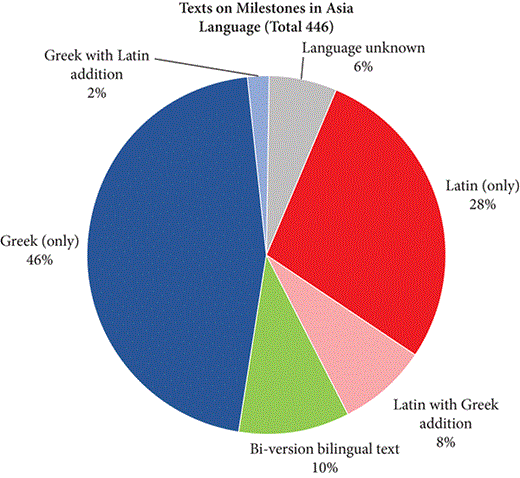
Breakdown by percentage of languages used on milestones in the province Asia.

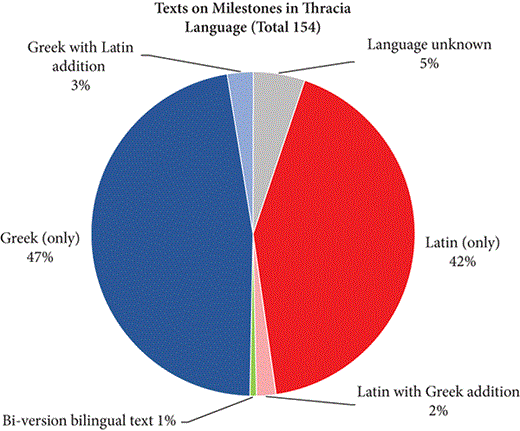
Breakdown by percentage of languages used on milestones in the province Thrace.

It is even more interesting, to look at the distribution over time (Fig. 6.3). The first Latin milestone stems from Nero. After that, however, the milestones show almost only Greek texts up to Diocletian. After this time the Latin ones predominate. Again this bar chart of the milestone-inscriptions reflects the well-known Greek-speaking situation in Thrace.24 Greek is seen there in the vast majority of inscriptions of all epigraphic types and was commonly used by the population during Roman rule. Latin, on the other hand, is the language of the army, administration, and Roman colonists. Therefore, we can conclude that perhaps the first road building and erecting of milestones was implemented by the rulers and governors as a model that was later followed by the communities. Their use of Greek next to, or instead of, Latin on the milestones was obviously tolerated generously, if the roads were taken care of. The Greek-language tradition is maintained during the High Empire. Afterwards the milestone texts offer a completely different linguistic output, with Latin overwhelmingly used, starting with the first tetrarchy. This goes probably hand in hand with Diocletian’s provincial reforms, which are thought to have promoted the use of Latin in imperial public administration (Rochette, this volume), although in other inscriptions Greek remained the main written language in Thrace, and these reforms arguably may have had little real impact on most speakers.25
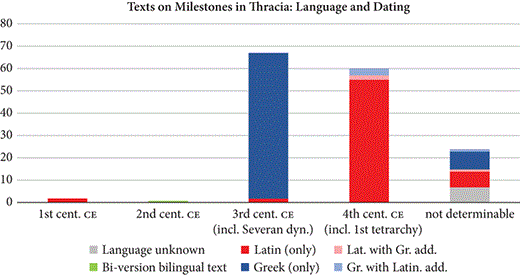
Bar chart showing languages used on milestones in the province Thrace over time.

5 The Celtic leuga
The texts of milestones in the Roman West are all presented in Latin, which corresponds to the lack of a pre-Roman lingua franca across this region. Celtic languages are perhaps the most widespread local language type across this area, a couple of which produce epichoric epigraphies (e.g. Gaulish and Celtiberian), but there is no evidence that a Celtic language was used as a widespread linking language. However, many milestone texts in Gaul and the Germanies provide a Celtic word at the end, the measure of distance. This is astonishing: all other milestones across the whole Empire, even those in Greek, use the Roman mile as the measurement. The exception is found only in the Gallic and Germanic provinces. There Roman milestones and their inscriptions give distances in the measurement of the Celtic leugae (1 leuga = 1.5 milia passuum = 2.2 km) instead of Roman miles. Figure 6.4 shows an example of a ‘Leuga-stone’ from Sedunum in the Alpes Poeninae, dating to 251–3 ce. It reads IImmpp(eratoribus) CCaa/eess(aribus) Gallo et / Volusiano / p(iis) f(elicibus) Augg(ustis) Aven[t(ico)] / leug(as) / XVII.
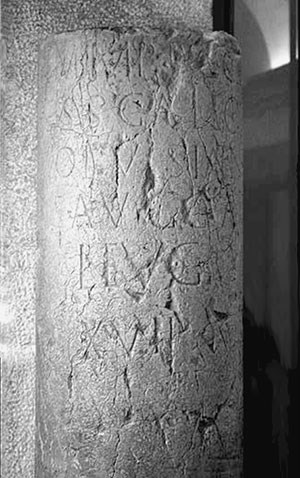
‘Leuga-stone’ CIL XVII 2, 659 (Sedunum, Alpes Poeninae) 251–3 ce. (Photograph by Gerold Walser.)

The oldest instances of the use of the leuga as a measurement known so far stem from the time of Trajan and Hadrian, but contemporaneous and later milestones show miles as well.26 Rightly it is concluded that the measure of leuga is a testimony to municipal road administration. However, this development is explained as the result of the pursuit of local autarky or administrative restructuring, meaning that local communities gained more control over road building in their territory.27 But the obligation to finance road building or restoration fell on them well before the Trajanic period, and there is no sign of dwindling powers of the governor. Rathmann then interprets the leuga as an imperial-period innovation in Gaul without a pre-Roman tradition, starting in Aquitania and proceeding to the east of the territory of the Gallic and Germanic provinces, a phenomenon that covers neither the entire Gallic–Germanic territory nor even the specific affected provinces comprehensively. This is because the whole province of Gallia Narbonensis and some communities in Aquitania, Lugdunensis, and the two Germanies continue with the mile system. From the time of the emperor Septimius Severus onwards, the region of the leuga-use seems to be more restricted geographically and was not extended. The introduction in certain Gallic and Germanic communities of their own measuring system appears as an act of self-portrayal by the communities, which the Roman state appears to have tolerated.
However, as the first use of the leuga on milestones shows either the abbreviated form or no clear labelling at all, the measurement seems already well known at this time.28 Recently it has also been argued from linguistic evidence that the Celtic term leuga is an early Germanic loan word and that it already formed part of the Celtic vocabulary of the Galatians who immigrated into Anatolia in the third century bce.29 Therefore it could possibly be concluded that a pre-Roman Celtic measurement seems to have been overlaid by the Roman measurements for a time, possibly only where Roman road building had in fact taken place. Along other roads or stretches of roads, especially those that were already well established, Celtic markers, which may also have been made of wood, may have been retained. The leuga was probably still in use among the local populations in Roman times, and along the new main roads (additional wooden) markers with this measure might have been deployed. This is suggested by the fact that various Gallic roads have provided no pre-Claudian milestones, even though Roman infrastructural activity is indicated. It is known best during Agrippa’s two governorships in Gallia Lugdunensis in 39 and 19 bce from Strabo (4.6.11), who reports the structuring of the road network on a large scale. Since even the Tabula Peutingeriana in the fourth century ce still gives measurements for the area in leugae, a strong rooting is indicated (Lugduno caput Galliarum usque hic legas…‘Lugdunum, capital of the Gauls, up to here in leagues…’) (Fig. 6.5). Nevertheless, one must agree with the general conclusions of Rathmann that the leugae-counting, found since the second century ce, is a peculiarity of a large part of the civitates of the Gallic–Germanic area, and perhaps the inhabitants found in the use of the Celtic measure a new opportunity for self-expression, though it still remains unexplained why the emperors tolerated the special case.30 Whatever the reason for its use, it may reflect a certain economic and political identity and demarcation, which later found fuller form in the Gallic Empire.
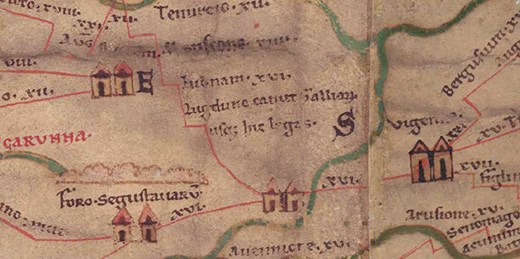
Tabula Peutingeriana section 1B5. (© Österreichische Nationalbibliothek, reproduced with permission.)

From this case one can see that the people of the Empire seem to have used, at least for some time or in some places, their accustomed measurements for counting distances at the same time as using the Roman mile. The fact is to be seen already for the Roman Republic in Polybius (3.39.8), who states that the new Roman road from Italy to Spain along the coast of southern France in his time was not yet fully measured in Roman miles (1 milia passuum = 8 stadia). Comparable as well for the time of the emperor Claudius is the case of Lycia with the so-called Stadiasmos Monument from Patara, where Greek stadia are used as the measure. With this inscription Claudius, who reorganized Lycia as a new province, is honoured as initiator and builder of a road network, which was for the main part based on older existing ways and paths. And these had already been measured—of course in the local measurement of Greek stadia. Unsurprisingly, this unit of measurement never appears on Roman milestones. This coincides with the finding of Hellenistic distance indicators in Asia or Macedonia, which obviously the Romans replaced by milestones.31
Roman respect for local traditions in matters of administration and governance is the exception rather than the rule, mainly occurring when the populace was required to fulfil certain duties or when such demands were being newly implemented in a region. The governor of Galatia, Sotidius Strabo (under Tiberius), for example, used the customary Persian schoenos for measurements in defining the services required from the populace for state logistics.32 Nevertheless, in the Gallic and Germanic provinces the leuga seems to prevail in a large area from Aquitania in the West into the territory of the Helvetii in the province of Germania Superior. In this region the Celtic measure, and perhaps at least orally and for limited uses the Celtic language, continue to be used by at least parts of the populace until the fifth century.33
6 Concluding Thoughts
Increased traffic and mobility were a consequence of Roman expansion. They promoted the spread of the Roman way of life and the Latin language beyond the Roman bases deep in their territory and hinterland. The enormous size of the territorial state meant that communication took place on an extremely large scale. Language and culture spread to undreamt-of regions and even previously relatively inaccessible landscapes. Because of the apparently higher mobility in the Roman Empire than in many other ancient societies, Latin played an important role as a vehicular language, at least in the West, where no lingua franca—like Greek in the east—was already well established. The basis of locomotion and exchange processes of all kinds is, of course, the infrastructure of routes and pathways, on both land and water. Above all, roads were an expedient and elaborately built infrastructure, which at the same time served as symbols of the power and dominion of Rome. In addition, the roads played a special role, inasmuch as they served not only as a medium of communication, but also as places of communication and representation. Thus, the mobility of people promoted the movement of their ideas and their language, on the one hand, with the help of the roads, and, on the other hand, texts were physically presented along the side of the roads. Milestones reflected Latin as the language of power. But at the same time tolerance towards local traditions or conditions was exercised where the state depended on the services and cooperation of the population. This pragmatism of the Romans was also likely to have contributed significantly to the long-lasting stability of their Empire and perhaps also to the uptake of Latin.
AE 1983, 721 (Colijnsplaat/Ganventa), see Stuart and Bogaers (2001).
AE 1980, 658.
Dio 60.17.4; Dig. 32.11pr: fideicommissa quocumque sermone relinqui possunt, non solum Latina uel Graeca, sed etiam Punica uel Gallicana uel alterius cuiuscumque gentis ‘Fideicommissa may be left in any language, not only in Latin or Greek but Punic, Gallic, or that of any other nation’.
Dig. 45.1.1.6 part 2: sed utrum hoc usque ad Graecum sermonem tantum protrahimus an uero et ad alium, Poenum forte uel Assyrium uel cuius alterius linguae, dubitari potest, et scriptura Sabini, sed et uerum patitur, ut omnis sermo contineat uerborum obligationem, ita tamen, ut uterque alterius linguam intellegat siue per se siue per uerum interpretem ‘Whether we extend this rule to the Greek language only or even to another, such as Punic or Assyrian or some other tongue, is a matter for doubt. The writings of Sabinus, however, allow it to be true that all tongues can produce a verbal obligation, provided that both parties understand each other’s language, either of their own accord or by means of a truthful interpreter’. Further, Ulpian states that a shopkeeper had to post the ‘general terms and conditions of business’ in clearly visible letters in the language that was used locally—naming explicitly Greek and Latin, of course, as the most used examples, Dig. 14.3.11.3: proscribere palam sic accipimus claris litteris, unde de plano recte legi possit, ante tabernam scilicet uel ante eum locum in quo negotiatio exercetur, non in loco remoto, sed in euidenti. litteris utrum graecis an latinis? puto secundum loci condicionem, ne quis causari possit ignorantiam litterarum. certe si quis dicat ignorasse se litteras uel non obseruasse quod propositum erat, cum multi legerent cumque palam esset propositum, non audietur ‘By public notice is meant a notice in writing, clearly visible and easily read, in the open, for example, in front of the shop or the place of business, not hidden away but on display. Should the notice be in Greek or Latin letters? It depends on the locality; no one should be able to claim that he did not know what the notice said. Certainly, if the notice was posted openly and was widely read, no one will be heard to say that he did not see it or know what it said.’ For the use of local languages in the juristic texts, see Wacke (1993). For the view that use of local languages would be exceptional in this context, see Speidel, this volume.
See, e.g., Harris (1989); Kolb (2018).
On Roman roads in historical perspective, Pekáry (1968); Rathmann (2003; 2006; 2014); Kolb (2016; 2019); on technical aspects, Quilici (2008).
Campbell (2012), esp. 200–28, 246–330; McGrail (2008), 606–37; Blackman (2008), 638–70; Kolb (2012).
CIL VI 5197 (Rome, 14–37 ce): Musico Ti(beri) Caesaris Augusti / Scurrano disp(ensatori) ad fiscum Gallicum / prouinciae Lugudunensis / ex uicariis eius qui cum eo Romae cum / decessit fuerunt bene merito / Venustus negot(iator) / Decimianus sump(tuarius) / Dicaeus a manu / Mutatus a manu / Creticus a manu // Agathopus medic(us) / Epaphra ab argent(o) / Primio ab ueste / Communis a cubic(ulo) / Pothus pediseq(uus) / Tiasus cocus // Facilis pediseq(uus) / Anthus ab arg(ento) / Hedylus cubicu(larius) / Firmus cocus / Secunda. The inscription states that on the occasion of Scurranus’ death a part of his staff was with him in Rome (ex uicariis eius qui cum eo Romae cum decessit fuerunt). This was an exceptional situation, otherwise it would not have been necessary to mention it. Functionaries of higher rank usually travelled with a larger entourage, which can be supported by the so-called mansio-accounts from Oxyrhynchus (fourth century ce, P.Oxy. LX 4087–8) or the rules for the use of the vehiculatio/cursus publicus by Sotidius Strabo, the Tiberian governor of Galatia, AE 1976, 653; Mitchell (1976); Kolb (2000; 2016); for the latest on the cursus publicus in the third to fourth centuries, see Lemcke (2016).
For a short overview for other uses of transport, see Kolb (2021); for the topic of migration, see Tacoma (2016), Lo Cascio and Tacoma (2017); for travel, see Casson (1994), Zwingmann (2012).
Robberies and murder were a common phenomenon along the roads of the Empire; see, e.g., CIL VIII 2728 = 18122 = ILS 5795): profectus sum et inter uias latrones sum passus. nudus saucius euasi cum meis ‘I set off and along the road I suffered (an attack by) robbers. Naked and wounded, I escaped with my companions’, or the record of the murder of two travelling Spaniards, CIL XIII 259: Canpan[us nat(ione?)] / H(ispanus) Iul(ia) Nou(a) [Karth(agine) et] / Siluanus a [latro]/nibus hi[c inte]/rfecti ‘Here lies Canpanus, a man from Hispania from Iulia Nova Carthago, and Silvanus, who on this spot were killed by robbers’.
Note the examples of private engagement for the building or restoration of roads (CIL II 2886: hanc uiam / Aug(ustam) / L(ucius) Lucret(ius) Densus / IIuir{um} / fecit; CIL II 3167; CIL III 600, 6983; CIL V 1863, 1864), including mountain penetration (CIL III 321; XIII 5166) or installations belonging to roads like bridges (CIL II 3221, 3271); cf. Kolb (2019a), 5–8; for other inscriptions along roads, Kolb (2016), 229–31; (2021).
Walser (1984); Inscriptiones Italiae 11/1, 50. 55–105.
Distance indicators along the roads were not a genuine Roman invention; some Greek precursors are known; see SEG 51, 823; SEG 43, 442; SEG 45, 1879 and 1880 (with traces of Aramaic text); SEG 46, 2120; SEG 47, 1624; cf. Kolb (2012), 59–60; Rathmann (2014), 202; in general on milestones, see Hirschfeld (1907); Rathmann (2003), passim; Kolb (2016), 232–5; (2019), 12–17.
Rathmann (2003), 204–6, gives a list of formulae; on the capita viarum, see Rathmann (2004).
e.g. CIL III 14149,30 (between Thawâne and Dhat-Ras, Arabia); AE 1969/70, 589 (Epitalion, Achaia); CIL XVII 4, 111 (Celeia, Noricum); CIL VIII (Mauretania Caesariensis); Kolb (2016).
On the importance of local forces, see Rathmann (2003), 104–20.
Therefore, a change in mentality is often concluded; see Rathmann (2003), 120–35. Destephen (2018) notes the loss of their practical use and disappearance in late-antique Asia Minor.
See, e.g., Clackson (2015a).
For the notion of the use of Latin as a ‘super-high’ language, see Adams (2003a).
See Mullen, this volume, n. 3.
French (2015), 186. The term ‘bilingual text’ is used by French in the narrow sense of the word: Latin and Greek versions of the same text (sometimes with slight variations)—what are now, for clarity, called bi-version bilingual texts. M(ilia) P(assuum) is the number of miles in Latin; Gk MP means Greek mile numbers.
Sharankov (2011) describes the linguistic situation in Thrace.
Cf. the situation of late-antique Asia Minor, where Destephen (2018) draws similar conclusions; generally Millar (2006), 20–5, 84–93.
CIL XVII 2, 426; CIL XVII 2, 343; see the texts below, n. 28. The measure was also used in Carnuntum in order to define the demarcation of the military district from the civil settlement, as the inscriptions from the Pfaffenberg show; see Piso (2005), 160–93, who in this military background traces the introduction of the leuga back to Drusus.
See especially Walser (1981), 84–103; Rathmann (2003), 115–20.
CIL XVII 2, 426: Imp(erator) Nerua / Traianus diu[i] / Neruae fil(ius) Cae[s(ar)] / Aug(ustus) Germanicus pon[t(ifex)] / maximus tri(bunicia) pot(estate) / [c]o(n)s(ul) / (leugas) XXVII; CIL XVII 2, 343: Imp(erator) Caes(ar) diui Tra/iani Part(hici) f(ilius) diui Ner/uae nep(os) Traianus / Hadrianus Aug(ustus) / pont(ifex) max(imus) tr(ibunicia) pot(estate) V / co(n)s{s}(ul) III p(ater) [p]atr(iae) Aug(ustonemeto) / c(iuitate) Aruernor(um) / l(eugas) XVII; CIL XVII 2, 378, 441.
Simon (2019).
Even whether economic reasons might provide the background, as Walser (1981), 99, has already suspected, cannot be proven so far; Rathmann (2003), 119, rightly rejects Walser’s assertion of a new combination of road administration and cursus publicus. Another way of interaction between indigenous languages and beliefs, on one side, and Roman domination, on the other, is discussed by Levinson (2016), regarding rabbinic literature in ancient Palestine. He states that these texts ‘interpreted and re-inscribed the Latin and Greek milestones as if they were addressing themselves in a local idiom—speaking Hebrew as it were—transforming the bilingual artifact [i.e. Greek and Latin] into a trilingual one’. The aim of translating and interpreting of these signs of power lies in creating a ‘counter-cartography’ of rabbinic wisdom.
Stadiasmus-monument SEG 44, 1204; Kolb (2016a), 230–1; for Hellenistic distance indicators, see n. 14.
AE 1976, 653.
For the late use of the Gaulish language, see Sidon. Ep. 3.3.2; Schmidt (1983), 1010–11; Meissner (2009); Blom (forthcoming).